A RICS Level 1 survey, also called a Condition Report, is the most basic RICS home survey. It suits newer, conventional homes in good condition. It gives traffic light condition ratings and a list of risks, but no advice on repairs and no valuation. For older or altered homes, a Level 2 or Level 3 survey is usually a better choice.
Many buyers want to know whether the cheapest RICS survey will do the job. Sometimes it will, and sometimes it leaves gaps that cost far more than the survey saved. This guide explains what a RICS Level 1 survey includes and leaves out, how it compares with Level 2 and Level 3, and gives you a simple scorecard to check whether a Level 1 survey is enough for the home you are buying in Liverpool or the North West.
In this guide
- What is a RICS Level 1 survey?
- What does a Level 1 survey include?
- What does a Level 1 survey not include?
- What do the condition ratings mean?
- How does Level 1 compare with Level 2 and Level 3?
- Is a Level 1 survey enough for your home?
- What does a Level 1 report look like?
- Which homes suit a Level 1 survey?
- When should you avoid a Level 1 survey?
- What affects the cost of a Level 1 survey?
- How does the survey process work?
- What happens if the report finds a problem?
- Is a Level 1 survey right for a new build?
- What mistakes do buyers make?
- Level 1 surveys in Liverpool
- FAQs
What Is a RICS Level 1 Survey?
The RICS Home Survey Level 1, often called a Condition Report, is the entry level survey in the RICS Home Survey Standard. It is a visual inspection of the property, written up in a short, clear report that rates the condition of each main part of the building.
According to the RICS description of the RICS Home Survey Level 1, the aim is to help you gain an objective view of the condition of the property, so you can make an informed decision. It is designed to be quick and straightforward, which is why it suits simple homes rather than complex ones.
The three RICS levels are
- Level 1, the Condition Report. The most basic level, focused on condition ratings.
- Level 2, the HomeBuyer Survey. Adds more detail and advice on repairs and maintenance, with an optional valuation.
- Level 3, the Building Survey. The most detailed level, for older, larger or altered homes.
What Does a Level 1 Survey Include?
The RICS description sets out what a RICS Level 1 survey covers. In plain terms, it includes
- a visual inspection of the inside and outside of the main building and permanent outbuildings, as far as can be safely accessed
- a desk top study and enquiries about matters affecting the property
- condition ratings for the main building, garage and some outside parts
- a list of risks to the building, the grounds and the people using them
- a list of issues your legal adviser should look into
- a note of suspected asbestos where the surveyor sees it
- recommendations for further investigation where the surveyor cannot reach a firm conclusion
If the surveyor has seen a current Energy Performance Certificate, they will also state its rating in the report.
What Does a Level 1 Survey Not Include?
This is where a Level 1 survey differs most from the higher levels. The RICS description makes clear that the report does not include advice on repairs or ongoing maintenance. It also does not include
- a market valuation or a rebuild cost for insurance
- costs for repairs
- lifting carpets or floorboards, moving heavy furniture or opening up the building
- testing of electrics, gas, heating, plumbing or drainage
- enquiries about contamination or other environmental dangers
- an asbestos inspection
- comments on legal documents
In short, a Level 1 survey tells you what condition things are in, but not what to do about them or what that might cost. That is fine for a sound modern home, but it can leave you with unanswered questions on an older one.
What Do the Condition Ratings Mean?
All three RICS levels use the same traffic light condition ratings. A Level 1 survey relies on them more heavily, because there is little explanation beyond the rating itself.
| Rating | Meaning |
|---|---|
| Condition rating 3 | Defects that are serious and need to be repaired, replaced or investigated urgently |
| Condition rating 2 | Defects that need repairing or replacing but are not considered serious or urgent |
| Condition rating 1 | No repair is currently needed, with normal maintenance |
| NI | Not inspected |
| R | Documents your legal adviser should request |
The RICS description says that where there is a condition rating 3, you should get written quotes for repairs before you commit to buying. Our guide to survey condition ratings explains each rating in more detail.
How Does Level 1 Compare With Level 2 and Level 3?
This table compares the three levels side by side.
| Feature | Level 1 Condition Report | Level 2 HomeBuyer Survey | Level 3 Building Survey |
|---|---|---|---|
| Best for | Newer, conventional homes in good condition | Conventional homes in reasonable condition | Older, larger, altered or unusual homes |
| Condition ratings | Yes | Yes | Yes |
| Advice on repairs | No | Yes, outline advice | Yes, detailed advice |
| Explains causes of defects | No | Limited | Yes |
| Valuation | No | Optional | Optional, by arrangement |
| Depth of inspection | Visual, most basic | Visual, more thorough | Most thorough |
| Typical report length | Shortest | Medium | Longest |
Our RICS HomeBuyer Survey in Liverpool page explains the Level 2 survey, and our residential building surveying page covers the Level 3 Building Survey.
Is a Level 1 Survey Enough for Your Home?
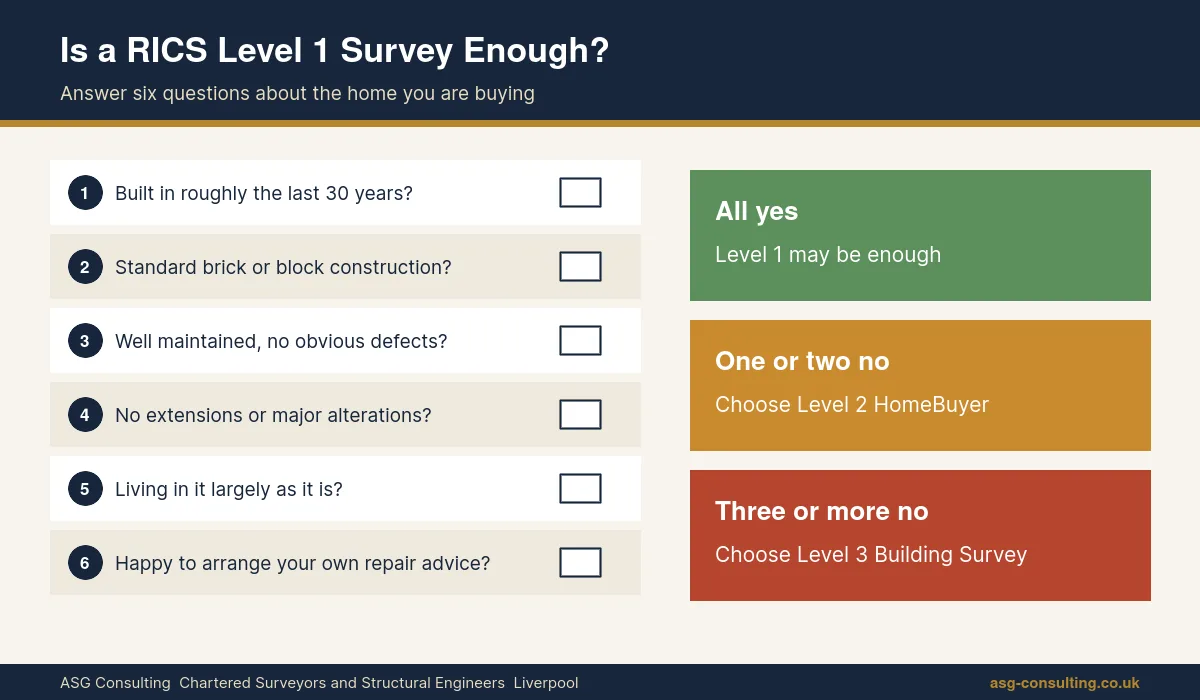
Use this simple scorecard. Answer each question about the home you are buying.
- Was the home built in roughly the last 30 years?
- Is it a standard brick or block house, bungalow or flat, rather than timber frame, concrete or another non traditional type?
- Does it look well maintained, with no obvious cracks, damp or roof problems?
- Is it free of extensions, loft conversions, removed walls or other major alterations?
- Do you plan to live in it largely as it is, without major works?
- Are you comfortable arranging your own advice on any repairs?
If you answered yes to every question, a RICS Level 1 survey may be enough. If you answered no to one or two, a Level 2 HomeBuyer Survey is usually the better choice. If you answered no to three or more, or the home is old, unusual or in poor condition, a Level 3 Building Survey is likely to be the right fit.
Our guide to the RICS HomeBuyer report explains what Level 2 adds.
What Does a Level 1 Report Look Like?
A RICS Level 1 survey report follows a standard RICS format, so reports from different surveyors look broadly similar. It usually includes
- a summary of the property, its construction and its location
- an overview of the condition ratings, so you can see the main issues at a glance
- a section for each part of the building, such as the roof, walls, windows, rooms and outbuildings, each with a rating
- a list of risks to the building, the grounds and people
- a list of matters for your legal adviser
- notes on anything the surveyor could not inspect
Each section is short, often just a line or two alongside the rating. That makes the report quick to read, but it also means you may need to ask the surveyor what a rating means for your plans. A good surveyor will be happy to talk the report through with you.
Which Homes Suit a Level 1 Survey?
A RICS Level 1 survey is most useful for
- newer houses and flats that are in good condition and have not been altered
- simple, conventional homes with no major alterations
- buyers who want a clear overview of condition without detailed repair advice
- homes where you already have trusted advice on repairs, for example from a builder in the family
It can also be useful as a quick check on a home you already know well, such as when buying from a relative.
When Should You Avoid a Level 1 Survey?
A Level 1 survey is rarely the right choice for
- Victorian, Edwardian and other period homes
- 1930s houses and older semis, which often have hidden defects
- homes with extensions, loft conversions or removed walls
- non traditional or system built homes
- homes showing cracks, damp, sagging roofs or other visible defects
- properties you plan to renovate
- listed buildings or homes in conservation areas
In these cases, the lack of repair advice and explanation means you may need further reports anyway, which can cost more in time and money than choosing a higher level survey from the start. Our guides to a Victorian house survey and a 1930s house survey explain why older homes need more detail.
What Affects the Cost of a Level 1 Survey?
A RICS Level 1 survey is usually the lowest cost RICS survey, because the inspection and report are simpler. The fee still depends on
- the size of the property and the number of rooms
- the type of property, such as a house, bungalow or flat
- its location and how easy it is to access
- any outbuildings or extra areas to inspect
Remember that a Level 1 survey does not include a valuation. If you want the surveyor to comment on value, a Level 2 survey with a valuation may be better value. ASG Consulting gives a fixed fee on request, usually confirmed within one working day. Our guide to home buyers survey costs explains what affects survey fees.
How Does the Survey Process Work?
The process is the same as for other RICS surveys.
- Get a quote. Tell the surveyor about the property and ask which level they recommend.
- Agree the terms. Confirm the level of survey and what it includes in writing.
- Book the inspection. The surveyor arranges access through the estate agent or seller.
- Inspection. A visual inspection of the inside and outside of the property.
- Receive the report. ASG Consulting reports are usually delivered within 3 to 5 working days of the inspection.
- Ask questions. Talk through any concerns with the surveyor.
Our guide to how long a house survey takes explains the timings in more detail.
What Happens if the Report Finds a Problem?
Because a RICS Level 1 survey does not give repair advice, any condition rating 2 or 3 item may need further investigation. Your options include
- getting quotes from builders or specialists for the repairs
- asking for a specialist report, such as a structural engineer or damp specialist
- asking the seller about the issue and any past repairs
- renegotiating the price or asking the seller to carry out repairs
- walking away if the issues are too serious
Our guide to renegotiating after a house purchase survey explains how to approach the seller.
Is a Level 1 Survey Right for a New Build?
For a brand new home, a RICS Level 1 survey is not usually the best fit. New builds are typically checked with a snagging survey, which looks for unfinished work and defects the developer should put right before or soon after you move in. Our guide to a snagging survey explains how that works.
For a home that is a few years old and in good condition, a Level 1 survey can be a sensible, lower cost way to check its condition. If the home has been extended, altered or poorly maintained, a Level 2 survey is usually the better choice.
What Mistakes Do Buyers Make?
Common mistakes when choosing a Level 1 survey include
- choosing it only because it is the cheapest, without checking whether it suits the property
- assuming it includes a valuation, when it does not
- expecting detailed repair advice, when it gives ratings only
- using it for an old or altered home, then needing further reports
- confusing it with the lender valuation, which is not a survey at all
Our guide to mortgage valuation vs survey explains why the lender valuation is not a substitute for a survey.
Level 1 Surveys in Liverpool
Liverpool and Merseyside have a varied housing stock. Newer estates and apartments in areas such as Liverpool city centre, the Baltic Triangle, Old Swan, Kirkby, Prescot and parts of the Wirral can suit a Level 1 survey where they are in good condition.
Much of the region, however, is made up of Victorian terraces in areas such as Anfield, Wavertree, Kensington and Toxteth, 1930s semis in Allerton, Childwall, Walton and Wallasey, and converted flats in older buildings. These homes usually benefit from the extra detail of a Level 2 or Level 3 survey, because common local issues such as damp, roof wear, cracking and past alterations need explaining, not just rating.
If you are not sure which level suits the home you are buying, tell us about the property and we will recommend the right survey, including the cheaper option where it is the right fit. We can also explain the differences between the levels before you book, so you only pay for the detail you need.
RICS Level 1 Survey FAQs
What is a RICS Level 1 survey?
A RICS Level 1 survey, or Condition Report, is the most basic RICS home survey. It gives traffic light condition ratings and a list of risks, but no repair advice and no valuation.
Is a Level 1 survey worth it?
It can be for newer, conventional homes in good condition. For older, altered or unusual homes, a Level 2 or Level 3 survey usually gives better value.
Does a Level 1 survey include a valuation?
No. A Level 1 survey does not include a market valuation or a rebuild cost for insurance.
What is the difference between Level 1 and Level 2?
Level 2 includes advice on repairs and maintenance and can include a valuation. Level 1 gives condition ratings only, without repair advice.
How long does a Level 1 survey take?
The inspection is usually shorter than higher level surveys. ASG Consulting reports are usually delivered within 3 to 5 working days of the inspection.
Is a Level 1 survey suitable for an old house?
Usually not. Older homes often need the extra detail and repair advice of a Level 2 or Level 3 survey.
Book a RICS Survey With ASG Consulting
ASG Consulting is an RICS regulated building surveying practice in Liverpool. We carry out RICS Level 1 Condition Reports, Level 2 HomeBuyer Surveys and Level 3 Building Surveys across Liverpool, Merseyside, the Wirral and the wider North West, with reports usually delivered within 3 to 5 working days of the inspection. We give a fixed fee on request, usually confirmed within one working day. To request a quote, call 0151 315 0626 or visit our contact page.
About the Author
Dave MacMillan is the lead surveyor at ASG Consulting, an RICS regulated building surveying practice at 54 St James Street, Liverpool. He has 8 years of experience in building surveying and inspects homes for buyers across Liverpool, Merseyside and the North West.
Last updated 14 November 2026
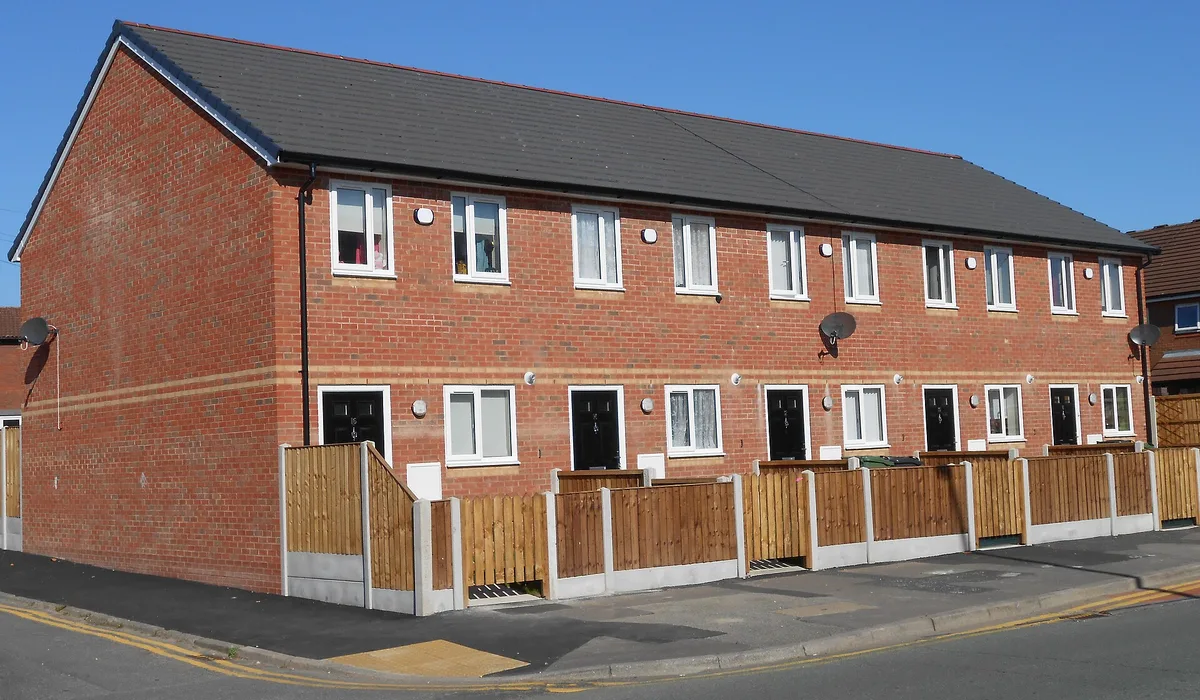
Featured photo of new houses on Church Road, Seacombe by Rept0n1x via Wikimedia Commons, licence CC BY SA 3.0, cropped.