You have paid for a survey, the report has landed in your inbox and it is a wall of coloured boxes. Some sections are green, some amber, a few are red, and there is a scattering of NI. For most buyers, survey condition ratings are the first thing they look at and the part that causes the most worry. A red box on the roof or the walls can feel like a reason to pull out, when often it is a reason to get a quote and negotiate.
This guide is a decoder and action plan. It explains exactly what each of the survey condition ratings means under the RICS Home Survey Standard, shows typical examples of each rating in Liverpool homes, and sets out what to do next for every condition rating 3, every condition rating 2 and every NI. It also covers how ratings differ between Level 1, Level 2 and Level 3 surveys, how to use them to renegotiate, and the mistakes buyers make when reading them. It is written for buyers in Liverpool, Merseyside and the North West.
In this guide
- What survey condition ratings are
- The ratings decoded
- Typical ratings in Liverpool homes
- What to do about a condition rating 3
- What to do about a condition rating 2
- What to do about NI
- A sample summary
- Ratings in Level 1, 2 and 3 surveys
- The other parts of the report
- Using ratings to renegotiate
- Common reading mistakes
- FAQs
What Survey Condition Ratings Are
RICS Home Surveys break the property into parts called elements, such as the roof covering, chimney stacks, main walls, windows, floors and services. The surveyor inspects each element and gives it a condition rating. The ratings are designed to be a quick visual summary, so you can see at a glance which parts of the house need attention and how urgently.
The ratings are defined by RICS, the professional body for surveyors, so they mean the same thing whichever regulated firm carries out the survey. You can read the official wording in the RICS description of the RICS Home Survey Level 2.
Survey condition ratings are about the condition of the property, not its value. A rating does not tell you whether the price is right, and a house with several amber ratings can still be a sound buy at the right price.
The Survey Condition Ratings Decoded
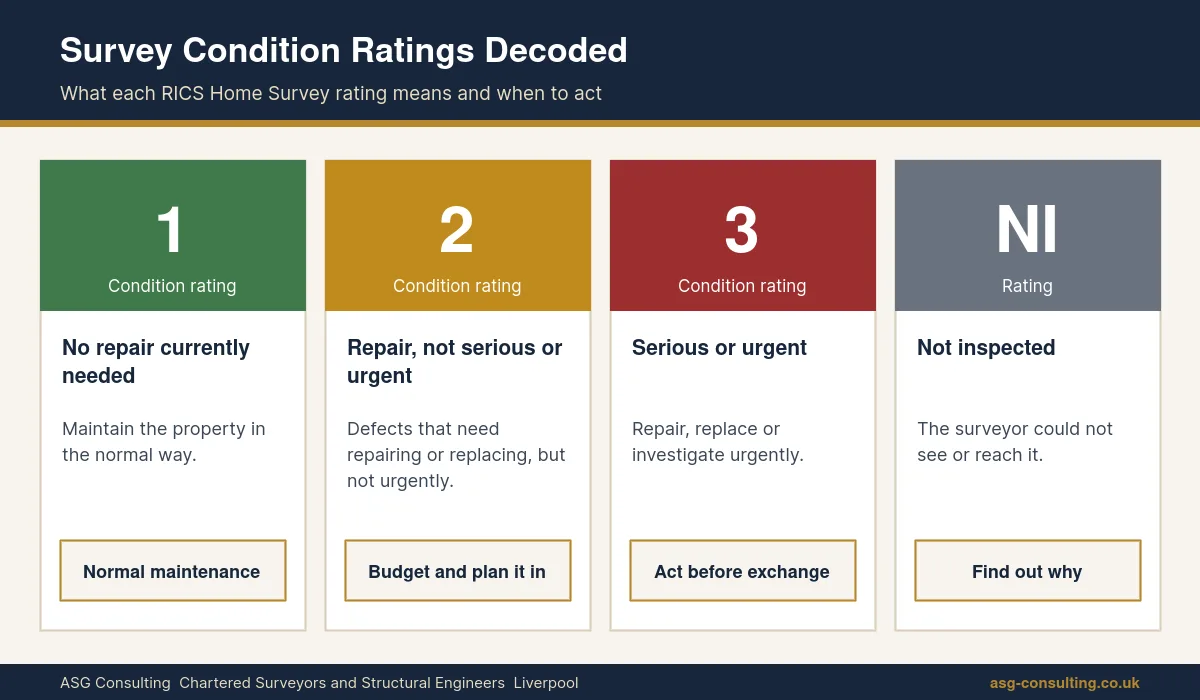
| Rating | Official meaning | What it means in practice | When to act |
|---|---|---|---|
| Condition rating 1, often green | No repair is currently needed. The property must be maintained in the normal way | The element is in reasonable condition for its age | Normal maintenance only |
| Condition rating 2, often amber | Defects that need repairing or replacing but are not considered to be either serious or urgent | Something needs attention, but it is not an emergency | Budget for it and plan it in |
| Condition rating 3, often red | Defects that are serious and or need to be repaired, replaced or investigated urgently | A significant defect, or something the surveyor could not rule out without further checks | Before you exchange contracts |
| NI | Not inspected | The surveyor could not see or reach the element | Find out why, and whether it matters |
The key word in condition rating 3 is or. A red rating can mean the defect is serious, or that it is urgent, or that it needs further investigation. Many condition rating 3 items in older houses are there because the surveyor saw a warning sign, such as an old electrical installation or a crack, and cannot confirm the cause during a visual inspection. That is the surveyor protecting you, not necessarily telling you the house is failing.
Typical Ratings in Liverpool Homes
Every property is different, but these are the kinds of items surveyors in Liverpool and Merseyside often rate in each band, especially in Victorian terraces, interwar semis and older flats.
Commonly rated 1
- Recently replaced roof coverings or windows in good order
- Modern rendered or brick walls with no significant cracking
- Internal doors, staircases and joinery in sound condition
Commonly rated 2
- Worn or eroded pointing to brickwork and chimney stacks
- Cast iron gutters and downpipes that leak at the joints
- Older double glazing with some failed seals
- Minor cracking to plaster, ceilings or around openings
- Dated kitchens and bathrooms, or worn sealant around baths and showers
- Slipped slates or tiles on an otherwise serviceable roof
Commonly rated 3
- An old or poorly maintained electrical installation, often with a recommendation for an electrical inspection
- A gas boiler or gas appliances with no recent service record
- Significant cracking that may indicate structural movement, as our guide to cracks in walls explains
- A chimney stack that is leaning or badly eroded
- Damp or decay affecting floor timbers, which our guide to dry rot vs wet rot covers
- Bowing walls or signs of wall tie failure, explained in our guides to bowing walls and wall tie failure
- A flat roof at the end of its life with signs of leaks
What to Do About a Condition Rating 3
Every condition rating 3 needs a response before you are legally committed to the purchase, which in England and Wales means before exchange of contracts. Work through this action plan for each one.
- Read the full text, not just the colour. The surveyor will explain what was seen, why it matters and what further investigation or repair is recommended.
- Call the surveyor. Most surveyors are happy to talk through their findings. Ask how serious the defect is, what the likely cause is and what kind of specialist should look at it.
- Book the right specialist. This might be a registered electrician, a Gas Safe engineer, a structural engineer, a roofer or a damp and timber specialist. Our guide to a structural engineer report for mortgage explains what an engineer can provide when cracking or movement is flagged.
- Get written quotes. Ideally two or three, so you know the real cost of putting the defect right.
- Tell your solicitor and your lender. Some items, such as missing building regulations approval or structural movement, may have legal or lending implications.
- Decide. Renegotiate the price, ask the seller to carry out the work before completion, or in rare cases walk away.
Do not ignore a condition rating 3 because the seller says it has always been like that. The cost of the repair, or the consequences of not doing it, will be yours once you complete.
What to Do About a Condition Rating 2
Condition rating 2 items are not urgent, but they add up. A house with a dozen amber items may need several thousand pounds of work over the next few years.
- List them. Put every condition rating 2 item into a simple spreadsheet with a rough priority.
- Price the bigger ones. Repointing, gutter replacement and window replacement can be significant. Get quotes for anything likely to cost more than a few hundred pounds.
- Plan the timing. Some items, such as gutters and pointing, are best done soon to prevent damp, which our guide to penetrating damp explains.
- Use the total in negotiations. A single amber item rarely justifies a price reduction, but several together can.
What to Do About NI
NI means not inspected. The surveyor will normally explain why, for example a roof void with no safe access, a floor hidden under fitted carpets, an outbuilding that was locked or a chimney that could not be seen from the ground. Under the RICS standard, the surveyor does not move heavy furniture or lift fitted carpets, fitted floor coverings or floorboards.
- Ask the seller or agent to provide access, then ask whether the surveyor can return to check it, sometimes for a small fee.
- For roofs and chimneys that cannot be seen from the ground, a drone inspection can fill the gap, as our guide to drone roof inspection explains.
- For services such as electrics, gas and drainage, which surveyors do not test, follow the recommendation to get a specialist test.
An NI is not good or bad. It is a gap in the information. The question is whether that gap could hide something expensive.
A Sample Summary of Survey Condition Ratings
To show how survey condition ratings work together, here is a simplified summary of the kind a surveyor might produce for a 1900s three bedroom terrace in south Liverpool. It is illustrative only.
| Element | Rating | Why |
|---|---|---|
| Chimney stack | 3 | Eroded pointing and a cracked flaunching, with damp staining in the bedroom below |
| Roof covering | 2 | Several slipped slates on an otherwise serviceable slate roof |
| Rainwater goods | 2 | Leaking cast iron gutter joints at the rear |
| Main walls | 1 | Solid brick walls with no significant movement |
| Windows | 2 | Older double glazing with two failed sealed units |
| Roof void | NI | No safe access hatch |
| Electricity | 3 | Older consumer unit with no recent test certificate |
| Heating | 3 | No service record for the boiler |
At first glance, three red ratings look alarming. In practice, the electrical test and boiler service are routine checks that might cost a few hundred pounds, and the chimney needs a roofer to repoint and renew the flaunching. The NI roof void is worth following up, because the slipped slates and chimney damp make it more likely that water has reached the roof timbers. A buyer here would get quotes for the chimney, ask for an electrical condition report and a gas safety check, arrange access to the roof void and then use the total to decide whether to renegotiate.
Ratings in Level 1, 2 and 3 Surveys
All three levels of RICS Home Survey use the same survey condition ratings, but the depth of inspection and the detail behind each rating are different.
| Level 1 | Level 2 | Level 3 | |
|---|---|---|---|
| Best for | Newer, conventional homes in good condition | Most conventional houses and flats in reasonable condition | Older, larger, altered or unusual properties, or where work is planned |
| Inspection | Brief visual inspection | More thorough visual inspection | Most detailed inspection |
| Detail behind ratings | Short | Explains defects and recommended actions | Explains causes, likely repairs and often guidance on costs and timing |
| Valuation | Not included as standard | Can be added | Can be added |
If your Level 2 report has several condition rating 3 items about the structure, a Level 3 survey or a specialist inspection can give you the detail you need to decide. Our guides to the RICS homebuyer survey and valuation and the full home buyers survey explain each level.
The Other Parts of the Report
The ratings are only part of the story. Read these sections too.
- Summary and overall opinion. The surveyor gives a view of the property as a whole, which puts the ratings in context.
- Risks. The report summarises defects and issues that present a risk to the building or grounds, or a safety risk to people, such as unsafe electrics, asbestos containing materials or flooding.
- Issues for your legal advisers. The surveyor does not act as a legal adviser, but flags things your solicitor should check, such as planning permission, building regulations approval, guarantees and rights of way.
- Further investigations. A clear list of the specialist checks the surveyor recommends before you commit.
- Valuation and reinstatement cost. Where included, the market value and the cost of rebuilding for insurance, which our guide to a rebuild cost assessment explains.
Using Ratings to Renegotiate
Survey condition ratings give you evidence, and evidence is what makes a renegotiation work. Sellers and agents respond far better to written quotes than to a list of red boxes.
- Separate the urgent from the cosmetic. Focus on condition rating 3 items and the larger condition rating 2 items. Do not try to negotiate on things that were obvious when you viewed, such as a dated kitchen.
- Get quotes. Two or three written quotes for each significant repair.
- Put your request in writing. Send the agent a short summary of the defects, the quotes and the reduction you are asking for, or ask for the work to be done before completion.
- Be reasonable. A fair request based on real costs is far more likely to succeed than an opening bid for a large discount.
- Know your limit. Decide in advance what you will do if the seller says no.
Our guide to how a house purchase survey can help you renegotiate goes into more detail, with example wording.
Common Reading Mistakes
These are the mistakes buyers make most often when reading survey condition ratings.
- Counting red boxes instead of reading them. Two red boxes for a boiler service and an electrical test are very different from two red boxes for structural movement and a failing roof.
- Assuming green means perfect. Condition rating 1 means no repair is currently needed. It does not mean the element will last forever.
- Ignoring the NI items. An uninspected roof void or floor can hide expensive problems.
- Skipping the further investigations. Recommendations are there because a visual survey could not answer the question.
- Waiting until after exchange. Once contracts are exchanged you are committed, and your negotiating power is gone.
- Not calling the surveyor. A ten minute call often answers questions the written report cannot.
Survey Condition Ratings FAQs
What does condition rating 3 mean on a survey?
Condition rating 3 means the surveyor found defects that are serious and or need to be repaired, replaced or investigated urgently. It should be dealt with, or at least investigated and priced, before you exchange contracts.
Should I pull out of a house with condition rating 3 items?
Not necessarily. Many condition rating 3 items, such as an electrical inspection or a boiler service, are common and affordable. Get specialist advice and quotes, then decide whether to renegotiate, ask the seller to fix it or walk away.
What does condition rating 2 mean?
Condition rating 2 means defects that need repairing or replacing but are not considered serious or urgent. Plan and budget for them.
What does NI mean on a survey?
NI means not inspected. The surveyor could not see or access that part of the property. The report should explain why and whether further checks are recommended.
Are survey condition ratings the same for all surveyors?
Yes, for RICS Home Surveys. The ratings are defined in the RICS Home Survey Standard, so a condition rating 3 means the same thing whichever RICS regulated firm produced the report.
Does a condition rating 3 affect the mortgage?
The condition ratings belong to your survey, which is for you, not the lender. However, some serious defects may also be picked up by the lender valuation and can affect the mortgage offer, so tell your broker about anything structural.
Can I ask my surveyor to explain the ratings?
Yes, and you should. Most surveyors expect a call after the report is issued and are happy to explain any rating and what to do next.
Book a RICS Survey With Clear Ratings
ASG Consulting is regulated by RICS. Our chartered surveyors carry out Level 2 and Level 3 surveys across Liverpool, Merseyside and the North West, with clear survey condition ratings and plain English explanations, and our surveyors are happy to talk you through every condition rating 3. To book, visit our home buyer survey Liverpool page.
About the Author
Harry is a property content writer with 3 years of experience writing about building surveying, commercial property and property compliance in the UK. He writes the guides at ASG Consulting for buyers, tenants and landlords, turning survey practice into clear, practical advice.
Reviewed by Dave MacMillan MRICS, chartered surveyor at ASG Consulting. Dave checks the technical content of our guides against current RICS practice before they are published.
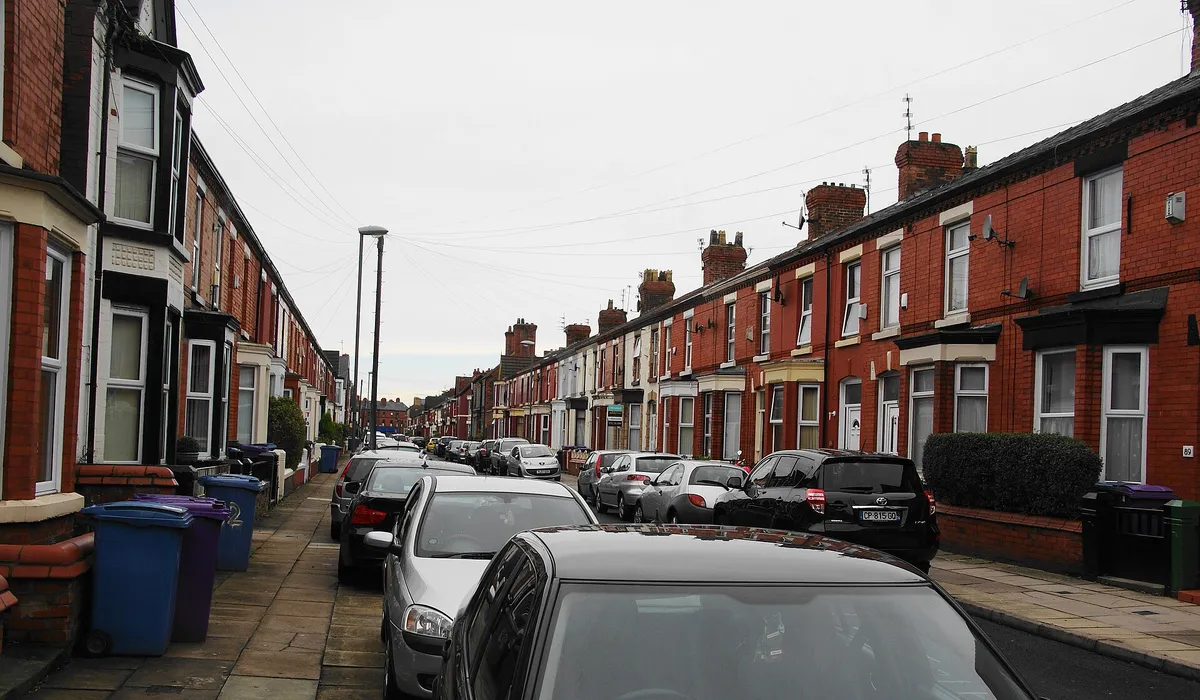
Featured photo of terraced houses in Wavertree, Liverpool by Bill Boaden via Wikimedia Commons, licence CC BY SA 2.0, cropped.