Trees near a house are one of the most common reasons for cracks, sticking doors and subsidence claims in the UK, and one of the most misunderstood. A large oak at the bottom of a long garden may pose no risk at all, while a fast growing conifer hedge planted a few metres from a bay window can cause real damage. Whether trees near house walls are a problem depends on the type of tree, how tall it will grow, how close it is, what the ground is made of and how deep the foundations go.
This guide is built as a risk scorecard. It explains how trees cause damage, gives you a species table with water demand and typical mature heights, shows you how to work out whether your house sits inside a tree zone of influence, and then walks through a simple scorecard you can fill in for any tree near your home. It also covers why cutting a tree down can make things worse, the rules on protected trees, insurance and mortgages, and when to call a surveyor. It is written for homeowners, buyers and landlords in Liverpool, Merseyside and the North West.
In this guide
- How trees damage houses
- Why the soil matters most
- Trees by species, water demand and height
- The zone of influence
- The tree risk scorecard
- Signs of tree root damage
- Should you cut the tree down
- Protected trees and neighbours
- Buying a house near trees
- Building an extension near trees
- Trees and soils in Liverpool
- FAQs
How Trees Damage Houses
Most people imagine tree roots pushing walls over or cracking foundations directly. That does happen, but it is not the main way trees near house foundations cause trouble. There are three mechanisms, and the first is by far the most important.
- Drying out shrinkable clay. A large tree can take hundreds of litres of water a day from the ground. On clay soils, that drying makes the clay shrink, the ground under the foundations drops and the house moves. This is the classic cause of tree related subsidence, and it is usually worst at the end of a long, dry summer.
- Direct physical pressure. Roots and trunks growing next to light structures, such as garden walls, paths, bay windows, drains and porches with shallow foundations, can lift or crack them as they thicken.
- Damage to drains. Roots are drawn to leaking drains and can enter and block them. A leaking drain can also soften the ground and cause localised settlement, which is sometimes wrongly blamed on the tree itself.
Tree root damage from trees near house foundations is therefore much more likely on clay soils than on sand, gravel or rock, and much more likely with thirsty species that grow large. Our guide to a subsidence survey explains how surveyors confirm whether movement is caused by trees or by something else.
Why the Soil Matters Most
With trees near house foundations, the single biggest factor is the soil. Clay soils shrink when they dry and swell when they get wet again. How much they move depends on the type of clay, which engineers describe as its volume change potential, usually graded as high, medium or low based on laboratory tests of plasticity.
On sands, gravels and rock there is little or no shrinkage, so even large trees close to a house rarely cause subsidence by drying the ground, though they can still damage drains and light structures. That is why two identical houses with identical trees in different parts of the country can behave completely differently.
The second soil factor is the depth of the foundations. Modern foundations for trees near house sites on clay are designed to be deeper, so they sit below the zone where the clay dries out. Older houses, including most Victorian, Edwardian and interwar homes, often have shallow foundations, sometimes less than a metre deep, which leaves them more exposed to seasonal movement.
Trees Near House Walls by Species, Water Demand and Height
Trees are grouped by how much water they take from the soil. The NHBC Standards, which are widely used by engineers and building control, put the following broadleaf trees in the high water demand group, all elms, eucalyptus, hawthorn, oaks, poplars and willows, with most other broadleaf trees in the moderate group. Some conifers, especially cypresses such as Leyland cypress, are also in the high group.
This table gives typical mature heights used for foundation design. Treat the heights as a guide, because trees vary with site and pruning.
| Tree | Water demand | Typical mature height |
|---|---|---|
| English oak | High | About 20 metres |
| Willow, crack or white | High | About 24 metres |
| Weeping willow | High | About 16 metres |
| Lombardy poplar | High | About 25 metres |
| Hybrid black poplar | High | About 28 metres |
| Hawthorn | High | About 10 metres |
| Leyland cypress | High | About 20 metres |
| Sycamore | Moderate | About 22 metres |
| Ash | Moderate | About 23 metres |
| Horse chestnut | Moderate | About 20 metres |
| Lime | Moderate | About 22 metres |
| Birch | Moderate | About 14 metres |
| Ornamental cherry | Moderate | About 9 metres |
The Lombardy poplar at 25 metres and the sycamore at 22 metres match the figures in the NHBC worked example. For a project where foundation depth matters, an engineer will use the current NHBC tables and, where needed, an arboricultural survey to identify each tree accurately.
The Zone of Influence
Engineers use a simple rule to judge how far a tree can dry out the soil. Under the NHBC Standards, the zone of influence extends to about 1.25 times the mature height for high water demand trees, 0.75 times the mature height for moderate water demand trees and 0.5 times the mature height for low water demand trees.
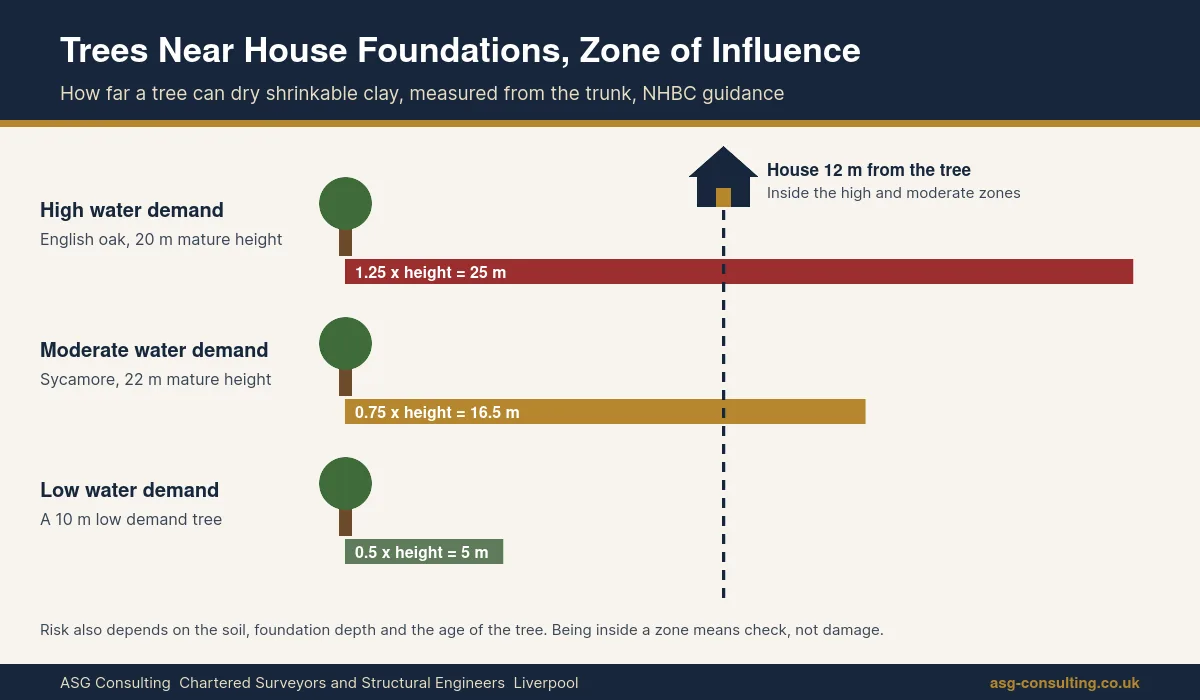
Some quick examples using the heights above.
- An English oak with a mature height of about 20 metres has a zone of influence of about 25 metres.
- A Leyland cypress hedge with a mature height of about 20 metres also reaches about 25 metres, even if it is currently kept trimmed at 3 metres.
- A sycamore at about 22 metres reaches about 16.5 metres.
- A birch at about 14 metres reaches about 10.5 metres.
If any part of the house sits inside that distance from trees near house walls, measured from the centre of the trunk, and the ground is shrinkable clay, the tree is capable of affecting the foundations. Being inside the zone does not mean damage will happen. It means the risk needs to be thought about, alongside foundation depth, the age of the tree and the condition of the house.
The Trees Near House Risk Scorecard
Use this scorecard for each significant tree near your home. It brings together the factors that decide whether trees near house walls are likely to cause trouble. Give one score for each row and add them up. It is a guide to help you decide whether to get advice, not a substitute for an inspection.
| Factor | Score 0 | Score 1 | Score 2 |
|---|---|---|---|
| Soil | Sand, gravel or rock | Unknown or mixed | Known clay |
| Water demand | Low | Moderate | High |
| Distance | Outside the zone of influence | Inside the outer half of the zone | Inside the inner half of the zone |
| Foundations | Modern, designed for trees | Unknown | Shallow, older house |
| Tree stage | Mature, stable for years | Still growing | Young, vigorous and getting bigger |
| Existing signs | None | Minor cracks that open and close with the seasons | Cracks widening, doors sticking, floors sloping |
- 0 to 4. Low concern. Keep an eye on the house and manage the tree sensibly.
- 5 to 8. Moderate concern. Monitor any cracks, keep records and consider advice from a surveyor before major tree work or building work.
- 9 to 12. High concern. Get a chartered surveyor or structural engineer to inspect before making decisions about the tree or the house.
Signs of Tree Root Damage
Movement caused by trees near house foundations often follows the seasons. Cracks open up in late summer and autumn when the clay is driest and close again in winter and spring when it rewets. Look for
- diagonal cracks above doors and windows, often wider at the top, on the side of the house nearest the tree
- cracks that are wider than about 3 millimetres or growing over time
- doors and windows that stick in summer and free up in winter
- gaps opening between skirting boards and floors, or between walls and ceilings
- sloping floors on the side nearest the tree, as our guide to sloping floors explains
- cracked or lifted paths, garden walls and drives near the tree
- blocked or slow drains, especially where roots have been found during clearance
Our guide to cracks in walls explains how to measure and record cracks, which is the best evidence you can give a surveyor or insurer. Many cracks have nothing to do with trees, so the pattern and timing matter.
Should You Cut the Tree Down
With trees near house walls, it is natural to want to remove a tree that might be causing damage, but it is not always the right answer. On clay soils, a large tree that has been drying the ground for many years has left the clay in a shrunken state. If the tree is removed, the clay slowly takes up water again and swells, which can push foundations and floors upwards. This is known as heave, and it can be as damaging as subsidence. It can carry on for years after a large tree has gone.
Options a surveyor or arboriculturist might suggest include
- Regular crown reduction or pollarding to reduce the water the tree takes up, carried out by a qualified tree surgeon.
- Removing a young or recently planted tree, where the ground has not yet been dried for long.
- Staged removal of a large tree over time, where heave risk is high.
- A root barrier between the tree and the house, in some cases.
- Repairing leaking drains so that roots are not drawn towards the house.
- Underpinning, only where movement is serious and other measures will not work, as our guide to underpinning explains.
Before cutting anything down, find out whether the tree is protected and take advice on heave if the ground is clay.
Protected Trees and Neighbours
Some trees are protected by a tree preservation order, and all trees above a small size in a conservation area are also protected. You usually need consent from the council, or must give six weeks notice in a conservation area, before cutting, pruning or felling them. Carrying out work without consent can lead to prosecution and a fine. GOV.UK sets out the rules in its guidance on tree preservation orders and trees in conservation areas.
If the tree is in a neighbouring garden or on the street, talk to the owner or the council first. You can usually cut back branches and roots that cross onto your land, up to the boundary, as long as the tree is not protected and you do not kill or destabilise it. Where a tree owned by someone else is causing damage, insurers often deal with the claim against the tree owner. If the boundary itself is in question, our guide to a boundary dispute surveyor explains how it is settled.
Buying a House Near Trees
Trees near house walls are something every buyer should think about, but they are rarely a reason on their own to walk away. A good survey will note significant trees, estimate their distance from the house, comment on visible cracking and say whether further investigation is needed.
When buying, ask the seller about any history of subsidence, insurance claims, crack monitoring, underpinning or tree work. Ask whether there are any tree preservation orders. Your solicitor can check searches and the property information form. Lenders and insurers may ask questions about large trees close to the house, especially on clay, and some insurers charge more or add an excess where subsidence has happened before.
A Level 2 survey suits most conventional houses, but a Level 3 survey looks harder at structural movement and is worth considering for older homes with big trees nearby. Our guide to the full home buyers survey explains what is included.
Building an Extension Near Trees
If you are planning an extension with trees near house walls on clay soil, the new foundations will usually need to be deeper than normal. NHBC guidance sets minimum foundation depths of about 1 metre on high volume change clay, 0.9 metres on medium and 0.75 metres on low, even away from trees, and much deeper inside a zone of influence, sometimes needing piles or special foundations with heave protection.
That is why an engineer will usually ask for a soil investigation and a tree survey early in the design. Getting the foundation right at the start is far cheaper than discovering a hidden root mat when the trench is dug. Our structural engineering team designs foundations near trees for extensions and new buildings.
Trees Near House Foundations in Liverpool
Much of Liverpool and Merseyside sits on glacial till, often called boulder clay, laid over sandstone, with sands, alluvium and made ground in places, especially near the river and the old docks. Glacial till is a mixed clay soil and its shrinkage potential varies from place to place, so it needs to be tested rather than assumed. In parts of the region, sandy soils mean trees are less likely to cause subsidence, while pockets of more plastic clay can behave very differently.
Many Liverpool suburbs, including leafy areas with large Victorian and interwar houses, have mature street trees and big garden trees close to houses with shallow foundations. Common culprits seen by surveyors include poplars and willows planted near former streams, sycamores that have seeded themselves along boundaries, and Leyland cypress hedges that have grown far taller than intended. If you are worried about trees near house walls at your home, a subsidence survey can confirm whether movement is happening and what is causing it.
Trees Near House FAQs
How close can a tree be to a house?
There is no single safe distance. It depends on the species, its mature height, the soil and the foundations. As a guide, NHBC treats a high water demand tree as able to affect the ground up to about 1.25 times its mature height away on shrinkable clay, and a moderate water demand tree up to about 0.75 times.
Which trees are worst for subsidence?
High water demand trees such as oaks, willows, poplars, elms, eucalyptus, hawthorn and some cypresses, including Leyland cypress, are the most likely to cause subsidence on clay soils.
Will cutting down a tree stop subsidence?
Not always. Removing a large mature tree on clay can cause heave, where the ground swells as it gets wetter. Take advice from a surveyor or engineer before felling a large tree near a house.
Do tree roots damage foundations directly?
Roots can lift or crack light structures with shallow foundations, such as garden walls, bays and porches. Most damage to houses comes from roots drying clay soil and causing it to shrink, rather than from roots pushing on the foundations.
Does my insurance cover tree root damage?
Many buildings insurance policies cover subsidence, including movement caused by trees, usually with a large excess. Check your policy and contact your insurer early if you see significant cracking.
Can I cut my neighbour tree roots?
You can usually cut roots and branches that cross onto your land, up to the boundary, as long as the tree is not protected and you do not harm the tree or make it unsafe. Speak to your neighbour first.
Should I buy a house with a large tree in the garden?
Often yes, but get a good survey, check the soil type, ask about past subsidence and insurance claims, and check whether the tree is protected before you commit.
Get Trees Near Your House Assessed
ASG Consulting is regulated by RICS. Our chartered surveyors and structural engineers inspect homes with trees near house walls, record and assess cracking, investigate subsidence and heave, and advise on tree management and foundations across Liverpool, Merseyside and the North West. To arrange an inspection, visit our subsidence survey page.
About the Author
Harry is a property content writer with 3 years of experience writing about building surveying, commercial property and property compliance in the UK. He writes the guides at ASG Consulting for buyers, tenants and landlords, turning survey practice into clear, practical advice.
Reviewed by Dave MacMillan MRICS, chartered surveyor at ASG Consulting. Dave checks the technical content of our guides against current RICS practice before they are published.
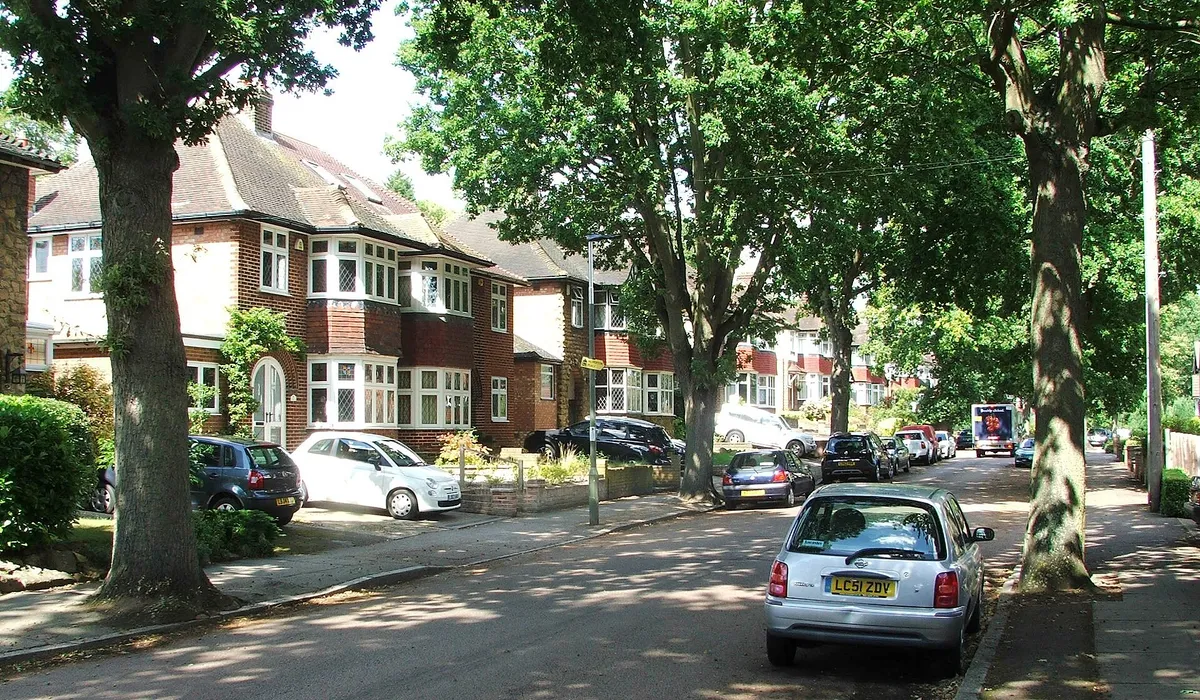
Featured photo of street trees beside semi detached houses in Oak Tree Gardens, Bromley by Chris Whippet via Wikimedia Commons, licence CC BY SA 2.0, cropped.