Cracks in walls are the most common reason homeowners call a surveyor and the most common reason they lose sleep for no reason at all. Almost every house in the UK has some cracking. Plaster shrinks, timber dries, bricks expand in summer and contract in winter, and the ground under a house moves a little every year. The question is never whether you have cracks in walls but which ones matter.
This guide gives you six easy checks you can do yourself in ten minutes, explains the BRE Digest 251 scale that surveyors and insurers use to grade cracks in walls, shows which crack patterns point to which cause, and sets out exactly when to worry and who to call. It is written for homeowners, buyers and landlords in Liverpool, Merseyside and the North West, where a lot of the housing stock is Victorian brick on shallow foundations.
In this guide
- Six easy checks for cracks in walls
- The BRE Digest 251 crack scale
- What the crack pattern tells you
- Common causes of cracks in walls
- Cracks in walls when to worry
- How to monitor a crack
- Who to call and what it costs
- Cracks in walls when buying a house
- Cracks in Liverpool homes
- FAQs
Six Easy Checks for Cracks in Walls
Before you call anyone about cracks in walls, run these six checks. Together they tell you more than the width of the crack on its own.
- Measure the width. Use a ruler or a crack gauge card. Under 1mm is hairline. Up to 5mm is slight. Over 5mm, or anything you can fit a pound coin into, needs a professional look.
- Note the shape. Is it a straight vertical line, a diagonal, a stepped line that follows the mortar joints, or a horizontal crack along a course of bricks? Each pattern points to a different cause.
- Check both sides of the wall. A crack that shows outside on the brickwork and inside on the plaster in the same place goes through the wall. That is structural movement rather than plaster shrinkage.
- Look at the openings. Cracks that run from the corners of windows and doors, and doors or windows that have started to stick, suggest the wall is distorting.
- Feel the edges. If one side of the crack sits proud of the other, the wall has moved out of plane. If the crack is wider at the top than the bottom, or the other way round, one part of the wall is dropping relative to the rest.
- Ask whether it is moving. Mark the ends with a pencil and date them. Fill a short section and see if it reopens. A crack that is the same size in six months is a very different problem from one that is growing.
The BRE Digest 251 Crack Scale
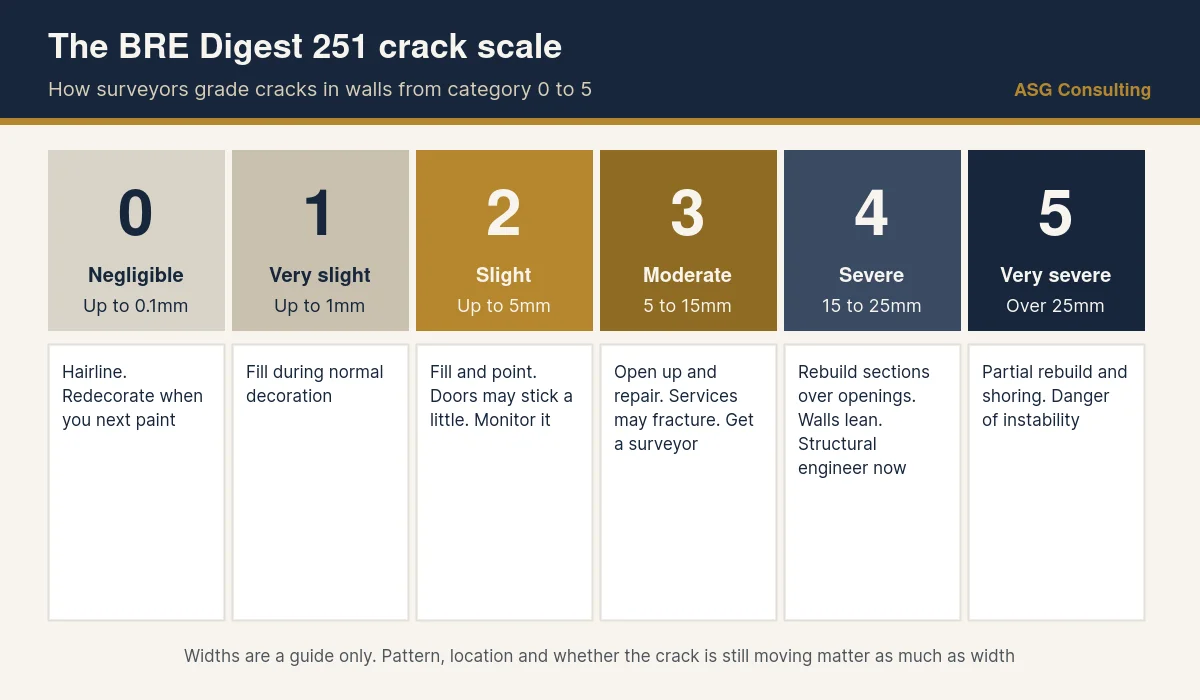
UK surveyors, structural engineers and insurers grade cracks in walls using BRE Digest 251, Assessment of damage in low rise buildings. The Building Research Establishment published it after studying how houses on clay soils behaved, and it links the width and number of cracks to the repair that is normally needed. BRE still publishes a summary of the crack categories on its website.
| Category | Typical width | What it usually means |
|---|---|---|
| 0 Negligible | Up to 0.1mm | Hairline. No action beyond decoration |
| 1 Very slight | Up to 1mm | Fine cracks treated easily during normal decoration |
| 2 Slight | Up to 5mm | Easily filled. Some external repointing. Doors and windows may stick slightly |
| 3 Moderate | 5 to 15mm, or several cracks of 3mm | Needs opening up and patching by a mason. Repointing and some brick replacement. Service pipes may fracture |
| 4 Severe | 15 to 25mm | Extensive repair with sections of wall rebuilt, especially over doors and windows. Floors slope and walls lean noticeably |
| 5 Very severe | Over 25mm | Major repair with partial or complete rebuilding. Beams lose bearing. Walls lean badly and need shoring |
Categories 0 to 2 are usually treated as cosmetic. Category 3 is where surveyors start to recommend a structural engineer, and category 4 and 5 are structural failures in progress. Two warnings go with the table. Width is only one signal, so a narrow crack that is actively widening can matter more than a wide one that has been stable for years. And the scale was written for low rise houses, so it should not be applied blindly to a converted mill or a large commercial building.
What the Crack Pattern Tells You
Experienced surveyors read cracks in walls the way a doctor reads a rash. The pattern narrows the cause before any measurement is taken.
| Pattern | Where it appears | Most likely cause |
|---|---|---|
| Fine map or web cracking | Plaster and render surfaces | Shrinkage of plaster or render as it dried |
| Straight vertical crack at a junction | Where an extension meets the original house, or where a wall meets a ceiling | Different parts of the building moving at different rates |
| Diagonal or stepped crack through mortar joints | External brickwork, often near a corner or an opening, wider at one end | Foundation movement, including subsidence, heave or settlement |
| Horizontal crack along a mortar course | External cavity walls, often at regular vertical spacing | Wall tie failure, where corroded ties expand and lift the brickwork |
| Vertical crack near the end of a long wall | Long runs of brickwork with no movement joint | Thermal expansion and contraction |
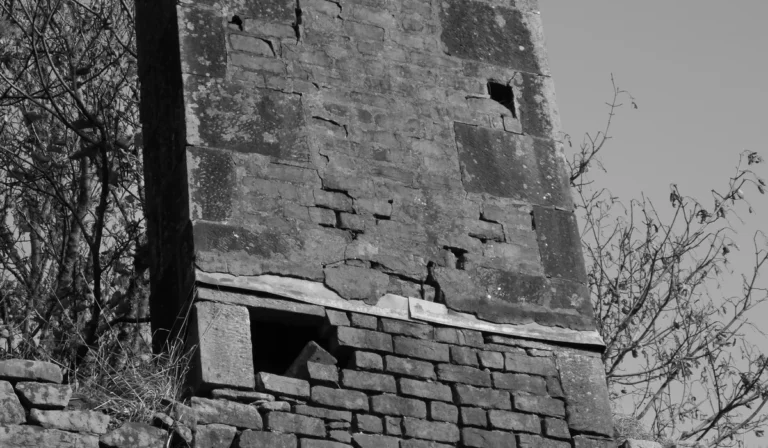
| Crack above a window or door | The brickwork over an opening, sometimes with a sagging course | Lintel failure or a missing lintel |
| Crack between wall and ceiling | Top of internal walls, upstairs more than downstairs | Roof spread or seasonal movement of timber |
The stepped diagonal crack in external brickwork is the one that worries people most, and rightly so, because it is the classic sign of foundation movement. Our guide to a subsidence survey covers that pattern in detail, including how to tell subsidence from the much more common and less serious settlement.
Common Causes of Cracks in Walls
Cracks in walls come from a short list of causes, and most of them are harmless.
Shrinkage. New plaster, new render and new timber all lose moisture in their first year. The result is fine cracks in walls that are annoying but harmless. New build homes and fresh extensions are full of it. Fill and decorate once the house has had a full year of heating.
Thermal movement. Brickwork expands in summer and contracts in winter. Long walls with no movement joints crack at their weakest point, often near a corner or a window. Cracks in walls from thermal movement open and close with the seasons and rarely get worse.
Settlement. Every building compresses the ground beneath it a little in its early years. Settlement cracks are usually small, uniform and stop moving. Most Victorian houses settled a century ago and have been stable since.
Subsidence. The ground under part of the foundation loses support, usually because clay soil dries and shrinks, a tree draws water from under the house, or a leaking drain washes the soil away. Cracks are diagonal, wider at the top, often appear suddenly in a dry summer and keep growing. This is the cause insurers pay for and the one that needs a proper investigation.
Heave. The opposite of subsidence. Clay that was dried by a tree swells again when the tree is removed, lifting part of the house. Cracks are often wider at the bottom and floors can lift.
Wall tie failure. In cavity walls built before the 1980s the steel ties that hold the two leaves together can rust. Rust takes up more space than steel, so the mortar joints are forced apart in horizontal lines. Our brickwork repair guide explains how ties are tested and replaced.
Lintel failure. Timber or steel lintels over windows and doors rot or rust, and the brickwork above cracks and drops. Common in older terraces and in houses where the original timber frames have been replaced with lighter uPVC units that no longer carry the brickwork.
Overloading and alterations. A removed chimney breast, an opened up wall without a proper beam, or a loft conversion that added weight to the structure. Cracks appear near the alteration and the fix starts with a structural engineer.
Vibration and impact. Heavy traffic, piling nearby or a vehicle strike on a corner. Usually obvious from the timing.
Cracks in Walls When to Worry
Most cracks in walls are category 0 to 2 and need nothing more than filler. The question of cracks in walls when to worry comes down to a short list of warning signs. Take it seriously if any of the following apply.
- The crack is wider than 5mm at any point
- It is wider at one end than the other
- It is diagonal or stepped through the external brickwork
- It appears on both sides of the wall in the same place
- It appeared suddenly, especially during a dry summer or after a nearby tree was planted or removed
- It keeps growing when you monitor it
- Doors or windows have started to stick, or gaps have opened between skirting boards and the floor
- The wall or the floor has started to lean or slope
- There is a damaged drain, a large tree or a recent structural alteration nearby
If you have ticked one of the first three, book a survey. If you have ticked three or more, book a structural engineer, and if the wall is leaning or bulging treat it as urgent and keep people away from the area until it has been looked at.
The reassuring side of the list is just as useful. A single hairline crack in plaster that is the same width along its length, that does not show on the outside, that sits nowhere near an opening and that has not changed in a year is almost never a structural problem. Fill it and move on.
How to Monitor a Crack
Monitoring cracks in walls turns a worry into data. The simplest method costs nothing. Draw a short pencil line across the crack at right angles, mark each end of the crack, write the date next to each mark and measure the width with a ruler. Repeat monthly. If the pencil line stays continuous and the width stays the same, the crack is stable.
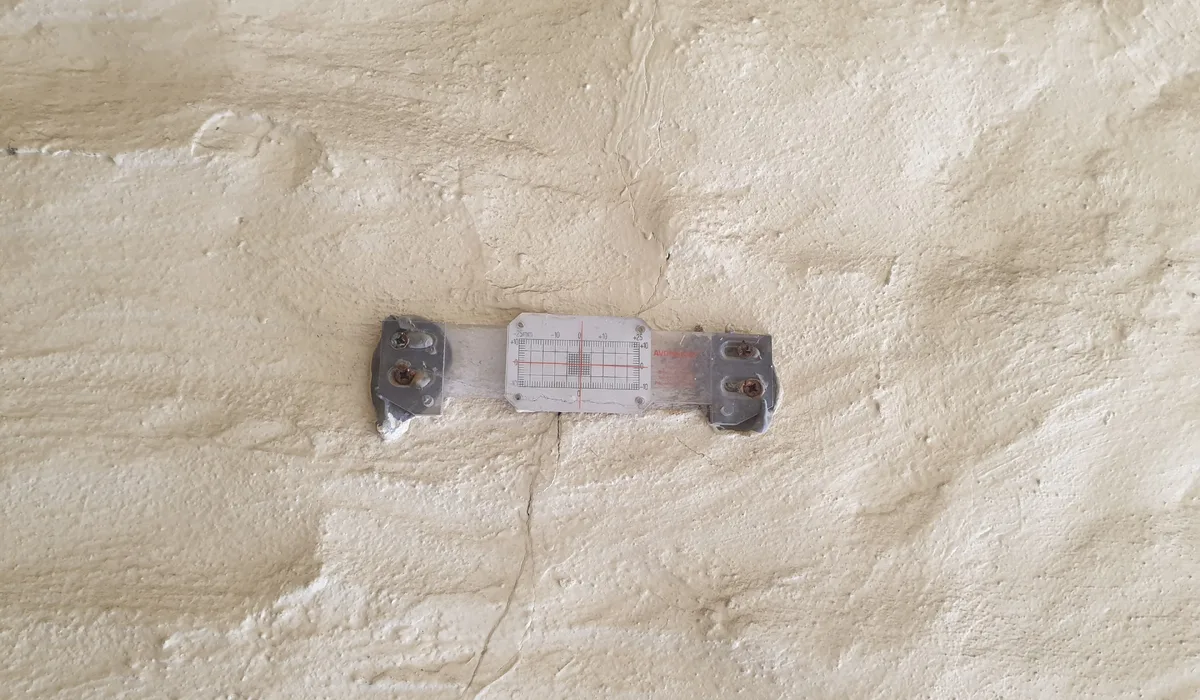
A crack monitor, sometimes called a tell tale, is a two part plastic gauge screwed across the crack. One half carries a grid and the other a cross hair, so movement in any direction shows as a shift on the grid. They cost a few pounds, and surveyors and insurers fit them when a crack needs watching through a full seasonal cycle. The photo at the top of this guide shows one in use. Many subsidence claims rest on 12 months of readings, because clay soils move with the seasons and a crack that closes in winter and opens in summer behaves very differently from one that only ever opens.
Whatever method you use, photograph the crack with a ruler in shot every time. Dated photographs are the evidence a surveyor, an engineer or an insurer will want.
Who to Call and What It Costs
For cracks in walls that have you unsure, a chartered building surveyor is the right first call. A specific defect inspection looks at the crack, the pattern, the surrounding structure and the likely cause, and tells you whether anything more is needed. Our building defect surveys page explains what a single defect inspection covers.
Where the surveyor suspects structural movement, the next step is a structural engineer. The engineer confirms the cause, decides whether monitoring or investigation is needed, and designs any repair, from crack stitching and repointing to a new lintel or, rarely, underpinning. Our guide to what a residential structural engineer does walks through that process step by step.
Where subsidence is likely, contact your buildings insurer before you commission repairs. Most policies cover subsidence, heave and landslip, and insurers usually appoint their own loss adjuster and engineer. The Association of British Insurers publishes a clear guide to subsidence claims, including the standard excess, which is usually 1,000 pounds.
As a guide to 2026 fees in the North West, a specific defect inspection and report from a chartered surveyor typically costs a few hundred pounds, a structural engineer inspection and report for a single crack sits in a similar range, and a full movement investigation with trial pits and drain surveys runs into the low thousands. Repairs range from under 100 pounds of filler to tens of thousands for underpinning, which is why diagnosis comes first.
Cracks in Walls When Buying a House
A Level 2 or Level 3 home survey reports cracks in walls by location, pattern and approximate width, and rates them using the traffic light condition ratings. A condition rating 3 against a crack means the surveyor wants it investigated before you exchange. Do not panic at the rating, but do act on it. Ask the seller whether there is any history of movement, any past insurance claim and any structural engineer report. A house that was underpinned 20 years ago with a certificate of structural adequacy is often perfectly sound and insurable, but you need the paperwork.
The surveyor cannot see through boxing, fitted wardrobes or fresh paint, and a fresh coat of paint over a single patch of wall is itself a flag. Where cracks are present our surveyors always check the same spot outside, look at the drains and nearby trees, and photograph everything with a scale. Our residential building surveying page explains the difference between a Level 2 and a Level 3 survey and which one suits an older house.
Cracks in Walls in Liverpool Homes
Most of Liverpool, Wirral and Sefton sits on glacial clay and sand over sandstone, with pockets of shrinkable clay that behave badly in dry summers. The housing stock is dominated by Victorian and Edwardian terraces on shallow brick footings, so small seasonal cracks in walls are normal and most of them are harmless. The patterns that matter locally are stepped cracks near large street trees, cracks that follow a leaking Victorian clay drain, horizontal cracking from wall tie failure in the 1930s and post war semis of Childwall, Crosby and Wallasey, and cracks above windows where original sash boxes have been replaced.
ASG Consulting inspects cracks in walls across Liverpool, Merseyside and the North West from our office in Liverpool city centre. Our chartered surveyors and structural engineers work together, so a single visit can cover both the survey and the engineering view where a crack needs it.
Cracks in Walls FAQs
What size of crack in a wall is serious?
As a rule, cracks under 1mm are hairline and cracks up to 5mm are slight and usually cosmetic. Cracks over 5mm, cracks that are wider at one end, stepped or diagonal cracks in external brickwork, and any crack that keeps growing should be looked at by a chartered surveyor or a structural engineer.
Are vertical cracks in walls worse than horizontal ones?
Neither is automatically worse. Straight vertical cracks at a junction between two parts of a building are usually differential movement and often harmless. Horizontal cracks along mortar courses in a cavity wall often mean wall tie failure, which needs repair but is routine. Diagonal and stepped cracks are the ones most associated with foundation movement.
Are cracks in walls normal in an old house?
Yes. Victorian and Edwardian houses have been moving gently for over a century and almost all of them have some cracking. What matters is whether a crack is new, growing, wide or in a pattern that points to a specific defect. Stable old cracks that have been filled and have not reopened are rarely a concern.
How long should I monitor a crack before worrying?
Most surveyors and insurers monitor through a full year so that both the dry summer and the wet winter are covered. A crack that is growing clearly within a few months should not wait that long and should be inspected straight away.
Does home insurance cover cracks in walls?
Standard buildings insurance covers damage caused by subsidence, heave and landslip, usually with an excess of around 1,000 pounds. It does not cover normal settlement, shrinkage, thermal cracking or wear and tear. Contact your insurer before commissioning repairs if you suspect subsidence.
Why do cracks in walls appear after building work?
New extensions, loft conversions and replastering all produce cracks in walls in their first year as materials dry and the new structure settles against the old. Fine cracks at the junction between new and old work are expected. Cracks in walls that are wide, stepped or growing after an alteration can mean the new load has not been carried properly, so ask the builder for the engineer design and the Building Control certificate.
Can I fill a crack in a wall myself?
Yes for hairline and slight cracks in plaster. Open the crack slightly with a scraper, fill with a flexible filler or a plaster repair compound, sand and decorate. Note the date so you know if it reopens. Do not fill a crack that has not been diagnosed if it is over 5mm, stepped or visible outside, because you will hide the evidence a surveyor needs.
Get a Crack Checked by a Chartered Surveyor
ASG Consulting is regulated by RICS. Our chartered surveyors inspect cracks in walls, diagnose the cause and tell you plainly whether you need to worry, and our structural engineers design the repair where one is needed. We work across Liverpool, Merseyside and the North West. To book an inspection, visit our building defect surveys page.
About the Author
Harry is a property content writer with 3 years of experience writing about building surveying, commercial property and property compliance in the UK. He writes the guides at ASG Consulting for buyers, tenants and landlords, turning survey practice into clear, practical advice.
Reviewed by Dave MacMillan MRICS, chartered surveyor at ASG Consulting. Dave checks the technical content of our guides against current RICS practice before they are published.
Featured photo of a wall crack monitor at The Great Oak, Llanidloes by Andy Dingley via Wikimedia Commons, licence CC BY SA 4.0, cropped.