Penetrating damp is rain getting into a building where it should not. It shows up as a damp patch on a bedroom ceiling after a storm, a stain spreading below a window, or wallpaper peeling on one wall of a front room. Unlike many other kinds of damp, penetrating damp nearly always has a clear source on the outside of the building, and once you find that source the fix is often simple and cheaper than people expect.
This guide is built as a source map. The position of the damp patch inside your home usually tells you where to look outside, so it links each common symptom to the part of the building most likely to be letting water in. It also shows you how to tell penetrating damp from rising damp and condensation, how to run a simple rain diary, which repairs to try first, and when to call a surveyor. It is written for homeowners, landlords and tenants in Liverpool, Merseyside and the North West, where wet westerly weather and solid brick walls make penetrating damp very common.
In this guide
- What penetrating damp is
- Penetrating damp, rising damp or condensation
- Signs of penetrating damp
- The source map
- Run a rain diary
- Solid walls and cavity walls
- The repair ladder
- Treatments to avoid
- Penetrating damp in rented homes
- When to get a survey
- Penetrating damp in Liverpool homes
- FAQs
What Penetrating Damp Is
Penetrating damp is water that travels through the roof, walls, windows or joints of a building from the outside in. It is usually caused by a defect, such as a cracked roof slate, a blocked gutter, failed pointing or a missing drip under a window sill. Rain is pushed into the defect by gravity or by wind, soaks through the masonry and appears as a damp patch on the inside.
Because the water comes from the weather, penetrating damp tends to get worse after heavy or wind driven rain and to dry back slowly in dry spells. It can appear at any height on any wall or ceiling, which is one of the clearest differences from rising damp. Left alone, it can rot timber, damage plaster, encourage mould and, in cavity walls, soak insulation so that it no longer works.
Penetrating Damp, Rising Damp or Condensation
Getting the diagnosis right matters, because the treatments are completely different. Many homes have been injected with chemical damp proof courses when the real problem was a leaking gutter.
| Penetrating damp | Rising damp | Condensation | |
|---|---|---|---|
| Where it appears | Any height, often in patches near a defect | Low on ground floor walls, usually below about 1 metre | Cold surfaces, window reveals, corners, behind furniture |
| When it gets worse | After heavy or wind driven rain | Fairly constant, sometimes worse in wet seasons | In cold weather, after cooking, bathing and drying clothes |
| Typical look | Spreading stains, tide marks, blown plaster | A horizontal tide mark with salts | Black mould spots and water droplets |
| Usual fix | Repair the outside defect | Lower ground levels, fix drainage, sometimes a new damp proof course | Heating, ventilation and insulation |
Our guides to rising damp and condensation in a house explain the other two in detail. It is also common to have more than one at once, such as condensation forming on a wall that is already cold and wet from penetrating damp.
Signs of Penetrating Damp
Look for these signs inside and outside the home.
- Damp patches that grow or darken after rain and shrink in dry weather.
- Brown tide marks on ceilings and walls, especially below the roof, chimney or windows.
- Blistering paint, peeling wallpaper or plaster that sounds hollow when tapped.
- Mould growing in one localised area rather than on every cold surface.
- Musty smells in a single room or cupboard.
- Wet or rotting skirting boards, window boards or floor timbers near an outside wall.
- Outside, green staining, moss, spalled bricks, eroded pointing or water running down the face of the wall.
The Penetrating Damp Source Map
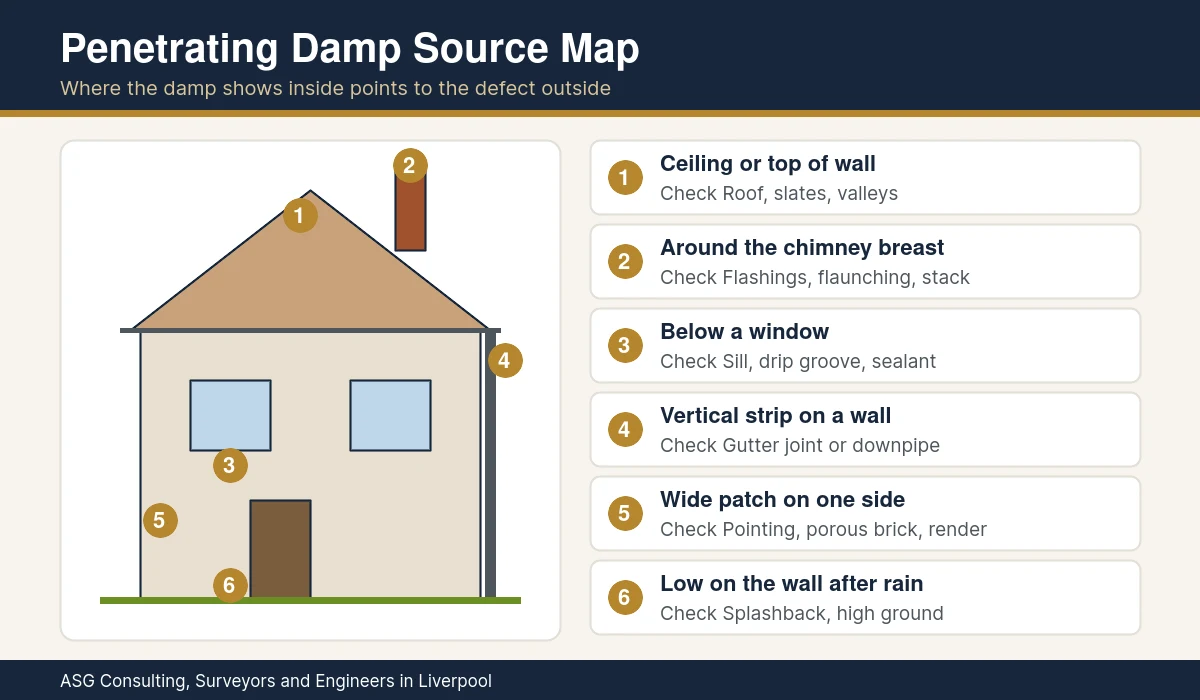
Water usually travels downwards and sideways from where it gets in, so the damp patch is normally at or below the defect. Use this map to decide where to look outside.
| Where the damp shows inside | Most likely source outside | What to check |
|---|---|---|
| Top floor ceiling or top of a wall | Roof covering, gutter or valley | Slipped slates, cracked tiles, blocked or leaking gutters, valley linings |
| Around a chimney breast | Chimney stack | Flashings, flaunching, pointing, missing cowls or pots |
| Below a window, on the reveal or at the sill | Window sill or frame | A missing drip groove, cracked sill, failed sealant around the frame |
| A vertical strip down one part of a wall | Downpipe or gutter joint | Cracked or blocked downpipes, leaking joints, overflowing hoppers |
| A wide patch across one elevation | Porous brick, eroded pointing or cracked render | The face of the wall on the side that takes the weather |
| Low on the wall after rain | Splashback or high ground levels | Paths, patios or soil above the damp proof course, blocked gullies |
| Below a flat roof or balcony | Flat roof covering or edge detail | Splits, ponding water, failed upstands and outlets |
| Around a door or extension junction | Threshold, abutment or flashing | Missing cavity trays, failed flashings where the roofs meet |
Roofs and chimneys are the hardest places to inspect safely. Surveyors increasingly use drones or camera poles instead of ladders, and our guide to drone roof inspection explains how. For flat roofs, our guide to flat roof problems covers the usual failure points.
Run a Rain Diary
Penetrating damp responds to the weather, so a short diary is one of the best diagnostic tools you have. It costs nothing and gives a surveyor or builder real evidence.
- Mark the edge of the damp patch lightly in pencil and photograph it with the date.
- Note the weather each day, including heavy rain and the wind direction. Wind driven rain from the west and south west is the main culprit in the North West.
- Check the patch after rain and after a dry spell. If it grows after storms and shrinks in dry weather, penetrating damp is very likely.
- Look outside during rain from the ground, safely. Watch gutters, downpipes and sills. Overflowing gutters and water running down the wall are easy to see when it is raining and easy to miss when it is dry.
- Keep going for a few weeks. A pattern linking rain, wind and the damp patch is far more useful than a single reading.
If you have a moisture meter, take readings at the same marked points each time. Treat readings with caution, because these meters are designed for timber and can give misleading results on masonry and plaster with salts in them.
Solid Walls and Cavity Walls
How penetrating damp behaves depends a lot on how your walls are built.
Solid brick walls
Most houses built before about the 1920s have solid walls, usually one brick or about 225mm thick. They work by absorbing rain into the outer part of the wall and letting it dry out again. Problems start when the pointing erodes, bricks crack or spall, or the wall is covered in hard cement render or impervious paint that traps moisture. A solid wall facing the prevailing weather may simply be too thin to resist heavy wind driven rain without good maintenance.
Cavity walls
Cavity walls have an outer and inner leaf with a gap between them, which should stop rain crossing to the inside. Penetrating damp appears when something bridges the cavity, such as mortar droppings on wall ties, debris at the base of the cavity, missing cavity trays over openings, or cavity wall insulation that has become wet. Our guide to cavity wall insulation problems explains how retrofitted insulation can carry water across in exposed locations.
The Repair Ladder
Start with the simplest and cheapest repairs and only move up the ladder if the problem continues. Many cases of penetrating damp are solved on the first or second rung.
- Clear and repair rainwater goods. Clean gutters, hoppers and downpipes, refix joints and replace cracked sections. This is the most common single fix.
- Repair the roof. Replace slipped or broken slates and tiles, and repair valleys and ridges.
- Repair the chimney. Renew flashings, flaunching and pointing, and fit cowls to disused flues.
- Repair sills, frames and sealant. Clear or cut drip grooves, repair cracked sills and renew failed sealant.
- Repoint and repair the masonry. Rake out and repoint eroded joints and replace badly spalled bricks, using a mortar that suits the wall. Lime mortar is usually right for older solid walls. Our guide to brickwork repair explains the options.
- Lower ground levels and improve drainage. Keep paths and soil at least 150mm below the damp proof course and clear gullies.
- Deal with the cavity. Remove debris or wet insulation and fit cavity trays where they are missing.
- Protect very exposed walls. Only once the defects are fixed, consider breathable render, cladding or a carefully chosen water repellent on walls that still take a soaking.
After the source is fixed, walls can take months to dry, often roughly a month for every 25mm of wall thickness in good conditions. Damaged plaster should be left until the wall has dried and then replaced, ideally with a breathable plaster on solid walls. Timber that has been wet for a long time should be checked for decay, as our guide to dry rot vs wet rot explains.
Treatments to Avoid
Some common responses to penetrating damp make things worse.
- Injecting a chemical damp proof course. It does nothing for rain coming in from above or from the side. Our guide to the damp proof course explains when one is and is not needed.
- Hard cement render or impervious paint on solid walls. These crack, let water in behind them and then stop it drying out.
- Tanking the inside of the wall. Waterproof coatings inside push the moisture elsewhere and hide the cause.
- Repainting with stain block and hoping. The stain will return if the water is still getting in.
- Silicone or sealant smeared over cracks. It rarely lasts, traps water and makes proper repair harder.
Penetrating Damp in Rented Homes
Landlords are responsible for keeping the structure and exterior of rented homes in repair, including roofs, walls, gutters and windows. Penetrating damp is therefore usually the landlord to fix, once the landlord knows about it.
Tenants should report penetrating damp in writing, with dated photos and notes of when it gets worse. In social housing, significant damp and mould now falls under fixed investigation and repair deadlines, which our guide to Awaabs Law sets out. Where landlord and tenant disagree about the cause, an independent housing disrepair survey can settle whether the damp is penetrating damp, rising damp or condensation.
When to Get a Survey
You can solve many cases yourself by clearing gutters and getting a roofer to fix obvious defects. Call in a chartered surveyor when
- the source is not obvious after simple repairs, or the damp keeps coming back
- several types of damp may be present at once
- timber floors, joists or roof timbers may have been affected
- you are buying a property and want to know what you are taking on
- a damp company has recommended expensive treatment and you want an independent view
- there is a dispute between landlord and tenant or with a neighbour
A surveyor will inspect the outside and inside together, take moisture readings in context, look at the age and construction of the building and give a diagnosis with a prioritised list of repairs. The Property Care Association also publishes useful guidance on damp, and you can find a qualified surveyor in structural waterproofing and damp through the Property Care Association.
Penetrating Damp in Liverpool Homes
Liverpool and Merseyside face the Irish Sea and take a lot of wind driven rain from the west and south west. Combine that with tens of thousands of Victorian and Edwardian solid walled terraces and it is easy to see why penetrating damp is one of the most common defects surveyors find here.
The usual culprits are tired cast iron gutters and downpipes, slate roofs with slipped slates, chimney stacks with failed flashings, eroded lime pointing that has been patched with hard cement, and gable walls exposed to the weather. Rear outriggers and flat roofed extensions add more junctions where water can get in. Our guide to a Victorian house survey covers these house types in more detail.
Penetrating Damp FAQs
What causes penetrating damp?
Penetrating damp is caused by rain getting into the building through a defect, such as a damaged roof, blocked or leaking gutters, failed pointing, porous bricks, cracked render, faulty window sills or a problem with a chimney. Wind driven rain makes it worse.
How can I tell if it is penetrating damp or rising damp?
Penetrating damp can appear at any height and usually gets worse after heavy rain, often near a visible defect outside. Rising damp is limited to the lower part of ground floor walls, usually below about 1 metre, and often leaves a horizontal tide mark with salts.
How do you fix penetrating damp?
Find and repair the source outside first, starting with gutters, downpipes, the roof and chimney, then sills, pointing and ground levels. Once the water is stopped, let the wall dry and then replace any damaged plaster.
Is penetrating damp covered by insurance?
Most home insurance policies exclude damage caused by gradual wear and tear or lack of maintenance, which covers most penetrating damp. Sudden storm damage, such as slates blown off in a gale, may be covered. Check your policy wording.
Who is responsible for penetrating damp in a rented home?
In most tenancies the landlord is responsible for repairing the structure and exterior, including roofs, walls and gutters. Tenants should report the problem in writing and keep evidence.
How long does a wall take to dry after penetrating damp?
It depends on the wall, the weather and ventilation, but drying often takes months. A common rule of thumb is about a month for every 25mm of wall thickness in good drying conditions.
Can penetrating damp cause mould?
Yes. Damp walls are cold and wet, which encourages mould. Treating the mould without stopping the water will not solve the problem.
Get Penetrating Damp Diagnosed by a Surveyor
ASG Consulting is regulated by RICS. Our chartered surveyors diagnose penetrating damp, rising damp and condensation across Liverpool, Merseyside and the North West, find the source and set out the repairs in a clear order of priority. To arrange an inspection, visit our damp and timber surveys page.
About the Author
Harry is a property content writer with 3 years of experience writing about building surveying, commercial property and property compliance in the UK. He writes the guides at ASG Consulting for buyers, tenants and landlords, turning survey practice into clear, practical advice.
Reviewed by Dave MacMillan MRICS, chartered surveyor at ASG Consulting. Dave checks the technical content of our guides against current RICS practice before they are published.
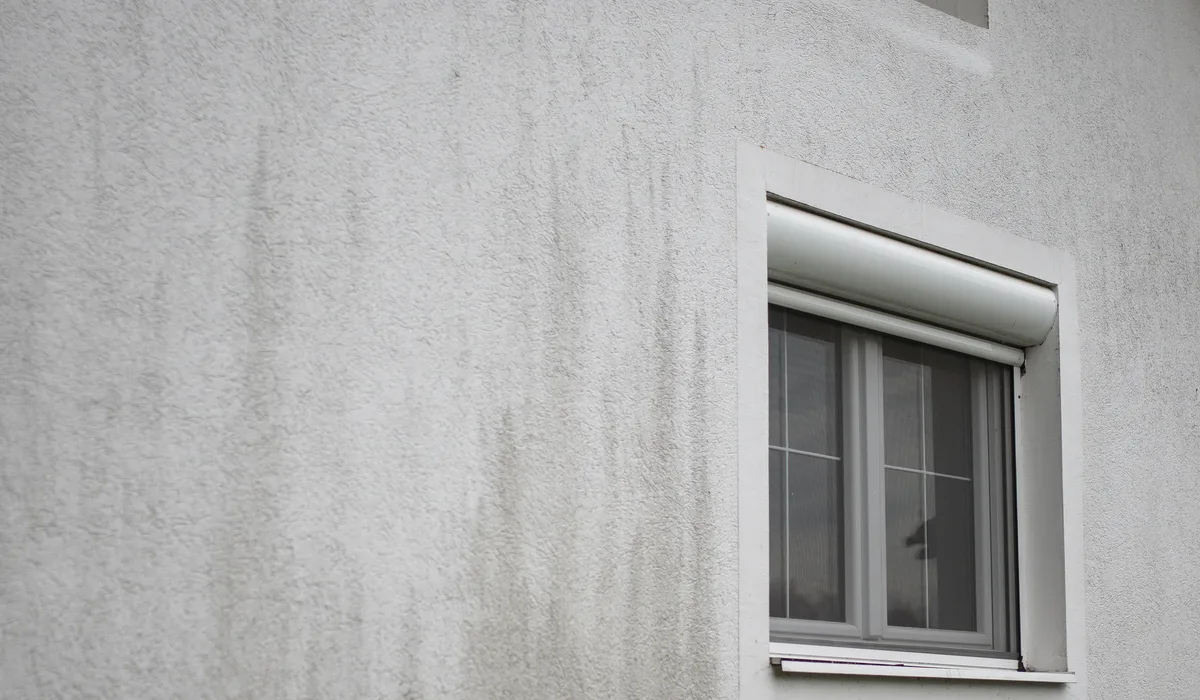
Featured photo of water staining running down a rendered wall below a window by Shixart1985 via Wikimedia Commons, licence CC BY 2.0, cropped.