If you are planning a loft conversion, a rear extension or knocking out a chimney breast in a terraced or semi detached house, sooner or later someone will mention a party wall surveyor. Many homeowners only learn about the Party Wall etc. Act 1996 when a builder asks whether notices have been served, or when a neighbour knocks on the door with a letter. Get the timing wrong and a project can be delayed by weeks or months.
This guide is built as a timeline. It walks through the party wall process from the first plan to the final inspection, with the notice periods, deadlines and decisions at each stage. It explains which works need notice, what a party wall surveyor actually does, the difference between an agreed surveyor and two surveyors, what a party wall award contains, and what the process typically costs in 2026. It is written for homeowners, landlords and developers in Liverpool, Merseyside and the North West.
In this guide
- What the Party Wall Act covers
- Which works need notice
- The three types of notice
- The party wall timeline
- What a party wall surveyor does
- Agreed surveyor or two surveyors
- What the award contains
- Access, security and flats
- Party wall surveyor costs in 2026
- Common mistakes
- If you are the neighbour
- Party wall work in Liverpool
- FAQs
What the Party Wall Act Covers
The Party Wall etc. Act 1996 came into force on 1 July 1997 and applies throughout England and Wales. It sets out a procedure for building work that affects a shared wall, a boundary wall or the foundations of a neighbouring building. It does not stop you building. Instead, it makes sure your neighbour is told in advance, that their property is protected, and that disputes are settled by surveyors rather than in court.
The Act uses two terms that come up again and again. The building owner is the person who wants to carry out the work. The adjoining owner is the neighbour whose property is affected. A party wall surveyor is appointed to resolve any dispute between them and to record how the work will be done.
The government publishes a plain English explanatory booklet, which you can read on GOV.UK in the Party Wall etc. Act 1996 explanatory booklet.
Which Works Need Notice
The Act covers three broad kinds of work. Common examples in houses include
- cutting into a party wall to insert steel beams for a loft conversion or extension
- removing a chimney breast that is attached to a party wall
- raising the height of a party wall or rebuilding it
- inserting a damp proof course through a party wall
- underpinning a party wall
- building a new wall on or astride the boundary line
- digging foundations for an extension close to the house next door
Minor work such as drilling to fix shelves, replastering, or adding or replacing electrical sockets usually does not need notice. If you are not sure, ask a party wall surveyor before you start, because serving notice is far cheaper than dealing with a dispute after work has begun. Our guides to loft conversion structural engineers and chimney breast removal explain the structural side of the most common projects.
The Three Types of Notice
The notice period depends on the type of work. A notice is only valid for a year, so do not serve it too long before you want to start.
| Notice | When it applies | Minimum notice |
|---|---|---|
| Line of junction notice, section 1 | Building a new wall on or astride the boundary line | One month |
| Party structure notice, section 2 | Work to an existing party wall, such as cutting in beams, removing chimney breasts or underpinning | Two months |
| Notice of adjacent excavation, section 6 | Digging within 3 metres of the building next door and deeper than its foundations, or within 6 metres where the dig cuts a 45 degree line from the bottom of their foundations | One month |
The notice periods come from the government explanatory booklet. Work can start earlier if the adjoining owner agrees in writing.
The Party Wall Timeline
This is how a typical project runs, from planning to completion. Build these stages into your programme from the start.
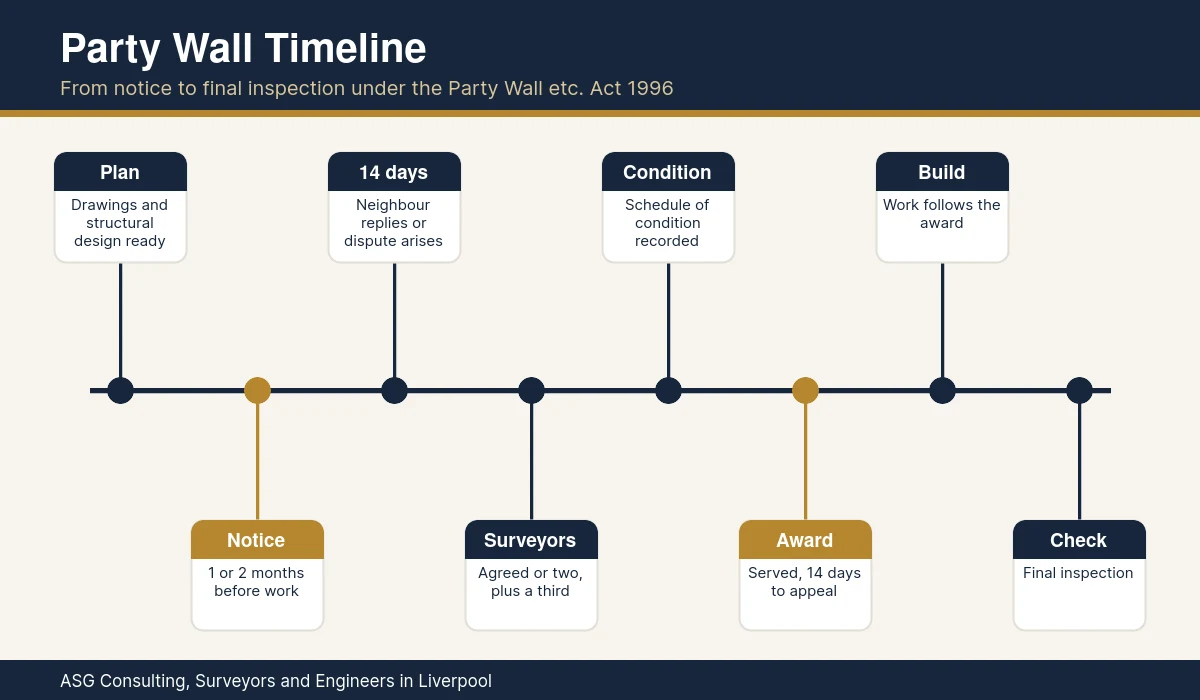
- Three months or more before work. Get your drawings and structural design finished, so you know exactly what will happen to the party wall and how deep the foundations will go. A party wall surveyor can only describe works that have been designed, so speak to one early.
- Serve the notices. Ask a party wall surveyor to serve the right notice on every adjoining owner, at least one or two months before work, depending on the notice type. In a terrace, that may be both neighbours and, for flats, more than one owner.
- The 14 day response window. The adjoining owner should reply within 14 days. They can consent, or dissent and appoint a surveyor. If they do nothing, a dispute is treated as having arisen.
- Surveyors are appointed. If there is a dispute, either one agreed party wall surveyor acts for both owners, or each owner appoints their own surveyor. The two surveyors select a third surveyor at the outset, in case they cannot agree later.
- Schedule of condition. The surveyors record the condition of the adjoining property before work starts, with dated photographs. Our guide to a party wall schedule of condition explains what it includes.
- The award is agreed and served. The surveyors prepare and sign a party wall award, which sets out the works, how and when they will be done, and who pays the costs.
- The 14 day appeal window. Each owner has 14 days from service of the award to appeal to the county court. Appeals are rare when the process has been handled properly.
- Work proceeds. The building owner carries out the work in line with the award. Surveyors may visit during the works if the award allows.
- Final inspection. After the work, the surveyors check the adjoining property against the schedule of condition and agree any repairs or compensation for damage caused.
For a party structure notice, a realistic timeline from serving notice to starting work is often two to three months, longer if there are several neighbours or the work is complex.
What a Party Wall Surveyor Does
A party wall surveyor does not take sides in the usual sense. Even when appointed by one owner, the surveyor has a duty to act impartially and to resolve the dispute in line with the Act. Their job is to
- check that the notices are valid and served correctly
- review the drawings and structural calculations for the proposed work
- record the condition of the adjoining property before work starts
- set the conditions for how and when the work will be carried out
- decide who pays the costs of the award and of any damage
- deal with disputes that arise during the work
Anyone can act as a party wall surveyor except the owners themselves, but most people choose a chartered surveyor with party wall experience, such as a member of RICS or the Faculty of Party Wall Surveyors. Look for a party wall surveyor who understands the structure of your type of house, because many awards depend on engineering detail.
Agreed Surveyor or Two Surveyors
When a dispute arises, the adjoining owner can choose how surveyors are appointed. Both routes lead to an award with the same legal effect.
| Agreed surveyor | Two surveyors | |
|---|---|---|
| Who acts | One surveyor appointed by both owners | Each owner appoints their own surveyor |
| Cost | Usually lower, one set of fees | Usually higher, two sets of fees |
| Speed | Usually quicker | Can take longer as two surveyors agree the award |
| Best when | Neighbours get on and trust one surveyor | The neighbour wants their own adviser, or the work is complex |
The building owner usually pays the reasonable fees of both surveyors where the work is solely for their benefit, so the adjoining owner choosing their own surveyor usually costs the building owner more. A good relationship with your neighbours before notices are served often saves money.
What a Party Wall Award Contains
The party wall award is the legal document at the heart of the process. A typical award includes
- a description of the works and the drawings they must follow
- a schedule of condition of the adjoining property
- working hours, access arrangements and protection measures
- requirements for temporary support, weatherproofing and making good
- who pays the surveyors fees and any other costs
- arrangements for inspecting the property after the work and dealing with damage
- in some cases, a requirement for security of expenses where the risk to the neighbour is high
Once served, the award is binding on both owners unless it is appealed within 14 days.
Access, Security and Flats
A few parts of the Act surprise building owners.
- Access to the neighbouring property. The Act gives a right of access to the adjoining land when it is needed to carry out works under the Act, with notice, usually 14 days except in an emergency. The award normally sets out how and when access will happen.
- Security for expenses. Where the work carries a real risk to the neighbouring building, such as deep excavation or major work to the party wall, the adjoining owner can ask for money to be held as security in case the work is not completed properly.
- Flats and leasehold buildings. In a converted house or block, the party wall may be shared with several owners, including the freeholder and long leaseholders. Each one with an interest of more than a year may need to be served with notice, which a party wall surveyor will check against the Land Registry titles.
- Party fence walls. A garden wall standing astride the boundary is also covered by the Act if you want to raise, rebuild or underpin it, but a timber fence is not.
Getting these details right at the start keeps the process smooth and avoids an invalid notice having to be served again.
Party Wall Surveyor Costs in 2026
Party wall surveyor costs depend on the type of work, the number of neighbours, whether one or two surveyors are appointed and how complex the structure is. These are typical 2026 ranges.
| Item | Typical 2026 cost |
|---|---|
| Preparing and serving a notice | About 50 to 150 pounds per adjoining owner |
| Schedule of condition only | About 300 to 700 pounds |
| Agreed surveyor award | About 900 to 1,800 pounds |
| Two surveyor award | About 1,800 to 3,500 pounds in total |
| Third surveyor referral | About 800 to 2,000 pounds or more |
These figures come from the BestBuilders party wall surveyor cost guide, updated in August 2026, which notes that the North of England is typically cheaper than London and the South East. A simple line of junction notice for a garden wall costs much less than an award for a loft conversion with steel beams cut into the party wall. Always ask each party wall surveyor for a written quote.
Common Party Wall Mistakes
These are the mistakes that cause the most delay and cost.
- Starting work before notice is served. The neighbour can seek an injunction to stop the work, and you lose the protection the Act gives you.
- Serving notice too late. If the builder is booked for next month and the work needs two months notice, the start date will slip.
- Serving the wrong notice or on the wrong person. Every owner with an interest in the adjoining property, including freeholders and long leaseholders, may need notice.
- Not having the structural design ready. A party wall surveyor cannot finalise an award without drawings and calculations.
- Skipping the schedule of condition. Without a dated record, it is very hard to prove whether cracks were there before the work.
- Treating it as a formality with neighbours. A friendly conversation before the notice lands makes everything easier.
If You Are the Neighbour
If you receive a party wall notice, do not ignore it. You have 14 days to respond, and if you do nothing a dispute is treated as having arisen and a surveyor will be appointed on your behalf. Your options are to consent, to dissent and agree to one surveyor, or to dissent and appoint your own surveyor.
Consenting can be sensible for small, low risk works by a neighbour you trust, but it is wise to agree a schedule of condition anyway. For anything structural, such as beams cut into the party wall, underpinning or deep excavation nearby, most adjoining owners are better protected by an award. If you need help understanding a notice, a chartered party wall surveyor can explain what the works mean for your property.
Party Wall Work in Liverpool
Liverpool and Merseyside are full of terraced and semi detached houses that share party walls, so the Party Wall Act affects a huge number of projects here. Loft conversions in Victorian terraces usually involve steel beams bearing into the party wall. Rear extensions to outriggers often need foundations within 3 metres of the neighbour, and chimney breast removals are very common in older houses.
Many of these party walls are solid brick with soft lime mortar, sometimes with chimney flues running through them and shallow foundations. That makes a careful structural design and a thorough schedule of condition especially important. Our schedules of condition service and structural engineering team support building owners and neighbours through party wall work across Liverpool, Merseyside and the North West.
Party Wall Surveyor FAQs
Do I need a party wall surveyor?
You need to serve notice for works covered by the Party Wall etc. Act 1996. A party wall surveyor is only needed if the neighbour does not consent in writing, or does not respond within 14 days. In practice many building owners use a surveyor to prepare and serve the notices correctly.
How much notice do I need to give?
One month for a new wall on the boundary line and for excavation near a neighbour, and two months for work to an existing party wall. Notices are valid for a year.
Who pays for the party wall surveyor?
Usually the building owner pays the reasonable costs of the award, including the surveyor for the adjoining owner, where the work is solely for the benefit of the building owner. The surveyors decide who pays in the award.
How much does a party wall surveyor cost?
Published 2026 figures put an agreed surveyor award at about 900 to 1,800 pounds and a two surveyor award at about 1,800 to 3,500 pounds in total, with lower costs in the North of England than in London.
What happens if my neighbour does not respond to a party wall notice?
If the adjoining owner does not respond within 14 days, a dispute is treated as having arisen. A surveyor can then be appointed on their behalf so that an award can be made.
Does the Party Wall Act apply in Scotland?
No. The Party Wall etc. Act 1996 applies throughout England and Wales only.
Can a party wall award be appealed?
Yes. Each owner has 14 days from service of the award to appeal to the county court.
Party Wall Support From Chartered Surveyors
ASG Consulting is regulated by RICS. Our chartered surveyors and structural engineers prepare schedules of condition, structural designs and condition reports that support party wall work for homeowners, landlords and developers across Liverpool, Merseyside and the North West. To find out more, visit our schedules of condition page.
About the Author
Harry is a property content writer with 3 years of experience writing about building surveying, commercial property and property compliance in the UK. He writes the guides at ASG Consulting for buyers, tenants and landlords, turning survey practice into clear, practical advice.
Reviewed by Dave MacMillan MRICS, chartered surveyor at ASG Consulting. Dave checks the technical content of our guides against current RICS practice before they are published.
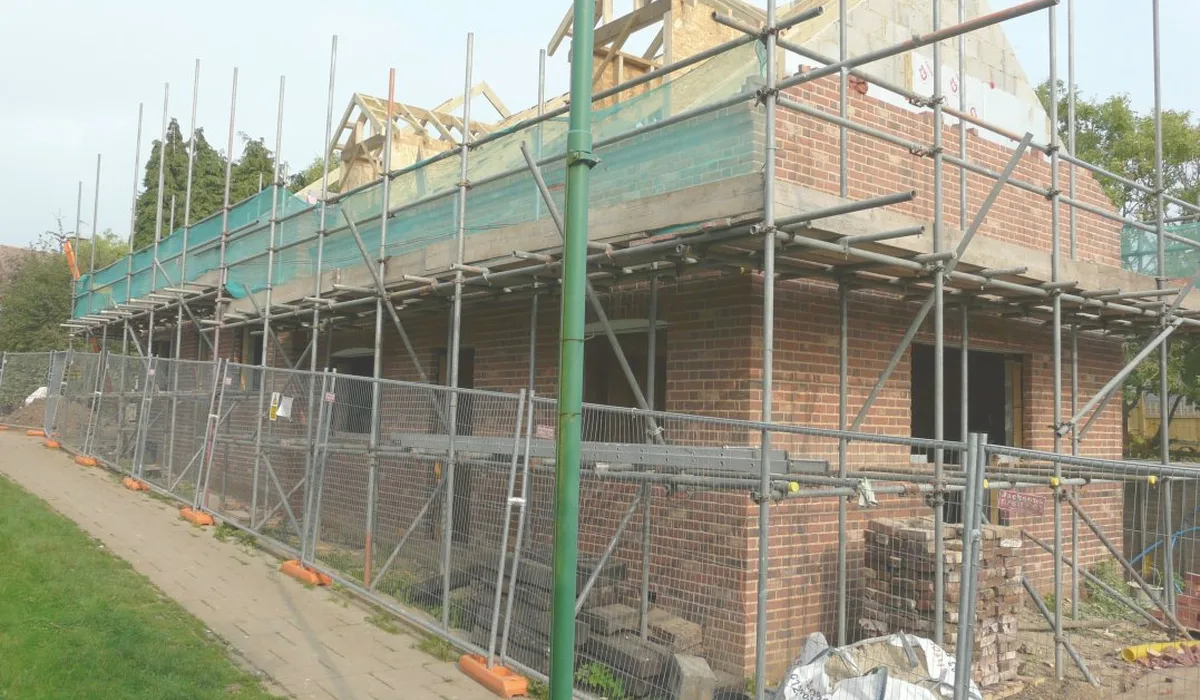
Featured photo of a pair of semi detached houses being built by John Baker via Wikimedia Commons, licence CC BY SA 2.0, cropped.