Dry rot vs wet rot is one of the most common questions we are asked when someone finds soft, crumbling or discoloured timber in a house. Both are forms of fungal decay, both need moisture to start, and both can weaken floors, roofs and joinery. But they behave very differently. Dry rot can spread through a building and travel across brick and plaster to reach new timber, while wet rot usually stays where the wood is wettest. Getting the diagnosis right decides how much of the building needs opening up, how urgent the work is and how much it will cost.
This guide is written as a side by side identification guide. It explains how to tell the two apart, where each one is usually found, what causes them, what a dry rot survey involves, how treatment differs and what buyers, owners and landlords should do next. It is written for property owners in Liverpool, Merseyside and the North West, where older homes with suspended timber floors make timber decay a familiar finding.
In this guide
- What rot actually is
- Dry rot vs wet rot at a glance
- How to recognise dry rot
- How to recognise wet rot
- Lookalikes and false alarms
- Where each one is found
- What causes timber decay
- What a dry rot survey involves
- How treatment differs
- Treatment mistakes to avoid
- A quick checklist
- Buying a house with rot
- Advice for landlords
- Preventing rot
- Timber decay in Liverpool homes
- FAQs
What Rot Actually Is
Timber rot is caused by fungi that feed on the wood. Their spores are almost everywhere in the air, but they only germinate and grow when timber stays damp for long enough. Once established, the fungus breaks down the cellulose and other parts of the wood, leaving it weak, light and crumbly.
In the UK, the fungus usually called dry rot is Serpula lacrymans. The term wet rot covers a group of other fungi, of which the cellar fungus is one of the most common. The names are misleading. Dry rot is not dry when it starts. It needs damp timber too, but it can survive at lower moisture levels than most wet rots and can spread into areas that would otherwise stay sound.
That is why the dry rot vs wet rot question matters. Both need fixing, but dry rot calls for a wider investigation and faster action.
Dry Rot vs Wet Rot at a Glance
The chart below sets out the main differences a surveyor looks for. The sections that follow explain each one in more detail.
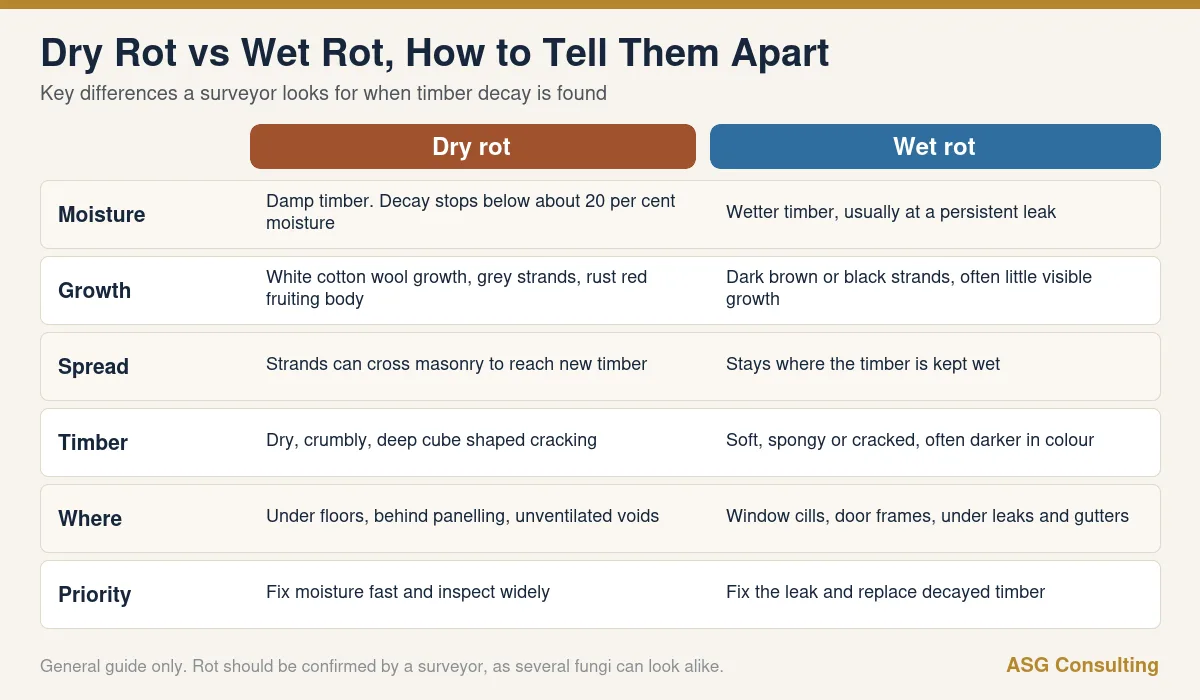
No single sign is conclusive. A surveyor looks at the whole picture, including where the decay is, how far it has spread, what the timber looks like and what the moisture source appears to be.
How to Recognise Dry Rot
Dry rot has some distinctive features, although not all of them are present in every case.
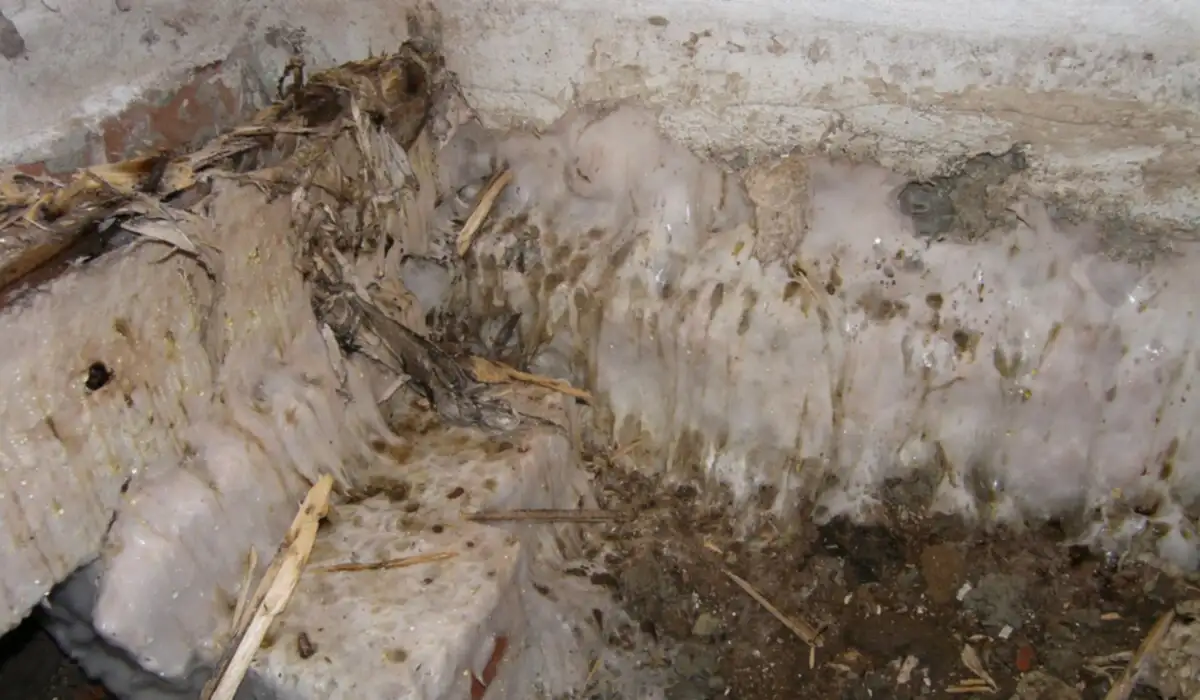
- Cotton wool growth. In damp, still conditions, dry rot can produce soft white growth like cotton wool. In drier conditions this becomes a grey or silvery skin with patches of yellow or lilac.
- Strands. Grey strands, sometimes as thick as a pencil, can run across timber, plaster and masonry. They carry moisture and nutrients, allowing the fungus to reach new timber.
- Fruiting body. A flat, pancake like growth with a rust red centre and a white edge. It releases fine rust coloured spores that can settle as dust on nearby surfaces.
- Timber damage. Affected wood becomes dry, light and brittle, with deep cracks across and along the grain, forming cube shaped pieces that crumble in the hand.
- Smell. A strong musty, mushroom like smell, especially in enclosed spaces such as under floors.
Dry rot is often found hidden, behind skirting boards, under floors, behind panelling or in voids, because it prefers dark, damp and poorly ventilated places. By the time it is visible in a room, it may have been active for some time.
How to Recognise Wet Rot
Wet rot is far more common in most homes, and it is usually easier to deal with.
- Location. It is found where timber has been kept wet for a long time, such as window cills, door frames, the ends of floor joists in damp walls, and timber under leaking baths or gutters.
- Timber damage. The wood becomes soft and spongy, or darker and cracked, depending on the fungus. Paint may look sound while the timber underneath has decayed.
- Strands. Some wet rots produce thin dark brown or black strands, but they do not travel through masonry in the way dry rot strands can.
- Containment. Wet rot usually stops spreading once the timber dries out, so the damage tends to stay close to the moisture source.
Because wet rot is linked so closely to the source of water, fixing the leak is usually the most important part of the cure.
Lookalikes and False Alarms
Not every white growth or stain is dry rot. Several other things can look similar, and a careful dry rot survey will rule them out.
- Salt deposits. White, fluffy salts on damp walls, known as efflorescence, can look like fungal growth but crumble to powder and have no strands.
- Surface mould. Black, green or grey mould on walls and timber is usually caused by condensation. It is unpleasant, but it does not decay the timber in the same way.
- Other wood decay fungi. Some wet rot fungi produce white sheets or strands that resemble dry rot at first glance.
- Woodworm damage. Small round exit holes and fine dust point to beetle activity rather than rot, although the two can occur together in damp timber.
Where there is any doubt, the surveyor may take a sample for laboratory identification. That small extra step can avoid a far bigger and more expensive treatment than is actually needed.
Dry Rot vs Wet Rot, Where Each One Is Found
| Location | More likely to be |
|---|---|
| Suspended timber floor with blocked air bricks | Either, dry rot if the void is damp and unventilated |
| Window cills and frames | Wet rot |
| Ends of joists built into damp walls | Either, often wet rot |
| Behind panelling or skirting on a damp wall | Dry rot is a risk |
| Roof timbers under a long term leak | Wet rot, sometimes dry rot |
| Cellars and basements | Either, depending on ventilation |
| Timber under a leaking bath or shower | Wet rot |
These are tendencies, not rules, and the dry rot vs wet rot answer always depends on what is found on site. Any location can host either type if the conditions are right, so identification on site is essential.
What Causes Timber Decay
Both forms of rot start with moisture. Building conservation guidance on dry rot notes that decay stops when the moisture content of timber falls below about 20 per cent, which is why finding and fixing the water source is always the first step. The Building Conservation guide to dry rot explains this environmental approach in detail.
Common moisture sources include the following.
- Leaking roofs, gutters, downpipes and flashings.
- Failed render, pointing or window seals letting rain into walls.
- Plumbing leaks from baths, showers, radiators and pipes.
- High external ground levels or bridged damp proof courses.
- Blocked air bricks under suspended timber floors.
- Condensation in poorly ventilated rooms and roof spaces.
- Past floods or long periods with a property left empty and unheated.
Our guide to rising damp in a house explains how to tell rising damp from other sources of moisture.
What a Dry Rot Survey Involves
When timber decay is suspected, a dry rot survey aims to identify the fungus, find the moisture source and map how far the damage extends.
- Visual inspection. Checking floors, skirtings, panelling, joinery and roof timbers for signs of decay, growth, strands and spores.
- Moisture readings. Taking readings in timber and masonry to find wet areas and understand the pattern.
- Opening up. Lifting floorboards or removing small areas of skirting or plaster where needed, with the owner agreement.
- Identification. Confirming whether the decay is dry rot, wet rot or something else, sometimes with samples.
- Cause and extent. Tracing the moisture source and how far any strands have travelled.
- Report. Explaining the findings, the urgency and a proportionate repair strategy.
A good dry rot survey is independent of any treatment contractor, so the advice is not driven by selling a chemical treatment. Our damp and timber surveys page explains how we approach these investigations.
Dry Rot vs Wet Rot Treatment Compared
The dry rot vs wet rot distinction matters most at the treatment stage, because the scope of work is very different.
| Step | Dry rot | Wet rot |
|---|---|---|
| Fix the moisture source | Essential and urgent | Essential |
| Dry out the structure | Vital, with ventilation and heating | Usually enough once the leak is fixed |
| Remove decayed timber | Remove affected timber and check well beyond visible damage | Cut out and replace decayed sections |
| Masonry | Localised treatment may be used to protect new timber | Rarely needed |
| New timber | Pre treated and isolated from damp masonry | Pre treated where at risk |
| Monitoring | Recommended until the building is dry | Usually limited |
Modern practice puts the emphasis on drying the building and removing the conditions that let the fungus grow, rather than relying on heavy chemical treatment. The Building Conservation guidance describes chemical treatment of masonry as localised, used mainly to form a barrier to protect timber, rather than to sterilise whole walls.
Treatment Mistakes to Avoid
Rot is often over treated or under treated, usually because the dry rot vs wet rot question was answered too quickly. These are the mistakes we see most often.
- Treating without finding the source. Spraying or replacing timber without fixing the leak means the decay will return.
- Assuming all rot is dry rot. Wet rot treated as dry rot can lead to unnecessary stripping of plaster and large bills.
- Assuming all rot is wet rot. Missing dry rot can let it spread unseen through floors and walls.
- Sealing in damp. Covering wet walls with impermeable finishes slows drying and can keep the fungus active.
- No follow up. Dry rot repairs should be followed by checks to confirm the building is drying out.
Dry Rot vs Wet Rot, a Quick Checklist
If you find decayed timber, these questions will help you describe it to a surveyor and decide how urgently to act.
- Is there white cotton wool growth or grey strands running onto plaster or brick? If so, treat it as possible dry rot.
- Is there rust coloured dust on nearby surfaces? This can be dry rot spores.
- Is the decay limited to timber next to an obvious leak? That points more towards wet rot.
- Does the timber break into cubes, or is it soft and spongy?
- Is there a strong mushroom smell in a closed space such as under the floor?
- Has the property been empty, flooded or unheated for long periods?
Your answers will not settle the dry rot vs wet rot question on their own, but they help the surveyor plan the inspection and decide where to look first. Take photographs before anything is disturbed, and avoid spreading dust or debris around the house.
Buying a House With Rot
Finding rot during a house purchase, whatever the answer to the dry rot vs wet rot question, does not have to end the sale, but it does need careful handling. Your survey may flag decay, high moisture readings or areas that could not be inspected. If dry rot is suspected, ask for a specialist dry rot survey before you commit, so you understand the extent and likely cost.
Use the findings to decide whether to proceed, renegotiate or ask the seller to carry out repairs with a guarantee. If the seller has had treatment carried out in the past, ask for the specification, the guarantee and confirmation that the moisture source was fixed. For older homes, a Level 3 building survey gives the detail you need. Our Victorian house survey guide explains where timber problems tend to hide in older homes, and our full home buyers survey guide covers the Level 3 service.
Advice for Landlords
For landlords, timber decay is often linked to the same issues that cause damp and mould complaints, such as leaks, poor ventilation and neglected gutters. Dealing with the moisture source quickly protects the building and reduces the risk of disrepair disputes. Our guide to housing disrepair surveys explains how independent evidence helps when condition is in question, and our HMO survey checklist covers shared houses, where higher occupancy often means more moisture.
Preventing Rot
Most timber decay is preventable with routine maintenance.
- Clear gutters and check downpipes at least once a year.
- Fix leaks from roofs, plumbing and appliances promptly.
- Keep air bricks clear and never block underfloor ventilation.
- Keep external ground levels well below the damp proof course.
- Maintain paint and putty on timber windows and doors.
- Ventilate kitchens, bathrooms and roof spaces well.
- Heat and ventilate empty properties, and check them regularly.
A regular inspection routine, such as the one set out in our planned preventative maintenance guide, catches small leaks before they become rot.
Timber Decay in Liverpool Homes
Many homes in Liverpool and Merseyside were built with suspended timber ground floors, timber sash windows and timber roof structures. Over a century or more, blocked air bricks, raised paths, leaking gutters and old repairs can create the damp conditions that rot needs. Wet rot in window cills and joist ends is common, and dry rot is found from time to time under floors and behind panelling in older terraces and villas, particularly where a property has been empty or neglected.
When we look at dry rot vs wet rot cases in the region, the cause is very often a simple one, such as a blocked air brick, a leaking downpipe or a bridged damp proof course. Fixing that cause, drying the structure and replacing the affected timber is usually more effective than wide scale chemical treatment.
Dry Rot vs Wet Rot FAQs
Which is worse, dry rot or wet rot?
Dry rot is usually more serious, because it can spread beyond the original damp area and travel across masonry to reach new timber. Wet rot tends to stay close to the moisture source.
Can a surveyor tell dry rot vs wet rot on site?
Usually, yes. An experienced surveyor can often tell dry rot vs wet rot from the growth, strands, timber damage and location, and will take a sample for laboratory identification where there is doubt.
Can dry rot spread through brick walls?
Its strands can grow across and through masonry to reach timber, but the fungus does not feed on the brick itself. Drying the wall and protecting new timber stops it.
Does wet rot turn into dry rot?
No. They are caused by different fungi. However, both can be present in the same building if conditions suit them.
How do I know if I need a dry rot survey?
If you see white cotton wool growth, grey strands, a rust red fruiting body or rust coloured dust, or if timber is crumbling into cubes, arrange a dry rot survey promptly.
Is rot covered by home insurance?
Many policies exclude gradual damage such as rot, although cover varies. Check your policy and speak to your insurer.
Can I treat wet rot myself?
Small areas of wet rot in joinery can often be cut out and repaired once the leak is fixed. For structural timber or anything that might be dry rot, get professional advice first.
Will a home survey find rot?
A home survey will report visible signs of decay and high moisture, but surveyors do not lift fitted floors or open up walls, so hidden decay may need a further investigation.
How long does it take a building to dry out after a leak?
It depends on the wall thickness, materials and conditions. Thick masonry walls can take many months to dry, which is why ventilation, heating and monitoring matter.
Book a Dry Rot Survey in Liverpool
ASG Consulting is regulated by RICS. Our surveyors investigate dry rot, wet rot and other timber decay across Liverpool, Merseyside and the North West, with independent advice on the cause and a proportionate repair plan. To get a quote, visit our residential building surveying page.
About the Author
Harry is a property content writer with 3 years of experience writing about building surveying, commercial property and property compliance in the UK. He writes the guides at ASG Consulting for buyers, tenants and landlords, turning survey practice into clear, practical advice.
Reviewed by Dave MacMillan MRICS, chartered surveyor at ASG Consulting. Dave checks the technical content of our guides against current RICS practice before they are published.
Featured photo of dry rot on a timber floor by Katarzyna Kłos via Wikimedia Commons, licence CC BY 4.0, cropped.