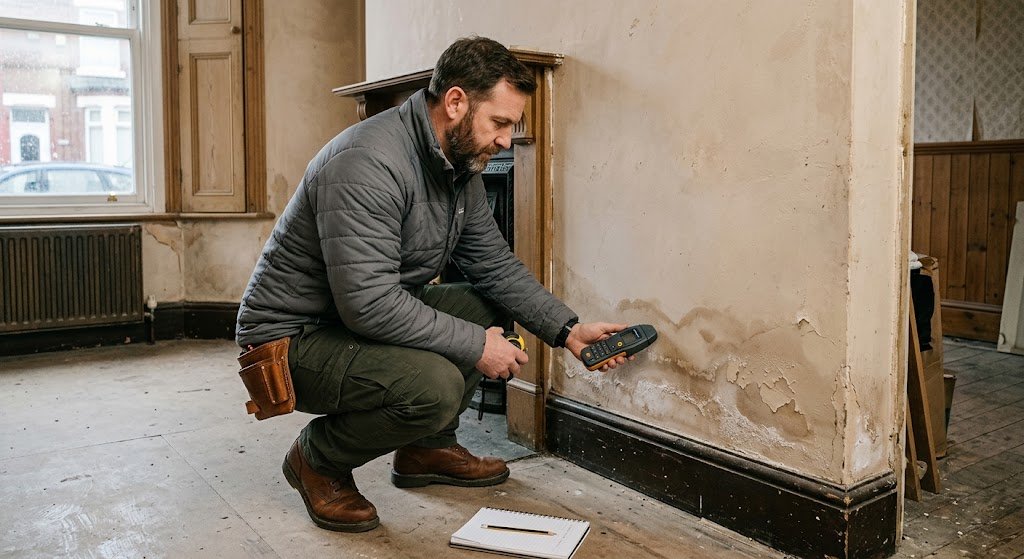
You’ve spotted a stain creeping up the bottom of a wall. It wasn’t there last winter. Maybe there’s a faint musty smell in the hallway you can’t quite place, or the plaster near the skirting board has gone soft and crumbly when you press it. Nine times out of ten, when a Liverpool homeowner rings us describing exactly that, the words “rising damp” come up within the first minute of the call.
Rising damp in a house is one of those phrases that gets thrown around a lot, often incorrectly, which is honestly part of the problem. It’s blamed for damp patches that are actually condensation. It’s used by some less scrupulous damp proofing firms to justify a five figure quote for work the property doesn’t need. And because the genuine version of it can look almost identical to two or three other issues on a wall, most homeowners have no reliable way to tell which one they’re actually dealing with.
So let’s slow down and go through it properly.
The Problem: Why Rising Damp In A House Gets Misdiagnosed So Often
Here’s the thing that catches people out. Rising damp in a house produces symptoms (staining, crumbling plaster, a tide mark) that condensation and penetrating damp can produce too, just for completely different reasons and with completely different fixes. Treat the wrong one and you’ll spend real money for zero improvement.
We see this constantly across Merseyside’s older housing stock. Victorian terraces in Toxteth, 1930s semis out in Crosby, Georgian Quarter conversions with walls that are two hundred years old in places. A lot of this property was built with solid brick walls and, depending on the era, either no proper damp proof course at all or one that’s long since failed. That’s a very different situation to a modern cavity wall new build, where rising damp is genuinely rare (though not impossible if something’s gone wrong during construction).
What Is Rising Damp In A House, Exactly?
Rising damp is groundwater being drawn upward through a wall’s masonry by capillary action, the same physical process that pulls water up a paper towel dipped in a glass. It happens because brick, stone and mortar are porous. Left unchecked, moisture travels up through the wall structure, usually stopping somewhere around a metre off the ground, because that’s roughly the point where evaporation catches up with the upward pull.
The reason it’s called “rising” damp specifically is because of that upward path. It’s not water coming in sideways through a wall (that’s penetrating damp) and it’s not moisture condensing out of humid indoor air onto a cold surface (that’s condensation). It’s water moving up from the ground itself.
It Usually Means The Damp Proof Course Has Failed
Most houses built after around 1990 have a damp proof course, a physical barrier, traditionally a layer of slate or bitumen felt, built into the wall a few courses above ground level specifically to stop this happening. When rising damp shows up in a property that age, the DPC has typically failed, been bridged by something (a flower bed piled too high against the wall is a classic culprit), or was never installed properly to begin with.
The Salt Marks Are Often The Real Giveaway
As groundwater rises and evaporates, it leaves behind dissolved salts, mainly nitrates and chlorides, that were picked up from the soil. These crystallise in the plaster and on the wall surface as a white, fluffy looking residue called salt efflorescence. It’s genuinely one of the more reliable visual clues, because condensation and penetrating damp don’t produce it in the same way. If you’re staring at a stain and wondering which kind of damp you’ve got, that white crusty texture is a decent hint you’re looking at the real thing .
How A Proper Survey Actually Solves This
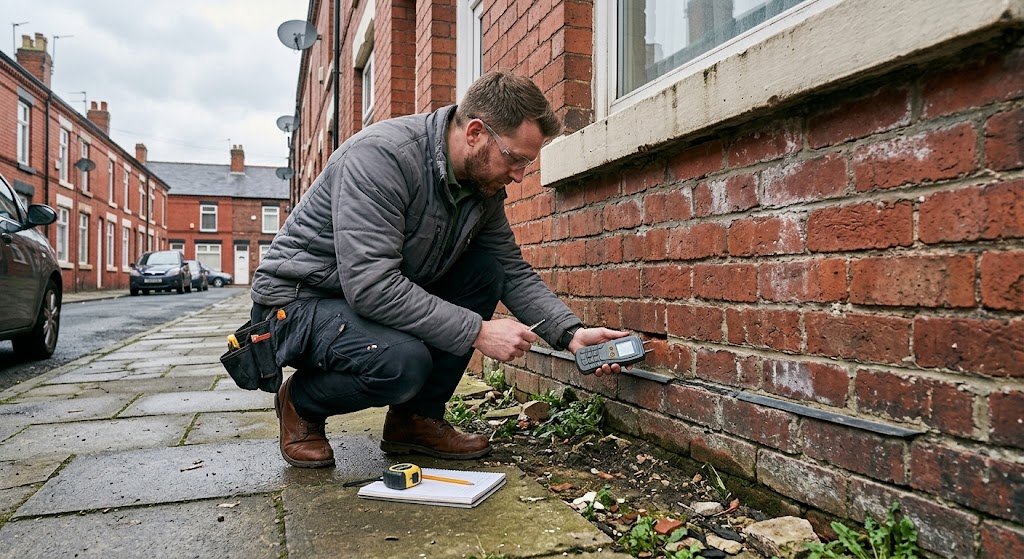
This is where a lot of well meaning advice online falls short. Articles will tell you the signs to look for, which is useful as far as it goes, but diagnosis by eye has real limits. You can’t tell from a photograph whether that tide mark is rising damp, penetrating damp from a cracked render higher up the wall, or condensation off the back of poor ventilation in a bathroom next door. Honestly, even experienced surveyors don’t rely on eyesight alone.
A proper inspection uses a moisture meter to take readings at multiple points up the wall, checks the height and condition of the existing damp proof course, looks at external ground levels (are they too high, bridging the DPC?), and examines whether there’s a more mundane explanation, like a leaking gutter or a blocked airbrick, before anyone recommends chemical injection or replastering. This kind of methodical, cause first approach is essentially what building pathology is: treating buildings a bit like a doctor treats a patient, working from symptom back to root cause rather than just papering over what’s visible.
ASG Consulting approaches every damp related enquiry this way. Our building pathology and defect analysis service exists precisely because guessing gets expensive, and a proper diagnosis, done once, properly, tends to cost far less over time than three failed attempts at a fix. Where a case is more complicated (or where a landlord or letting agent needs it independently verified), we’ll sometimes recommend a specific defect survey focused entirely on the damp issue, rather than a full building survey covering everything else too.
A Liverpool Case That Illustrates The Point
We inspected a mid terrace in Wavertree a while back where the owner had already spent close to £2,000 on damp proofing work carried out by a firm that, in fairness, seemed to genuinely believe they were treating rising damp. The staining was there. The smell was there. It looked like a textbook.
Except it wasn’t. What we found on inspection was a cracked section of rendering above the treated area, roughly at first floor height, that was letting rainwater track down inside the cavity and emerge lower down the wall, mimicking rising damp almost perfectly. The chemical DPC injection that had already been carried out hadn’t done anything, because there was never a failed damp proof course to begin with. Once the render was repaired properly, the “rising damp” problem more or less stopped on its own within a couple of months.
It’s a useful reminder that surface symptoms lie. We’ve written more broadly about this pattern, where a small, easily dismissed sign turns out to trace back to something bigger, in this piece on the building problems most homeowners only discover too late, which covers a similar case involving a crack that looked cosmetic and wasn’t.
Rising Damp vs Penetrating Damp vs Condensation: What To Actually Look For
Since these three get confused so often, here’s a rough way to tell them apart, though nothing beats an actual inspection.
Rising damp typically stays low, rarely climbing past about a metre, and often comes with that white salt residue and a tide mark pattern along the base of a wall.
Penetrating damp can appear at any height, tends to correspond with a specific external defect (cracked render, a damaged gutter, missing pointing) and often gets noticeably worse after heavy rain.
Condensation shows up as surface moisture, black mould spots (especially in corners, on north facing walls, or around window reveals) and is usually tied to poor ventilation, drying clothes indoors, or simply not opening windows enough. It’s by far the most common of the three, and it’s often mistaken for the other two.
A few things worth thinking about before you commission any damp related work: whether the “damp” has appeared suddenly or built up gradually, whether it’s worse in winter (points toward condensation or rising damp) or after rain specifically (points toward penetrating damp), and whether anyone’s actually taken proper moisture readings, or just looked at the wall and made a call. If a company quotes you for a damp proof course without ever putting a meter to the wall, that’s worth questioning.
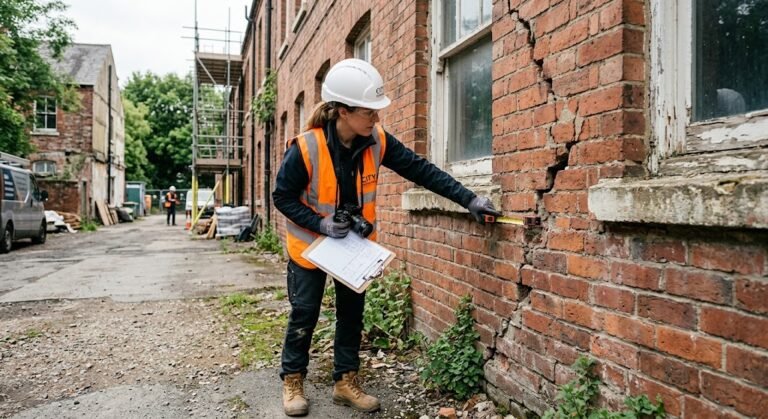
Wider structural defects can sometimes complicate the picture too. Cracking, settlement, or previous underpinning nearby can all interact with how moisture moves through a wall, which is part of why building defect surveys tend to look at a property holistically rather than treating each symptom in isolation.
FAQs About Rising Damp In A House
How Serious Is Rising Damp in a Home?
Rising damp can become a serious property problem if it is ignored for too long.
It can damage plaster, skirting boards, flooring and internal finishes.
Persistent moisture may also create conditions where mold and decay develop.
A proper damp survey can identify the cause before repairs become more extensive.
How Do You Get Rid of Rising Damp?
The first step is confirming that the problem is actually rising damp.A professional survey can check the damp-proof course, ground levels and moisture patterns.Treatment may involve repairing or installing a suitable damp-proof course and removing damaged plaster.The affected walls should then be allowed to dry before they are properly repaired and redecorated.
What Are the First Signs of Rising Damp?
Early signs often include damp patches appearing along the lower sections of walls.
You may notice peeling paint, bubbling plaster or damaged skirting boards near the floor.
White, powdery salt deposits can also appear as moisture moves through the masonry.
A musty smell or persistent moisture around ground-floor walls can be another warning sign.
How Much Does It Cost to Fix Rising Damp?
The cost depends on the size of the affected area and the underlying cause.
Minor repairs may be relatively affordable, while extensive plaster and damp-proofing work can cost considerably more.Properties with damaged walls, floors or skirting may require additional remedial work.Getting a professional assessment first can help avoid paying for unnecessary treatments.
Is It Illegal to Sell a House With Rising Damp?
No, it is not generally illegal to sell a house simply because it has rising damp.
However, sellers should be honest about known defects and provide accurate information when required.A serious damp problem may affect the property’s condition, negotiations and mortgage or survey process.Having the issue investigated and documented can make the sale process clearer for everyone involved.
What Happens If Rising Damp Is Left Untreated?
Untreated rising damp can gradually cause more damage to plaster, timber, flooring and decorative finishes.Salt contamination can make walls difficult to redecorate even after they appear dry.Long-term moisture can also contribute to unpleasant smells, mould and deterioration of building materials. Early investigation can help identify the cause and prevent a relatively contained problem from becoming more costly.
Final Thoughts
Rising damp in a house isn’t as common as the damp proofing industry sometimes makes it out to be, but when it is genuine, ignoring it rarely ends well. The plaster keeps deteriorating, skirting and timber can start to suffer, and what would’ve been a straightforward, relatively affordable fix a year ago becomes a bigger job. Not always. But often enough that it’s not worth the gamble.
If you’ve spotted a stain that won’t go away no matter how many times it gets painted over, or you’re buying a property and something about a wall doesn’t sit right with you, it’s worth getting it looked at properly before committing to any treatment. ASG Consulting are chartered building surveyors working across Liverpool, Merseyside and the wider North West, and damp diagnosis is something we deal with most weeks of the year. If tenants or a landlord dispute is involved rather than a straightforward homeowner enquiry, our house disrepair survey service covers that specific situation too.
Get in touch, describe what you’re seeing, and we’ll tell you honestly whether it sounds like something that needs a full inspection or something you can keep an eye on for now.
About the Author
This article was put together by the team at ASG Consulting, a firm of RICS chartered building surveyors based in Liverpool. We work with homeowners, landlords and investors across Merseyside and the North West, offering residential, commercial and specialist surveying services, including detailed building pathology and defect analysis for properties where the cause of a problem isn’t as obvious as it first appears