A house survey inspection usually takes about 1 hour for a Level 1 Condition Report, 1 to 4 hours for a Level 2 HomeBuyer Survey and 3 to 8 hours for a Level 3 Building Survey. The written report then follows. At ASG Consulting, reports usually arrive within 3 to 5 working days of the inspection.
So how long does a house survey take from start to finish, including the report? For most buyers, the whole process from booking to having the report in hand takes one to three weeks. The biggest factors are how quickly you book, how easy the property is to access and the size, age and condition of the house. This guide sets out a realistic timeline, explains what happens on the day and shows you how to avoid the delays that hold up a purchase.
In this guide
- How long does each survey level take?
- What is the timeline from offer to report?
- What happens on the day of the survey?
- How long does a survey take on a flat?
- How long does a Level 3 survey take?
- Does a longer survey mean a better survey?
- What makes a survey take longer?
- How can you speed up your survey?
- Where does the survey fit in the buying process?
- What can you do while you wait?
- What should you do when the report arrives?
- How long do surveys take on Liverpool homes?
- FAQs
How Long Does Each Survey Level Take?
The time a surveyor spends at the property depends mainly on the level of survey you choose. These are typical ranges for an average home. Larger, older or altered properties take longer.
| Survey | Typical time on site | Typical report time at ASG Consulting |
|---|---|---|
| RICS Level 1 Condition Report | About 1 hour | Usually 3 to 5 working days |
| RICS Level 2 HomeBuyer Survey | About 1 to 4 hours | Usually 3 to 5 working days |
| RICS Level 3 Building Survey | About 3 to 8 hours, sometimes a full day | Usually 3 to 5 working days |
The on site times are based on published industry guidance in the Ellis and Co buyer guide, which also notes that large or older homes may need a full day for a Level 3 survey. Report times vary between firms, so always ask when you book.
A quicker inspection is not a worse one. A Level 2 HomeBuyer Survey is designed for conventional homes in reasonable condition, so the surveyor does not need as long. A Level 3 Building Survey takes longer because the surveyor looks in more detail and explains causes, repair options and timing. Our guide to survey condition ratings explains how the findings are reported.
What Is the Timeline From Offer to Report?
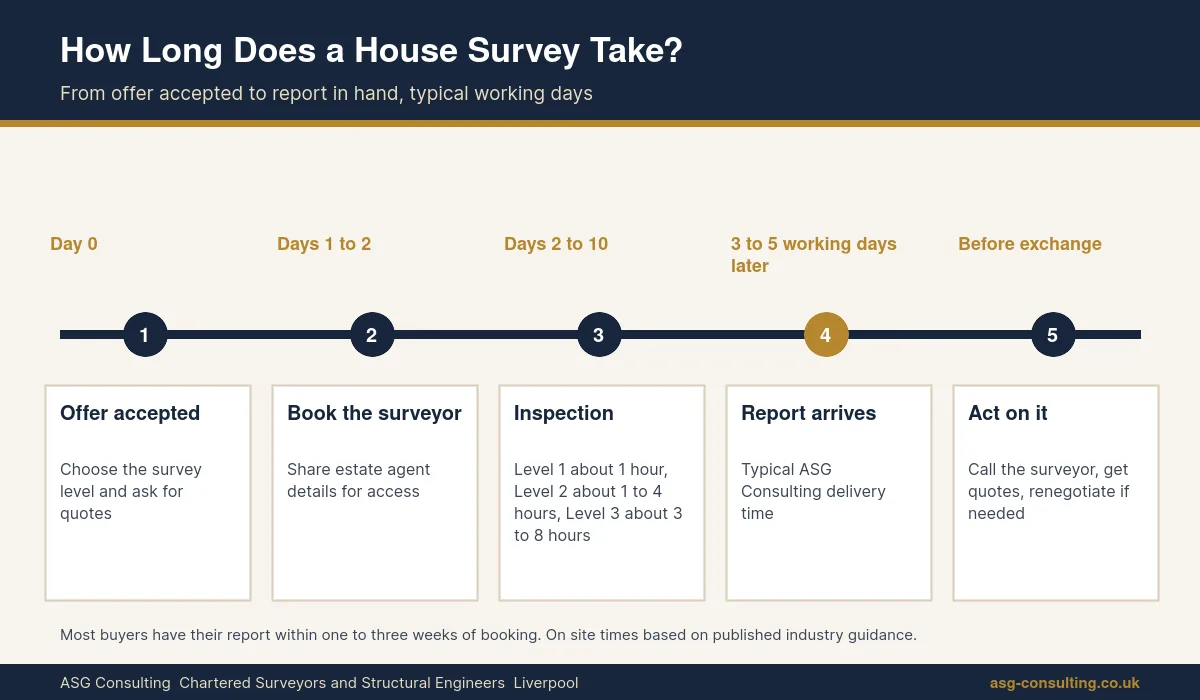
Here is a realistic timeline for a typical purchase, counted in working days after your offer is accepted.
- Day 0, offer accepted. Decide which survey you need and ask two or three RICS regulated firms for a quote. ASG Consulting usually confirms a fixed fee within one working day.
- Days 1 to 2, book the surveyor. Confirm the booking and give the surveyor the estate agent details so they can arrange access.
- Days 2 to 10, the inspection. The surveyor visits once a date is agreed with the agent and the seller. Busy spring and summer months can push this out.
- 3 to 5 working days later, the report. The surveyor writes up the findings, adds photographs and sends the report.
- The next few days, follow up. Read the report, call the surveyor with questions, and arrange any specialist checks or quotes for repairs.
- Before exchange, decide. Use the findings to go ahead, renegotiate or, in rare cases, withdraw.
Put together, the honest answer to how long does a house survey take from booking to report is one to three weeks for most buyers. The same published guidance gives a range of one to three weeks from booking to report delivery.
What Happens on the Day of the Survey?
Knowing what the surveyor actually does helps explain how long a house survey takes and why. Surveys follow the RICS Home Survey Standard, which sets out what is inspected at each level.
- Outside first. The surveyor walks round the property, checking the roof, chimneys, walls, windows, gutters, drains, boundaries and grounds from ground level and from neighbouring public areas.
- Room by room inside. Each room is checked for cracking, damp, ventilation, floors, ceilings, joinery and fittings, with moisture readings taken where needed.
- The roof space. Where there is safe access, the surveyor inspects the roof timbers, insulation, ventilation and the underside of the roof covering.
- Services. The surveyor looks at the electrics, gas, heating, water and drainage, though they do not test them.
- Notes and photographs. Everything is recorded so the report can explain what was found and where.
You do not need to be there. Most surveys are arranged through the estate agent and the seller lets the surveyor in. Many buyers prefer to speak to the surveyor by phone afterwards instead.
How Long Does a House Survey Take on a Flat?
A survey on a flat or apartment is often quicker inside, because there are fewer rooms and usually no roof space of its own. The surveyor will still look at the parts of the building that affect you, such as the main roof, external walls, communal hallways, stairs and fire doors, where they can be seen and reached.
For a typical one or two bedroom flat, a Level 2 HomeBuyer Survey inspection often sits at the shorter end of the 1 to 4 hour range. Time can increase if the building is large, if access to communal areas needs arranging through a managing agent or if the building has issues such as cladding or a flat roof that need extra attention. Our guide to a survey for buying a flat explains what is and is not covered.
How Long Does a Level 3 Building Survey Take?
A RICS Level 3 Building Survey is the most detailed survey and takes the longest. The surveyor looks more closely at each part of the building, opens up accessible hatches and covers, and records enough detail to explain the likely causes of defects and the options for repair.
Published guidance suggests a Level 3 inspection often takes 3 to 8 hours, with large or older homes sometimes needing a full day. A large Victorian villa with cellars, several roof slopes and a rear outrigger can easily take most of a day. A modest three bedroom semi in good condition may take closer to half a day. Our residential building surveying page explains what the Level 3 Building Survey includes.
Does a Longer Survey Mean a Better Survey?
Not always. How long a house survey takes depends on the level, the property and the surveyor. A quick inspection on a modern flat may be entirely appropriate, while a short visit to a large old house should raise questions.
What matters more is whether the surveyor is RICS regulated, whether the level of survey suits the property, whether the report is clear and whether the surveyor is happy to talk it through with you. When you compare quotes, ask each firm
- which survey level they recommend for this property and why
- roughly how long they expect to be on site
- how soon after the inspection the report will arrive
- whether they will speak to you after you have read the report
- whether they can use a drone or other equipment for roofs that cannot be seen from the ground
What Makes a Survey Take Longer?
If you are wondering how long does a house survey take for your particular home, these are the factors that make the biggest difference. Several things can lengthen the inspection or delay the report.
| Factor | Why it adds time |
|---|---|
| Size of the property | More rooms, more roof slopes and more outbuildings to inspect |
| Age of the property | Older homes have more elements to check and more history of alterations |
| Condition | Defects need recording, photographing and explaining |
| Extensions and conversions | Loft conversions, knock throughs and extensions raise questions about structure and approval |
| Access problems | A locked loft hatch, no ladder or a missing key can mean a second visit |
| Occupied and furnished homes | Heavy furniture and fitted floor coverings hide parts of the structure |
| Time of year | Spring and summer are the busiest months for surveyors |
| Flats | The surveyor may need access to communal areas and roof spaces through the managing agent |
How Can You Speed Up Your Survey?
You cannot rush a good inspection, but you can avoid most of the delays. Use this checklist.
- Book the survey as soon as your offer is accepted. Do not wait for the mortgage valuation.
- Choose the right level at the start, so you do not need a second survey later.
- Give the surveyor the estate agent contact details straight away.
- Ask the agent to make sure the loft hatch is clear and a ladder is available, and that keys for outbuildings, garages and meter cupboards are left out.
- For a flat, ask the agent for managing agent details so communal areas can be accessed.
- Tell the surveyor about anything you are worried about, such as a crack you noticed at the viewing or plans for an extension.
- Be available by phone the day the report arrives, so you can talk through the findings quickly.
Where Does the Survey Fit in the Buying Process?
The survey runs alongside the legal work your solicitor or conveyancer is doing. Both need to be finished before you exchange contracts, because once you exchange you are legally committed to buy.
| Stage | What happens |
|---|---|
| Offer accepted | Instruct a solicitor, apply for the mortgage and book the survey |
| Weeks 1 to 3 | Survey inspection and report, lender valuation, searches ordered |
| Following weeks | Specialist checks and quotes, legal enquiries, mortgage offer |
| Exchange | Contracts exchanged and deposit paid, completion date fixed |
| Completion | Money transferred and you get the keys |
The lender valuation is not the same as your survey. Our guide to mortgage valuation vs survey explains the difference and why most buyers need both.
What Can You Do While You Wait for the Report?
Knowing how long a house survey takes means you can use the waiting time well. While the surveyor writes up the findings
- chase your solicitor for the searches and the seller replies to enquiries
- check your mortgage application is progressing and the lender valuation has been booked
- ask the seller or agent for any guarantees, certificates and paperwork for past work, such as a new roof, damp treatment, electrical work or an extension
- start getting rough quotes for anything you already know needs doing, such as a new kitchen or bathroom
- think about your plans for the property, such as an extension or loft conversion, so you can ask the surveyor about them
That way, when the report arrives you can act on it quickly and keep the purchase on track. If a specialist check is recommended, it can then be booked the same week rather than adding weeks to the timeline.
What Should You Do When the Report Arrives?
The report is only useful if you act on it before exchange. When it lands
- read the summary and the condition ratings first
- call the surveyor to talk through anything rated 3 and any further investigations
- book specialists, such as an electrician, a Gas Safe engineer or a structural engineer, where recommended
- get written quotes for significant repairs
- send your solicitor any legal points the surveyor has raised
- decide whether to proceed, renegotiate or ask the seller to carry out repairs
If the report raises structural concerns, our structural engineering team can carry out a follow up inspection. Our guide to how a house purchase survey can help you renegotiate explains the next step.
How Long Does a House Survey Take on Liverpool Homes?
In Liverpool and across Merseyside, the type of property makes a real difference to how long a house survey takes.
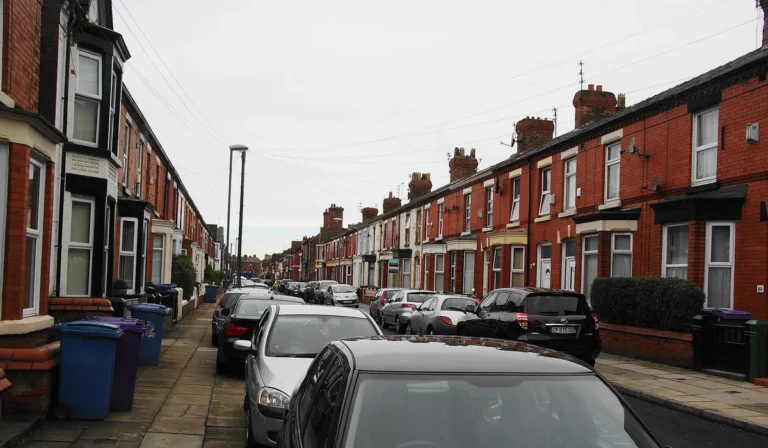
- Victorian and Edwardian terraces in areas such as Anfield, Wavertree, Kensington and Toxteth often have rear outriggers, slate roofs, solid walls and a history of alterations. They usually take longer than a modern home of the same size and often suit a Level 3 Building Survey.
- 1930s semis in Allerton, Childwall, West Derby and Crosby are usually straightforward Level 2 inspections unless they have been extended or converted.
- Converted flats in the Georgian Quarter and large Victorian villas can take longer because access to roofs and communal parts has to be arranged.
- New build homes in the city centre and on newer estates are quicker to inspect, though a snagging inspection may suit them better.
Where a roof or chimney cannot be seen safely from the ground, a drone can fill the gap without delaying the report. Our high level drone surveying service explains how.
How Long Does a House Survey Take FAQs
How long does a house survey take?
The inspection usually takes about 1 hour for a Level 1 Condition Report, 1 to 4 hours for a Level 2 HomeBuyer Survey and 3 to 8 hours for a Level 3 Building Survey. At ASG Consulting, the report usually follows within 3 to 5 working days.
How long does a homebuyer survey take?
A RICS Level 2 HomeBuyer Survey inspection typically takes about 1 to 4 hours on site, depending on the size and condition of the property.
How soon after the survey will I get the report?
At ASG Consulting, reports are usually delivered within 3 to 5 working days of the inspection. Other firms vary, so ask when you book.
Do I need to be at the property during the survey?
No. The surveyor usually arranges access through the estate agent and the seller. You can speak to the surveyor by phone after the report arrives.
When should I book my survey?
As soon as your offer is accepted. Booking early gives you time to act on the findings before you exchange contracts.
Can a survey delay my house purchase?
Rarely on its own. Delays usually come from booking late, access problems or follow up checks. Booking promptly and arranging access in advance keeps things moving.
Book Your Survey With ASG Consulting
ASG Consulting is an RICS regulated building surveying practice in Liverpool. We carry out RICS Level 2 HomeBuyer Surveys and Level 3 Building Surveys across Liverpool, Merseyside, the Wirral and the wider North West, with reports usually delivered within 3 to 5 working days of the inspection. We give a fixed fee on request, usually confirmed within one working day. To request a quote, call 0151 315 0626 or visit our RICS HomeBuyer Survey in Liverpool page.
About the Author
Dave MacMillan is the lead surveyor at ASG Consulting, an RICS regulated building surveying practice at 54 St James Street, Liverpool. He has 8 years of experience in building surveying and inspects homes for buyers across Liverpool, Merseyside and the North West.
Last updated 9 November 2026
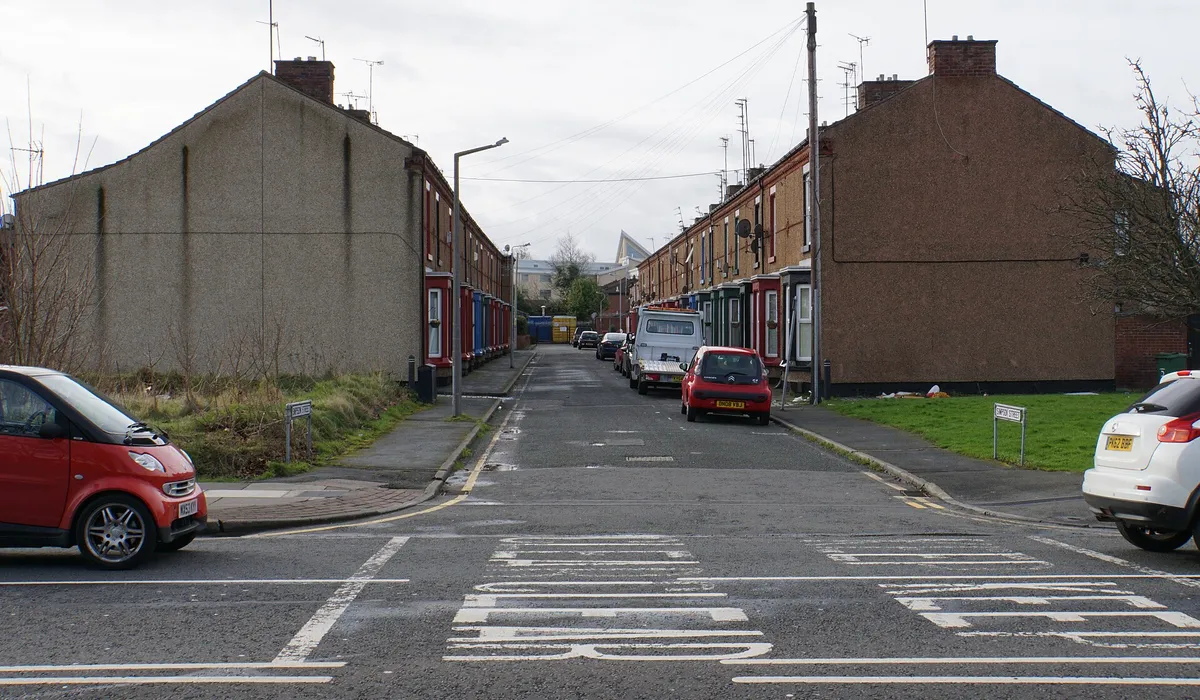
Featured photo of Simpson Street, Birkenhead by Bill Boaden via Wikimedia Commons, licence CC BY SA 2.0, cropped.