A snagging survey is a detailed inspection of a new build home to find defects, unfinished work and poor workmanship, so the builder can put them right. New homes are built quickly, by many different trades, and small mistakes are common. A professional new build snagging survey gives you a clear written list of what needs fixing and the evidence to make sure it gets done.
This guide is laid out as a practical toolkit. It explains when to book a snagging survey, walks you through a room by room checklist of the most common snags, shows the timeline of your rights from reservation to the end of the warranty, and explains what to do if the builder does not fix things. It is written for buyers of new build homes in Liverpool, Merseyside and the North West.
In this guide
- What a snagging survey is
- Why new homes have snags
- When to book
- Your rights timeline
- Room by room checklist
- Snags that matter most
- Snagging apartments
- Extra tests worth paying for
- Snagging survey cost
- Choosing an inspector
- Using the report with your builder
- If the builder will not fix it
- Mistakes to avoid
- New builds in Liverpool and Merseyside
- FAQs
What a Snagging Survey Is
A snag is any defect or unfinished item in a new home, from a scratched worktop or a door that does not close properly to missing insulation or a badly fitted roof tile. A snagging survey is a systematic inspection of the whole property, inside and out, carried out by an independent inspector who records every issue with photographs and a description.
The result is a snagging list, a report you send to the builder so they can arrange repairs. It is different from a RICS Level 2 or Level 3 survey, which is designed mainly for existing homes and focuses on condition and future repairs. A new build snagging inspection focuses on whether the home has been finished to the standard the builder and the warranty provider promise.
Most snags are cosmetic, but a good inspector will also look for issues that point to bigger problems, such as poor drainage falls, missing fire stopping, gaps in insulation or roof defects.
Why New Homes Have Snags
A new house is built by a long chain of trades, often working to tight deadlines at the end of a financial year or a sales phase. Finishing work is usually the last thing done, and the final checks are carried out by the builder, not by someone working for you.
The Home Builders Federation national customer satisfaction survey, published in March 2026, found that 93 per cent of new build buyers reported problems to their builder after moving in, and nearly a quarter reported 16 or more snags. That does not mean new homes are badly built, but it does show that some issues are almost certain, and that it pays to find them early.
When to Book a Snagging Survey
There are two main points to inspect a new home, and you can use both.
- Before completion. Buyers of homes from builders registered with the New Homes Quality Code have a right to a pre completion inspection. This lets you or your inspector check the property before you complete, so obvious issues can be fixed before you move in. Access time can be limited and the inspection may have to follow a standard checklist.
- After you move in. A full snagging survey soon after completion allows a more thorough inspection, including running taps, testing heating and checking items that are easier to see once the home is lived in.
For most buyers, the ideal is a pre completion inspection where allowed, followed by a full snagging survey within the first few weeks. Whatever you choose, report snags as soon as possible, because the first two years are when the builder is responsible for most defects.
Your New Build Rights Timeline
The infographic below shows the key stages, from reservation to the end of a typical 10 year warranty.
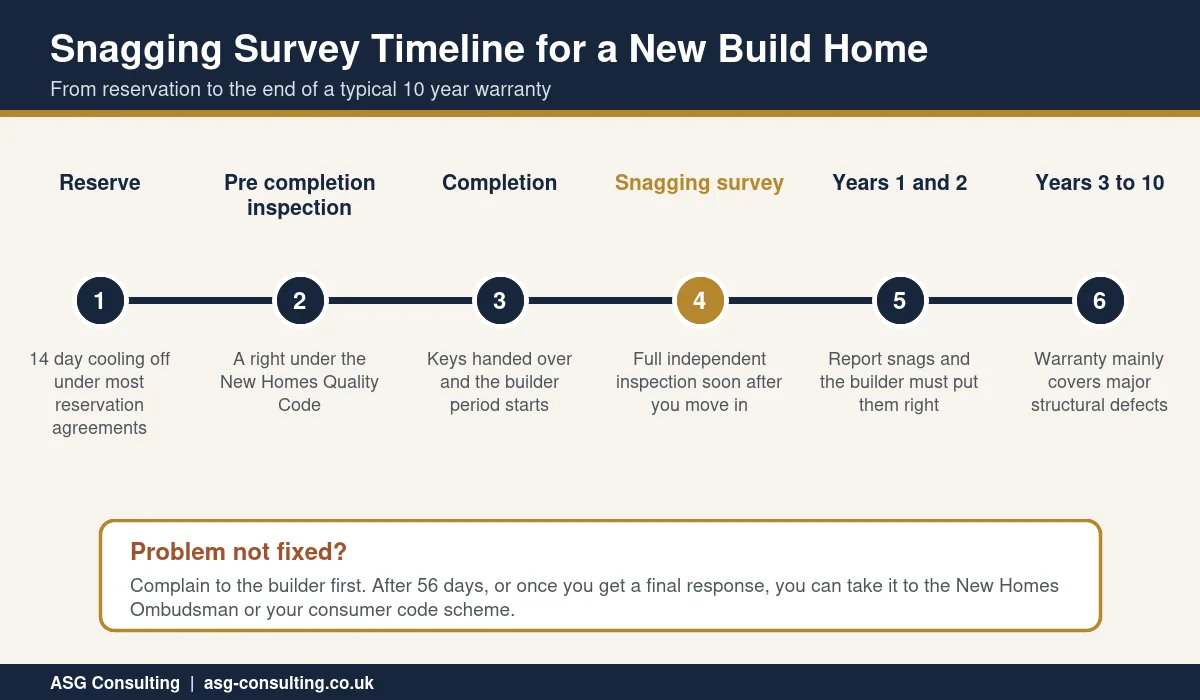
- Reservation. Under most reservation agreements you have a cooling off period, often 14 days, to change your mind.
- Pre completion inspection. Your right under the New Homes Quality Code, where the builder is registered.
- Completion. You get the keys and the builder period of the warranty begins.
- Snagging survey. Ideally in the first weeks after you move in.
- Years one and two. The builder is usually responsible for putting right defects that breach the warranty standards.
- Years three to ten. The warranty provider mainly covers major structural defects.
Warranty terms vary between providers, so check the policy documents you receive at completion.
Room by Room Snagging Checklist
A professional inspector will check hundreds of items, but this checklist shows what a thorough new build snagging inspection covers. You can also use it for your own walk round.
Outside and roof
- Brickwork for chips, staining, uneven joints and mortar splashes.
- Roof tiles, ridge and verge for slipped, cracked or missing pieces.
- Gutters and downpipes for gaps, poor joints and correct falls.
- Air bricks and weep vents, which should be clear and not buried by paths or soil.
- Paths, drives and patios, which should slope away from the house.
- Fencing, gates and garden levels, including drainage after rain.
Kitchen and utility
- Doors and drawers that are aligned and close properly.
- Worktops, joints and sealant around sinks.
- Appliances fitted and working, with instructions supplied.
- Extractor ducting connected to the outside.
Bathrooms
- Sealant around baths, shower trays and basins.
- Tiling, grout and trims for cracks and gaps.
- Water pressure, hot water and drainage from every outlet.
- Extractor fans that run and vent to the outside.
Living areas and bedrooms
- Walls and ceilings for cracks, uneven plaster and poor decoration.
- Doors that open and close without catching, and skirting and architraves that are fixed and finished.
- Windows that open, lock and seal properly, with no damaged glass.
- Floors that are level, with no squeaks or loose boards.
Loft and services
- Loft insulation laid evenly to the full depth.
- Roof timbers, felt and ventilation.
- Boiler, heating controls and radiators working, with commissioning paperwork.
- Consumer unit labelled, with electrical and gas certificates supplied.
The Snags That Matter Most
Cosmetic snags are annoying but easy to fix. Some issues are more important because they can lead to damp, heat loss or safety problems if they are left. A new build snagging inspection should flag these clearly.
- Missing or poorly fitted insulation in the loft or around windows.
- Missing fire stopping in lofts, between homes and around service pipes.
- Roof defects, such as loose tiles, missing fixings or poor ventilation.
- Drainage problems, including paths that fall towards the house and blocked or buried air bricks.
- Window and door leaks caused by poor seals or missing cavity closers.
- Cracks in walls or ceilings beyond normal drying shrinkage.
Some fine cracks are normal in the first year as the timber and plaster dry out. Our guide to cracks in walls explains which cracks are normal and which need a closer look.
New Build Snagging for Apartments
Apartments need a slightly different approach. As well as the flat itself, the building has shared areas, shared services and fire safety features that affect everyone who lives there. A new build snagging inspection of an apartment should look at the following.
- Fire doors to the flat and in corridors, which should close fully on their own and have intact seals and correct gaps.
- Fire stopping around pipes and cables where they pass through walls and ceilings, where access allows.
- Balconies, including drainage, balustrade fixings and the threshold into the flat.
- Ventilation systems, which in many new flats run continuously and must be balanced and accessible for servicing.
- Communal areas, such as stairs, lifts, bin stores and entrances, which the managing agent should also be checking.
Snags in communal areas are usually raised through the managing agent or residents group rather than by one owner. Even so, it is worth noting them in your report so there is a record from the start.
Extra Tests Worth Paying For
A standard snagging survey is mainly visual, backed by simple checks of doors, windows, taps and services. Some inspectors offer extra tests that can find hidden problems.
- Thermal imaging, which shows cold spots where insulation is missing or air is leaking in around windows and doors.
- Moisture readings, which help separate normal drying out from leaks or damp.
- Drain camera checks, which look for debris, poor joints or damage in new drains.
- Air tightness and ventilation checks, useful where condensation is already appearing.
These tests add cost, but they can be worthwhile on larger homes, apartments with mechanical ventilation, or where you have already noticed draughts, damp patches or cold rooms.
Snagging Survey Cost
The HomeOwners Alliance says a professional snagging survey starts at around 320 pounds, and an inspection typically takes 2 to 6 hours depending on the size of the property. Larger homes, apartments with communal areas and inspections that include thermal imaging or drain checks cost more.
When you compare quotes, check what is included. Ask whether the inspector will test services, inspect the loft, check the outside and garden, and provide photographs for every snag. A cheap quote that leaves out the loft or the exterior may cost you more in the long run if serious issues are missed.
Choosing a Snagging Inspector
Look for an inspector who is independent of the builder and has a background in building surveying or construction. Useful questions include the following.
- Are you regulated by a professional body such as RICS?
- Do you hold professional indemnity insurance?
- Will you inspect the loft, roof from ground level and the outside?
- Do you use moisture meters or thermal imaging?
- How soon will I receive the report, and in what format?
- Will you carry out a follow up inspection to check repairs?
If you are buying a resale home rather than a new build, our guide to the full home buyers survey explains which survey to choose instead.
Using the Report With Your Builder
A snagging survey only helps if the builder acts on it. Follow these steps.
- Send the full report to the builder customer care team in writing and keep a copy.
- Ask for a written response with dates for each repair.
- Allow access for the repairs and keep a log of each visit.
- Check each item once it is fixed and sign off only what is done properly.
- Ask for a follow up inspection if many items were listed.
- Report any new snags that appear during the first two years.
Keep everything in writing. Emails, photographs and dated notes are far more useful than phone calls if a dispute arises later.
If the Builder Will Not Fix It
Most builders put snags right, but if they do not, you have routes to escalate.
Start with the builder formal complaints process. If the builder is registered with the New Homes Quality Code, you can take an unresolved complaint to the New Homes Ombudsman Service once you have a final response, or after waiting at least 56 days from your first complaint. The HomeOwners Alliance says the issue must have arisen within two years of reservation or completion, whichever is later, and that the ombudsman can award compensation of up to 75,000 pounds, as well as requiring the builder to put things right.
Builders registered with other schemes, such as the Consumer Code for Home Builders, have their own dispute services. For homes reserved from 1 January 2024, that scheme can award up to 50,000 pounds. Your warranty provider may also have a resolution service for defects within the builder period. Your snagging report and written records will be key evidence in any of these routes.
New Build Snagging Mistakes to Avoid
Buyers often lose the chance to get defects fixed for simple reasons. Avoid these common mistakes.
- Waiting too long. The builder period is usually two years, and leaving snags until the end makes them harder to resolve.
- Reporting by phone only. Always put new build snagging issues in writing so there is a clear record.
- Accepting a partial fix. Check each repair yourself before you agree it is closed.
- Making your own alterations first. Changing fittings or decorating over defects can make it harder to prove the builder is responsible.
- Ignoring the outside. Roofs, gutters, levels and drainage are easy to overlook but often cause the most expensive problems.
Snagging Surveys in Liverpool and Merseyside
New build homes are going up across the region, from city centre apartments and waterfront schemes to family estates in Knowsley, St Helens, Sefton, the Wirral and Warrington. Apartments raise extra snagging points, such as communal areas, fire doors and balconies, while houses on new estates often show issues with external levels, drainage and roof finishes.
Wet and windy weather off the Irish Sea also tests new homes quickly. Poor seals around windows, badly fitted roof tiles and blocked weep vents tend to show up in the first winter, so book your snagging survey early and check again before the end of the two year builder period.
Snagging Survey FAQs
Is a snagging survey worth it?
For most buyers, yes. It costs a small fraction of the price of the home and gives you a professional list of defects, backed by photographs, that the builder must take seriously.
Can I do my own snagging list?
You can, and the checklist above will help. A professional inspector will usually find more, including issues in the loft and on the roof that are hard to spot yourself.
How long do I have to report snags?
The builder is usually responsible for most defects in the first two years after completion. Report snags as early as possible and keep doing so throughout that period.
Can the builder refuse a snagging inspection?
Builders registered with the New Homes Quality Code must allow a pre completion inspection. After completion it is your home, so you can arrange a new build snagging inspection at any time.
What is the difference between a snagging survey and a homebuyer survey?
A homebuyer survey is designed for existing homes and focuses on condition and future repairs. A snagging survey checks a new build against the standards it should have been finished to.
Do I still need a snagging survey if the home has a warranty?
Yes. The warranty sets the standard the home should meet, but it does not find defects for you. A snagging survey identifies the issues so you can report them while the builder is still responsible.
Does a snagging survey include a valuation?
No. A snagging inspection checks the quality of the finished home. If your lender or you need a valuation, that is a separate report carried out by a RICS registered valuer.
Should I delay completion because of snags?
Talk to your solicitor first. Serious defects found at a pre completion inspection may justify a delay, but minor snags are usually fixed after you move in.
Book a Snagging Survey in Liverpool
ASG Consulting is regulated by RICS. Our surveyors inspect new build homes across Liverpool, Merseyside and the North West and provide clear, photographed reports you can send straight to your builder. To discuss an inspection, visit our residential building surveying page.
About the Author
Harry is a property content writer with 3 years of experience writing about building surveying, commercial property and property compliance in the UK. He writes the guides at ASG Consulting for buyers, tenants and landlords, turning survey practice into clear, practical advice.
Reviewed by Dave MacMillan MRICS, chartered surveyor at ASG Consulting. Dave checks the technical content of our guides against current RICS practice before they are published.
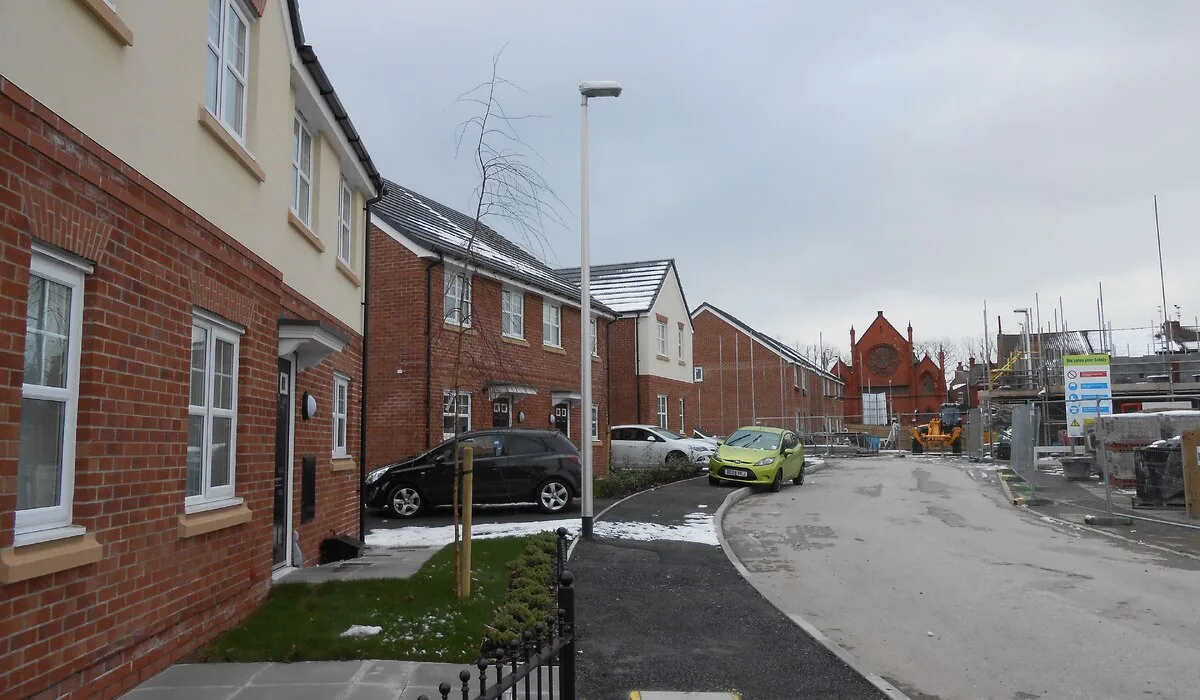
Featured photo of a new housing development in Birkenhead by Rept0n1x via Wikimedia Commons, licence CC BY SA 3.0, cropped.