The most common conservatory problems are leaking roofs, condensation, overheating in summer and cold in winter, blown double glazing, cracking from weak foundations, damp at the junction with the house, and missing approval where the doors to the house were removed. Many are fixable, but a survey before you buy helps you see which ones apply and what they may cost.
A conservatory can add light and space to a home, and many houses in Liverpool and the North West have one. They are also one of the most common sources of questions on a survey report. This guide uses a myth and fact approach to the conservatory problems buyers ask about most, explaining what is true, what is not, and what to check before you buy a house with a conservatory.
In this guide
- Why do conservatories cause problems?
- What are the common myths about conservatories?
- What roof problems affect conservatories?
- Why does a conservatory get condensation?
- Why is a conservatory too hot or too cold?
- What about blown windows and frames?
- Can a conservatory have structural problems?
- Why is there damp where it meets the house?
- Does a conservatory need building regulations?
- What about solid roof conversions?
- Is a conservatory different from an extension?
- What affects the cost of fixing conservatory problems?
- What should you check when viewing?
- Which survey do you need?
- Conservatories in Liverpool homes
- FAQs
Why Do Conservatories Cause Problems?
A conservatory is a lightweight structure, mostly glass or polycarbonate, attached to a heavier, older house. The two parts are built differently, move differently and handle heat and moisture differently. Many conservatories were also built quickly and cheaply, sometimes with little attention to foundations, drainage or the joint with the house.
That combination explains most conservatory problems. Leaks, condensation, uncomfortable temperatures and cracking are all linked to the way a conservatory is built and connected to the house.
Age matters too. Many conservatories were added in the 1980s, 1990s and early 2000s, so seals, glazing and roofs on older examples are often reaching the end of their working life. Knowing roughly when it was built helps you judge which conservatory problems are likely.
What Are the Common Myths About Conservatories?
These are the myths buyers most often believe, and the facts behind them.
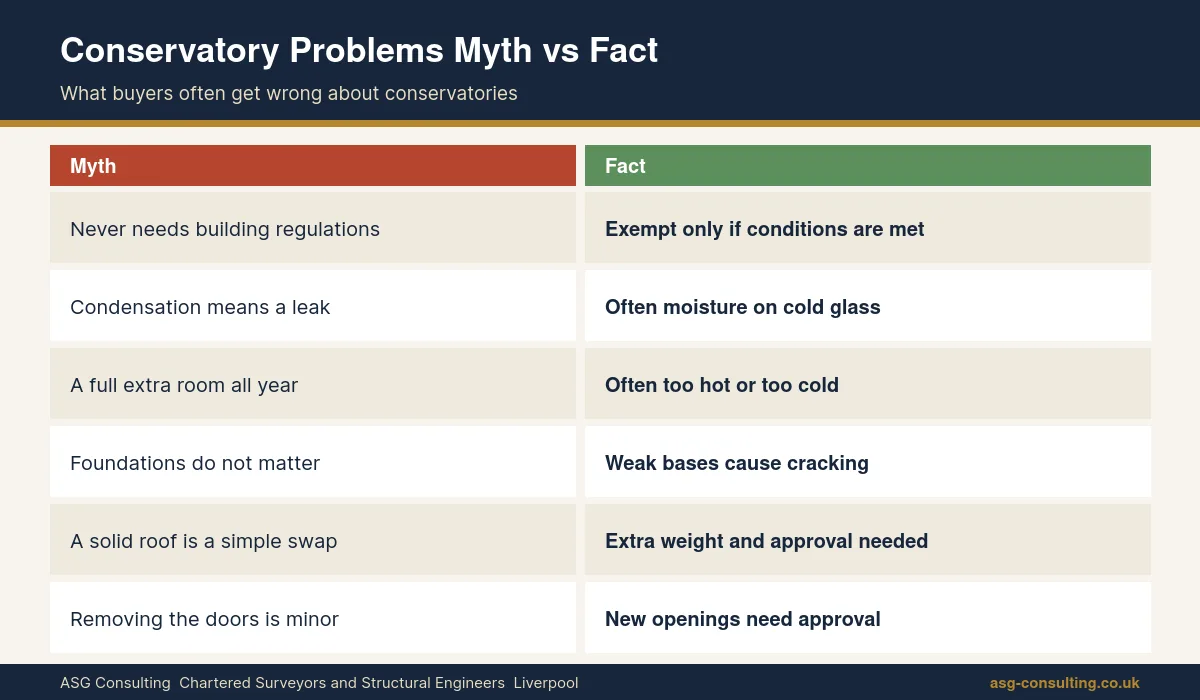
| Myth | Fact |
|---|---|
| Conservatories never need building regulations | Many are exempt, but only if they meet specific conditions, including separation from the house by external quality doors or windows |
| Condensation means the conservatory is leaking | Condensation is often caused by moisture inside meeting cold glass, not by a leak |
| A conservatory adds a full extra room | Many are too hot in summer and too cold in winter to use comfortably all year |
| Foundations do not matter for a lightweight structure | Shallow or poor foundations can cause cracking and movement, especially on clay or near trees |
| Replacing the roof with a solid one is always simple | A solid roof adds weight and can change how building regulations apply |
| Removing the doors to the house is just a small change | A new opening between the house and conservatory needs building regulations approval |
What Roof Problems Affect Conservatories?
The roof is the most common source of conservatory problems. Look for
- Leaks. Water dripping or staining, often at joints, glazing bars or where the roof meets the house wall.
- Failed seals. Rubber gaskets and seals perish over time, letting water in.
- Discoloured or brittle sheets. Polycarbonate roofs can yellow, crack and become noisy in rain.
- Blocked gutters. Small conservatory gutters fill with leaves and overflow.
- Dirty or green roofs. Algae and debris collect on low pitched roofs.
- Sagging. Roofs not designed for snow loads or later alterations can sag.
Many roof leaks can be repaired by replacing seals, flashings or individual panels. Widespread problems may mean the roof is near the end of its life.
Why Does a Conservatory Get Condensation?
Condensation forms when warm, moist air meets cold glass and frames. Conservatories are particularly prone to it because they have large areas of glazing that cool quickly, especially overnight and in winter.
Common causes include
- drying clothes inside the conservatory
- poor ventilation, with trickle vents closed or missing
- moisture moving from the house into the conservatory
- plants, pets and people adding moisture to the air
- single glazed or older double glazed roofs
It can be hard to tell condensation from a leak. Condensation usually appears evenly on cold surfaces, while a leak tends to show up in one spot during or after rain. Our guide to condensation in a house explains how to manage moisture.
Why Is a Conservatory Too Hot or Too Cold?
Glass lets in a lot of heat when the sun shines and loses heat quickly when it does not. Many conservatories become uncomfortably hot in summer and cold in winter, which limits how often they can be used.
Factors that make this worse include
- south facing conservatories with no shading
- polycarbonate or older glass roofs with poor insulation
- no separate heating or ventilation
- large areas of single glazing or older double glazing
Blinds, roof vents, better glazing or a replacement roof can help, but each has a cost. If you plan to use the conservatory as an everyday room, factor this in.
What About Blown Windows and Frames?
Double glazed units have a sealed gap between the panes. When the seal fails, moisture gets in and the glass mists up between the panes. This is often called a blown unit.
A survey will look for
- misting or water droplets between panes
- cracked or chipped glass
- warped, discoloured or rotten frames
- doors and windows that are hard to open, close or lock
- missing or damaged locks and handles
Blown units can usually be replaced individually, but several failed units may point to an older conservatory nearing the end of its life.
Can a Conservatory Have Structural Problems?
Yes. Conservatories are often built on shallow foundations and low dwarf walls. Problems include
- cracks in the dwarf walls or floor
- gaps opening up where the conservatory meets the house
- doors and windows sticking as the frame distorts
- sloping floors
- movement caused by nearby trees, leaking drains or clay soil
Because a conservatory and the house usually have different foundations, some movement between the two is common. Wider or growing cracks may need investigation. Our guides to cracks in walls and trees near a house explain what to look for, and our structural engineering team can investigate where movement is suspected.
Why Is There Damp Where It Meets the House?
The junction between the conservatory roof and the house wall is a weak point. Water can get in if
- the lead or other flashing has failed or was never fitted properly
- the conservatory roof was fixed over the house damp proof course or air bricks
- gutters overflow against the house wall
- the conservatory floor is higher than the house floor or damp proof course
This can cause damp on the inside of the original house wall, which is now inside the conservatory or in the room next to it. Blocked air bricks under a conservatory can also affect ventilation to timber floors in the house. Our guides to penetrating damp and the damp proof course explain these issues.
Does a Conservatory Need Building Regulations?
Many conservatories are exempt from building regulations, but only if they meet certain conditions. The Planning Portal guidance on conservatories and building regulations says they are normally exempt when
- they are built at ground level and are less than 30 square metres in floor area
- they are separated from the house by external quality walls, doors or windows
- they have an independent heating system with separate temperature and on and off controls
- glazing and any fixed electrical installations comply with the relevant building regulations requirements
- they are single storey
The same guidance says any new structural opening between the conservatory and the existing house needs building regulations approval, even if the conservatory itself is exempt.
This matters when buying, because many sellers have removed the doors between the house and conservatory, or extended the house heating into it. Ask for paperwork, and ask your solicitor to check. Our guide to a regularisation certificate explains what can be done if approval is missing. Planning permission is a separate question, and many conservatories fall under permitted development rights, but not all.
What About Solid Roof Conversions?
Replacing a glass or polycarbonate conservatory roof with a solid, tiled or insulated roof is popular because it can make the room more comfortable. But it is not always simple.
- A solid roof is much heavier, so the frames, dwarf walls and foundations must be able to carry it.
- It may change how the structure is treated under building regulations, and approval is often needed.
- Poor detailing can lead to leaks, condensation and cracking.
If the house you are buying has a solid roof conservatory, ask for details of who installed it, any structural calculations, guarantees and building control sign off.
Is a Conservatory Different From an Extension?
Yes, and the difference matters when you buy. A conservatory is usually a lightweight, mostly glazed structure, separated from the house by external doors or windows and often exempt from building regulations. A single storey extension is built with solid walls and a roof, is designed as part of the house and normally needs building regulations approval.
Problems arise when a conservatory has gradually been turned into an extension, for example by removing the doors to the house, adding a solid roof, connecting the house heating and using it as a main living space. In that case, it may no longer meet the conditions for exemption, and it may not perform well as a habitable room. A survey can comment on how the structure has been altered, and your solicitor can check what approvals exist.
What Affects the Cost of Fixing Conservatory Problems?
The cost of putting right conservatory problems depends on what is wrong and how widespread it is. Simple jobs, such as clearing gutters, replacing a few seals or a single blown glazed unit, are usually modest. Larger jobs, such as a new roof, new frames or foundation repairs, can be significant.
Factors that affect the cost include
- the size of the conservatory and the type of roof
- whether the frames and dwarf walls are sound
- whether the problem is in the conservatory or in the house wall behind it
- whether building regulations approval is needed for the work
- access, especially for roofs over patios or close to boundaries
Get written quotes for any significant conservatory problems before you exchange contracts. Our guide to renegotiating after a house purchase survey explains how to use them with the seller.
What Should You Check When Viewing?
Use this checklist when viewing a house with a conservatory.
- Look up at the roof for staining, cracks, gaps and debris.
- Check for drips, damp patches and mould, especially at the junction with the house.
- Open and close every door and window.
- Look for misting between double glazed panes.
- Check the dwarf walls and floor for cracks and slopes.
- Look for doors between the house and conservatory, or signs they have been removed.
- Check the heating, and whether it is separate from the house system.
- Visit on a sunny day and a cold day if you can, to judge the temperature.
- Ask when it was built, by whom, and for any guarantees and approvals.
Our house viewing checklist covers the rest of the house.
Which Survey Do You Need?
For a conventional house in reasonable condition with a typical conservatory, a RICS Level 2 HomeBuyer Survey is usually suitable. It will comment on the conservatory as part of the inspection. Our RICS HomeBuyer Survey in Liverpool page explains what it covers.
For an older house, a large or altered conservatory, a solid roof conversion or signs of cracking or damp, a Level 3 Building Survey gives more detail on the structure and how the conservatory connects to the house. Our residential building surveying page explains the Level 3 survey.
Remember that a survey is a visual inspection. It will not test the heating or electrics in detail, and it cannot see hidden foundations, so further checks may be recommended where problems are suspected.
Conservatories in Liverpool Homes
Conservatories are common across Liverpool and Merseyside, especially on 1930s semis in areas such as Allerton, Childwall, Woolton and Wallasey, on post war and 1970s houses in suburbs such as Maghull, Huyton and Halewood, and on bungalows in Formby, Crosby and across the Wirral.
Common findings on surveys in the area include
- leaking polycarbonate roofs on older conservatories
- failed flashings at the junction with the house wall
- doors to the house removed without building regulations approval
- condensation and mould in north facing conservatories
- cracking in dwarf walls on clay soils or near trees
- solid roof conversions without clear paperwork
Wet and windy weather from the Irish Sea puts conservatory roofs and seals under strain, so check them closely on homes in exposed coastal areas.
Conservatory Problems FAQs
What are the most common conservatory problems?
Leaking roofs, condensation, overheating and cold, blown double glazing, cracking from weak foundations, damp where it meets the house and missing approval for removed doors.
Does a conservatory need building regulations approval?
Many are exempt if they are under 30 square metres, single storey, separated from the house by external quality doors or windows and have independent heating. New openings to the house need approval.
How do I know if my conservatory roof is leaking or has condensation?
Condensation usually appears evenly on cold glass, often overnight or in cold weather. A leak tends to show in one place during or after rain.
Does a survey check the conservatory?
Yes. A RICS survey inspects the conservatory visually as part of the property and comments on visible defects, but it does not test services or see hidden foundations.
Is it worth replacing a conservatory roof with a solid roof?
It can make the room more comfortable, but the structure must carry the extra weight and building regulations approval is often needed. Get proper advice first.
Does a conservatory add value to a house?
A well built, usable conservatory can add appeal. A leaking, cold or poorly built one may put buyers off or need costly work.
Book a Survey With ASG Consulting
ASG Consulting is an RICS regulated building surveying practice in Liverpool. We carry out RICS Level 2 HomeBuyer Surveys and Level 3 Building Surveys on homes with conservatories and extensions across Liverpool, Merseyside, the Wirral and the wider North West, with reports usually delivered within 3 to 5 working days of the inspection. We give a fixed fee on request, usually confirmed within one working day. To request a quote, call 0151 315 0626 or visit our contact page.
About the Author
Dave MacMillan is the lead surveyor at ASG Consulting, an RICS regulated building surveying practice at 54 St James Street, Liverpool. He has 8 years of experience in building surveying and inspects homes for buyers across Liverpool, Merseyside and the North West.
Last updated 14 November 2026
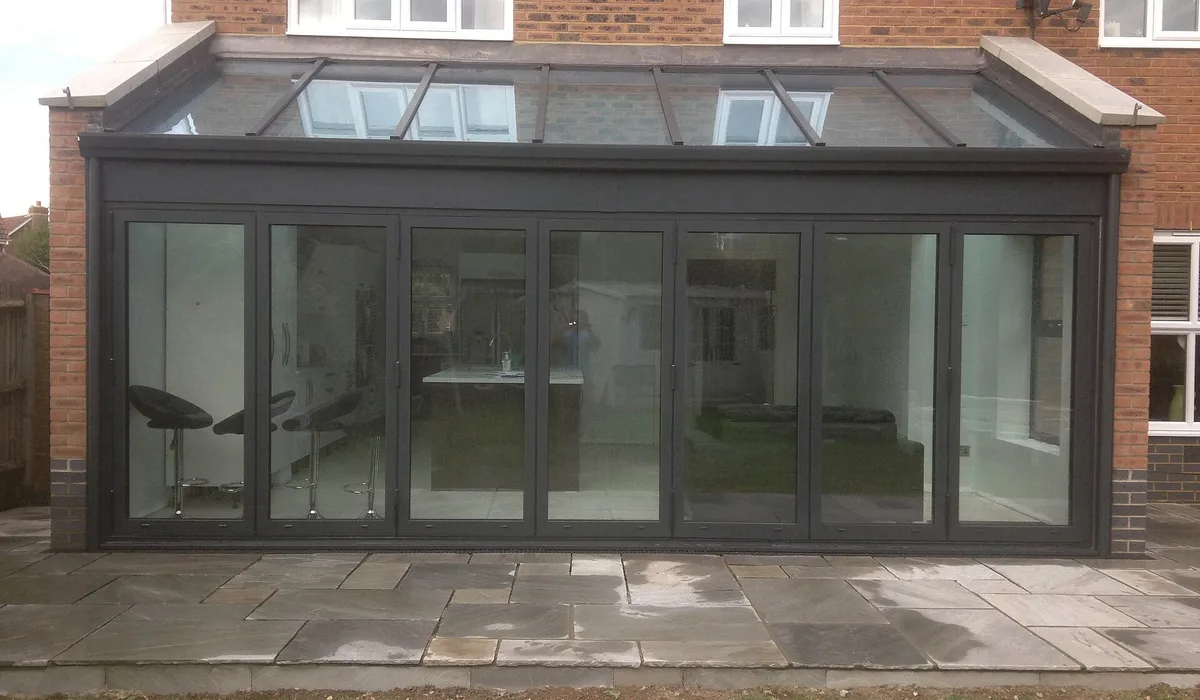
Featured photo of a glazed conservatory in Peterborough by Posh Homes via Wikimedia Commons, licence CC BY SA 4.0, cropped.