Housing disrepair claims Liverpool tenants bring are legal claims against a landlord who has been told about a problem in a rented home, such as damp, mould, leaks, broken heating or unsafe wiring, and has failed to fix it within a reasonable time. A successful housing disrepair claim can force the repairs to be done and pay compensation for the time you lived with the problem.
This guide to housing disrepair claims Liverpool tenants and landlords deal with is written as a roadmap rather than a sales page. It walks through the seven stages of the official court protocol in order, explains what evidence carries weight at each stage, sets out what compensation usually looks like, and covers the Liverpool details that most national guides miss. It is general information for tenants and landlords in Liverpool and Merseyside, not legal advice.
In this guide
- What counts as a housing disrepair claim
- A quick eligibility check
- The seven step roadmap
- Evidence that wins claims
- What compensation looks like
- Time limits
- Social housing and Awaabs Law
- Private renters in Liverpool
- Choosing help and spotting red flags
- What the disrepair surveyor does
- Advice for landlords
- FAQs
What Counts as a Housing Disrepair Claim
Most housing disrepair claims Liverpool courts hear rest on two pieces of law. Section 11 of the Landlord and Tenant Act 1985 makes landlords of most tenancies under seven years responsible for keeping in repair the structure and exterior of the home, and the installations for water, gas, electricity, sanitation, heating and hot water. The Homes Fitness for Human Habitation Act 2018 added a duty to make sure the home is fit to live in at the start of the tenancy and throughout it.
Common problems behind a housing disrepair claim include the following.
- Penetrating damp from leaking roofs, gutters, walls or windows.
- Rising damp and the mould growth that follows it.
- Broken boilers and no heating or hot water for long periods.
- Leaking pipes, toilets and waste pipes.
- Unsafe electrics and faulty wiring.
- Rotten windows and doors that let in water or cannot be secured.
- Structural cracks, collapsing ceilings and failing plaster.
Two points matter more than anything else. First, the landlord must know about the problem, which usually means you reported it. Second, the landlord must have failed to repair it within a reasonable time. Cosmetic issues, damage you caused and improvements you would like are not disrepair.
A Quick Eligibility Check
Before you start, run through these questions. Most successful housing disrepair claims Liverpool solicitors take on tick almost every box, and if you can answer yes to most of them, your housing disrepair claim is likely to be worth pursuing.
- Do you rent from a private landlord, the council or a housing association?
- Is the problem caused by disrepair rather than by your own use of the home?
- Did you report it to the landlord or agent, ideally in writing?
- Has the landlord had a reasonable time to repair it and failed to do so?
- Has the problem affected your health, your belongings or your use of the home?
- Did the problem start or continue within the last six years?
Shelter confirms that council, housing association and private tenants can all claim, and that you can take action during the tenancy or after it ends, as long as you are within the time limits explained below.
Housing Disrepair Claims Liverpool Roadmap in Seven Steps
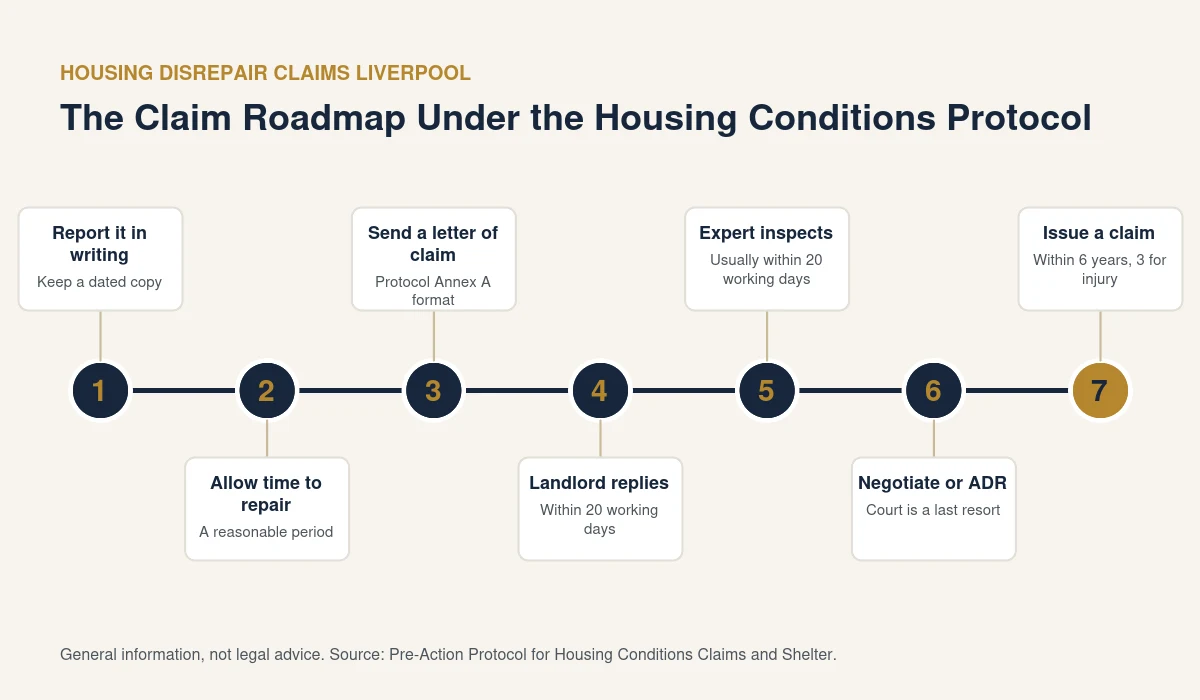
Most housing disrepair claims Liverpool tenants bring follow the Pre Action Protocol for Housing Conditions Claims in England. The protocol sets out what both sides should do before anyone goes to court, and judges expect it to be followed. The timeline below shows the full journey.
Step 1. Report the Problem in Writing
Tell your landlord or letting agent about every problem, in writing, and keep a copy. An email or a message through the landlord repair portal is fine. Describe each problem, where it is, when it started and how it affects you. If you report something by phone, follow it up with an email the same day.
Step 2. Allow a Reasonable Time to Repair
The law does not set a single deadline for private landlords. What is reasonable depends on the problem. No heating in winter or a serious leak needs action within days, while a cracked window pane may reasonably take a few weeks. Keep a diary of every visit, missed appointment and failed repair.
Step 3. Send a Letter of Claim
If repairs are not done, the next stage in housing disrepair claims Liverpool tenants pursue is a formal letter of claim. The protocol includes a specimen letter in Annex A. It lists the defects, the history of complaints, the effect on you and any losses, and it can propose a single joint expert to inspect.
Step 4. The Landlord Responds Within 20 Working Days
The landlord should reply within 20 working days of receiving the letter of claim. The reply should name a contact, disclose relevant documents such as repair records, respond to the expert proposal, and say whether liability is accepted and what repairs will be done.
Step 5. An Expert Surveyor Inspects
The protocol says the property should usually be inspected within 20 working days of the landlord receiving the letter of claim, or sooner where there is a serious health and safety risk. The expert is often a single joint expert instructed by both sides, which keeps costs down and avoids competing reports.
Step 6. Negotiate or Use ADR
Court should be a last resort. Many housing disrepair claims Liverpool tenants bring settle at this stage with an agreed schedule of repairs and a compensation payment. Mediation, the landlord complaints procedure, the Housing Ombudsman for social tenants and council environmental health are all alternatives a court may expect you to have considered.
Step 7. Issue a Court Claim
If the landlord does not respond or the dispute cannot be resolved, you can issue proceedings. Smaller claims go to the small claims track, while larger or more complex claims go to the fast track or multi track, where you will almost certainly want a solicitor.
Evidence That Wins Housing Disrepair Claims
Strong evidence is what separates a quick settlement from a long argument in any housing disrepair claim. The table below shows what to collect and why it matters.
| Evidence | Why it matters | How to collect it |
|---|---|---|
| Written reports to the landlord | Proves the landlord knew about the disrepair and when | Keep emails, letters, portal messages and texts |
| Dated photographs and video | Shows the extent of the problem and how it changed over time | Photograph the same spots every few weeks |
| A disrepair diary | Records missed appointments, failed repairs and daily impact | Write a short entry whenever something happens |
| Medical evidence | Links health problems such as asthma or chest infections to the conditions | Ask your GP for notes or letters |
| Receipts and bills | Supports claims for damaged belongings and extra heating costs | Keep receipts, energy bills and photos of damaged items |
| Independent survey report | Confirms the cause, the defects and the repairs needed | Instruct a surveyor experienced in disrepair work |
Shelter advises keeping copies of every letter and email with your landlord, receipts for financial losses, sick notes or hospital reports, and proof of belongings you had to throw away because of damp.
What Compensation Looks Like in a Housing Disrepair Claim
In housing disrepair claims Liverpool county courts decide, compensation usually has two parts.
- General damages for discomfort, inconvenience and loss of enjoyment of the home. Courts often calculate these as a percentage of the rent for the period of disrepair, and specialist housing solicitors Anthony Gold note that awards around 25 to 50 per cent of the rent are much more usual than higher figures.
- Special damages for specific losses, such as damaged carpets, furniture, clothing and extra energy costs. These are valued on the remaining life of the item, not the cost of a new one.
As a worked example, a tenant paying 600 pounds a month who lived with serious disrepair for four years paid 28,800 pounds in rent over that period. An award at 25 per cent of that rent would be 7,200 pounds in general damages, before any special damages.
The court can also order the landlord to carry out the repairs. Shelter explains that the small claims track covers repair orders where both the repair work and the compensation are each under 1,000 pounds, and compensation only claims up to 10,000 pounds. Personal injury, such as illness caused by mould, is assessed separately and normally needs medical evidence.
Time Limits for a Housing Disrepair Claim
According to Shelter guidance on time limits, you generally have up to six years to bring a housing disrepair claim, or three years where you are claiming for personal injury. The clock starts from when the landlord should have carried out the work.
If you are a social housing tenant using the Housing Ombudsman, there is a separate rule. You usually need to bring the complaint within a year of the final response from your landlord.
Do not leave it late. Older housing disrepair claims Liverpool courts see are often the hardest to prove, because evidence fades, contractors move on and memories become less reliable.
Social Housing Tenants and Awaabs Law
Awaabs Law came into force for social housing in England on 27 October 2025. It sets legal deadlines for councils and housing associations to deal with hazards. Emergency hazards must be dealt with within 24 hours. For significant damp and mould hazards, landlords must investigate and then start repairs within set timescales, with Shelter noting a deadline of five working days after investigations finish.
For council and housing association tenants in Liverpool and across Merseyside, a missed Awaabs Law deadline is strong evidence in a housing disrepair claim. Keep a careful record of when you reported the problem and when the landlord visited.
The Renters Rights Act will extend Awaabs Law and a Decent Homes Standard to private rented homes, but the dates for those parts had not been confirmed at the time of writing.
Private Renters in Liverpool
Private tenants make up a large share of housing disrepair claims Liverpool solicitors handle, especially in older terraced streets. A few local points are worth knowing.
- Landlord licensing. Liverpool City Council runs a selective licensing scheme covering most privately rented homes in 16 wards, and it is due to end in March 2027. The council consulted on options for a new scheme from 27 July to 5 October 2026, including a city wide option. Licence conditions cover issues such as fire and electrical safety, excess cold and damp.
- Council enforcement. The council private sector housing team can inspect a home under the Housing Health and Safety Rating System and serve notices on landlords. Their findings can support your housing disrepair claim.
- Protection from eviction. Section 21 no fault evictions were abolished from 1 May 2026 under the Renters Rights Act, which reduces the risk of revenge eviction for tenants who complain.
Older Liverpool housing stock adds its own problems. Solid walled Victorian terraces, hard cement pointing and blocked air bricks often lead to damp and mould, which our guide to rising damp in a house explains in more detail.
Choosing Help and Spotting Red Flags
You can run a small housing disrepair claim yourself, but larger claims usually need a solicitor. Legal aid may be available where the disrepair poses a serious risk of harm to your health or safety. Many firms also offer no win no fee agreements, where their fee comes out of your compensation if you win.
Liverpool has a busy market for housing disrepair claims, and not every firm behaves well. Watch for these red flags.
- Cold calls, door knocking or text messages offering quick cash for a claim.
- Pressure to sign on the spot before you understand the agreement.
- Upfront fees, or vague answers about what share of your compensation they will keep.
- Advice to stop paying rent, which can put your home at risk.
- Exaggerating the problems or asking you to sign something untrue.
A reputable solicitor will explain the costs in writing, check whether you qualify for legal aid, and tell you honestly if your housing disrepair claim is weak.
What the Disrepair Surveyor Does
In most housing disrepair claims Liverpool tenants and landlords settle, the expert report is the turning point. A surveyor acting as an expert has a duty to the court under Part 35 of the Civil Procedure Rules, which means the report must be independent and must not take sides.
A good disrepair surveyor will do the following.
- Inspect every room and the outside of the building, not just the areas listed in the claim.
- Take moisture readings and thermal images to separate condensation from penetrating or rising damp.
- Identify the cause of each defect and whether it falls within the landlord repairing duties.
- Prepare a schedule of defects and repairs, often in a Scott Schedule format the court can follow.
- Estimate the cost and time needed for the remedial works.
This matters because many disputes are really about cause. A landlord may say mould is lifestyle condensation, while a tenant says it is penetrating damp. An impartial survey settles that question with evidence. Our guide to what a housing disrepair survey is explains the process step by step.
Advice for Landlords Receiving a Letter of Claim
Landlords and agents in Liverpool receive a steady flow of letters of claim. Handling them properly keeps costs down.
- Diary the deadline. Reply within 20 working days, as the protocol requires.
- Gather your records. Repair logs, contractor invoices, inspection reports and tenant communications all need to be disclosed.
- Inspect quickly. Agree a single joint expert where possible, or arrange a joint inspection.
- Repair what is genuinely in disrepair. Prompt works reduce the period on which compensation is calculated.
- Never retaliate. Threats or attempts to remove a tenant who has complained can lead to penalties and weaken your position.
Planned maintenance is the best defence. Our guide to preventing housing disrepair sets out how landlords can stop problems before they become claims.
Housing Disrepair Claims Liverpool FAQs
How long do housing disrepair claims take?
Simple housing disrepair claims Liverpool landlords settle after the expert inspection can finish within a few months. Claims that go to court, involve personal injury or are defended can take a year or longer.
Can I claim if I have already moved out?
Yes. You can bring a housing disrepair claim after the tenancy ends, as long as you are within the time limit, which is generally six years, or three years for personal injury.
Will making a claim affect my tenancy?
It should not. Section 21 no fault evictions were abolished in England from 1 May 2026, and landlords who retaliate against tenants for complaining risk serious consequences.
Do I have to pay for the survey?
It depends on how the claim is funded. With a single joint expert the cost is often shared or recovered from the landlord if the claim succeeds. Your solicitor should explain this before the survey is booked.
Can I stop paying rent until repairs are done?
No. Withholding rent can lead to arrears and possession proceedings. Keep paying rent and use the protocol process instead.
Housing Disrepair Surveys in Liverpool
ASG Consulting is regulated by RICS. If you are preparing or defending housing disrepair claims Liverpool wide, our surveyors carry out impartial housing disrepair inspections across Liverpool and Merseyside for tenants, landlords, solicitors and housing providers, with clear reports that follow the court protocol. To arrange an inspection, visit our housing disrepair surveys page, or read our wider guide to housing disrepair in Liverpool.
About the Author
Harry is a property content writer with 3 years of experience writing about building surveying, commercial property and property compliance in the UK. He writes the guides at ASG Consulting for buyers, tenants and landlords, turning survey practice into clear, practical advice.
Reviewed by Dave MacMillan MRICS, chartered surveyor at ASG Consulting. Dave checks the technical content of our guides against current RICS practice before they are published.