A coal mining report shows whether a property is affected by past, present or planned coal mining, including mine shafts within 20 metres, gas emissions and subsidence claims. If you are buying a house in a former coalfield, such as parts of St Helens, Wigan or Knowsley, your solicitor will usually order one. It is a desk search, not a physical survey.
Much of the North West sits on the old Lancashire coalfield, and centuries of mining left shafts, shallow workings and spoil heaps under towns and suburbs. Most homes on former coalfields are perfectly safe, but buyers still need to know what lies underneath. This guide answers the questions buyers ask most about a coal mining report when buying a house, explains how to read the results, and shows how the report fits alongside your building survey in Merseyside and the wider North West.
In this guide
- What is a coal mining report?
- Who provides coal mining reports?
- Do you need a coal mining report when buying a house?
- How do you check if a property is affected?
- What does a coal mining report include?
- How do you read the results?
- What is a mine entry?
- Does a building survey check for mining?
- What are the signs of mining subsidence?
- What if there has been a subsidence claim?
- Will mining affect your mortgage or insurance?
- What if you plan to extend?
- What other ground searches should you consider?
- What should you ask the seller?
- Coal mining in Merseyside and the North West
- FAQs
What Is a Coal Mining Report?
A coal mining report, sometimes called a coal mining search or CON29M report, is a property search that tells you whether a home may be affected by coal mining. It draws on official records of past mine workings, mine entries, subsidence claims and future mining plans.
It is a desk based search of records. No one visits the property, and it does not tell you about the condition of the house itself. That is why it sits alongside your building survey, rather than replacing it.
Who Provides Coal Mining Reports?
Coal mining reports in England, Scotland and Wales come from the Mining Remediation Authority, which was known as the Coal Authority until it was renamed on 28 November 2024. The GOV.UK announcement on the Coal Authority becoming the Mining Remediation Authority explains that its statutory responsibilities, including public safety and subsidence, did not change with the new name.
Reports are usually ordered by your solicitor or conveyancer as part of the searches, although you can also order one yourself.
Do You Need a Coal Mining Report When Buying a House?
You need one if the property is in a coal mining reporting area. Conveyancers routinely check this at the start of a purchase, and lenders usually expect the search where it applies.
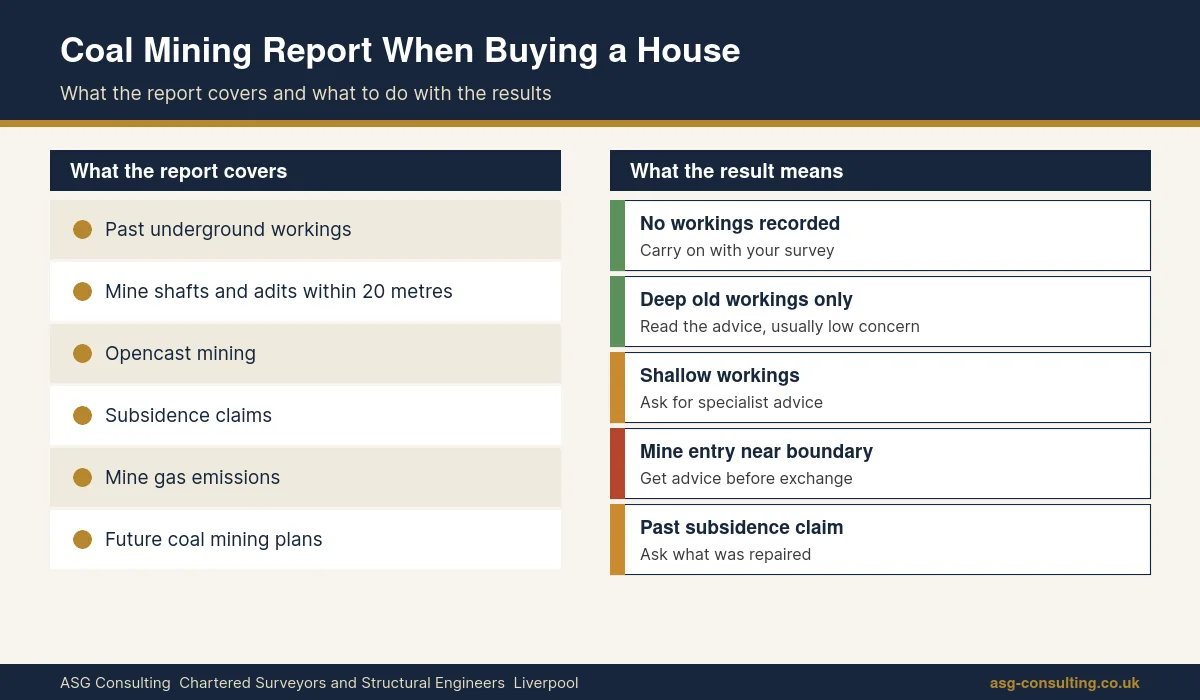
Use these quick checks.
- Is the property in a former coalfield? If yes, a coal mining report is usually needed.
- Is the property near a known pit, spoil heap or old colliery site? Ask your solicitor to check carefully.
- Has the seller mentioned subsidence or mining? Make sure the search is done and any claims are explained.
- Are you outside a coalfield? A coal mining report may not be needed, but your solicitor will confirm this.
Even if you are outside a coalfield, other ground issues, such as clay soils, trees and old quarries, can still affect a house. Our guide to subsidence surveys explains these wider risks.
How Do You Check if a Property Is Affected?
GOV.UK explains how to find out if a property is affected by coal mining. You can use the Mining Remediation Authority online search service with the postcode and property boundaries, and the results show straight away whether a mining report is needed. If you do not know the postcode, you can use the interactive map to check a wider area.
This free check is a useful first step before you make an offer, especially if you are looking at homes in areas with a mining history. It takes only a few minutes and can save you time later.
What Does a Coal Mining Report Include?
According to GOV.UK, a coal mining report covers
- mine entries, such as shafts and adits, within 20 metres of the property boundaries
- gas emissions from mine workings
- other reported hazards
- future plans for coal mining
Reports also typically cover past underground and opencast workings, subsidence claims and any notices affecting the property. Some enhanced reports include wider ground risks at an extra cost.
| Item | What it tells you |
|---|---|
| Past underground workings | Whether coal was mined beneath or near the property, and roughly how deep |
| Mine entries | Whether any shafts or adits are recorded near the boundary |
| Opencast mining | Whether the land was mined from the surface and later filled |
| Subsidence claims | Whether any damage claims have been made for the property |
| Mine gas | Whether any gas emissions have been reported nearby |
| Future mining | Whether any coal mining is planned in the area |
How Do You Read the Results?
Most reports start with a summary. Use this simple guide to what the results usually mean.
| Result | Usual meaning | What to do |
|---|---|---|
| No past workings or entries recorded | Low concern from coal mining | Carry on, with your normal building survey |
| Deep past workings, no recent activity | Movement from old deep workings has usually stopped | Read the advice in the report and ask your solicitor to confirm |
| Shallow workings recorded | Possible risk of ground movement | Ask your solicitor and surveyor, and consider specialist advice |
| Mine entry within 20 metres | A shaft or adit may be close to the home | Get specialist advice before exchange, especially if you plan to extend |
| Past subsidence claim | The property was affected and may have been repaired | Ask for details of the claim and repairs |
| Gas emissions reported | Possible mine gas nearby | Get specialist advice |
Your solicitor should explain the results and raise any questions with the seller. If the report recommends further investigation, follow it up before you exchange contracts.
What Is a Mine Entry?
A mine entry is a way into a mine, usually a vertical shaft or a sloping tunnel called an adit. Many old shafts were filled or capped decades ago, sometimes poorly, and some were never properly recorded.
A recorded mine entry close to a house does not automatically mean a problem, but it does need to be understood. Old shafts can occasionally collapse, and building close to them needs care. If a mine entry is recorded within or near the boundary, ask for specialist advice on its condition and whether any treatment has been carried out. The Mining Remediation Authority runs a 24 hour hazard line on 0800 288 4242 for reporting hazards such as sudden holes or collapses.
Does a Building Survey Check for Mining?
A building survey does not search mining records, but it does look closely at the house for signs of movement that could be linked to mining or other ground problems. The two work together.
| Check | What it covers |
|---|---|
| Coal mining report | Records of mining, mine entries, claims and gas near the property |
| RICS building survey | The physical condition of the house, including cracking, distortion and past repairs |
| Structural engineer | Detailed investigation and repair design where movement is found |
For a conventional house in good condition, a RICS Level 2 HomeBuyer Survey is usually enough, and our RICS HomeBuyer Survey in Liverpool page explains what it covers. For older homes or homes with signs of movement, a Level 3 Building Survey gives more detail, as explained on our residential building surveying page.
What Are the Signs of Mining Subsidence?
Mining subsidence can look similar to other types of movement. Signs a surveyor looks for include
- cracks in walls, especially diagonal cracks around doors and windows
- doors and windows that stick or no longer close
- sloping or uneven floors
- walls that lean or bulge
- cracking in paths, drives and garden walls
- gaps between walls and ceilings or skirting boards
- evidence of past repairs, such as patched cracks or new render
These signs do not prove mining is the cause. Clay soils, trees, leaking drains and poor foundations can all cause similar damage. Our guides to cracks in walls, sloping floors and bowing walls explain how movement is investigated.
What If There Has Been a Subsidence Claim?
A past coal mining subsidence claim tells you the property was affected at some point. It does not necessarily mean there is a problem now. Ask
- when the claim was made and what damage was reported
- what repairs were carried out, and by whom
- whether the claim was settled and closed
- whether any further movement has been noticed since
GOV.UK explains that you may be able to make a claim for subsidence damage caused by coal mining. If you buy a home and later suspect mining damage, contact the Mining Remediation Authority. Where movement is suspected, our structural engineering team can investigate the cause and advise on repairs.
Will Mining Affect Your Mortgage or Insurance?
For most homes on former coalfields, a clear or routine coal mining report causes no problems with lenders or insurers. Issues are more likely where
- a mine entry is recorded within or very close to the boundary
- shallow workings are recorded beneath the property
- there is an open subsidence claim or recent damage
- the valuer or surveyor has seen signs of significant movement
In these cases, a lender may ask for further reports before lending. Our guide to a structural engineer report for a mortgage explains what lenders usually want to see.
What If You Plan to Extend?
If you plan an extension, garage or major groundworks, mining records matter even more. New foundations near a recorded mine entry or shallow workings may need specialist investigation and design, and the Mining Remediation Authority may need to give permission before work affects coal mining features.
Raise this early, before you exchange contracts, if extending is part of your plan. Our guides to underpinning and steel beam calculations cover other structural work you may need to plan for.
What Other Ground Searches Should You Consider?
A coal mining report only covers coal. Depending on where you are buying, your solicitor may recommend other searches too.
- Environmental search. Covers contaminated land, flood risk, ground stability and nearby land uses.
- Brine subsidence search. In parts of Cheshire, historic salt and brine extraction can affect the ground, and a separate brine search may be needed.
- Other mining searches. Some areas have a history of mining for minerals other than coal, which a standard coal report will not cover.
- Drainage and water search. Shows public sewers and connections, which matter if you plan to extend.
Ask your solicitor which searches suit the property. A coal mining report when buying a house is one piece of the picture, and your building survey checks how the house itself has performed.
What Should You Ask the Seller?
Ask these questions early and share the answers with your solicitor and surveyor.
- Has the property ever been affected by subsidence or ground movement?
- Has a coal mining subsidence claim ever been made, and what repairs were done?
- Are there any old shafts, capped areas or unusual hollows in the garden?
- Have any cracks been repaired, and are they being monitored?
- Has a structural engineer ever inspected the property?
- Was the house built on land that was previously used for mining or spoil?
Honest answers, together with the coal mining report and a building survey, give you a clear view of the ground and the house before you commit.
Coal Mining in Merseyside and the North West
The North West has a long coal mining history. The former Lancashire coalfield runs beneath towns such as St Helens, Haydock, Wigan and Leigh, and parts of Knowsley. Collieries operated in these areas for well over a century. For example, the National Mining Records Society records that Ravenhead Colliery in St Helens worked from 1866 until its reserves were exhausted in 1968.
Most of central Liverpool and much of the Wirral lie outside the main coalfield, but you should never assume. Older workings can be found in unexpected places, and only the official search will confirm whether a coal mining report is needed for a particular address.
Common points found on surveys of homes in former mining areas include
- historic cracking and distortion that has been repaired and is now stable
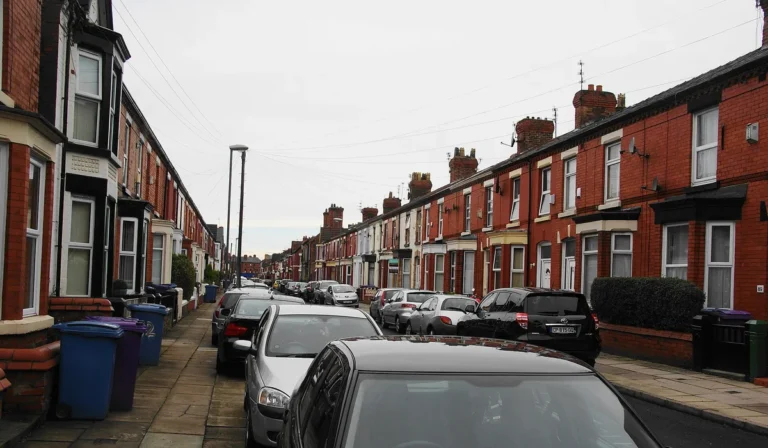
- terraced houses with slightly out of level floors and openings
- garden walls and paths showing old movement
- homes built on former colliery or spoil heap land
- extensions where the junction with the original house has moved
Historic movement is common and often stable. The key is to understand whether movement is old or ongoing, which is where a good survey helps. A surveyor will look at the pattern, age and width of any cracks, whether repairs have held, and whether doors and windows still work properly, and will recommend a structural engineer if the evidence suggests movement is continuing.
Coal Mining Report FAQs
What is a coal mining report?
It is a property search that shows whether a home may be affected by coal mining, including past workings, mine entries within 20 metres, gas emissions, claims and future mining plans.
Do I need a coal mining report when buying a house?
You need one if the property is in a coal mining reporting area. Your solicitor will usually check this and order the report where needed.
Who provides coal mining reports?
The Mining Remediation Authority, which was called the Coal Authority until November 2024, provides coal mining reports in England, Scotland and Wales.
Does a coal mining report check the house itself?
No. It is a records search. A building survey checks the condition of the house, including signs of movement.
Is it safe to buy a house on a former coalfield?
Most homes on former coalfields are safe and mortgageable. Read the report carefully and get advice if it shows shallow workings, nearby mine entries or claims.
Are St Helens and Wigan in a coal mining area?
Yes, both sit on the former Lancashire coalfield, so a coal mining report is often needed. Check each address with the official search.
Book a Survey With ASG Consulting
ASG Consulting is an RICS regulated building surveying practice in Liverpool. We carry out RICS Level 2 HomeBuyer Surveys, Level 3 Building Surveys and structural inspections across Liverpool, Merseyside, St Helens, Warrington and the wider North West, with reports usually delivered within 3 to 5 working days of the inspection. We give a fixed fee on request, usually confirmed within one working day. To request a quote, call 0151 315 0626 or visit our contact page.
About the Author
Dave MacMillan is the lead surveyor at ASG Consulting, an RICS regulated building surveying practice at 54 St James Street, Liverpool. He has 8 years of experience in building surveying and inspects homes for buyers across Liverpool, Merseyside and the North West.
Last updated 17 November 2026
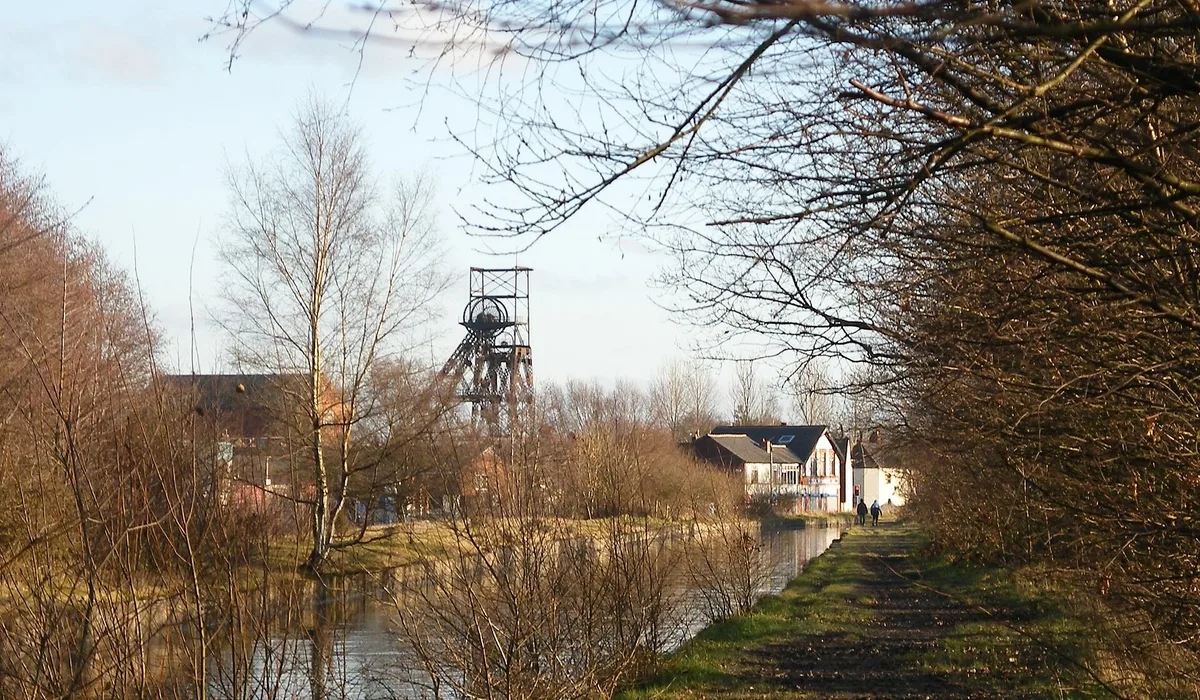
Featured photo of the Bridgewater Canal and Astley Green Colliery pithead by J3Mrs via Wikimedia Commons, licence CC BY SA 3.0, cropped.