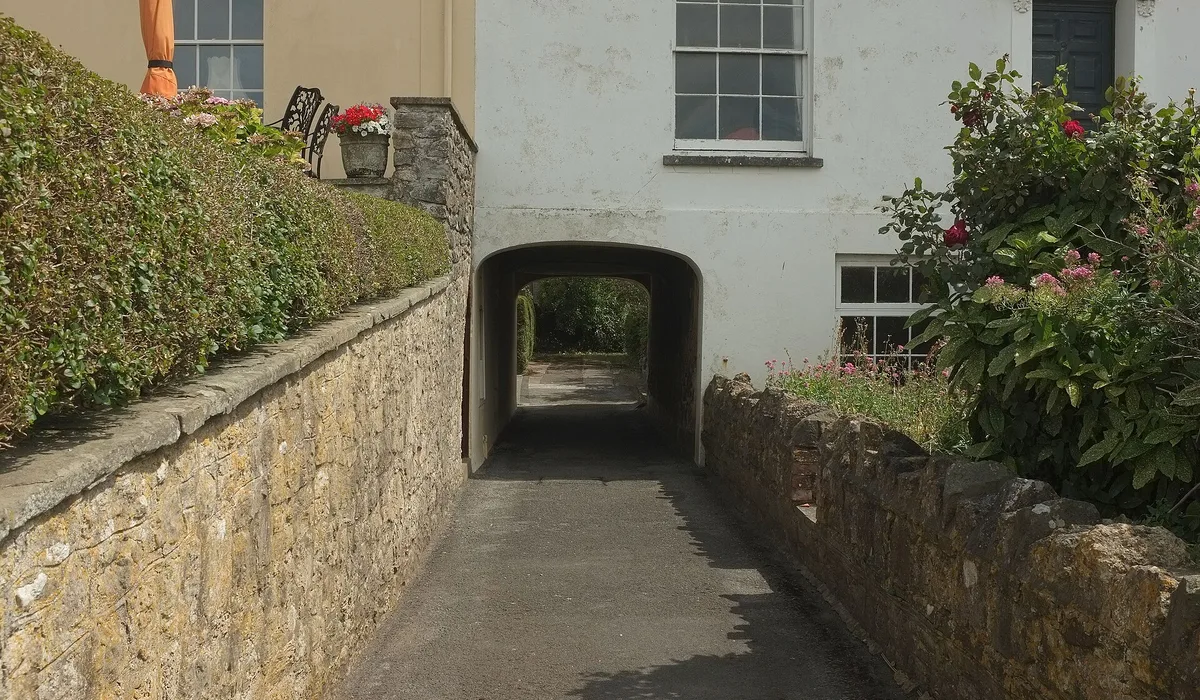
A flying freehold is part of a freehold house that sits above or below land owned by someone else, such as a bedroom over a passageway owned by a neighbour. It matters because you may depend on your neighbour to support and repair the structure below. Many lenders accept a flying freehold, but often with limits and legal safeguards.
Flying freeholds are more common than many buyers expect, especially in older terraced streets. They often go unnoticed until a solicitor spots them on the title plan or a lender asks questions late in the process. This guide explains in plain English what a flying freehold is, why it can cause problems, how lenders treat it and what you can do to protect yourself before you buy.
In this guide
- What is a flying freehold?
- What is a creeping freehold?
- Where are flying freeholds found?
- Why can a flying freehold be a problem?
- Will a lender give you a mortgage?
- How do you spot a flying freehold?
- What does a survey look at?
- What legal checks should your solicitor make?
- How can the risks be reduced?
- Does indemnity insurance help?
- Will a flying freehold affect a future sale?
- How is a flying freehold different from leasehold?
- What should you ask before you buy?
- What mistakes do buyers make?
- Should you still buy the house?
- Flying freeholds in Liverpool
- FAQs
What Is a Flying Freehold?
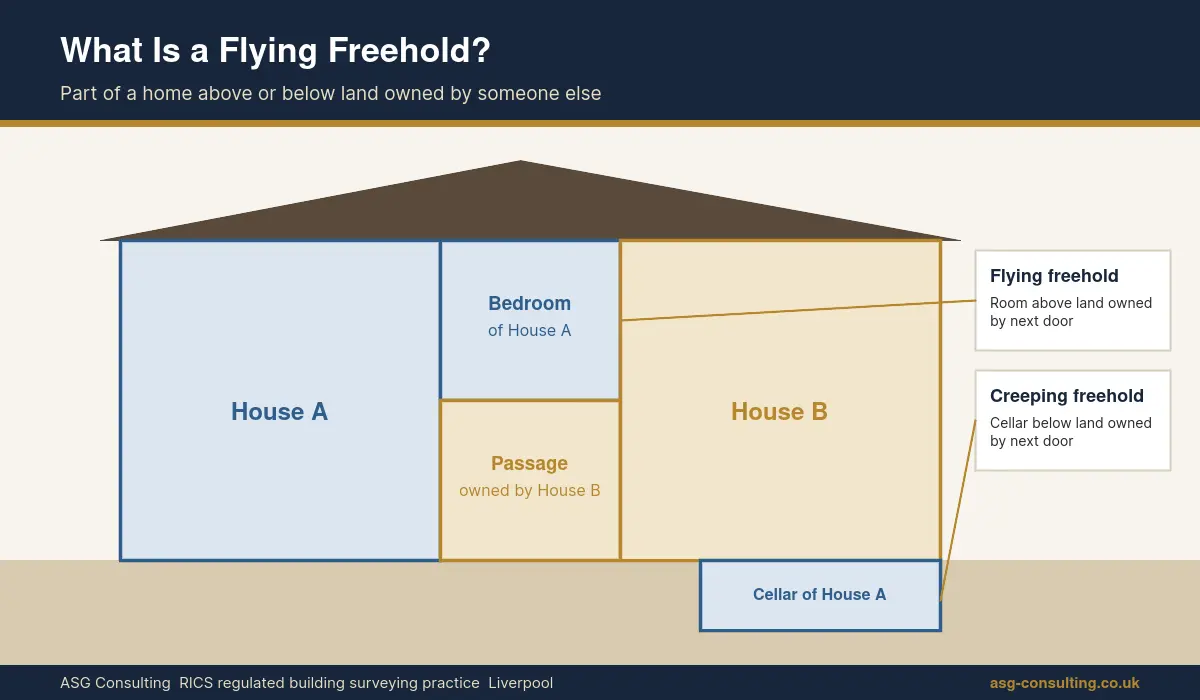
A flying freehold is where part of a freehold property overhangs or sits above land or a building that belongs to someone else. The classic example is a terraced house with a bedroom built over a shared passageway or over part of the house next door.
You own that room outright as part of your freehold, but the ground and structure beneath it belong to your neighbour. In other words, part of your home is effectively flying above land you do not own.
What Is a Creeping Freehold?
A creeping freehold is the opposite situation. Part of your property, such as a cellar or basement, extends under a neighbouring property. Lenders and solicitors often deal with flying and creeping freeholds together, because both mean that two owners depend on each other for support, repairs and access.
| Type | What it means | Common example |
|---|---|---|
| Flying freehold | Part of your home sits above land owned by someone else | A bedroom over a shared passageway |
| Creeping freehold | Part of your home sits below land owned by someone else | A cellar extending under the house next door |
| Irregular boundary | The dividing line between houses is not straight | A first floor room that steps over a party wall |
Where Are Flying Freeholds Found?
Law firm Trowers and Hamlins explains in its article on flying freeholds that they mainly arise in historic buildings that were later split into separate ownership. Common examples include
- a room over a shared passageway between terraced houses
- terraces where the dividing line between houses is not straight
- a cellar or basement extending under a neighbouring property
- balconies that overhang adjoining land
- older houses split into separate freehold parts
Modern developments usually include proper rights and obligations between owners from the start, so flying freeholds tend to cause more problems in older property.
Why Can a Flying Freehold Be a Problem?
The main concern is dependency. If the structure under your room belongs to your neighbour and they do not maintain it, your room could be affected.
The legal issue is that a promise to carry out repairs, known as a positive covenant, does not automatically bind future owners of the neighbouring property. Trowers and Hamlins notes that without an obligation on the neighbour and a right of access to fix problems, an owner may be in a difficult position if something goes wrong.
In practice, the risks include
- a neighbour failing to repair the passage walls, roof or structure that support your room
- no clear right to enter the neighbouring land to carry out repairs yourself
- disputes about who pays for shared repairs
- damp, movement or cracking spreading from a poorly maintained neighbouring structure
- delays or problems getting a mortgage
Will a Lender Give You a Mortgage?
Often yes, but lenders take different approaches. The UK Finance Mortgage Lenders Handbook includes a question for conveyancers asking whether each lender will lend on flying freeholds, and the answers vary widely.
| Lender approach | What it means for you |
|---|---|
| Will not lend | You will need a different lender |
| Accepts up to a set share of the property | Limits listed by lenders commonly range from 10 to 25 percent of the floor area |
| Accepts if only part of the title is affected | Often subject to rights of support and repair |
| Accepts with conditions | May need enforceable covenants, rights of access or indemnity insurance |
| Needs referral | The lender decides case by case |
Because policies differ and change over time, tell your mortgage broker early if you know or suspect there is a flying freehold. Your solicitor will check the specific lender requirements during conveyancing.
How Do You Spot a Flying Freehold?
You can often spot the signs on a viewing. Look for
- A passageway under the house. A covered alley or tunnel between houses, with rooms above it.
- A room that seems too big. A bedroom that extends further than the ground floor below it.
- Odd internal layouts. Steps, sloping floors or bulkheads where rooms cross over space belonging to next door.
- A cellar that runs beyond the front or side wall. This could suggest a creeping freehold.
- Split or converted buildings. Older houses divided into separate freehold parts.
The title plan from HM Land Registry may also show the boundaries, but plans do not always show upper floors clearly. Your solicitor should confirm the position.
It also helps to walk around the outside of the terrace. Look at where the passage runs, which doors open into it and whether the rooms above line up with the house you are buying. Photographs of the passage, the ceiling above it and the rear of the houses are useful to share with your solicitor and surveyor. If the passage is gated or locked, ask who holds the keys and who uses it, as this can point to shared rights that need checking.
What Does a Survey Look At?
A surveyor does not check the legal title, but a survey can help in two ways. First, the surveyor may notice a layout that suggests a flying freehold and flag it for your solicitor. Second, the survey looks at the condition of the parts of the structure that can be seen, including the passage walls, ceilings, roof and any signs of damp or movement.
Where the structure under your room is in poor condition, that is important evidence when your solicitor discusses rights of repair and support. A RICS Level 2 HomeBuyer Survey suits many conventional houses, and our RICS HomeBuyer Survey in Liverpool page explains what it covers. For older or altered houses, a Level 3 Building Survey gives more detail, as described on our residential building surveying page.
What Legal Checks Should Your Solicitor Make?
Your solicitor should check
- the title plan and register for the extent of the flying or creeping freehold
- whether you have a right of support from the structure beneath
- whether you have a right of access to carry out repairs
- whether there are covenants about maintenance and who pays
- whether those obligations bind future owners of the neighbouring property
- what the lender requires and whether those requirements are met
The Law Society explains the differences between freehold, leasehold and commonhold, which helps with understanding how ownership and obligations work.
How Can the Risks Be Reduced?
There are several ways to reduce the risks of a flying freehold. Which one is suitable depends on the property, the neighbours and the lender.
| Option | How it helps |
|---|---|
| Deed of mutual covenant | Neighbours agree to maintain and repair, with a chain of covenants passing obligations to future owners |
| Rights of access | Gives you the right to enter the neighbouring land to carry out repairs |
| Rights of support | Confirms the structure beneath must continue to support your room |
| Indemnity insurance | Covers certain financial losses if the neighbour fails to support or repair |
| Choosing a different lender | Some lenders accept flying freeholds more readily than others |
Good relations with neighbours also help. Many flying freeholds cause no problems for decades because neighbours cooperate on repairs. Our guide to a party wall surveyor explains how shared walls are handled when building work is planned.
Does Indemnity Insurance Help?
Indemnity insurance is often available on reasonable terms and is frequently required by lenders, according to Trowers and Hamlins. It can cover certain losses if the neighbour fails to support or repair the structure under your room.
However, indemnity insurance does not fix the physical problem or give you rights you do not have. It is a financial safeguard, so read what it covers carefully and ask your solicitor to explain the limits.
Will a Flying Freehold Affect a Future Sale?
It can. Future buyers and their lenders will ask the same questions you are asking now. A flying freehold that is small, well documented and in good condition is much easier to sell than one with unclear rights and a neglected structure beneath.
Keep copies of any deeds, covenants, indemnity policies and repair records. Our guide to a survey before selling a house explains how sellers can prepare for questions from buyers.
How Is a Flying Freehold Different From Leasehold?
With a leasehold flat, the lease usually sets out who repairs the structure, how costs are shared and who can enter which parts of the building. Those obligations are built into the lease and pass to each new owner.
A flying freehold is different. You own the room outright, but there may be no single document setting out repairs, access and costs between you and your neighbour. That is why the legal checks matter so much. Where the rights are clear and well drafted, a flying freehold can work just as well as a leasehold arrangement. Where they are missing, the owner can be left relying on goodwill.
This is one reason why flats in converted houses are usually sold on long leases, so that repair obligations can be properly set out. Our guide to a survey for buying a flat explains how leasehold repair obligations affect buyers.
What Should You Ask Before You Buy?
Ask the seller, the estate agent and your solicitor these questions.
- Is any part of the house above or below land owned by someone else?
- How large is that part compared with the whole house?
- Who owns and maintains the passage, cellar or structure beneath?
- Are there any written agreements about repairs, support or access?
- Have there been any disputes or problems with the neighbours?
- Has any repair work been carried out to the shared structure, and who paid?
- Is there an existing indemnity policy, and can it pass to you?
Share the answers with your surveyor too, so the inspection can focus on the parts of the structure that matter most.
What Mistakes Do Buyers Make With Flying Freeholds?
Most problems come from finding out too late. Common mistakes include
- Not telling the mortgage broker early. If your chosen lender will not accept the flying freehold, switching lenders late can delay the purchase.
- Assuming the title plan shows everything. Plans do not always show upper floors or cellars clearly.
- Ignoring the condition of the passage. Damp, cracked or neglected passage walls and ceilings can affect the room above.
- Relying only on insurance. Indemnity insurance helps financially but does not repair the structure.
- Not keeping records. Missing paperwork can make a future sale harder.
Should You Still Buy the House?
In many cases, yes. Flying freeholds are a known issue that solicitors and lenders deal with regularly. The key questions to ask are
- How large is the flying freehold compared with the whole house?
- What condition is the structure beneath it in?
- Do you have rights of support and access?
- Will your chosen lender accept it?
- Is indemnity insurance available and suitable?
- Are the neighbours cooperative and the property well maintained?
If the answers are reassuring, a flying freehold need not stop you buying. If the structure beneath is in poor condition and your rights are unclear, take advice before committing.
Flying Freeholds in Liverpool
Liverpool and Merseyside have many streets of Victorian and Edwardian terraced houses, and some older terraces were built with covered passageways between pairs of houses to give access to rear yards. Where a bedroom sits over one of these passages, part of one house may be a flying freehold over land belonging to its neighbour. Larger period houses in areas such as Toxteth, Princes Park and Everton have also been split up over the years, sometimes creating complicated ownership arrangements.
Issues to look out for in older Liverpool properties include
- bedrooms above covered passageways between terraced houses
- damp or cracked passage walls and ceilings below a flying freehold
- cellars that extend under the pavement or a neighbouring house
- older houses split into separate parts without clear repair obligations
- missing documents about who maintains shared passages
Our guides to a Victorian house survey and an Edwardian house survey cover other issues common in these terraces.
Flying Freehold FAQs
What is a flying freehold in simple terms?
It is part of your freehold home that sits above land or a building owned by someone else, such as a bedroom over a passageway owned by a neighbour.
Can you get a mortgage on a flying freehold?
Often yes. Many lenders accept flying freeholds, but some limit the size, need extra legal rights or require indemnity insurance. A few will not lend.
Is a flying freehold a problem?
It can be if the structure beneath is poorly maintained or your rights of support and access are unclear. Many cause no problems in practice.
How do I know if a house has a flying freehold?
Look for rooms over passageways or neighbouring space. Your solicitor will confirm the position from the title and deeds.
Does a survey check for flying freeholds?
A surveyor may notice a layout that suggests one and inspect the visible structure, but the legal position is checked by your solicitor.
What is the difference between a flying and creeping freehold?
A flying freehold sits above land owned by someone else. A creeping freehold extends below it, such as a cellar under a neighbouring house.
Book a Survey With ASG Consulting
ASG Consulting is an RICS regulated building surveying practice in Liverpool. We carry out RICS Level 2 HomeBuyer Surveys and Level 3 Building Surveys on terraced and period homes across Liverpool, Merseyside, the Wirral and the wider North West, with reports usually delivered within 3 to 5 working days of the inspection. We give a fixed fee on request, usually confirmed within one working day. To request a quote, call 0151 315 0626 or visit our contact page.
About the Author
Dave MacMillan is the lead surveyor at ASG Consulting, an RICS regulated building surveying practice at 54 St James Street, Liverpool. He has 8 years of experience in building surveying and inspects homes for buyers across Liverpool, Merseyside and the North West.
Last updated 19 November 2026
Featured photo of a passageway at The Beach, Clevedon by Derek Harper via Wikimedia Commons, licence CC BY SA 2.0, cropped.