The most common slate roof problems are slipped or missing slates caused by corroded nails, often called nail fatigue, cracked or flaking slates, failed flashings and valleys, and old repairs such as bitumen coatings. Good quality Welsh slate can last a century or more, so the slate itself is often fine while the fixings fail.
Slate roofs cover a huge number of Victorian and Edwardian homes in Liverpool and across the North West. Many are now well over 100 years old, and buyers and homeowners are often unsure whether a few slipped slates mean a simple repair or a full new roof. This guide works through slate roof problems by symptom, explains what causes each one, shows how long different slates last and sets out how surveyors decide between repair and replacement.
In this guide
- Why do slate roofs fail?
- What are the signs of slate roof problems?
- What is nail fatigue?
- Do the slates themselves fail?
- What about flashings, valleys and ridges?
- Which past repairs cause problems?
- How long does a slate roof last?
- Should you repair or replace a slate roof?
- How can you look after a slate roof?
- What should you ask a roofer?
- How is a slate roof inspected?
- Do slate roof problems affect buying a house?
- Slate roofs in Liverpool
- FAQs
Why Do Slate Roofs Fail?
Natural slate is one of the most durable roofing materials there is. The Building Conservation guide to repairing slated roofs notes that slate, stone and clay, fixed to modern standards, can last for centuries. So when a slate roof fails, the slate is often not the weakest link.
Most slate roof problems come from
- the fixings, especially iron nails that corrode over time
- the details, such as flashings, valleys, ridges and abutments, which often fail long before the slates
- the timbers, including battens and rafters that rot where water has been getting in
- poor quality slate in some later repairs or re roofs
- poor past repairs, such as coatings, mastic and tingles that were never meant to be permanent
What Are the Signs of Slate Roof Problems?
Use this table to link what you can see to the most likely cause.
| What you see | Likely cause | Typical next step |
|---|---|---|
| A few slipped or missing slates | Corroded nails or storm damage | Local repair, then monitor |
| Many slipped slates across a slope | Widespread nail fatigue | Consider stripping and re slating that slope |
| Lots of metal strips holding slates | Many past tingle repairs | Assess overall condition, a re roof may be due |
| Flaking, crumbling or white stained slates | Poor quality or weathered slate delaminating | Replace affected slates or the covering |
| Damp patches on ceilings near chimneys | Failed flashings or chimney defects | Repair flashings and the chimney |
| Damp where two slopes meet | Worn valley lining | Renew the valley |
| Loose or missing ridge tiles | Failed mortar bedding | Rebed or mechanically fix the ridge |
| Black coating over the slates | Past bitumen or similar coating | Usually means the covering will need replacing |
| Sagging roof line | Rafter or purlin movement, or heavy replacement covering | Structural assessment of the roof timbers |
Inside the loft, look for daylight through the slates, damp or stained timbers, rusty nails and fallen debris on the insulation. Many older slate roofs have no underlay, so any gap lets water straight in.
What Is Nail Fatigue?
Nail fatigue, sometimes called nail sickness, is the gradual failure of the nails that hold the slates to the battens. Older roofs were often fixed with iron nails, which corrode over the decades. As they rust through, slates start to slip, usually one or two at first and then more over time.
The Building Conservation guide points out that ferrous nails fail far more quickly than the roofing material itself. That is why a 100 year old slate roof may have slates that are still sound but fixings that are at the end of their life.
Signs of nail fatigue include
- slipped slates appearing after every storm
- slates lying in the gutter or on the ground
- many tingle repairs, which are small metal clips used to hold slipped slates in place
- rusty nail heads or nail holes visible from the loft
A few slipped slates can be fixed individually. Once slips are widespread across a slope, the long term fix is to strip the roof, renew the battens and re fix the slates with modern non ferrous nails, reusing sound slates where possible.
Do the Slates Themselves Fail?
Good quality slate can last a very long time, but not all slate is equal.
- Delamination. Some slates split into layers or flake as they weather. This is more common with poorer quality slate, including some cheaper imported slate used in later re roofs.
- Mineral staining. Some slates contain minerals that rust or stain, which can weaken them over time.
- Cracks and breaks. Slates crack from foot traffic, impact and frost, especially near the edges and around repairs.
- Thin or soft slates. Lower quality slates may wear more quickly and absorb more water.
When a roof is stripped, sound slates can often be reused. The same guide advises realistic expectations, noting that reuse is not usually expected to save more than about half of the slates, even when they look sound.
What About Flashings, Valleys and Ridges?
Leaks on slate roofs very often come from the details rather than the slates. Common points of failure are
- Chimney flashings. Lead or mortar fillets around chimneys crack and lift, letting water run down inside the chimney breast. Our guide to chimney breast removal covers the wider chimney issues in older houses.
- Valleys. Lead or other linings where two slopes meet wear thin, split or are blocked by moss and debris.
- Ridges and hips. Mortar bedding cracks and ridge tiles work loose.
- Abutments. Where the roof meets a higher wall, such as on a rear outrigger, failed flashings are a frequent source of damp.
- Gutters and eaves. Blocked or failed gutters let water back up under the lower courses of slate.
Repairing the details can often stop a leak without touching the main slope. Our guide to penetrating damp shows how to link damp patches inside to defects on the roof.
Which Past Repairs Cause Problems?
Many slate roofs have been patched over the years, and some repairs cause slate roof problems of their own.
| Past repair | Problem |
|---|---|
| Bitumen or similar coatings over the slates | Traps moisture, hides defects and usually means the slates cannot be reused |
| Many tingles or clips | A sign of widespread nail fatigue, and the Building Conservation guide describes tingles as a temporary fix |
| Mastic or sealant smeared over joints | Rarely lasts and traps water |
| Sprayed foam on the underside of the roof | Can hide decay in battens and timbers and may concern lenders |
| Heavy concrete tiles replacing slate | Extra weight can overload original roof timbers |
Our guide to spray foam insulation surveys explains why sprayed foam can cause problems with mortgages and timber condition.
How Long Does a Slate Roof Last?
A slate roof is a system, and its parts wear out at different rates. These are typical expectations, which vary with exposure, quality and maintenance.
| Part of the roof | Typical life |
|---|---|
| Good quality natural slate, such as Welsh slate | Often 100 years or more |
| Lower quality or some imported slate | Shorter and more variable |
| Iron nails in older roofs | Often the first part to fail |
| Timber battens | Usually renewed whenever the roof is stripped |
| Lead flashings and valleys | Long lasting if correctly detailed, but vulnerable at joints and fixings |
| Mortar ridges and fillets | Need periodic repair or rebedding |
The age of a roof alone does not tell you its condition. A 120 year old roof that has been well maintained may be in better order than a cheap re roof from 30 years ago.
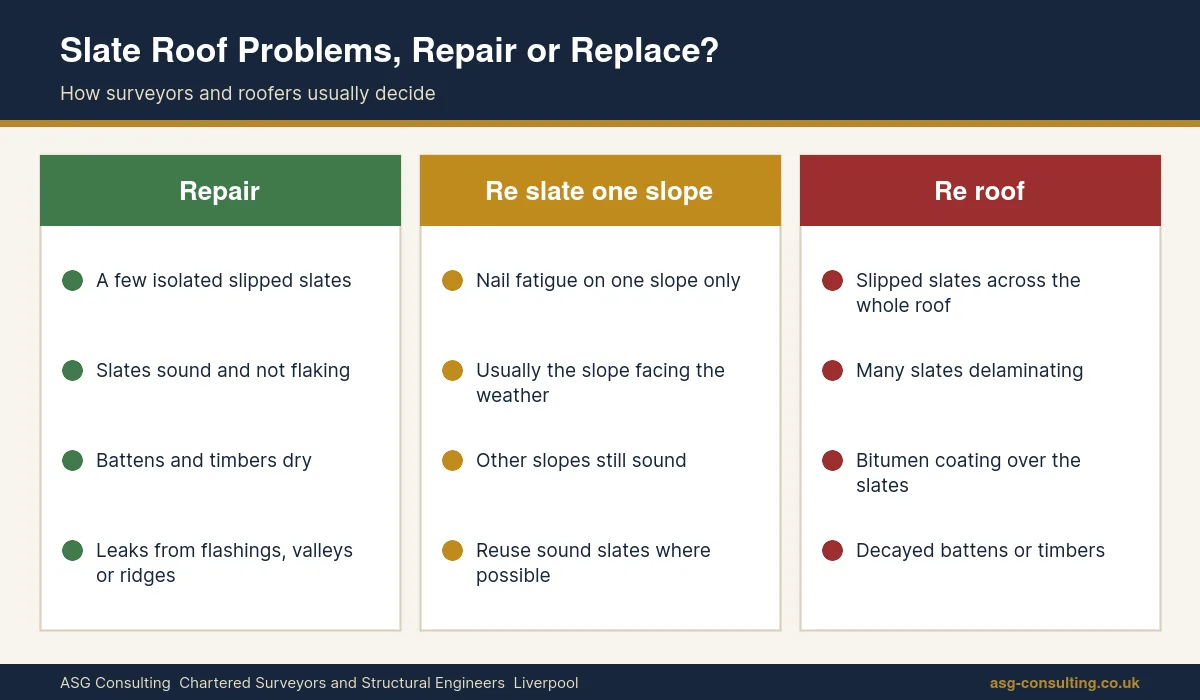
Should You Repair or Replace a Slate Roof?
Surveyors and roofers weigh up several factors. As a rough guide
- Repair where slips are few and isolated, the slates are sound, the battens and timbers are dry and the leaks come from flashings, valleys or ridges.
- Re slate one slope where nail fatigue is widespread on a single slope, often the one facing the prevailing weather, while others are still sound.
- Re roof where slips are widespread across the whole roof, many slates are delaminating, the roof has been coated with bitumen or the battens and timbers are decayed.
A re roof is also a chance to add a breathable underlay, improve insulation and ventilation, renew the flashings and valleys, and repair the chimney stacks while scaffolding is up. For listed buildings and conservation areas, like for like slate and consent may be required, and our guide to a listed building survey explains the extra considerations.
How Can You Look After a Slate Roof?
Regular, modest maintenance prevents many slate roof problems from becoming expensive. A simple routine looks like this.
- Look up after storms. Check from the ground for slipped slates, loose ridge tiles and lifted flashings, and get them fixed promptly.
- Clear gutters twice a year. Blocked gutters and hoppers let water back up under the lower slates and into the walls.
- Keep valleys clear. Remove moss, leaves and debris so water can run freely.
- Check the loft. Look for daylight, damp patches, stained timbers and fallen debris once or twice a year.
- Watch the chimneys. Cracked flaunching, eroded pointing and leaning stacks let water in around the roof.
- Avoid walking on the slates. Slate cracks easily underfoot, so use a qualified roofer with roof ladders or crawling boards.
- Keep records. Note and photograph repairs, so you can see whether problems are spreading.
What Should You Ask a Roofer?
If repairs or a re roof are needed, these questions help you compare quotes.
- Is the work a local repair, a single slope or the whole roof, and why?
- Which slates will be reused, and what replacement slate will be used to match?
- Will the battens be renewed and a breathable underlay installed?
- What nails or fixings will be used?
- Are flashings, valleys, ridges and chimneys included?
- Is scaffolding included, and does the work need consent for a listed building or conservation area?
- What guarantee is offered, and is it backed by insurance?
How Is a Slate Roof Inspected?
A surveyor will look at the roof from ground level and from the loft, but many slate roof problems are hard to see from the ground, particularly on tall terraces and rear slopes.
- From the ground. Binoculars and a camera with a zoom lens show slipped slates, tingles, coatings, ridges and chimneys.
- From the loft. The underside of the roof shows daylight, damp timbers, nail corrosion and any sprayed foam.
- From the air. A drone or a camera on a mast gives a close view of the slates, valleys and flashings without anyone needing to climb on the roof.
Our high level drone surveying service captures close up images of roofs and chimneys that cannot be seen safely from the ground. For buyers, a RICS Level 3 Building Survey gives the most detailed view of an older slate roof. Our residential building surveying page explains what is included, and our RICS HomeBuyer Survey in Liverpool suits more conventional homes in reasonable condition.
Do Slate Roof Problems Affect Buying a House?
Slate roof problems are one of the most common items flagged on surveys of older homes, and they rarely stop a sale on their own. What matters is whether the roof needs routine repairs or is close to needing replacement, because a full re roof on a terraced or semi detached house is a significant cost.
If your survey flags the roof, get a roofer to inspect it and provide a written quote before you exchange contracts. Lenders occasionally ask for repairs to be completed where a roof is letting in water, and some insurers ask about the age and condition of the roof. A clear quote also gives you evidence if you decide to renegotiate the price, as our guide to how a house purchase survey can help you renegotiate explains.
Slate Roofs in Liverpool
Slate is the traditional roofing material across much of Liverpool and the wider North West, thanks to the nearby North Wales quarries and the huge growth of the city in the Victorian era. Terraces in Anfield, Walton, Kensington, Wavertree and Toxteth, and villas around Sefton Park and Aigburth, were commonly roofed in Welsh slate.
Slate roof problems seen regularly by surveyors in the area include
- widespread nail fatigue on roofs that have never been stripped
- slipped slates on slopes facing the prevailing south westerly wind and rain
- failed flashings around chimney stacks and rear outriggers
- worn valleys and parapet gutters between terraced houses
- old bitumen coatings and heavy concrete tile replacements
- later re roofs using lower quality slate that has started to delaminate
Many terraces share roofs and chimney stacks with neighbours, so repairs may need coordinating, and work on shared elements can sometimes involve party wall procedures.
Slate Roof Problems FAQs
What are the most common slate roof problems?
The most common problems are slipped or missing slates caused by corroded nails, failed flashings around chimneys and walls, worn valleys, loose ridge tiles, delaminating slates and poor past repairs such as bitumen coatings.
How long does a slate roof last?
Good quality natural slate, such as Welsh slate, often lasts 100 years or more. The nails, battens and flashings usually need renewing long before the slates wear out.
What is nail sickness on a slate roof?
Nail sickness, or nail fatigue, is when the nails holding the slates corrode and fail, so slates start to slip. Once it is widespread, the long term fix is to strip and re fix the slates with new nails and battens.
Can a slate roof be repaired instead of replaced?
Yes, if slips are isolated, the slates are sound and the timbers are dry. Widespread slipping, delamination, bitumen coatings or decayed timbers usually mean a re roof is the better option.
Is a coated slate roof a problem when buying a house?
It can be. Coatings trap moisture, hide defects and usually mean the slates cannot be reused, so the roof is likely to need replacing sooner. A surveyor will flag this.
Should I get a survey on a house with an old slate roof?
Yes. A RICS Level 3 Building Survey gives the most detailed view of an older slate roof, and a drone inspection can add close up images where the roof cannot be seen from the ground.
Get Your Slate Roof Checked by ASG Consulting
ASG Consulting is an RICS regulated building surveying practice in Liverpool. Our surveyors inspect slate roofs as part of Level 2 and Level 3 surveys and use drones where roofs cannot be seen safely from the ground, across Liverpool, Merseyside, the Wirral and the wider North West. Reports are usually delivered within 3 to 5 working days of the inspection, and we give a fixed fee on request. To request a quote, call 0151 315 0626 or visit our contact page.
About the Author
Dave MacMillan is the lead surveyor at ASG Consulting, an RICS regulated building surveying practice at 54 St James Street, Liverpool. He has 8 years of experience in building surveying and inspects homes for buyers across Liverpool, Merseyside and the North West.
Last updated 10 November 2026
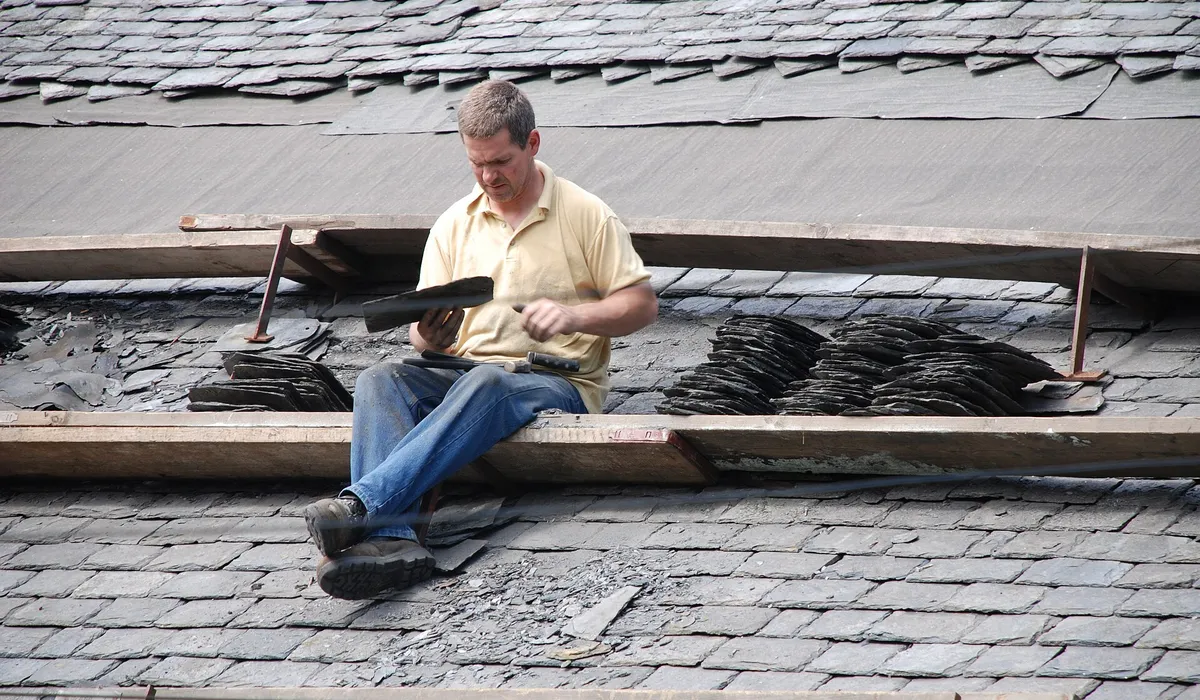
Featured photo of a slater at work in Rothesay by Karora via Wikimedia Commons, public domain, cropped.