An ex council house survey should confirm how the home was built, because some former council houses use non traditional concrete or steel systems that lenders treat differently. For a conventional brick ex council house in reasonable condition, a RICS Level 2 HomeBuyer Survey usually suits. Non traditional or altered homes need a Level 3.
Former council homes are some of the best value properties in Liverpool and across the North West. Many are solidly built, with generous gardens and good room sizes. But buyers often have questions about mortgages, construction types, Right to Buy history and, for flats, service charges. This guide is a checklist built around the property type, so you can see what an ex council house survey should look at, what your solicitor needs to check and how to choose the right level of survey.
In this guide
- What counts as an ex council house?
- Are ex council houses a good buy?
- How were ex council homes built?
- What is a non traditional council house?
- What should an ex council house survey check?
- What about ex council flats?
- Can you get a mortgage on an ex council house?
- What legal checks does your solicitor need to make?
- What questions should you ask the seller?
- Which survey level do you need?
- Buying an ex council house in Liverpool
- FAQs
What Counts as an Ex Council House?
An ex council house, sometimes called an ex local authority home, is a property that was originally built or owned by a council and later sold into private ownership. Most were sold to tenants under the Right to Buy scheme from 1980 onwards, and many have since been sold on again on the open market.
Ex council homes include semi detached and terraced houses, bungalows, maisonettes and flats in low rise and high rise blocks. They were built over a long period, from the interwar years through to the 1970s and beyond, using a wide range of methods. That variety is why an ex council house survey needs to start by working out exactly what kind of building you are buying.
Are Ex Council Houses a Good Buy?
Many are. Council houses were often built to good space standards, with sizeable gardens and sound brick construction. Buyers frequently get more space for their money than with a private home of a similar age.
There are some things to weigh up, though.
- Construction. Some estates used concrete or steel systems that can affect mortgages, insurance and resale.
- Alterations. Many homes have been extended or modernised by owners since they were sold, with varying quality.
- Estate factors. The appearance, management and owner occupier mix of an estate can affect future demand.
- Flats. Leases, service charges and major works bills need careful checking.
An ex council house survey and good legal advice will help you separate a sound bargain from a property that will be hard to sell later.
How Were Ex Council Homes Built?
Councils used a mix of traditional and non traditional methods, depending on the era and on shortages of materials and skilled labour.
| Era | Typical construction | What a survey looks for |
|---|---|---|
| Interwar, 1919 to 1939 | Mostly brick, often with early cavity walls, plus some concrete and steel systems | Wall tie corrosion, roof coverings, chimneys, any non traditional systems |
| Post war, 1945 to the mid 1950s | Many prefabricated and system built homes alongside brick houses | Identifying the system, signs of concrete or steel decay, evidence of repair schemes |
| 1950s to 1970s | Brick houses, in situ concrete houses and low and high rise flats | Cracking, flat roofs, cladding, windows, communal parts for flats |
| Later homes | Mostly conventional brick and block construction | Usual age related defects and later alterations |
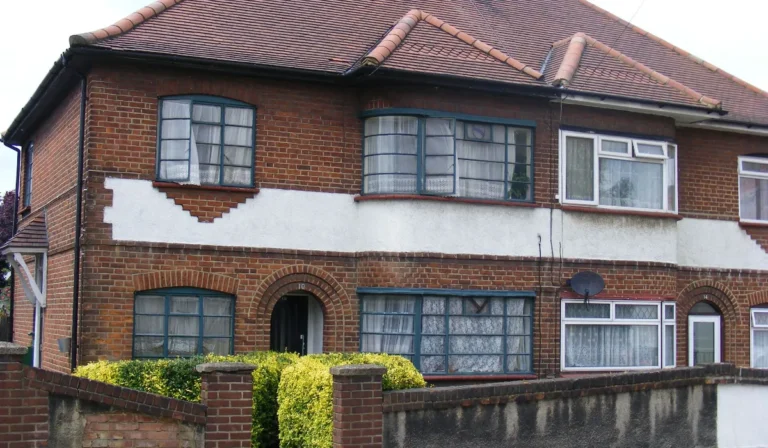
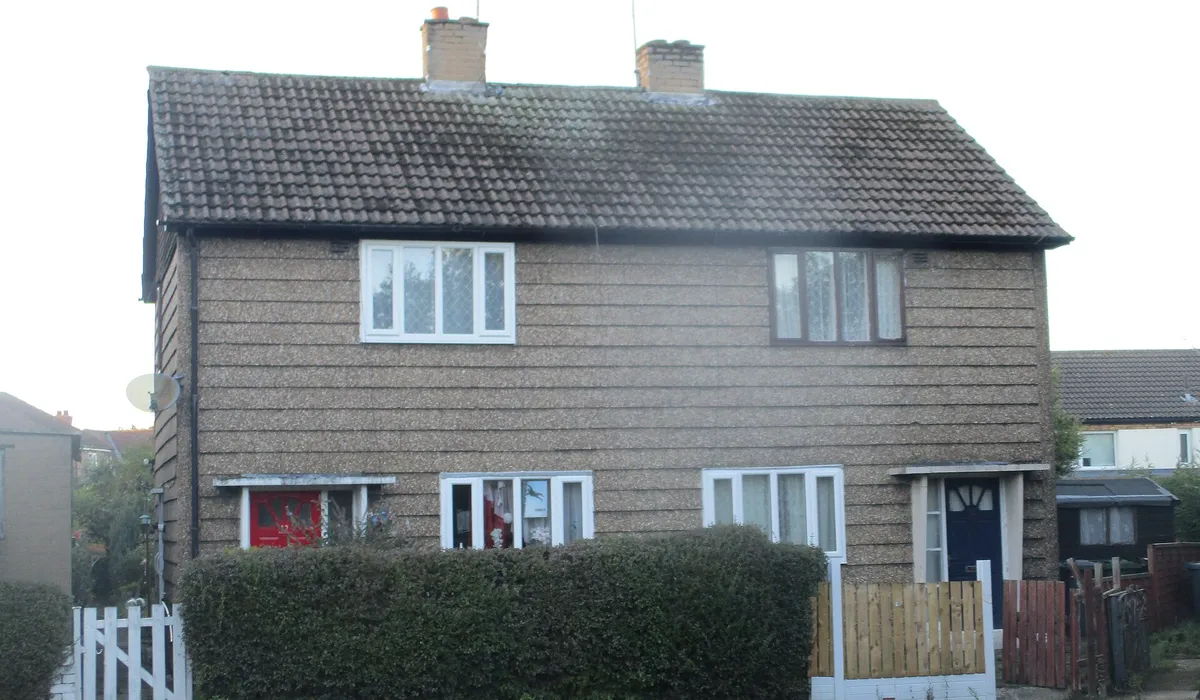
Many ex council houses look like ordinary brick semis from the street, even when the structure behind is something else. Some non traditional houses were later refurbished with a new brick outer skin, which can make them look conventional at first glance.
What Is a Non Traditional Council House?
A non traditional, or non standard, house is one not built from conventional brick or stone with a slate or tiled roof. Many ex council houses fall into this group. Common families include
- Precast reinforced concrete houses. Built from factory made concrete panels or posts. Several types, such as Airey, Cornish Unit, Orlit, Reema and Unity, were designated as defective under the Housing Act 1985 because the concrete and reinforcement can deteriorate.
- In situ concrete houses. Built by pouring concrete on site, such as Wimpey No Fines. These are often treated more favourably by lenders than precast concrete houses, though it depends on the lender and the condition.
- Steel framed houses. Built around a steel frame, which can corrode where it is exposed to damp.
- Timber framed and other systems. Including some post war prefabricated designs.
For designated defective precast concrete houses, many lenders will only lend if the house has been repaired under an approved scheme and has a certificate to prove it. Without that evidence, a mortgage may be hard or impossible to get, which also affects who you can sell to later. Our guide to non standard construction explains the main types in more detail.
What Should an Ex Council House Survey Check?
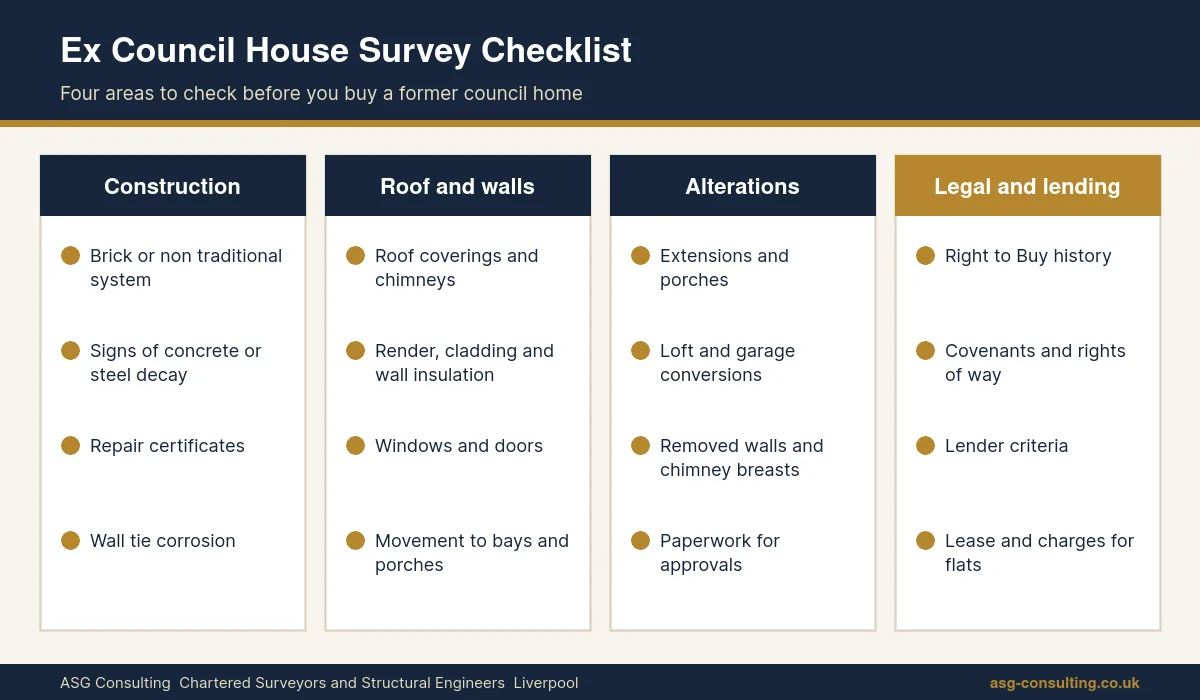
Use this checklist to make sure nothing important is missed. A good surveyor will cover these points as part of the inspection.
Construction and structure
- The construction type, and whether it is traditional brick or a non traditional system
- Signs of cracking, spalling concrete or rust staining that could indicate decay of concrete or steel
- Evidence of past repair schemes or a new outer skin
- Wall tie corrosion in older cavity walls
- Movement, especially to bays, porches and extensions
Roof and external walls
- Roof coverings, which may be original concrete tiles nearing the end of their life
- Chimney stacks, flashings and gutters
- Render, cladding and external wall insulation added under later energy schemes
- Windows and doors, often replaced at least once
Alterations and additions
- Extensions, porches, conservatories and loft conversions added after purchase
- Removed walls or chimney breasts
- Garage conversions and outbuildings
- Whether paperwork for alterations is likely to be needed
Inside and services
- Damp, condensation and ventilation, especially in homes with solid floors and sealed up fireplaces
- Signs of asbestos containing materials, which were widely used in mid twentieth century buildings
- The age of the electrics, heating and drainage
Grounds and boundaries
- Boundaries, shared paths and rear access routes common on estates
- Trees, garden walls and drives
- Any land that appears to be used but is not part of the title
The report uses condition ratings to show what needs attention. Our guide to survey condition ratings explains what each rating means.
What About Ex Council Flats?
Ex council flats and maisonettes need extra care, because you are buying into a whole building as well as your own flat.
- The lease. Check the length of the lease, the ground rent and the rules on alterations and subletting.
- Service charges and major works. The council or housing association usually still owns the freehold and manages the block. Ask for recent service charge accounts and details of any planned major works, such as new roofs, windows or cladding, which leaseholders may have to contribute to.
- The block. The height of the block, the construction, the condition of the roof and communal areas, and fire safety arrangements all matter.
- Access. Lenders may be more cautious about flats reached by external walkways, often called deck access.
A surveyor inspecting a flat will look at the parts of the building that affect you where they can be seen. Our guide to a survey for buying a flat explains what is and is not covered, and our guide to a section 20 notice explains how major works costs are shared.
Can You Get a Mortgage on an Ex Council House?
Usually yes, for a conventional brick house. Lender criteria vary, but common restrictions include
- non traditional construction, especially designated defective concrete houses without a repair certificate
- flats in taller blocks, often above about five storeys
- flats in blocks where few other flats are privately owned
- deck access flats
- certain types of cladding
- lower maximum loan to value for some ex council homes, meaning a bigger deposit
These points come from published mortgage guidance, and each lender sets its own rules. A specialist mortgage broker can tell you which lenders will consider a particular property. Ask early, before you spend money on a survey and legal fees, if the property is non traditional or a flat in a larger block.
Remember that the lender valuation is not the same as your own survey. Our guide to mortgage valuation vs survey explains the difference.
What Legal Checks Does Your Solicitor Need to Make?
Your solicitor or conveyancer will deal with these, but it helps to know what to ask.
| Check | Why it matters |
|---|---|
| Right to Buy history | If the seller bought recently under Right to Buy, they may need to repay some of their discount and the former landlord may have a right to be offered the home first |
| Covenants on the title | Council sales often include covenants on alterations, use and parking |
| Construction certificates | Repair certificates for designated defective houses, and guarantees for later work |
| Planning and building regulations | Approvals for extensions, loft conversions and removed walls |
| Rights of way and shared areas | Rear paths, shared drives and estate land |
| Lease and service charges for flats | Lease length, charges, planned works and the freeholder |
The GOV.UK guidance on Right to Buy explains the rules that apply to tenants buying their homes, which helps explain some of the restrictions you may see on resale.
What Questions Should You Ask the Seller?
Before you book an ex council house survey, a few questions to the seller or agent can save time and money.
- When was the property bought from the council, and was it bought under Right to Buy?
- Do you know how the house was built, and has it ever been described as non traditional?
- Has any structural repair or refurbishment scheme been carried out, and is there a certificate?
- What alterations have been made, such as extensions, porches, loft conversions or removed walls, and is there paperwork?
- Has external wall insulation, render or cladding been added, and is there a guarantee?
- When were the roof, windows, boiler and electrics last replaced or tested?
- For a flat, what are the current service charges, and are any major works planned or already billed?
- Have any mortgage offers on the property fallen through because of the construction?
Honest answers help you choose the right survey level and give your surveyor useful context. If the seller does not know, that is useful information too, because it means the survey needs to work harder to establish the facts.
Which Survey Level Do You Need?
Choose the level of ex council house survey based on the construction, condition and history of the property.
| Property | Suggested survey |
|---|---|
| Conventional brick house in reasonable condition, little altered | RICS Level 2 HomeBuyer Survey |
| Conventional brick house that has been extended or altered | RICS Level 3 Building Survey |
| Non traditional construction, repaired or unrepaired | RICS Level 3 Building Survey, sometimes with a specialist structural report |
| Ex council flat in a low rise block | RICS Level 2 HomeBuyer Survey in most cases |
| Flat in a larger or system built block | RICS Level 3 Building Survey or specialist advice |
For a straightforward brick ex council house, the Level 2 survey is often the right fit and better value. Our RICS HomeBuyer Survey in Liverpool page explains the Level 2 survey, and our residential building surveying page covers the Level 3 Building Survey. Where the structure needs a closer look, our structural engineering team can carry out a specialist inspection.
Buying an Ex Council House in Liverpool
Liverpool built tens of thousands of council homes in the twentieth century, from interwar cottage estates to post war overspill developments. Large estates and former council housing can be found across the city and wider Merseyside, including areas such as Norris Green, Croxteth, Dovecot, Speke, Belle Vale, Kirkby and parts of the Wirral.
What an ex council house survey often finds in Liverpool
- sound brick semis and terraces from the interwar years, with typical age related wear such as roof coverings, chimneys and wall ties
- some non traditional concrete and steel framed houses on interwar and post war estates, some refurbished and some not
- external wall insulation and render added under energy schemes, which needs checking for cracking and damp
- owner extensions and porches of varying quality
- low rise ex council flats and maisonettes, with leases and service charges to review
Wind driven rain from the Irish Sea makes roofs, chimneys and exposed gable walls work hard here, so these deserve close attention on any older home.
Ex Council House Survey FAQs
Do I need a survey on an ex council house?
Yes. An ex council house survey confirms the construction type, which affects mortgages and resale, and reports on the condition of the property. A conventional brick house in good condition usually suits a Level 2 survey.
Are ex council houses harder to get a mortgage on?
Conventional brick ex council houses are usually mortgageable on normal terms. Non traditional houses, flats in high rise or deck access blocks and some cladding types can be harder, and some lenders ask for a larger deposit.
How can I tell if a council house is non traditional?
Clues include concrete panels or posts, unusual roof shapes, metal sheet cladding and very uniform houses on an estate. A surveyor can usually identify the construction and will tell you if specialist advice is needed.
What is a PRC house?
PRC stands for precast reinforced concrete. Some PRC house types were designated defective under the Housing Act 1985, and many lenders only lend on them if they have been repaired under an approved scheme with a certificate.
Is an ex council flat a good investment?
It can be, but check the lease, service charges, planned major works, the block construction and lender criteria before you commit.
Which survey is best for an ex council house?
A RICS Level 2 HomeBuyer Survey usually suits a conventional brick house in reasonable condition. Choose a Level 3 Building Survey for non traditional, extended or poorly maintained homes.
Book an Ex Council House Survey With ASG Consulting
ASG Consulting is an RICS regulated building surveying practice in Liverpool. We carry out RICS Level 2 HomeBuyer Surveys and Level 3 Building Surveys on former council houses and flats across Liverpool, Merseyside, the Wirral and the wider North West, with reports usually delivered within 3 to 5 working days of the inspection. We give a fixed fee on request, usually confirmed within one working day. To request a quote, call 0151 315 0626 or visit our contact page.
About the Author
Dave MacMillan is the lead surveyor at ASG Consulting, an RICS regulated building surveying practice at 54 St James Street, Liverpool. He has 8 years of experience in building surveying and inspects homes for buyers across Liverpool, Merseyside and the North West.
Last updated 10 November 2026
Featured photo of Airey houses on Sugar Hill Close, Oulton by Mtaylor848 via Wikimedia Commons, licence CC BY SA 4.0, cropped.