A cracked lintel is one of the most common structural defects found around windows and doors. The lintel is the beam that spans the top of an opening and carries the brickwork, floors and sometimes the roof above it. When a lintel cracks, rusts, sags or loses its bearing, the walls above can start to crack and move. Some cases are minor and stable, but others need prompt lintel replacement before bricks drop or windows and doors are damaged.
This guide is laid out as a crack pattern diagnosis guide. It explains what lintels are made of, the four crack patterns to recognise, what causes each one, how a structural engineer or surveyor assesses the problem, the steps involved in lintel replacement, building regulations, costs and what buyers should do when a survey flags a cracked lintel. It is written for homeowners, landlords and buyers in Liverpool, Merseyside and the North West.
In this guide
- What a lintel does
- Types of lintel
- Four crack patterns to know
- What causes a cracked lintel
- How urgent is it
- How a cracked lintel is assessed
- Repair or lintel replacement
- Lintel replacement step by step
- Building regulations and approvals
- What affects the cost
- Problems by property age
- Preventing lintel problems
- Buying a house with a cracked lintel
- Lintel problems in Liverpool homes
- FAQs
What a Lintel Does
Every window and door opening in a masonry wall needs something to carry the load above it. That job is done by a lintel, or in older buildings sometimes by a brick or stone arch. The lintel transfers the weight of the wall, and any floor or roof loads, out to the masonry on either side of the opening. Those resting points are called bearings.
If the lintel is too weak, too short, badly supported or deteriorating, it cannot carry the load properly. The result is usually cracking in the brickwork above or beside the opening, sometimes with movement in the window or door frame. A cracked lintel therefore needs to be understood in the context of the whole wall, not just the beam itself.
Types of Lintel
The type of lintel affects how it fails and how it is repaired.
| Lintel type | Common in | Typical problems |
|---|---|---|
| Timber | Older homes, often hidden behind brick or render | Rot from damp, insect attack, sagging |
| Brick arch or soldier course | Victorian and Edwardian homes | Dropped or loose bricks, cracked joints |
| Stone | Period and larger homes | Cracks across the stone, often near mid span |
| Concrete | Interwar and post war homes | Cracking, spalling and rusting reinforcement |
| Steel | Many homes from the 1970s onwards | Corrosion, especially where water gets in |
Identifying the lintel type is often the first step in deciding whether a repair or full lintel replacement is needed.
Four Crack Patterns to Know
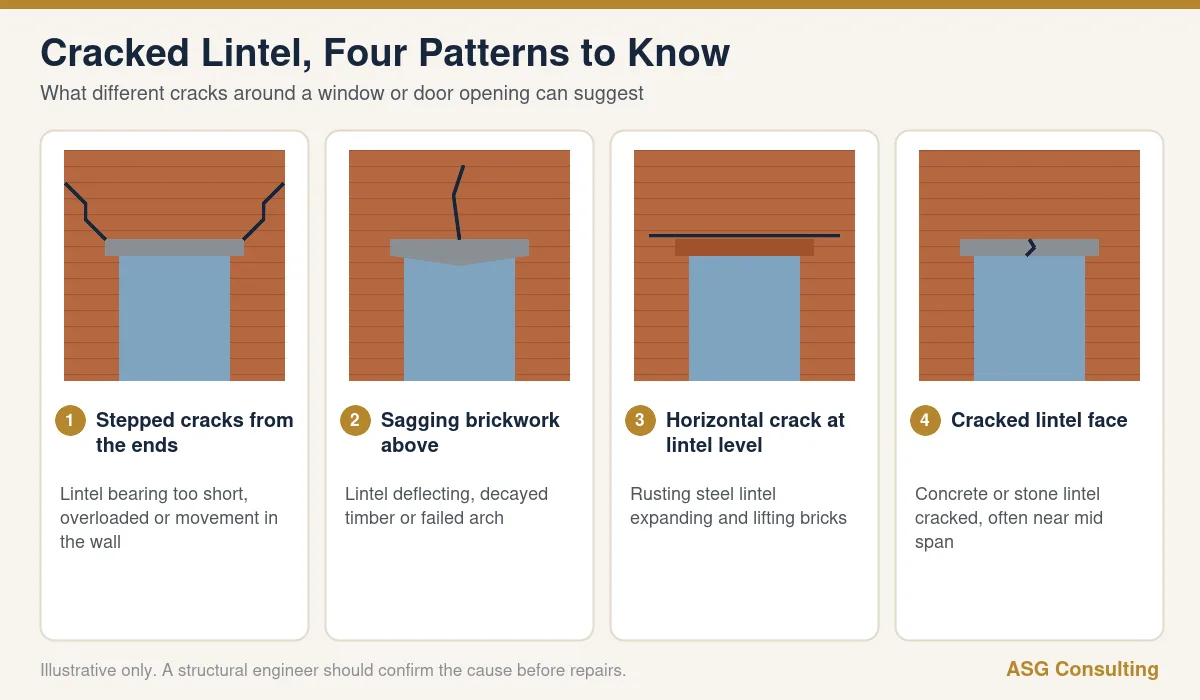
The diagram below shows four common crack patterns around openings and what they can suggest.
1. Stepped cracks from the ends
Diagonal stepped cracks running up and away from the ends of a lintel often point to a problem at the bearings. The lintel may be too short, the bearing may have crushed, or there may be wider movement in the wall. This pattern is common where openings have been widened without a properly sized lintel.
2. Sagging brickwork above
A dip in the brick courses above an opening, sometimes with a vertical crack at mid span, suggests the lintel or arch is deflecting. In older homes this can mean a hidden timber lintel has rotted, or a brick arch has lost its shape.
3. Horizontal crack at lintel level
A horizontal crack along the line of the lintel, often with bricks lifting, is a classic sign of a rusting steel lintel. As steel corrodes it expands, pushing the brickwork up and opening a crack. This is known as rust jacking.
4. Cracked lintel face
A crack running across a concrete or stone lintel, often near the middle of the span, means the lintel itself has failed or been overloaded. Concrete lintels can also show spalling where rusting reinforcement pushes off the surface.
What Causes a Cracked Lintel
Common causes include the following.
- Corrosion. Steel lintels and the reinforcement in concrete lintels rust when water gets in, often through failed pointing, cavity trays or window seals.
- Rot. Timber lintels decay when kept damp, especially behind render or in solid walls.
- Undersized lintels. Openings widened for new windows or patio doors without a properly designed lintel.
- Short bearings. Lintels that do not sit far enough onto the wall at each end.
- Extra loads. New floors, loft conversions or heavy roof coverings adding load above an opening.
- Removed supports. Removing a chimney breast or wall without checking what it carried. Our guide to chimney breast removal explains why this matters.
- Wider movement. Subsidence, settlement or wall tie failure can show up as cracking at openings, which are the weakest points in a wall.
Openings often show the first signs of movement that is actually happening elsewhere. Our guides to cracks in walls and wall tie failure explain how to tell local lintel problems from wider issues.
How Urgent Is It
Not every cracked lintel is an emergency, but some need quick action.
| Sign | Urgency |
|---|---|
| Hairline crack that has not changed for years | Monitor and seek advice at the next opportunity |
| Cracks wider than a few millimetres or growing | Get a structural assessment soon |
| Windows or doors sticking, frames distorting | Get a structural assessment soon |
| Bricks loose, dropping or bulging above an opening | Urgent, keep people clear and get help promptly |
| Visible sagging of the lintel or arch | Urgent, temporary support may be needed |
If bricks look likely to fall, keep the area below clear and contact a structural engineer or contractor straight away. Temporary propping can be put in quickly to make the opening safe.
How a Cracked Lintel Is Assessed
A structural engineer or building surveyor will usually do the following.
- Inspect the crack pattern. Record the position, width and direction of cracks inside and out.
- Identify the lintel. Work out the type, size and condition, sometimes by removing a brick or some plaster.
- Check the bearings. Look at how far the lintel sits onto the wall and whether the masonry below is sound.
- Look for causes. Check for water ingress, corrosion, rot, alterations and wider movement.
- Consider loads. Assess what the lintel carries, including floors and roof.
- Recommend a solution. Repair, strengthen or full lintel replacement, with a specification where needed.
Where cracks may be historic, the engineer may suggest monitoring them over several months before deciding on major work. Our guide to the residential structural engineer explains what a structural inspection involves.
Repair or Lintel Replacement
The right answer depends on the cause and the condition of the lintel.
- Minor cracking with a sound lintel. Crack stitching with helical bars and repointing may be enough.
- Light surface rust on a steel lintel. Cleaning, treating and improving weatherproofing can extend its life, provided there is no significant section loss.
- Dropped brick arch. The arch can often be rebuilt or supported with a hidden steel angle.
- Badly corroded, rotted or cracked lintel. Full lintel replacement is usually the right answer.
- Undersized lintel after an alteration. A new, properly designed lintel is needed.
Our guide to brickwork repair explains crack stitching and repointing in more detail.
Lintel Replacement Step by Step
A typical lintel replacement in a house wall follows these steps.
- Design. A structural engineer specifies the new lintel and how the wall will be supported during the work.
- Temporary support. Props and needles are installed to carry the wall above while the old lintel is removed.
- Remove the old lintel. Brickwork around the opening is carefully taken out, along with the failed lintel.
- Prepare bearings. The masonry at each end is made good to give a sound, level bearing.
- Install the new lintel. The new lintel is set on mortar beds, with a cavity tray and weep vents where needed.
- Rebuild brickwork. Bricks are relaid to match, and the props are removed once the mortar has gained strength.
- Make good. Internal plaster, window or door frames and decoration are repaired.
In cavity walls, both leaves may need new lintels, and the cavity tray and insulation details must be put back properly to avoid damp and cold bridging. Poorly detailed lintels can also cause condensation at window heads. Our guide to condensation in house rooms explains why cold spots matter.
Building Regulations and Approvals
Replacing a lintel or forming a new opening is structural work and will usually need building regulations approval. The work should be designed by a competent person and inspected by building control. Keep the structural calculations and the completion certificate, as buyers and their solicitors may ask for them later. The government guide to building regulations approval explains when approval is needed.
If the wall is a party wall, or the work may affect a neighbour, the Party Wall Act may also apply. Listed buildings and properties in conservation areas may need additional consents, especially where the appearance of the opening changes. If you are buying a house where lintel work was carried out without approval, our guide to the regularisation certificate explains the options.
What Affects the Cost
The cost of a cracked lintel repair or lintel replacement varies widely, so get written quotes based on a proper specification. The main factors are as follows.
- The width of the opening and the type of lintel needed.
- Whether one or both leaves of a cavity wall are involved.
- Access, including whether scaffolding is needed for upper floor openings.
- The amount of brickwork that must be taken down and rebuilt.
- Matching bricks and mortar, especially on period homes.
- Engineering design, building control fees and making good inside.
Fixing the cause, such as water getting into the wall, is just as important as replacing the lintel, or the new one may fail in the same way.
Lintel Problems by Property Age
The age of a home gives useful clues about the type of lintel and how it is likely to fail.
- Before 1919. Solid brick walls with brick arches, stone lintels or timber lintels hidden behind the brickwork or inside face. Dropped arches, rotted timber and cracked stone are the usual findings.
- 1919 to 1960s. Cavity walls became common, with concrete lintels and some early steel. Concrete lintels can crack and spall as their reinforcement rusts, and bay windows of this period often show movement.
- 1970s onwards. Galvanised steel lintels became widespread. They perform well when kept dry, but failed cavity trays, missing weep vents or poor pointing can let water reach the steel.
- Altered homes of any age. Widened openings for patio doors, bifold doors or larger windows are a frequent cause of cracking if the new lintel was not properly designed.
Preventing Lintel Problems
Most lintel failures are linked to water or alterations, so prevention is straightforward.
- Keep pointing around window and door heads in good order.
- Make sure window cills and seals shed water away from the wall.
- Keep weep vents above openings clear in cavity walls.
- Fix leaking gutters and downpipes that run water down the wall.
- Get structural advice before widening any opening or removing a wall or chimney breast.
- Check window and door heads during routine maintenance, especially after storms.
Catching early signs, such as a hairline crack or a little rust staining, makes a simple repair far more likely than a full lintel replacement.
Buying a House With a Cracked Lintel
Home surveys often flag a cracked lintel, rusting steel at window heads or cracking above openings. This does not have to stop a purchase, but it should be investigated before you commit. Ask for a structural engineer to inspect the defect, get a quote for any repair or lintel replacement and use the findings to renegotiate if needed.
Ask the seller whether any openings have been widened, whether windows or doors have been replaced and whether building control approval was obtained. For older homes, our Victorian house survey guide explains what to look for around bay windows and arches, which often show lintel related cracking.
Lintel Problems in Liverpool Homes
Liverpool and Merseyside have many Victorian and Edwardian homes with brick arches, stone lintels and hidden timber lintels, and many interwar and post war homes with concrete and early steel lintels. Wind driven rain along the coast and frequent wet weather speed up corrosion and rot where water gets into walls.
The cracked lintel cases we see most often include rusting steel lintels lifting brickwork above windows, dropped soldier course arches on terraces, rotted timber lintels behind render and widened openings for patio doors without adequate support. Most can be put right with a properly designed repair or lintel replacement, especially when the problem is caught early.
Cracked Lintel FAQs
Is a cracked lintel dangerous?
It can be. Hairline cracks that have been stable for years may be minor, but sagging, loose or dropping bricks above an opening need urgent attention.
Can a cracked lintel be repaired instead of replaced?
Sometimes. Minor cracking can be stitched and repointed if the lintel is sound. Badly corroded, rotted or cracked lintels usually need replacing.
How do I know if my lintel is steel?
Steel lintels are often hidden, but a horizontal crack at the head of an opening with bricks lifting is a common sign of a rusting steel lintel. A surveyor can confirm the type.
Do I need building regulations approval for lintel replacement?
Usually, yes. Replacing a lintel is structural work, so it should be designed properly and inspected by building control.
How long does lintel replacement take?
A single domestic window or door lintel can often be replaced within a day or two, plus time for making good, depending on access and the size of the opening.
Will my window need replacing too?
Not always. Many windows can be protected and left in place, but distorted or damaged frames may need repair or replacement.
Can I replace a lintel myself?
It is not recommended. Lintel replacement involves temporarily supporting the wall above, choosing a lintel of the right size and strength and meeting building regulations. Mistakes can cause sudden collapse of brickwork, so the work should be designed by an engineer and carried out by an experienced builder.
Can a cracked lintel cause damp?
Yes. Cracks around the opening and failed cavity trays can let rain into the wall, and the cold spot at the window head can also attract condensation.
Who should I call about a cracked lintel?
A structural engineer or building surveyor should assess the cause first. A builder can then carry out the work to the engineer specification.
Does home insurance cover lintel failure?
Gradual deterioration is often excluded, but cover varies. Check your policy, especially if the cracking is linked to subsidence.
Speak to a Structural Engineer in Liverpool
ASG Consulting is regulated by RICS. Our team assesses cracked lintels and other structural defects across Liverpool, Merseyside and the North West, with clear advice on the cause and a practical repair or lintel replacement specification. To find out more, visit our structural engineering page.
About the Author
Harry is a property content writer with 3 years of experience writing about building surveying, commercial property and property compliance in the UK. He writes the guides at ASG Consulting for buyers, tenants and landlords, turning survey practice into clear, practical advice.
Reviewed by Dave MacMillan MRICS, chartered surveyor at ASG Consulting. Dave checks the technical content of our guides against current RICS practice before they are published.
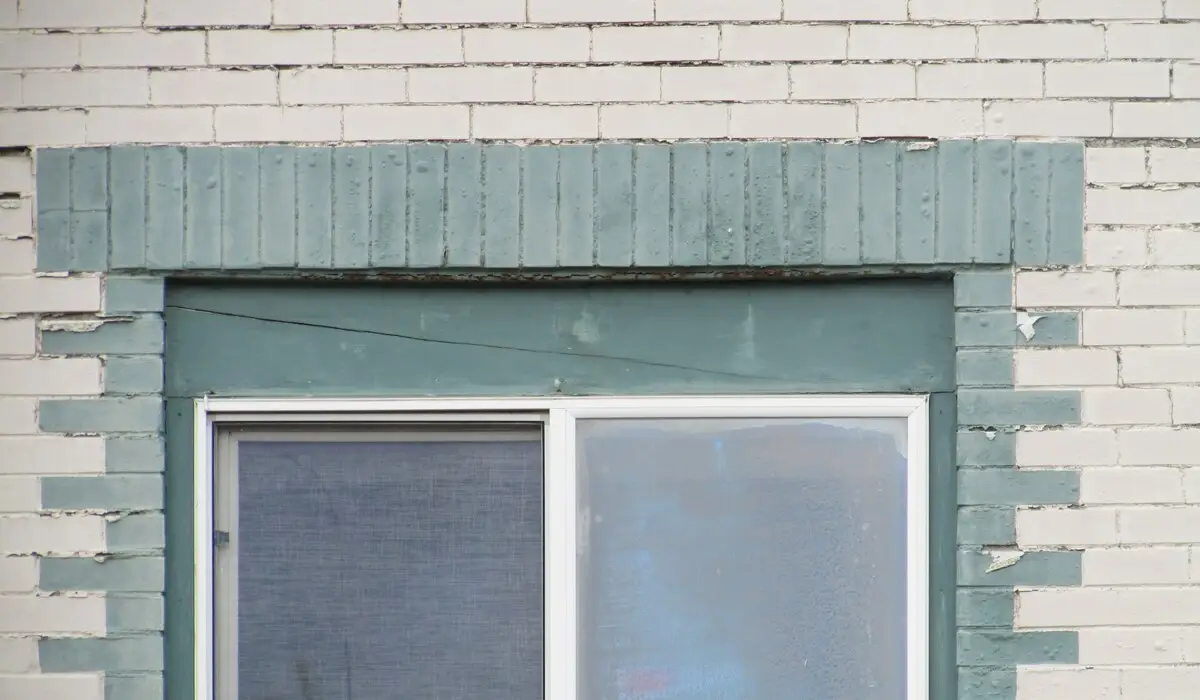
Featured photo of a lintel over a window by Chris Light via Wikimedia Commons, licence CC BY SA 4.0, cropped.