Retaining wall failure happens when a wall that holds back soil or a change in ground level starts to lean, bulge, crack or collapse. It is one of the more dangerous building defects a homeowner can face, because a retaining wall is under constant pressure from the ground behind it, and when it goes, it can go quickly. The good news is that most walls give clear warning signs first, and early retaining wall repair is usually far cheaper and safer than waiting for a collapse.
This guide is built as a diagnosis and action guide. It explains how retaining walls work, why they fail, how to read the warning signs, who is responsible for the wall, which repair options engineers use and what they cost in 2026. It is written for homeowners, landlords and buyers in Liverpool, Merseyside and the North West, where sloping streets, terraced gardens and old sandstone walls are common.
In this guide
- What a retaining wall does
- Types of retaining wall
- Why retaining walls fail
- Warning signs
- Diagnosis table
- What to do if a wall is moving
- Who is responsible
- Retaining wall repair options
- How an engineer investigates
- Costs in 2026
- Approvals and neighbours
- Preventing retaining wall failure
- Buying a house with a retaining wall
- Liverpool and Merseyside
- FAQs
What a Retaining Wall Does
A retaining wall holds back ground that would otherwise slip or slump to a lower level. You will find them along sloping gardens, between terraced plots, beside driveways cut into a bank, along pavements on hilly streets and under raised patios. Unlike an ordinary garden wall, which mainly stands up under its own weight, a retaining wall is pushed sideways all the time by the soil behind it.
That sideways pressure grows quickly with height, and it rises sharply when the ground behind becomes wet. A wall that has stood for decades can start to move after a few very wet winters, a blocked drain, new paving above it or the removal of a tree. Understanding these forces is the key to spotting trouble early.
Types of Retaining Wall
Different walls resist the ground in different ways, and each has its own weak points.
| Type | How it works | Common weak points |
|---|---|---|
| Gravity masonry wall | Uses its own weight in brick or stone to resist the ground | Weak mortar, no drainage, bulging and leaning |
| Reinforced concrete cantilever | A concrete stem tied into a wide base that the soil weight holds down | Cracking, corroded reinforcement, blocked drainage |
| Timber sleeper wall | Sleepers held by posts or stacked and tied back | Rotting timber, posts snapping at ground level |
| Gabion wall | Wire baskets filled with stone | Corroded wire, baskets bulging or settling |
| Crib or block system | Interlocking units filled with free draining material | Units displacing, fill washing out |
Many older walls in the North West are gravity walls built from sandstone or brick, often long before anyone carried out engineering calculations. They can perform well for a century, but they rely heavily on good drainage and sound mortar.
Why Retaining Walls Fail
Most retaining wall failure comes down to one or more of these causes.
- Water pressure. Trade2Base notes that most retaining wall failures are drainage failures, and that saturated ground can more than double the pressure on a wall. Blocked weep holes, missing drainage behind the wall and leaking drains all add to the load.
- Extra loads above the wall. Parking cars, building an extension, adding a patio or stacking materials close to the top of a wall pushes more weight against it.
- Undersized or unengineered walls. Many garden walls were built without design, too thin for their height or without a proper foundation.
- Deterioration. Mortar washes out, bricks and stone weather, timber rots and steel corrodes.
- Tree roots and vegetation. Roots can push walls apart, and removing a large tree can change moisture levels in the ground.
- Ground movement. Soft or made ground, nearby excavation or changes in groundwater can undermine the foundation.
Warning Signs of Retaining Wall Failure
The infographic below shows the most common warning signs and why water pressure is so important.
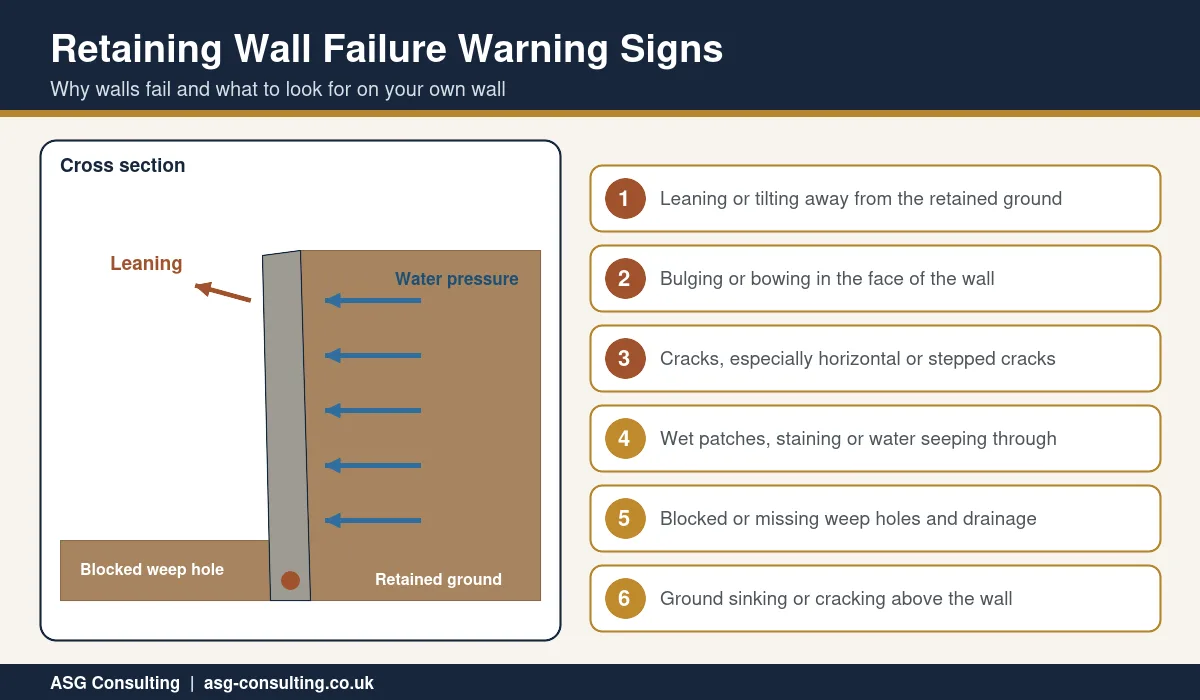
Walk along your wall at least twice a year and after heavy rain. Look along the face from one end to spot bulges, and compare its line against a fence post, a string line or a spirit level. Take dated photographs from the same position each time, so you can see whether anything is changing.
Diagnosis Table
This table is a first guide to the signs of retaining wall failure you may be seeing. It does not replace an inspection by a structural engineer.
| What you see | Likely cause | Urgency |
|---|---|---|
| Wall leaning outwards at the top | Ground pressure exceeding what the wall can resist, often with poor drainage | High, get advice quickly |
| Bulge in the middle of the wall | Loss of strength in the masonry, water pressure, weak mortar | High |
| Wet face, staining or water seeping through | Water building up behind the wall, blocked weep holes | Medium, fix drainage soon |
| Horizontal crack along a mortar joint | Bending under load, often at mid height or near the base | Medium to high |
| Ground sinking or cracking behind the wall | Soil moving towards the wall or being washed out | High |
| Loose or missing stones or bricks | Weathering and lost mortar | Medium, repair before it spreads |
If you are seeing cracks in the walls of the house as well as the retaining wall, our guide to cracks in walls explains how to tell which ones matter.
What to Do If a Wall Is Moving
A wall showing signs of retaining wall failure, especially one beside a pavement, road, driveway or play area, should be treated as a safety issue.
- Keep people away. Stop children, visitors and cars using the area in front of the wall and below it.
- Remove loads from above. Move vehicles, bins, planters and stored materials away from the top of the wall.
- Deal with water. Clear any blocked weep holes you can reach safely and stop obvious leaks, such as a broken downpipe discharging behind the wall.
- Call a structural engineer. Ask for an urgent inspection and advice on temporary propping or other safety measures.
- Tell the council if it borders a highway. A wall that could fall onto a pavement or road may need the highway authority to be informed.
- Notify your insurer and neighbours. Let them know what is happening, even if you are not sure about cover.
Do not dig out soil from the base of the wall or try to push it back into place. Both can make a collapse more likely.
Who Is Responsible for a Retaining Wall
Responsibility depends on who owns the wall and what it is supporting. As a general rule, the owner of the land being held up is often responsible for keeping it supported, but the deeds and the history of the site can change that. Check your title plan and deeds first, and remember that title plans only show general boundaries. Our guide to using a boundary dispute surveyor explains how ownership of boundary features is established.
Walls next to roads have extra rules. Under section 167 of the Highways Act 1980, a retaining wall within four yards of a street that is more than four feet six inches high at any point is subject to control by the local authority. New walls of this kind need approved plans, and if an existing wall could endanger people using the street, the council can serve a notice requiring the owner to make it safe. Councils commonly carry out emergency works if a wall collapses onto a highway and then seek to recover the cost.
Retaining Wall Repair Options
The right retaining wall repair depends on the type of wall, its height, how far it has moved and what is above it. A structural engineer will usually recommend one or more of the following.
- Drainage improvements. Clearing or adding weep holes, installing a gravel drainage layer and a perforated land drain behind the wall, and redirecting surface water away from the top.
- Repointing and local rebuilding. Replacing lost mortar and rebuilding loose sections, using a mortar that suits the original masonry.
- Buttresses. Brick, stone or concrete piers built against the front of the wall to resist further movement.
- Ground anchors and tie backs. Steel anchors drilled through the wall into the ground behind and fixed with plates to hold it back.
- Reducing the load. Lowering ground levels, moving parking or removing heavy features from above the wall.
- Full rebuild. Taking down the failed section and building a new engineered wall, often in reinforced concrete or block with proper drainage.
Short term measures, such as temporary propping or sandbags, may be needed while the permanent repair is designed and approved.
How an Engineer Investigates Retaining Wall Failure
A structural engineer looks at the wall as a whole system, not just the visible cracks. A typical investigation of retaining wall failure includes the following.
- Measuring the height, thickness and lean of the wall at several points.
- Checking the condition of the masonry, mortar, concrete or timber.
- Looking for weep holes, drainage outlets and signs of water behind the wall.
- Recording what sits above the wall, such as parking, buildings, trees or paving.
- Digging small trial holes, where safe, to check the foundation and the soil behind.
- Setting up simple monitoring points if it is unclear whether the wall is still moving.
The report should explain the cause, how urgent the problem is and the most practical retaining wall repair, with drawings or a specification your contractor can price.
Retaining Wall Repair Costs in 2026
Retaining wall repair costs vary widely with height, access and how much of the wall needs work. The Trade2Base retaining wall cost guide, published in June 2026, gives these supply and fit rates per square metre of wall face.
| Wall type | Typical cost per square metre |
|---|---|
| Timber sleeper | 120 to 250 pounds |
| Concrete block, rendered or faced | 150 to 300 pounds |
| Gabion baskets | 150 to 300 pounds |
| Brick | 180 to 350 pounds |
| Reinforced concrete | 250 to 450 pounds |
| Natural stone | 250 to 500 pounds |
These rates exclude excavation, foundations, muck away and drainage. The same guide puts foundations at 80 to 200 pounds per linear metre and structural engineer design for a domestic wall at typically 400 to 1,200 pounds. Emergency propping, scaffolding, poor access and work next to a road can all add to the bill.
Retaining Wall Repair Approvals and Neighbours
Several sets of rules can apply to retaining wall repair or rebuilding, so check them before work starts.
- Engineering design. Trade2Base recommends engineered design for walls retaining roughly 1 to 1.2 metres of ground or more, and for any wall supporting a driveway, building or other heavy load.
- Building control. Approval is often needed for engineered walls and for walls that support a building or form part of it.
- Highway approval. Walls covered by section 167 of the Highways Act need plans approved by the local authority.
- Party wall notices. Excavation near a neighbouring building may fall under the Party Wall etc. Act 1996.
- Planning and conservation. Rebuilding walls in conservation areas, next to listed buildings or changing their height may need consent.
If the wall is shared with a neighbour or holds up their land, agree the scope of work and who pays before starting, and put it in writing.
Preventing Retaining Wall Failure
Simple maintenance goes a long way to preventing retaining wall failure. A short routine twice a year helps most walls last far longer.
- Keep weep holes and drainage outlets clear of soil, leaves and plant growth.
- Make sure downpipes, gullies and paving drain away from the top of the wall.
- Remove self seeded trees and shrubs growing in or close to the wall.
- Repoint open joints before mortar loss spreads.
- Avoid parking, building or stacking heavy materials near the top without advice.
- Photograph the wall from the same spots each year to spot slow movement.
If you plan to add a driveway, extension or raised patio near an existing wall, ask an engineer to check it first. Small changes in load can be enough to trigger retaining wall failure in an older wall.
Buying a House with a Retaining Wall
Retaining walls are easy to overlook when viewing a property, especially if they are hidden by plants. If the garden is on more than one level, or the house sits above or below a road, ask your surveyor to look closely at any walls. A full home buyers survey will report visible defects, and a structural engineer can be brought in if the wall is leaning, bulging or wet.
Ask the seller who owns and maintains the walls, whether any work has been done, and whether there have been any notices from the council. Repair costs for a large wall can be significant, so it is better to know before you exchange.
Retaining Walls in Liverpool and Merseyside
Liverpool and its surroundings have more retaining walls than many people realise. The city sits on sandstone ridges at Everton, Woolton and Mossley Hill, and many streets climb steeply from the river. Victorian and Edwardian homes on these slopes often have stepped gardens with sandstone or brick retaining walls that are well over a century old. Across the Wirral, Bidston, Oxton and parts of West Kirby have similar walls along gardens and lanes.
These old walls were usually built without drainage layers, and decades of rain, root growth and lost mortar have weakened many of them. Add new driveways, extensions and heavier vehicles, and some walls are now carrying far more than they were built for. A local structural engineer who knows these walls can quickly judge whether yours needs monitoring, retaining wall repair or rebuilding.
Retaining Wall Failure FAQs
How do I know if my retaining wall is failing?
The early signs of retaining wall failure are leaning, bulging, new cracks, wet patches, blocked weep holes and ground sinking behind the wall. Any of these, especially if they are getting worse, should be checked by a structural engineer.
Is retaining wall repair covered by home insurance?
It depends on the policy and the cause. Sudden collapse may be covered in some cases, but gradual deterioration and poor maintenance are often excluded. Check your policy wording and tell your insurer early.
Can a leaning retaining wall be saved?
Often yes, if retaining wall failure is caught early. Improving drainage, removing loads, adding buttresses or installing ground anchors can stabilise many walls. Severely leaning or bulging walls usually need rebuilding.
Do I need a structural engineer for retaining wall repair?
For anything more than minor repointing, yes. An engineer will work out why the wall is failing and design a repair that will last. Engineered design is generally recommended for walls retaining around a metre or more of ground.
Who pays if a retaining wall between two gardens fails?
It depends on ownership and what the wall supports. Check the deeds, agree responsibility with your neighbour and take legal and surveying advice if you cannot agree.
How long does a rebuilt retaining wall last?
A properly designed and drained wall in good materials should last many decades after retaining wall repair or rebuilding. Regular checks of drainage and weep holes are the best way to protect it.
Retaining Wall Advice in Liverpool
ASG Consulting is regulated by RICS. Our structural engineers investigate retaining wall failure across Liverpool, Merseyside and the North West, explain what is causing the movement and specify safe, practical retaining wall repair. To arrange an inspection, visit our structural engineering page.
About the Author
Harry is a property content writer with 3 years of experience writing about building surveying, commercial property and property compliance in the UK. He writes the guides at ASG Consulting for buyers, tenants and landlords, turning survey practice into clear, practical advice.
Reviewed by Dave MacMillan MRICS, chartered surveyor at ASG Consulting. Dave checks the technical content of our guides against current RICS practice before they are published.
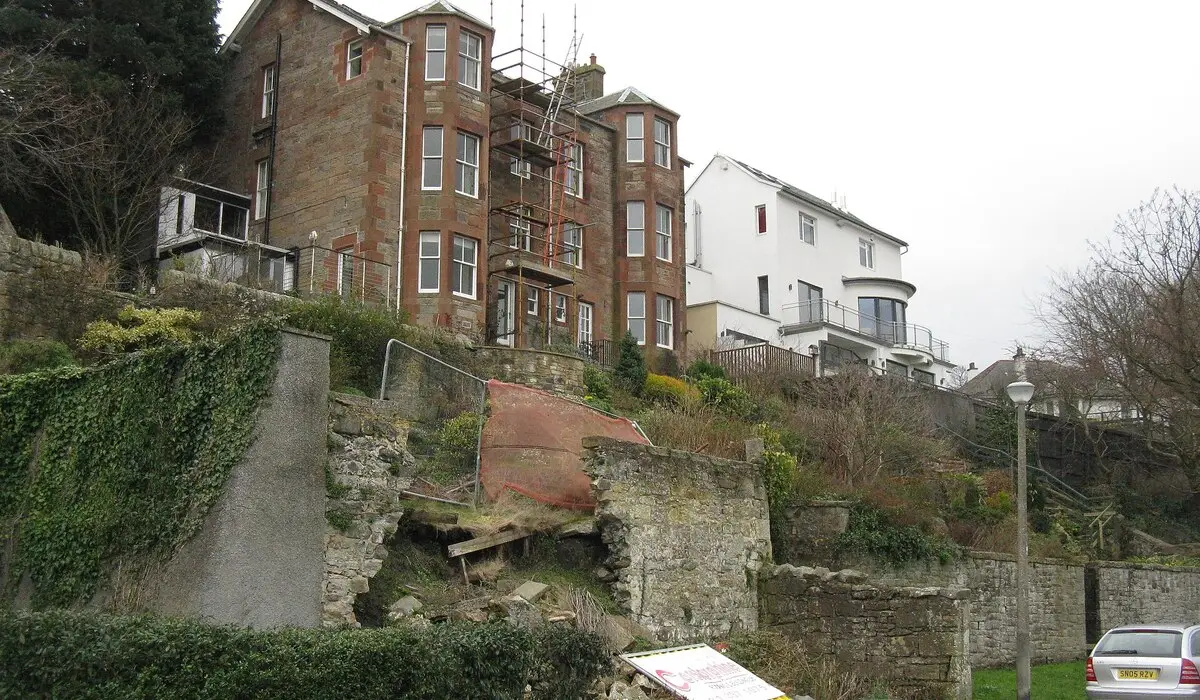
Featured photo of a collapsed retaining wall at Cramond by M J Richardson via Wikimedia Commons, licence CC BY SA 2.0, cropped.