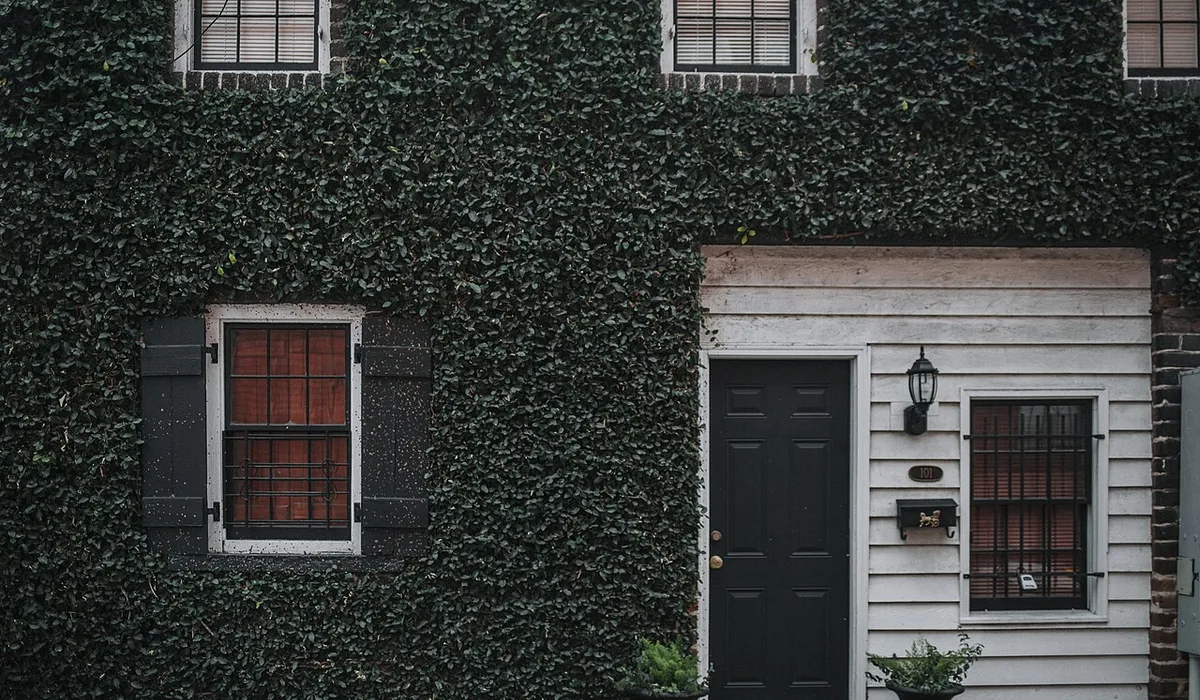
Ivy on house walls is not always a problem. On sound brick or stone it rarely causes damage, and it can even shelter the wall. It does cause trouble where mortar is weak, render is cracked or stems reach gutters, roofs and chimneys. When buying, ask a surveyor to check the wall behind and plan careful removal or trimming.
Ivy can make a house look charming, but many buyers worry about what it hides. The honest answer is that it depends on the condition of the wall underneath. This article explains when ivy helps, when it harms, the 6 warning signs to look for and how to remove it safely if you need to.
Contents
Does Ivy on House Walls Cause Damage?
Not on its own, in most cases. The Royal Horticultural Society advice on ivy on buildings says the small aerial roots of ivy cannot bore into sound masonry. They grip the surface rather than growing into the brick or stone.
The trouble starts where the wall already has weak points. The roots can enter existing cracks and open joints and widen them as they grow. Damage also happens when ivy is pulled off with force, which can bring loose mortar, paint and render away with it.
Can Ivy on House Walls Actually Help?
Yes, in some cases. Historic England guidance on ivy on walls explains that a healthy cover of ivy can moderate temperature extremes and reduce the cycles of wetting and drying that cause brick, stone and mortar to decay. It can also trap airborne pollution and provide a valuable home for wildlife.
So a wall in good condition with well kept ivy is often fine. The question for a buyer is whether the wall under the leaves is in good condition, and that is often hard to see.
What Are the 6 Warning Signs of Ivy Damage?
These 6 warning signs suggest ivy on house walls is causing harm or hiding a problem that needs a closer look.
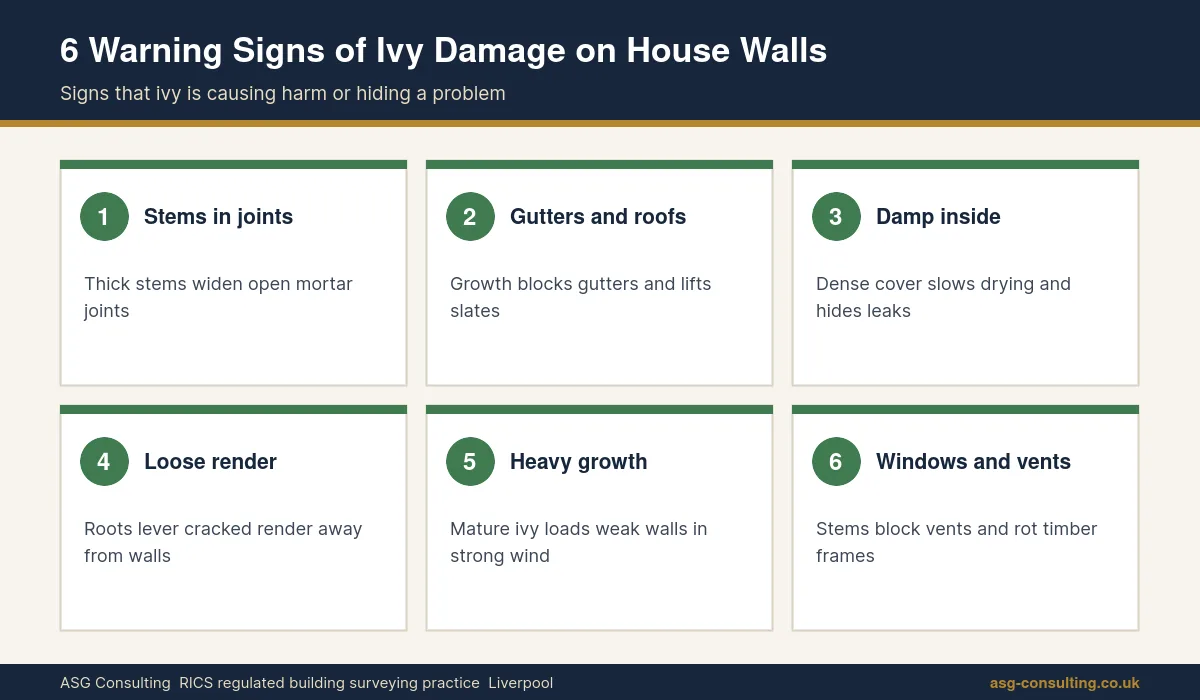
- Stems in mortar joints. Thick stems pushing into joints or cracks can widen them over time.
- Growth into gutters and roofs. Ivy can block gutters and lift slates, tiles and copings.
- Damp patches inside. Dense growth can stop a damp wall drying out and may hide the source of the water.
- Loose or missing render. Roots in cracked render can lever pieces away from the wall.
- Heavy or leaning growth. Mature ivy is heavy and can act like a sail in strong wind, loading weak walls.
- Stems around windows and chimneys. Growth into frames, vents and chimneys can cause decay and blockages.
Is Ivy a Problem on Every Type of Wall?
No. The condition and type of wall make a big difference. This comparison shows where ivy is usually fine and where it needs care.
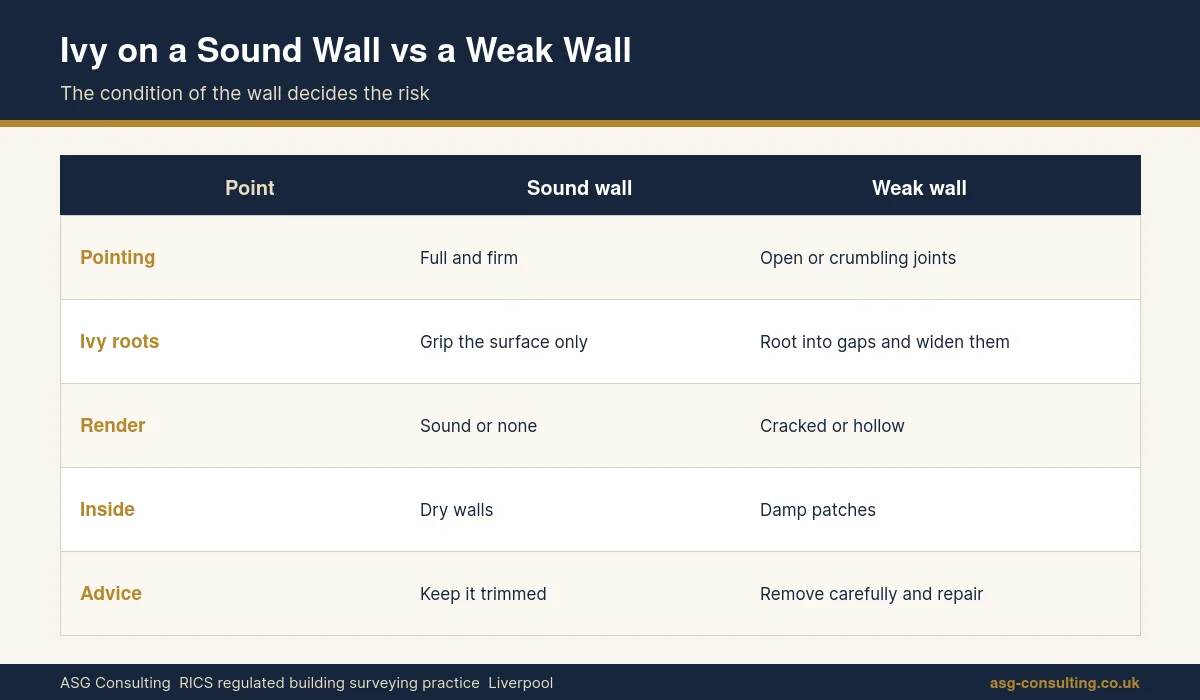
| Wall | Ivy usually | Why |
|---|---|---|
| Sound brick with good pointing | Low risk | Roots grip the surface but cannot enter solid masonry |
| Brick with weak or missing pointing | Higher risk | Stems can root into open joints and widen them |
| Cracked render or pebbledash | Higher risk | Roots get behind loose render and lever it away |
| Garden and boundary walls | Varies | Heavy growth can load old walls with shallow foundations |
| Timber cladding and frames | Higher risk | Growth holds moisture against timber and encourages rot |
The guide to brickwork repair explains how open joints and damaged bricks are usually put right.
Can Ivy Make Damp Worse?
It can. Where a wall already has a damp problem, a thick cover of ivy can limit how well the wall dries out. It can also hide leaking gutters, cracked render or failed pointing that let rain in. Penetrating damp, where water gets through the wall from outside, is the most common result.
The guide to penetrating damp explains how to find the source of the water and how it is usually fixed.
Can Ivy Affect Foundations?
Rarely, but it is possible. The RHS notes that a mature ivy growing close to an old house with shallow foundations on clay soil could take moisture from the ground and add to the risk of subsidence. This is far less common than with large trees, but it is worth knowing about on clay sites.
The guide to trees near a house covers how roots and soil type affect foundations in more detail.
How Do You Remove Ivy Safely?
If ivy needs to go, take it off slowly. Pulling it off in large sheets is what usually causes the most damage. These 6 safe steps follow the RHS approach.
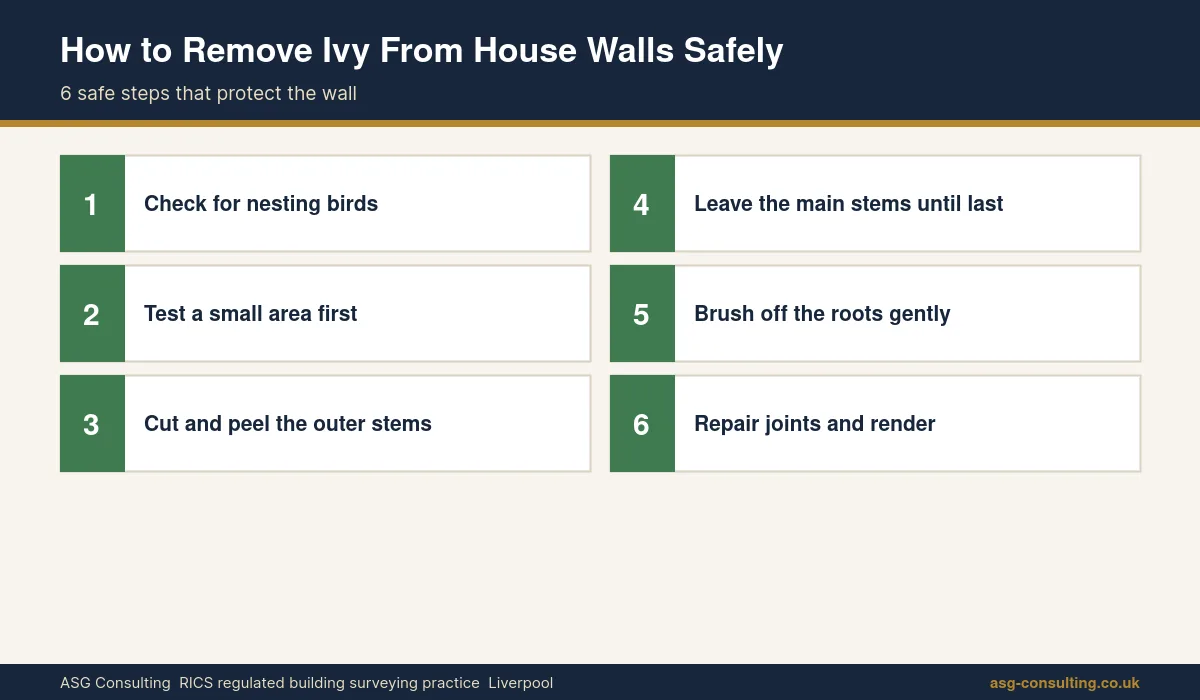
- Check for nesting birds. It is an offence under the Wildlife and Countryside Act 1981 to damage or destroy an active nest. The nesting season generally runs from March to August.
- Test a small area first. See how firmly the ivy is attached and how sound the wall is underneath.
- Cut and peel the outer stems. Work from the outside in, cutting stems into small sections.
- Leave the main stems until last. Cutting the main stems too early can make the ivy root harder into the wall.
- Clean off the roots gently. A stiff brush or scraper removes the small root marks without harming soft brick or mortar.
- Repair the wall. Repoint open joints with a suitable mortar and fix any loose render once the wall is clear.
Wear gloves and cover your arms, as ivy can irritate the skin. For large, old plants on a tall wall, use a professional with safe access equipment.
Should You Keep or Remove Ivy on House Walls?
It depends on the wall and on how much time you want to spend on upkeep. Keeping ivy on walls is usually reasonable when the brickwork and pointing are sound, the growth is kept below gutter level and it is trimmed back from windows, vents, roofs and chimneys at least once a year.
Removal is usually the better choice when the wall has open joints, cracked render or damp inside, when stems are lifting slates or blocking gutters, or when a surveyor cannot see enough of the wall to judge its condition. Once ivy is off, a wall can be repaired and then left clear or allowed to regrow under control.
Ivy on House Walls in Liverpool
Ivy is common on older homes across Liverpool and Merseyside. Victorian villas around Sefton Park and Princes Park, sandstone houses in Woolton and Allerton, and Edwardian terraces in Wavertree and Aigburth often have ivy on side walls, rear walls and garden walls.
Many of these homes were built with soft lime mortar, which can wear away over time and give ivy stems a way into the joints. Coastal homes in Crosby, Hoylake and New Brighton face strong winds, which add load to heavy ivy growth on exposed walls. Sandstone boundary walls, common across south Liverpool, can also be pushed apart by thick stems.
Does a Home Survey Check Ivy on House Walls?
Yes, as far as the surveyor can see. A surveyor will note ivy on house walls, look for signs of damage around it and comment on gutters, roofs and chimneys. Dense growth can hide parts of the walls, so the report will say which areas could not be seen and may recommend a further check once the ivy is cut back.
For a conventional home in reasonable condition, a RICS HomeBuyer Survey in Liverpool is often suitable. For older or altered homes, a Level 3 Building Survey gives more detailed advice on the condition of walls, roofs and repairs.
Ivy on House Walls FAQs
Does ivy damage brick walls?
Not usually on sound brick. It can damage walls with weak mortar, cracks or loose render, and when it is pulled off by force.
Should I remove ivy before buying a house?
You cannot remove it before you own the house. Ask a surveyor to check the walls and plan careful removal or trimming after you move in.
Can ivy cause damp?
It can make existing damp worse by slowing drying and hiding leaks, but it rarely causes damp on its own.
When is the best time to remove ivy?
Outside the bird nesting season, which generally runs from March to August. Always check for active nests first.
Will ivy grow back after removal?
Yes, if the stump is left. Cut new growth back regularly or dig out the stump and main roots.
Does a surveyor check behind ivy?
A surveyor checks what is visible and notes any areas hidden by ivy, which may need a further look once it is cut back.
Talk to a Surveyor at ASG Consulting
ASG Consulting is an RICS regulated building surveying practice based in Liverpool. It carries out RICS Level 2 HomeBuyer Surveys and Level 3 Building Surveys across Liverpool, Merseyside, the Wirral and the wider North West, with reports usually delivered within 3 to 5 working days of the inspection. Fees are fixed and given on request, usually confirmed within one working day. Call 0151 315 0626 to request a quote or to talk through which survey suits the property.
About the Author
Dave MacMillan is the lead surveyor at ASG Consulting, an RICS regulated building surveying practice at 54 St James Street, Liverpool. He has 8 years of experience in building surveying and inspects homes for buyers across Liverpool, Merseyside and the North West.
Last updated 27 November 2026