A build over agreement is permission from the water company to build over or close to a public sewer, usually within 3 metres of it. When buying a house with an extension, conservatory or garage near a sewer, ask whether an agreement or approval exists, check the drainage search and consider a CCTV drain survey before you exchange.
Most buyers only hear about a build over agreement when the drainage search comes back with a question. It sounds alarming, but in most cases it is a paperwork issue that can be sorted with the right checks. This article explains what the agreement is, why so many older Liverpool homes are affected and the 6 easy steps to follow before you commit.
Contents
What Is a Build Over Agreement?
A build over agreement is a legal document between a property owner and the local water company. It allows building work over or near a public sewer or lateral drain, while protecting the pipe and keeping access to it if repairs are ever needed.
In Liverpool and most of the North West, the water and sewerage company is United Utilities. Its guidance on building over a public sewer explains that approval is usually needed for work within 3 metres of a public sewer, even when the pipe sits on private land.
When Is a Build Over Agreement Needed?
An agreement or approval is usually needed when new building work sits over a public sewer or within about 3 metres of one. Common examples include
- single storey rear extensions and kitchen extensions
- conservatories and garden rooms with solid foundations
- attached garages and garage extensions
- porches and side extensions built close to a shared drain
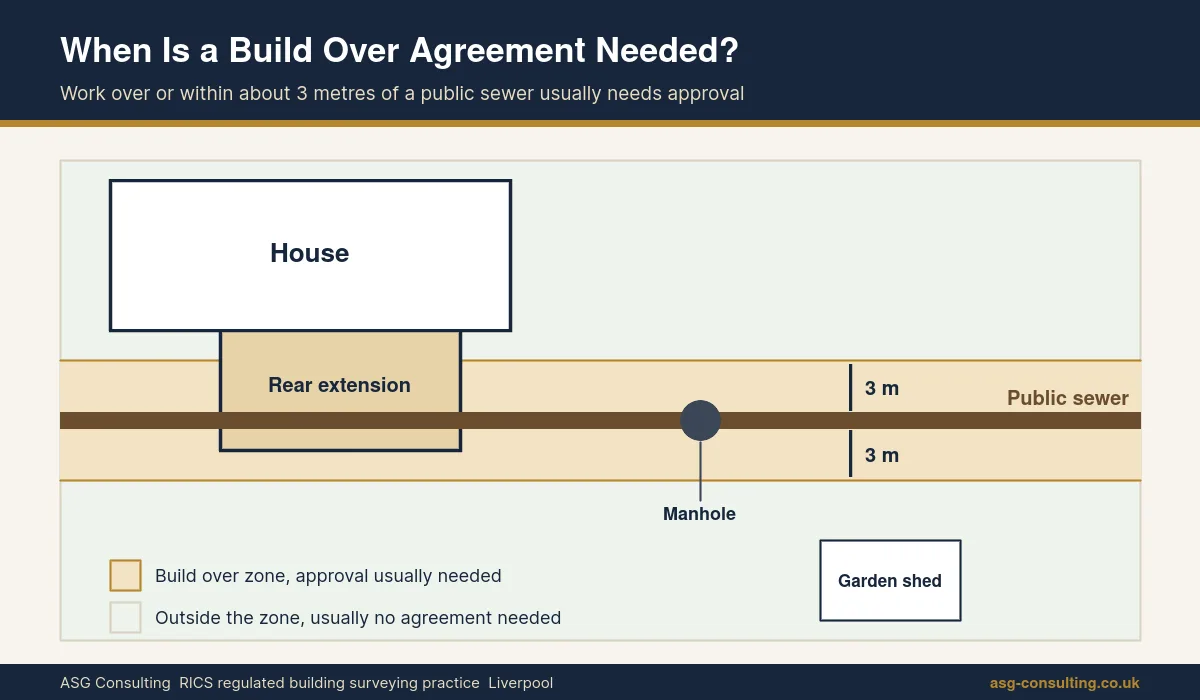
Planning permission and a build over agreement are separate. Planning permission does not give permission to build over a sewer, so an extension can have full planning approval and still be missing the water company approval.
Some pipes cannot be built over at all. United Utilities says it does not normally allow building over manholes, pumping mains, strategic sewers and most brick or masonry sewers, and a diversion of the pipe may be needed instead.
Why Do So Many Older Homes Have a Public Sewer Underneath?
The rules changed on 1 October 2011. From that date, most shared private sewers and lateral drains in England were transferred to the water companies, as announced in the government notice that water customers are no longer liable for sewerage repairs. Drains that serve one property and sit within its boundary stayed with the owner.
This means a drain shared with neighbours, which was private when an extension was built, may now be a public sewer. Many extensions built before 2011 were put up over shared drains without any agreement, simply because none was needed for a private pipe at the time.
What Are the Risks of No Build Over Agreement?
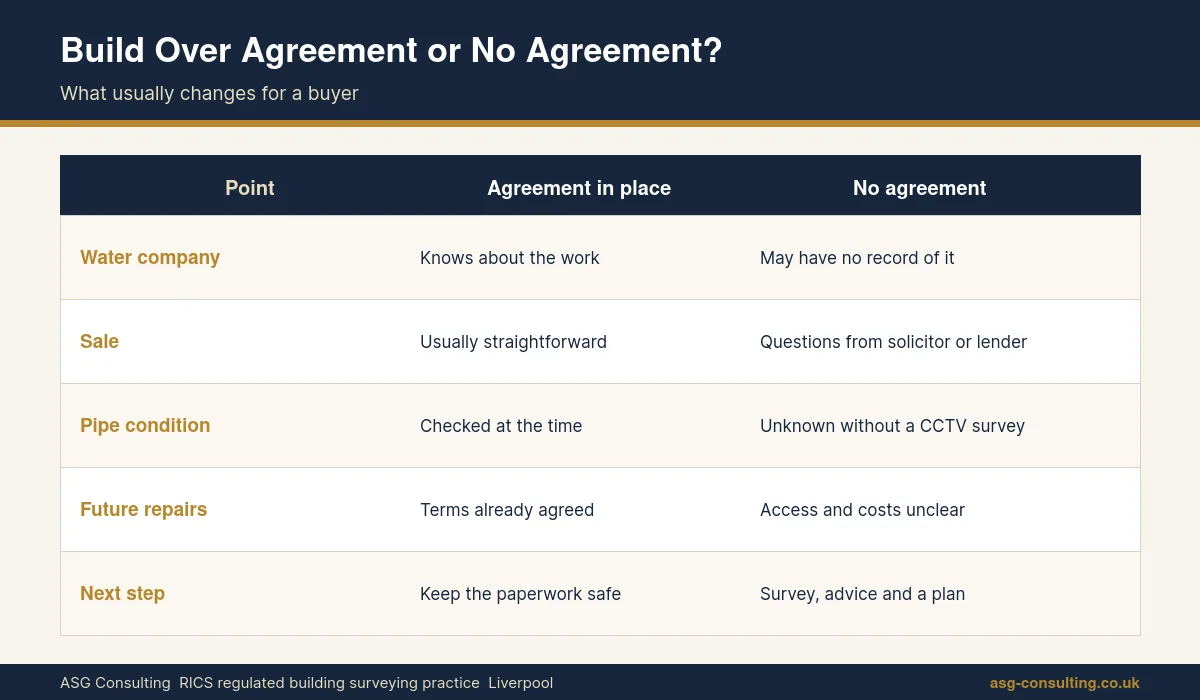
A missing agreement is not always serious, but it is worth understanding before you buy. The main risks are
- Access for repairs. If the sewer fails, the water company may need to reach it, which could mean work under or next to the extension.
- Damage to the pipe. Foundations built over a sewer can crack it, leading to leaks, blockages or movement in the ground.
- Delays in the sale. Solicitors and lenders may ask questions that slow down the purchase.
- Future costs. Repairs, a retrospective approval or a diversion can add cost and time.
What Are the 6 Easy Steps When Buying a House With a Build Over Issue?
Follow these 6 easy steps in order. Most cases are settled at step 2 or 3.
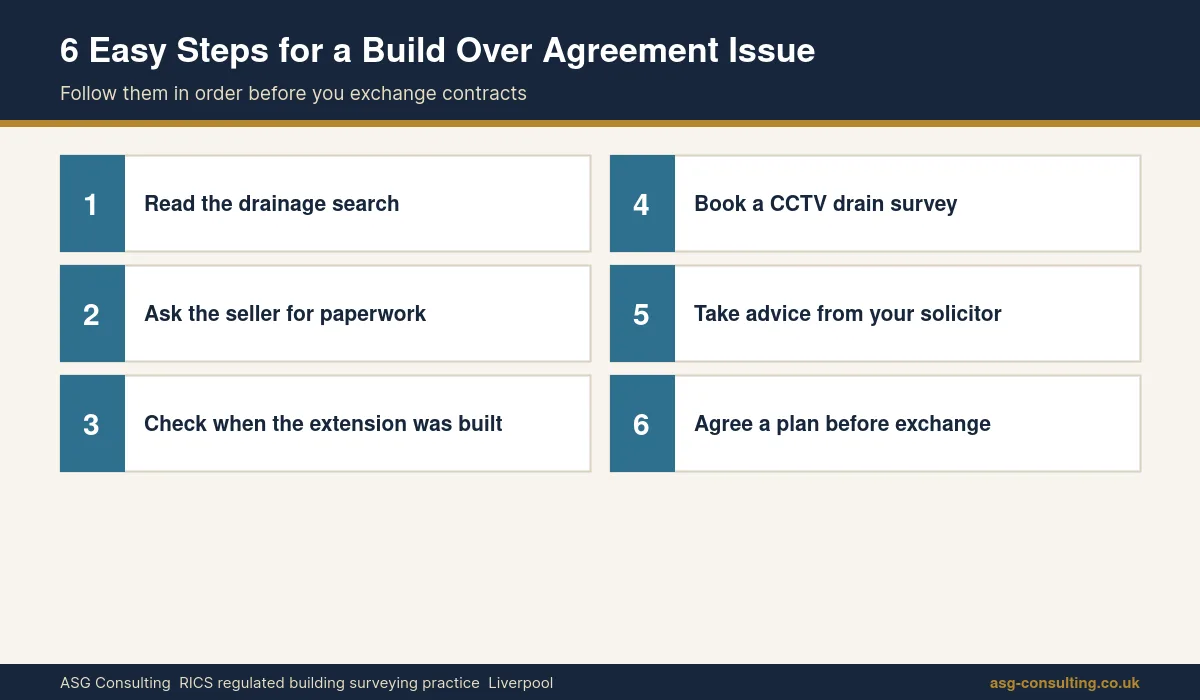
- Read the drainage search. The drainage and water search, often called a CON29DW, shows whether a public sewer is recorded within the boundary and near the buildings.
- Ask the seller for paperwork. Ask for the build over agreement, the water company approval or the Building Control completion certificate for the extension.
- Check the dates. Find out when the extension was built. Work before 1 October 2011 over a shared drain is a common reason for a missing agreement.
- Book a CCTV drain survey. A camera survey shows the route and condition of the pipe and whether it runs under the extension.
- Talk to your solicitor. Your solicitor can advise on a retrospective approval, an indemnity policy or a price reduction.
- Agree a plan before exchange. Decide who will deal with any approval or repairs, and get it confirmed in writing.
Can You Get a Retrospective Build Over Agreement?
Sometimes. United Utilities says retrospective agreements may be issued where work has already been carried out over or close to a sewer, but only by exception. The water company may ask for a CCTV survey of the pipe to check its condition before deciding.
Some solicitors suggest an indemnity insurance policy instead. Ask exactly what the policy covers and what it does not. A policy may not be available once the water company has been contacted about the property, so take advice before anyone makes that call.
How Does a CCTV Drain Survey Help?
A CCTV drain survey sends a small camera through the pipes. It records the route of the sewer, the depth where possible and any cracks, root growth, displaced joints or blockages. The report helps you, your solicitor and the water company decide whether the pipe is in good condition and whether it really sits under the extension.
The guide to a drain survey explains what the camera can find and how to read the report.
How Does a Build Over Agreement Affect an Extension You Plan?
If you plan to extend after you move in, check the sewer route first. A pipe across the back of the garden can limit where and how you build. Options may include building to one side of the pipe, using special foundations or bridging over it, or diverting the sewer.
Where approval is needed, apply early, as it can affect the design and the start date. The guide to buying a house with an extension covers the other paperwork to check for existing extensions.
Build Over Agreements in Liverpool Homes
Build over questions are very common in Liverpool. Many Victorian and Edwardian terraces in Anfield, Walton, Kensington, Wavertree and Toxteth were built with one shared drain running behind a whole row of houses. Over the years, many of these homes gained rear kitchen extensions, bathrooms and lean to rooms built over that shared drain.
Since 2011, most of those shared drains are public sewers managed by United Utilities. Interwar semis in Allerton, Childwall and Crosby can be affected too, where garages and side extensions were built over drains shared with the house next door. If you are buying an extended terrace or semi, expect the drainage search to need a close read.
Does a Home Survey Check for a Build Over Agreement?
No. A surveyor cannot confirm whether an agreement exists, as that is a legal and records question for your solicitor. A survey does note inspection chambers, signs of drainage problems and any extensions that may sit over drains, and it may recommend a CCTV drain survey.
For a conventional home in reasonable condition, a RICS HomeBuyer Survey in Liverpool is often suitable. For older or much extended homes, the Level 3 Building Survey described on the residential building surveying page gives more detail on the condition of extensions and drainage.
Build Over Agreement FAQs
What is a build over agreement?
It is permission from the water company to build over or within about 3 metres of a public sewer, with terms that protect the pipe.
Is a missing build over agreement a reason not to buy?
Not usually. Check the drainage search, ask for paperwork, consider a CCTV survey and take advice from your solicitor.
Who is the water company for Liverpool?
United Utilities manages public sewers across Liverpool, Merseyside and most of the North West.
Does planning permission cover building over a sewer?
No. Planning permission is separate, so an approved extension can still need water company approval.
Why are older extensions often affected?
Most shared private drains became public sewers on 1 October 2011, so extensions built over them earlier often have no agreement.
Does a house survey confirm a build over agreement?
No. Your solicitor checks the paperwork, while a surveyor notes drains and extensions and may recommend a CCTV drain survey.
Talk to a Surveyor at ASG Consulting
ASG Consulting is an RICS regulated building surveying practice based in Liverpool. It carries out RICS Level 2 HomeBuyer Surveys and Level 3 Building Surveys across Liverpool, Merseyside, the Wirral and the wider North West, with reports usually delivered within 3 to 5 working days of the inspection. Fees are fixed and given on request, usually confirmed within one working day. Call 0151 315 0626 to request a quote or to talk through which survey suits the property.
About the Author
Dave MacMillan is the lead surveyor at ASG Consulting, an RICS regulated building surveying practice at 54 St James Street, Liverpool. He has 8 years of experience in building surveying and inspects homes for buyers across Liverpool, Merseyside and the North West.
Last updated 27 November 2026