Planned preventative maintenance is the practice of inspecting, servicing and repairing a building on a regular schedule, before things break. Instead of waiting for a leak, a boiler failure or a blocked gutter to cause damage, owners plan the work in advance and spread the cost over time. For landlords, block managers and commercial owners, a good planned maintenance schedule is one of the simplest ways to protect property value, keep tenants safe and avoid emergency bills.
This guide is laid out as a practical calendar. It explains what planned preventative maintenance covers, sets out tasks by frequency, lists the legal safety checks landlords must not miss, shows rough life spans for major building elements and walks through how to build and budget a plan. It is written for property owners in Liverpool, Merseyside and the North West.
In this guide
- What planned preventative maintenance is
- Planned versus reactive maintenance
- Who needs a plan
- The maintenance calendar
- Seasonal checklist
- Legal safety checks for landlords
- Life spans of building elements
- How to build a plan
- Budgeting and sinking funds
- Commercial and mixed use buildings
- Records and tenants
- Common mistakes
- Liverpool and Merseyside buildings
- FAQs
What Planned Preventative Maintenance Is
Every building is made of parts that wear out at different rates. Gutters fill with leaves, sealants crack, paint flakes, boilers need servicing and roofs slowly deteriorate. Planned preventative maintenance turns all of this into a schedule of tasks, each with a set frequency, a responsible person and a budget.
A typical plan has two layers. The first is routine servicing and inspections, such as clearing gutters, testing alarms and servicing boilers. The second is longer term work, such as redecoration, roof repairs and replacing windows or kitchens, planned years ahead based on a condition survey. Together, they give owners a clear view of what needs doing, when and at what cost.
Planned Versus Reactive Maintenance
Reactive maintenance means fixing things only when they fail. It can seem cheaper in the short term, but it tends to cost more overall.
| Point | Reactive maintenance | Planned preventative maintenance |
|---|---|---|
| When work happens | After something breaks | On a set schedule, before failure |
| Cost | Emergency call outs and knock on damage | Planned work, often bundled for better prices |
| Tenant impact | Disruption, complaints and possible claims | Less disruption, fewer surprises |
| Budgeting | Unpredictable spikes | Spread over years with a sinking fund |
| Compliance | Easy to miss legal deadlines | Safety checks built into the calendar |
A blocked gutter is a good example. Clearing it costs very little. Left alone, it can overflow, soak a wall, cause damp and mould inside and lead to a disrepair complaint. Our guide to Awaabs Law explains why damp and mould now carry strict timescales for social landlords.
Who Needs Planned Preventative Maintenance
Any building benefits from a plan, but planned preventative maintenance is especially important for the following owners.
- Private landlords, who must meet safety rules and keep homes free from serious hazards.
- Social landlords and housing associations, who manage large stock and face strict timescales for damp, mould and repairs.
- Freeholders and residents management companies, who look after shared roofs, walls and communal areas on behalf of leaseholders.
- Commercial owners and occupiers, whose leases often set out repairing duties and dilapidations at the end of the term.
- Schools, churches and community buildings, where budgets are tight and failures can close the building.
Even homeowners can use a simple version of planned preventative maintenance to protect their biggest asset and avoid unwelcome surprises.
The Planned Maintenance Schedule Calendar
The infographic below shows a simple planned maintenance schedule for homes, rental property and small blocks of flats. Larger or commercial buildings will need a more detailed plan.
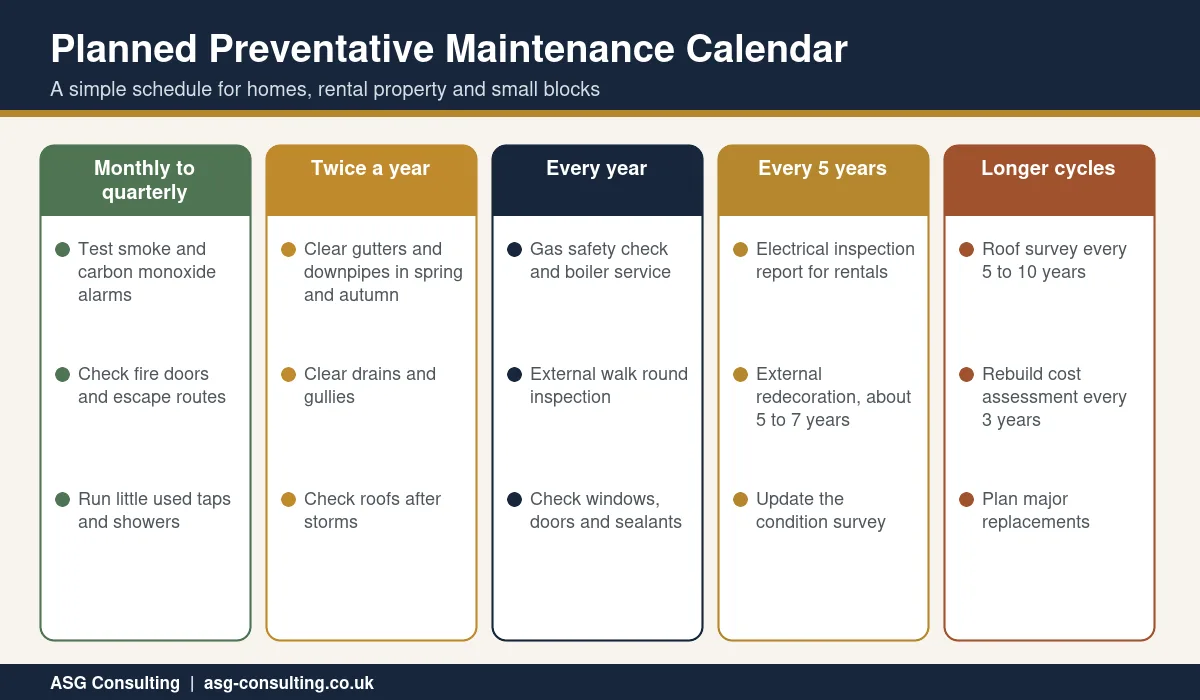
Monthly to quarterly
- Test smoke and carbon monoxide alarms, or ask tenants to do so and report faults.
- Check fire doors close fully and escape routes in shared areas are clear.
- Run little used taps and showers in empty properties to reduce legionella risk.
- Walk round communal areas to check lighting, doors and flooring.
Twice a year
- Clear gutters and downpipes, ideally in late autumn and spring.
- Check and clear drains, gullies and weep holes.
- Look over roofs from the ground and after storms for slipped tiles or damaged flashings.
- Check trees and vegetation near walls, drains and roofs.
Every year
- Gas safety check and boiler service.
- External walk round inspection of walls, windows, doors, paths and boundaries.
- Check sealants around windows, baths and showers.
- Review the maintenance plan and update the budget.
Every five years or so
- Electrical installation condition report for rented homes.
- External redecoration of timber and render, often every 5 to 7 years depending on exposure.
- Update the condition survey and long term plan.
Longer cycles
- Roof survey every 5 to 10 years, more often after severe weather. A drone roof inspection can be a quick way to check roofs that are hard to reach.
- Rebuild cost assessment for insurance, with a full review at least every three years. See our guide to a rebuild cost assessment.
- Plan replacement of major components such as boilers, windows, roofs and kitchens.
Seasonal Checklist
Building a planned maintenance schedule around the seasons makes it easier to remember and helps you beat the weather.
Autumn
- Clear gutters, downpipes and gullies once most leaves have fallen.
- Service boilers and bleed radiators before the heating season.
- Check roof coverings, chimneys and flashings before winter storms.
- Lag exposed pipes in lofts, outbuildings and voids.
Winter
- Check for condensation, damp and mould and act quickly on reports.
- Inspect roofs and gutters from the ground after storms and heavy snow.
- Keep paths and steps safe in shared areas.
Spring
- Clear gutters again and check for winter damage.
- Inspect external walls, pointing and render for frost damage.
- Plan and book summer redecoration and repairs.
Summer
- Carry out external painting, roof work and repointing in dry weather.
- Cut back vegetation from walls, roofs and drains.
- Review the year and update the plan and budget.
Legal Safety Checks for Landlords
For residential landlords, some tasks in a planned preventative maintenance plan are legal requirements. Missing them can lead to fines, prosecution and problems regaining possession. The main ones in England include the following.
| Check | Typical frequency | Notes |
|---|---|---|
| Gas safety check | Every 12 months | By a Gas Safe registered engineer, with a copy of the record given to tenants |
| Electrical installation condition report | At least every 5 years | Remedial work for unsatisfactory results must be completed within 28 days |
| Smoke alarms | Fitted on every storey with living accommodation | Checked at the start of each new tenancy |
| Carbon monoxide alarms | In rooms with a fixed combustion appliance, excluding gas cookers | Repaired or replaced when reported faulty |
| Legionella risk assessment | Reviewed regularly, often every two years | And when the water system changes |
| Fire risk assessment for shared areas | Reviewed regularly and after changes | Applies to common parts of blocks and HMOs |
The government smoke and carbon monoxide alarm booklet for landlords explains the alarm rules that came into force in October 2022. The PPM guide from Fixflo sets out the gas, electrical and legionella frequencies above. HMOs, blocks of flats and commercial buildings have extra duties, so check the rules that apply to your property type.
Life Spans of Building Elements
Long term planning depends on knowing roughly when major parts of a building will need replacing. The ranges below are rough planning guides only. Actual life depends on quality, exposure, use and how well each element is maintained, which is why a condition survey is so valuable.
| Element | Rough planning life |
|---|---|
| External paintwork to timber | About 5 to 7 years |
| Gas boiler | Around 10 to 15 years |
| Felt flat roof covering | Around 10 to 20 years |
| Kitchen and bathroom fittings | Around 15 to 25 years |
| uPVC windows and doors | Around 20 to 35 years |
| Concrete or clay roof tiles | Often 50 years or more, with repairs to fixings and flashings |
A building condition survey records the current state of each element and estimates when work will be needed, which turns these broad ranges into a realistic plan for your building.
How to Build a Planned Preventative Maintenance Plan
Whether you own one rental property or a large portfolio, the steps are similar.
- List your assets. Record each building, its age, construction and main elements.
- Get a condition survey. Ask a surveyor to inspect and rate the condition of each element and estimate remaining life.
- Add legal checks. Put gas, electrical, alarm, legionella and fire safety dates into the calendar.
- Set routine tasks. Add gutter clearing, drain checks, servicing and inspections with clear frequencies.
- Plan major works. Schedule redecoration, roof work and replacements over a 5 to 10 year period.
- Cost and budget. Attach estimated costs to each task and build a yearly budget.
- Assign responsibility. Decide who books each job and who checks it is done.
- Review every year. Update the plan after inspections, repairs and changes in condition.
For portfolios and blocks, a planned maintenance schedule works best as part of wider asset management, where maintenance, compliance, insurance and capital planning are looked at together.
Budgeting and Sinking Funds
One of the biggest benefits of planned preventative maintenance is predictable spending. Once you know when major work is likely, you can set money aside each year rather than facing a large bill all at once.
In blocks of flats, this is often done through a reserve or sinking fund collected with the service charge, where the lease allows it. A realistic long term plan helps the freeholder or management company set fair contributions and explain them to leaseholders. For individual landlords, setting aside a fixed amount each month for planned works has the same effect. Our guide to property management in Liverpool covers how this fits into day to day management.
Commercial and Mixed Use Buildings
Shops, offices, industrial units and mixed use buildings need planned preventative maintenance that goes beyond the basics. As well as the building fabric, there may be lifts, fire alarms, emergency lighting, sprinklers, air conditioning and other plant, each with its own servicing requirements and specialist contractors.
Commercial leases also shape the plan. Tenants on full repairing leases may carry most of the repair burden, while landlords may recover costs through a service charge. At the end of a lease, poor maintenance can lead to a dilapidations claim. Keeping a clear planned maintenance schedule, with records of what was done and when, helps both landlords and tenants manage these obligations and avoid disputes.
Records and Tenants
A plan only works if it is recorded and followed. Keep a log of every inspection, service, certificate and repair, with dates, contractors and photographs. Digital tools make this easier, but a well kept spreadsheet can work for smaller portfolios.
Tenants are part of the process too. Encourage them to report problems early, test their own alarms and give access for planned work. Clear communication about when contractors will visit, and why, reduces missed appointments and complaints. Good records are also your best evidence if a disrepair claim or dispute ever arises.
Using Technology to Stay on Track
For anything more than a handful of properties, software makes planned preventative maintenance much easier to run. Property management and maintenance platforms can send reminders before certificates expire, let tenants report repairs with photographs, store contractor records and produce reports for owners and auditors.
Technology does not replace inspections, though. Drones can help survey roofs and high level areas safely, moisture meters and thermal cameras can track damp, and simple sensors can warn of leaks or high humidity in empty properties. Used together with regular visits, these tools help owners spot problems early and target spending where it is needed most.
Common Mistakes
These are the mistakes we see most often when owners set up a planned maintenance schedule.
- Planning without a survey. Guessing at condition leads to work in the wrong places at the wrong time.
- Only covering compliance. Legal checks are vital, but gutters, roofs and paintwork protect the building itself.
- No budget. A plan without money set aside quickly turns back into reactive repairs.
- Not updating the plan. Buildings change, and so should the schedule.
- Poor records. If work is not logged, it is hard to prove it was done.
Planned Maintenance for Liverpool and Merseyside Buildings
Property in Liverpool and the wider North West faces some specific challenges. Many homes are Victorian or Edwardian terraces with slate roofs, chimneys, sash windows and solid walls, all of which need regular attention. Wind driven rain from the Irish Sea hits exposed elevations hard, especially near the coast at Crosby, Southport and the Wirral, so gutters, pointing and window seals need checking more often.
Converted houses and older blocks of flats also bring shared roofs, communal stairs and fire safety duties that must be built into the plan. A local surveyor who understands these building types can help you set realistic frequencies and budgets for your portfolio.
Planned Preventative Maintenance FAQs
What is the difference between planned and preventative maintenance?
The terms are often used together. Planned maintenance means work is scheduled in advance, and preventative maintenance means it is done to stop problems before they happen. A planned preventative maintenance plan combines both.
How often should a planned maintenance schedule be reviewed?
At least once a year, and after any major repair, survey or change in the use of the building.
Do small landlords need a PPM plan?
Yes, even a simple one. A short calendar of legal checks, gutter clearing, servicing and inspections can prevent expensive damage and helps show you are a responsible landlord.
Is planned preventative maintenance more expensive?
It means spending small amounts regularly, but it usually reduces total costs by avoiding emergency repairs and damage caused by neglected problems.
Where should I start?
Start with a condition survey and a list of legal safety checks. Those two things give you the foundation for a realistic plan.
Can a surveyor prepare a maintenance plan for me?
Yes. A building surveyor can inspect the property, record the condition of each element and produce a costed long term plan that you or your managing agent can follow.
What should a planned maintenance schedule include?
It should list each task, how often it is needed, who is responsible, the expected cost and when it was last done. Legal safety checks, routine servicing and longer term replacements should all be included.
How far ahead should planned preventative maintenance look?
Most plans look five to ten years ahead for major works, with a detailed one year schedule for routine tasks. Larger estates sometimes plan further ahead for roofs and other big ticket items.
Maintenance Planning in Liverpool
ASG Consulting is regulated by RICS. Our surveyors carry out condition surveys and help landlords, block managers and commercial owners across Liverpool, Merseyside and the North West turn them into practical, costed maintenance plans. To discuss your buildings, visit our asset management page.
About the Author
Harry is a property content writer with 3 years of experience writing about building surveying, commercial property and property compliance in the UK. He writes the guides at ASG Consulting for buyers, tenants and landlords, turning survey practice into clear, practical advice.
Reviewed by Dave MacMillan MRICS, chartered surveyor at ASG Consulting. Dave checks the technical content of our guides against current RICS practice before they are published.
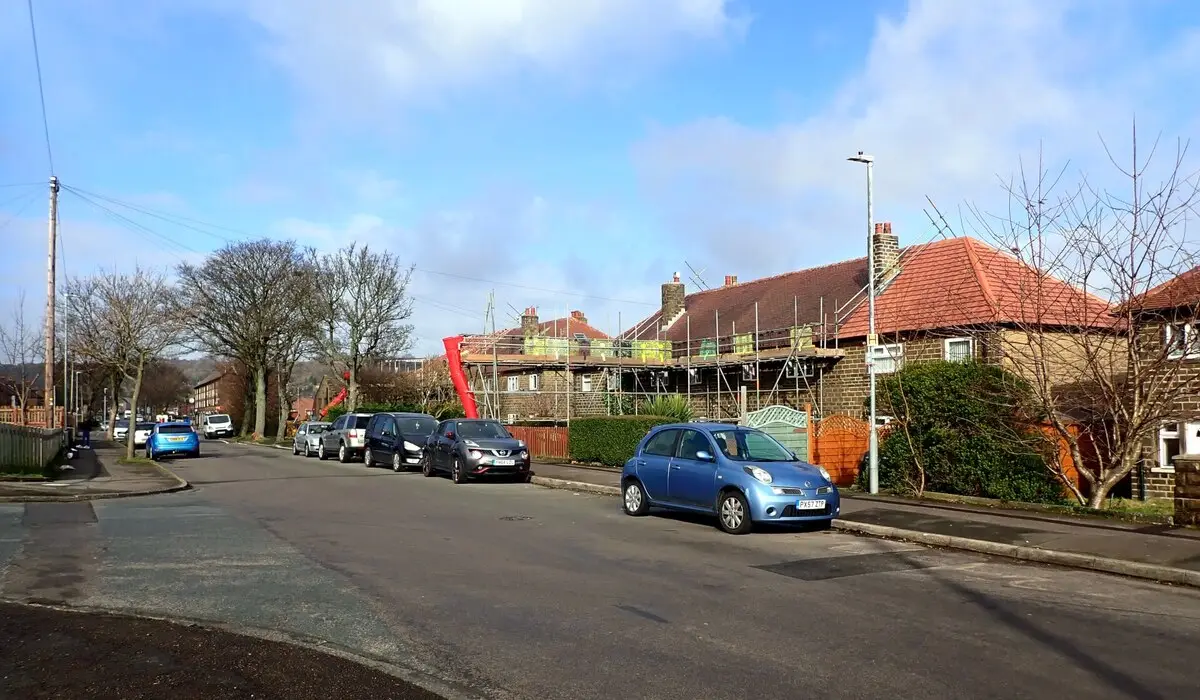
Featured photo of roofs being repaired on Sycamore Avenue, Leymoor by habiloid via Wikimedia Commons, licence CC BY SA 2.0, cropped.