If there is no FENSA certificate for replacement windows or doors fitted since April 2002, first ask the seller to order a copy, as FENSA can reissue lost certificates. If none exists, check other competent person schemes and building control records. Remaining options include a regularisation certificate, indemnity insurance or accepting the risk.
Replacement windows and doors are one of the most common reasons for missing paperwork when buying an older home. Many houses in Liverpool and the North West have had uPVC windows fitted over the last twenty years, and the certificate is often lost, never issued or not passed on. A missing certificate rarely stops a sale, but it does raise questions your solicitor will want answered. This guide works through the problem as a set of decisions, so you can see what to do next if a house you are buying has no FENSA certificate.
In this guide
- What is a FENSA certificate?
- Why does a FENSA certificate matter?
- Which windows and doors need a certificate?
- What should you do if there is no FENSA certificate?
- What are your options compared?
- How does a regularisation certificate work?
- When is indemnity insurance used?
- What should you check on the windows themselves?
- Does a survey check windows?
- What safety rules apply to replacement windows?
- What if you are buying a flat?
- What about doors, roof windows and conservatories?
- Will a lender ask for a FENSA certificate?
- What happens when you sell later?
- What should you ask the seller?
- What mistakes do buyers make?
- Replacement windows in Liverpool homes
- FAQs
What Is a FENSA Certificate?
A FENSA certificate shows that replacement windows or doors were fitted by an installer registered with FENSA, a competent person scheme for the glazing industry. Registered installers can self certify that their work meets building regulations, so the homeowner does not need a separate building control application.
FENSA is not the only scheme. The Planning Portal guidance on building regulations for doors and windows explains that you can use an installer registered with the relevant competent person scheme, or ask a building control body to check the work and issue a certificate of compliance. So a house may have valid paperwork from another scheme or from building control, even if there is no FENSA certificate.
Why Does a FENSA Certificate Matter?
The certificate is evidence that the windows meet building regulations, which cover things such as energy efficiency, safety glazing, ventilation and means of escape in a fire. FENSA explains in its guidance on selling your home that buyers and their solicitors will expect proof that replacement windows comply.
Without that proof, you cannot be sure the work was done to the required standard. In practice, the bigger risk is usually not enforcement by the council but buying windows that are poorly fitted, lack safety glass where it is needed or do not provide a safe escape route from upstairs rooms.
Which Windows and Doors Need a Certificate?
According to the Planning Portal, building regulations have applied to all replacement glazing since 1 April 2002. This table summarises the general position.
| Situation | Paperwork usually expected |
|---|---|
| Windows or doors replaced before April 2002 | No building regulations certificate needed for the replacement |
| Windows or doors replaced since April 2002 by a registered installer | A certificate from FENSA or another competent person scheme |
| Windows or doors replaced since April 2002 by an unregistered installer | A building control completion certificate |
| Repairs such as replacing broken glass or a sash cord | Usually no certificate needed |
| New windows in an extension or new opening | Covered by building regulations for the wider building work |
Ask the seller when the windows were installed. If they were fitted before April 2002, a missing FENSA certificate is not usually an issue for the replacement itself.
What Should You Do If There Is No FENSA Certificate?
Work through these steps in order. Most cases are resolved at the first or second step.
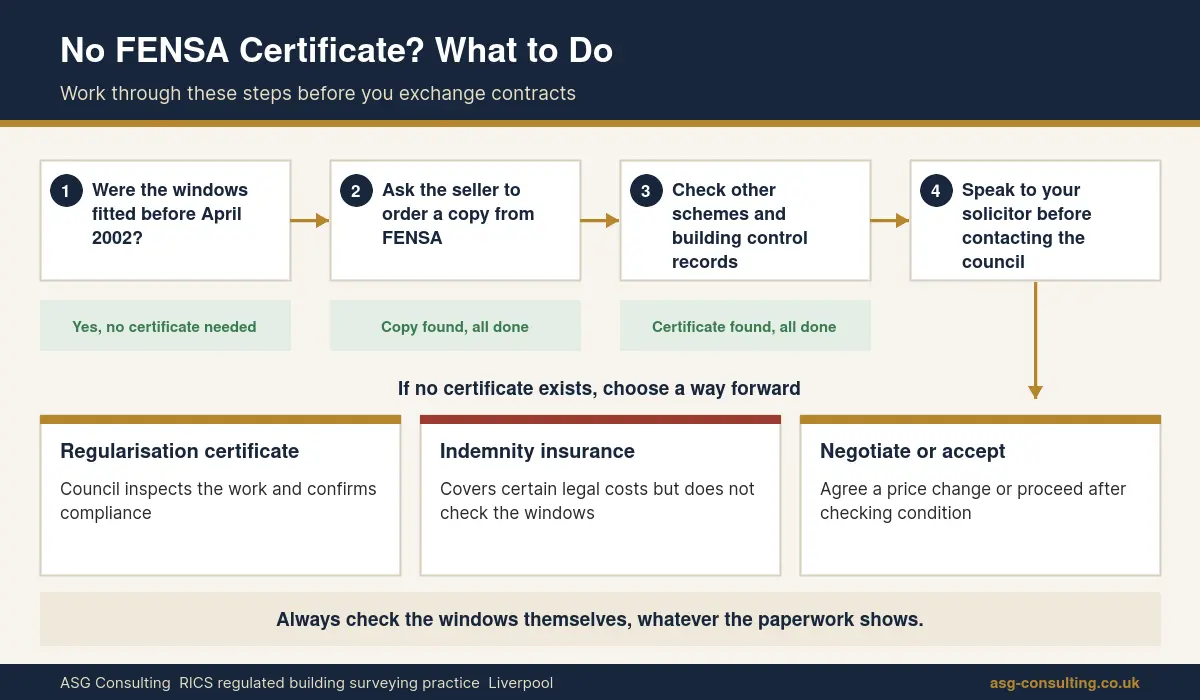
- Check the installation date. If the windows were fitted before April 2002, no certificate is needed for them.
- Ask the seller to order a copy. FENSA keeps records of registered installations and says it can reissue lost certificates through its website.
- Check other schemes. The installer may have been registered with a different competent person scheme, which will have its own records.
- Check building control records. If the work was approved by the council or a private building control body, a completion certificate may exist.
- Ask your solicitor for advice. If no certificate exists, your solicitor will explain the options and what your lender requires.
- Choose a way forward. Options include a regularisation certificate, indemnity insurance or accepting the risk, ideally after checking the condition of the windows.
What Are Your Options Compared?
If no certificate can be found, the main options look like this.
| Option | What it involves | Points to consider |
|---|---|---|
| Order a copy | The seller requests a replacement from FENSA or the relevant scheme | Quick and simple where the installer was registered |
| Regularisation certificate | The seller applies to the council, which inspects the work retrospectively | Gives real evidence of compliance but can take time and may need work |
| Indemnity insurance | A one off policy covering certain costs if the council takes enforcement action | Does not prove the windows are safe or well fitted |
| Accept the risk | Proceed without a certificate or policy | Your lender may not agree, and a future buyer may ask the same questions |
| Negotiate | Agree a price reduction or ask the seller to sort the paperwork | Depends on the market and the condition of the windows |
How Does a Regularisation Certificate Work?
A regularisation certificate is issued by the local authority building control team for work carried out without building regulations approval. An inspector visits, checks the work and may ask for parts to be opened up or improved before issuing the certificate.
For windows, an inspector may check the glazing type, safety glass in critical areas, escape windows in upstairs rooms and trickle vents where needed. Our guide to a regularisation certificate explains the process in more detail.
Important point. Contacting the council can make indemnity insurance unavailable, because many policies are not offered once the authority has been approached. Agree the approach with your solicitor before anyone contacts building control.
When Is Indemnity Insurance Used?
Indemnity insurance is often suggested as a quick solution to missing certificates. It usually covers certain financial losses if the council takes enforcement action, and it can satisfy many lenders.
However, it does not check the windows, fix defects or prove they are safe. If the windows are poorly fitted or lack safety glazing, the policy will not help with that. Use it as a legal safeguard, not as a substitute for looking at the windows properly.
What Should You Check on the Windows Themselves?
Whatever the paperwork shows, look at the windows and doors on a viewing.
- Condensation between panes. Misting inside double glazed units suggests failed seals.
- Opening and closing. Windows should open smoothly and lock securely.
- Gaps and sealant. Look for gaps around frames, cracked sealant and draughts.
- Damp and mould. Check walls and reveals around the windows for staining.
- Trickle vents. Many replacement windows have small vents in the frame to help reduce condensation.
- Safety glass marks. Glass in doors and low level panels often has a small etched mark showing it is toughened or laminated.
- Lintels above. Cracking above windows can suggest problems with the support over the opening.
Our guides to condensation in a house and cracked lintels explain related problems.
Does a Survey Check Windows?
Yes, as part of a visual inspection. A RICS home survey looks at the windows and external doors, notes their type and general condition, and comments on visible defects such as failed seals, rot, poor fitting or signs of damp. The surveyor may also note where safety or escape concerns are visible.
A surveyor does not check every window in detail or confirm compliance with building regulations, and will advise your solicitor to check for certificates. A RICS Level 2 HomeBuyer Survey suits many conventional homes, and our RICS HomeBuyer Survey in Liverpool page explains what it covers. For older or altered homes, a Level 3 Building Survey gives more detail, as explained on our residential building surveying page.
What Safety Rules Apply to Replacement Windows?
Building regulations for replacement windows are mainly about safety, energy and ventilation. The Planning Portal guidance highlights three safety points that buyers should understand.
| Requirement | What it means |
|---|---|
| Safety glazing | Glass in critical areas, such as glazed doors and low level panels, should be safety glass |
| Means of escape | A replacement window should give at least the same potential for escape as the one it replaced |
| Escape window size | Escape windows need a clear openable area of at least 0.33 square metres, at least 450mm wide and high, with the bottom of the opening no more than 1100mm above the floor |
| Ventilation | Kitchens and bathrooms need higher ventilation, and other rooms may need trickle vents |
Escape windows matter most in upstairs bedrooms and loft rooms. If a window looks too small or does not open wide enough, ask your surveyor or a window specialist to check it.
What If You Are Buying a Flat?
In a flat, windows may belong to you or to the freeholder, depending on the lease. If the freeholder replaced the windows as part of major works, the paperwork may be held by the managing agent rather than the seller.
Ask your solicitor to check who is responsible for windows under the lease and to request certificates from the right person. Our guide to a survey for buying a flat covers other lease and repair questions.
What About Doors, Roof Windows and Conservatories?
The same building regulations apply to replacement external doors that are substantially glazed, and to replacement roof windows and rooflights. So a missing certificate can relate to a new front door, French doors, patio doors or a roof window in a loft room, not just the main windows.
Conservatories are slightly different. Many conservatories are exempt from building regulations if they meet certain conditions, such as being separated from the house by external quality walls and doors and having their own heating controls. However, the glazing in a conservatory still needs to be safe, and if the separating doors have been removed the exemption may no longer apply. Our guide to conservatory problems explains what to check.
Will a Lender Ask for a FENSA Certificate?
Your lender relies on your solicitor to confirm that the property has a good title and that any required approvals are in place. If certificates are missing for work that needed them, your solicitor will usually report this and may suggest a solution such as a copy certificate, a regularisation certificate or indemnity insurance.
Each lender has its own requirements, so the right answer depends on your lender and the circumstances. Raise the issue early, so it does not cause a delay just before exchange of contracts.
What Happens When You Sell Later?
Whatever approach you take when you buy, a future buyer will probably ask the same questions. If you obtain a copy certificate or a regularisation certificate, keep it safely with your property documents. If you rely on indemnity insurance, keep the policy so it can be passed on.
If you replace windows yourself in future, use an installer registered with a competent person scheme and keep the certificate and guarantee. That makes the next sale simpler.
What Should You Ask the Seller?
Ask these questions early and share the answers with your solicitor and surveyor.
- When were the windows and doors replaced, and by whom?
- Do you have a FENSA certificate or another scheme certificate?
- Do you have any guarantees or warranties for the windows?
- Were any windows replaced as part of an extension or conversion?
- Have any double glazed units been replaced because of misting?
- Have there been any problems with leaks, draughts or condensation?
Our house viewing checklist covers other things to look at on a viewing.
What Mistakes Do Buyers Make?
Common mistakes include
- Assuming the windows are unsafe. A missing certificate often reflects lost paperwork rather than bad work.
- Assuming indemnity insurance fixes everything. It is a legal safeguard, not a quality check.
- Contacting the council too early. This can affect whether indemnity insurance is available.
- Ignoring the installation date. Windows fitted before April 2002 do not need a certificate for the replacement.
- Forgetting guarantees. A guarantee may be more useful to you than the certificate if the windows fail.
Replacement Windows in Liverpool Homes
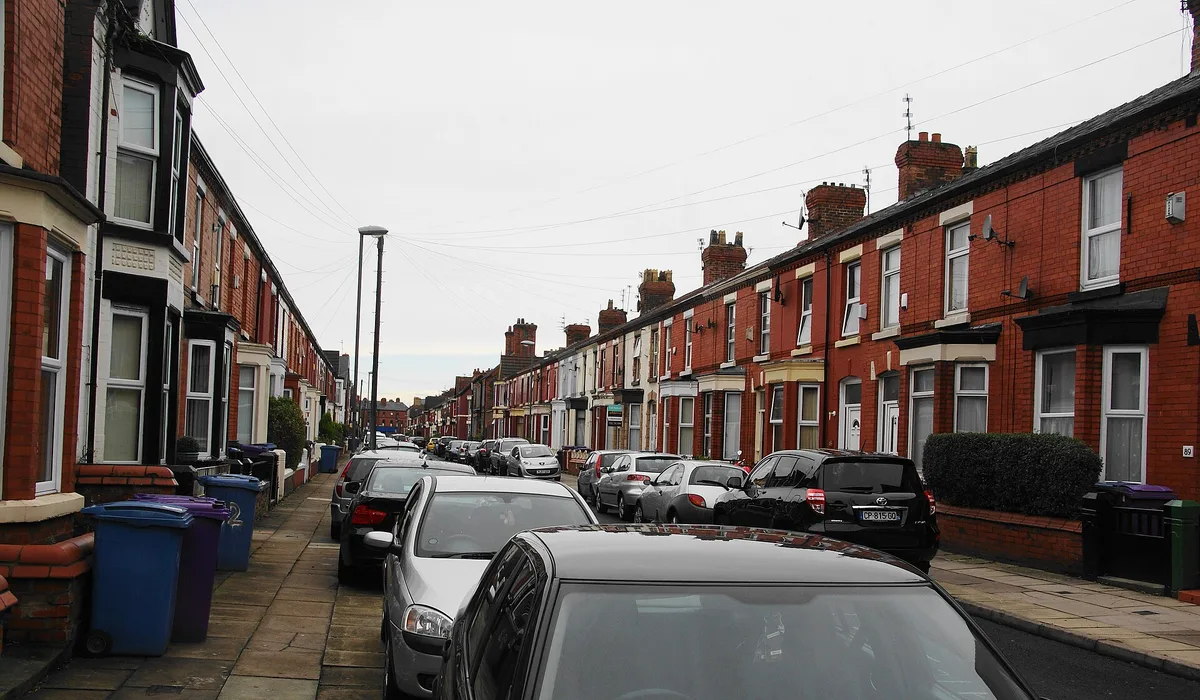
Many Victorian and Edwardian terraces in areas such as Wavertree, Anfield, Kensington and Walton have had their original timber sashes replaced with uPVC windows, often more than once. Interwar semis in Allerton, Crosby and Maghull have frequently had replacement windows and doors too. In conservation areas, replacing windows may also need planning permission where an Article 4 direction applies.
Issues to look out for in Liverpool homes include
- uPVC windows fitted without paperwork in older terraces
- missing safety glass in replacement doors and low level panels
- upstairs and loft windows that are too small to be used as escape routes
- condensation and mould where windows have no trickle vents
- replacement windows in conservation areas fitted without the required permission
Our guides to buying a house in a conservation area and a Victorian house survey cover related issues.
No FENSA Certificate FAQs
Can I buy a house with no FENSA certificate?
Yes. Many buyers do. Ask the seller to order a copy, check other schemes and building control, and agree a way forward with your solicitor.
How do I get a copy of a FENSA certificate?
FENSA says it can reissue lost certificates through its website for installations by registered installers.
Do windows fitted before 2002 need a FENSA certificate?
No. Building regulations have applied to replacement glazing since 1 April 2002, so earlier replacements do not need a certificate.
Is indemnity insurance enough if there is no FENSA certificate?
It may satisfy your lender, but it does not prove the windows are safe or well fitted, so still check their condition.
Does a homebuyer survey check for a FENSA certificate?
A surveyor inspects the windows visually and will ask your solicitor to check paperwork, but does not confirm compliance.
What is the difference between FENSA and building control approval?
FENSA lets registered installers self certify. Building control approval is an inspection and certificate from a building control body.
Book a Survey With ASG Consulting
ASG Consulting is an RICS regulated building surveying practice in Liverpool. We carry out RICS Level 2 HomeBuyer Surveys and Level 3 Building Surveys on homes across Liverpool, Merseyside, the Wirral and the wider North West, with reports usually delivered within 3 to 5 working days of the inspection. We give a fixed fee on request, usually confirmed within one working day. To request a quote, call 0151 315 0626 or visit our contact page.
About the Author
Dave MacMillan is the lead surveyor at ASG Consulting, an RICS regulated building surveying practice at 54 St James Street, Liverpool. He has 8 years of experience in building surveying and inspects homes for buyers across Liverpool, Merseyside and the North West.
Last updated 21 November 2026
Featured photo of terraced houses in Wavertree by Bill Boaden via Wikimedia Commons, licence CC BY SA 2.0, cropped.