A Japanese knotweed survey is a specialist inspection that confirms whether knotweed is present on or near a property, maps how far it has spread and sets out a plan to deal with it. Knotweed has a fearsome reputation with buyers and lenders, but the rules changed in 2022 and most cases are now far easier to manage than many people think. What matters is which category the knotweed falls into and whether there is a proper management plan in place.
This guide is built around those categories. It explains how to recognise knotweed through the year, how surveyors classify it under the RICS framework, what each category means for your mortgage, sale or purchase, what treatment costs, and what the law says about sellers and neighbours. It is written for buyers, sellers, landlords and homeowners in Liverpool, Merseyside and the North West.
In this guide
- What a knotweed survey is
- How to identify knotweed through the year
- The 2022 RICS rules
- Categories A to D explained
- When you need a specialist survey
- What the survey includes
- Treatment options and costs
- Building work and knotweed
- Common myths
- Mortgages and insurance
- Selling a house with knotweed
- Buyer checklist
- Neighbours and the law
- Liverpool and Merseyside
- FAQs
What a Japanese Knotweed Survey Is
Japanese knotweed is an invasive plant that spreads through underground stems called rhizomes. It grows quickly, can push through weak paving and poor quality walls, and is hard to remove once established. Because of this, its presence can affect how a property is valued, lent on and insured.
A standard home survey will note knotweed if the surveyor can see it. A Japanese knotweed survey goes further. It is carried out by a specialist, usually a member of the Property Care Association, who confirms the identification, measures the visible stands, assesses how far the rhizomes are likely to extend, checks neighbouring land where possible and recommends a treatment and management plan. The report is the document lenders, buyers and insurers will want to see.
How to Identify Knotweed Through the Year
Knotweed changes appearance with the seasons, which is why it is often missed or mistaken for other plants.
| Season | What to look for |
|---|---|
| Spring | Red or purple shoots pushing up like asparagus, with rolled dark leaves |
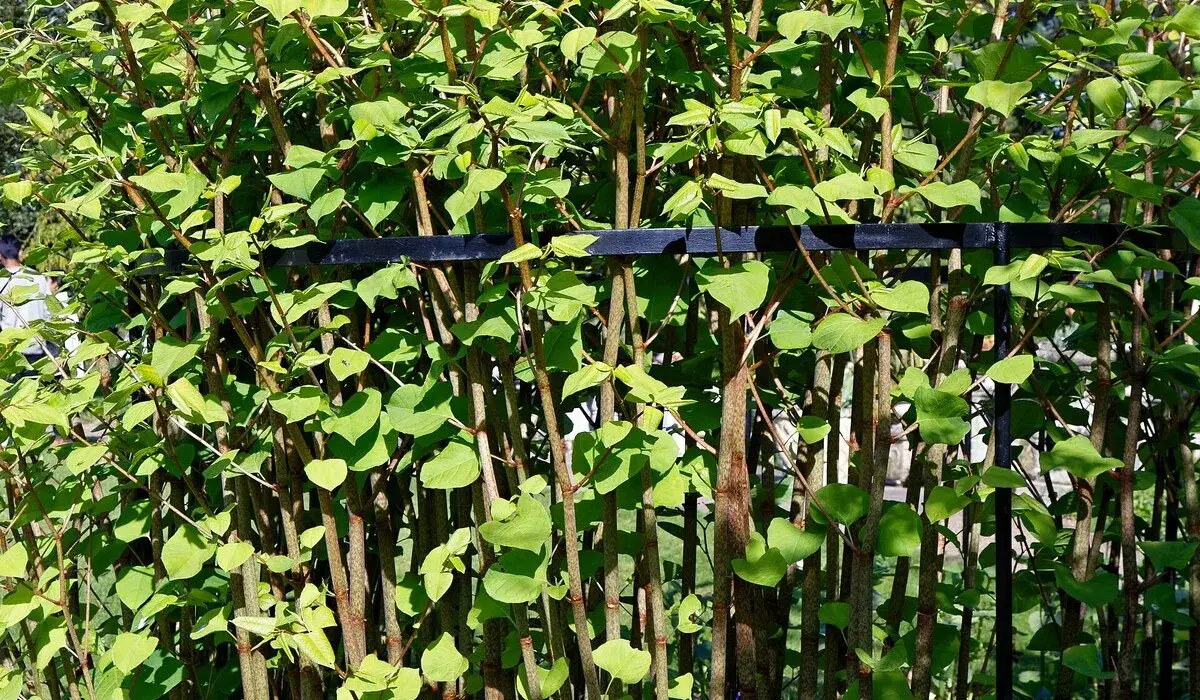
| Summer | Dense stands up to around two to three metres high, with hollow green stems speckled purple and large shield shaped leaves |
| Late summer | Clusters of small creamy white flowers hanging from the leaf joints |
| Autumn | Leaves turn yellow and fall, stems begin to brown |
| Winter | Dead brown hollow canes left standing, with new crowns hidden at ground level |
Other clues include stems that grow in a zigzag pattern from one leaf to the next, and leaves arranged alternately along the stem. Plants often confused with knotweed include bindweed, Russian vine, Himalayan balsam and some types of bamboo. If you are unsure, take clear photographs of the stems and leaves and ask a specialist.
The 2022 RICS Rules
For many years, surveyors judged knotweed risk mainly by distance, using a seven metre rule from the plant to the property. In February 2022, RICS published new guidance, Japanese knotweed and residential property, which took effect on 23 March 2022. It replaced the seven metre rule with a more practical approach based on where the knotweed is and what it is actually doing.
Under the new guidance, a surveyor carrying out a normal inspection identifies knotweed only if it is clearly visible, without checking plant by plant. If knotweed is seen, the surveyor follows a decision tree to place it in one of four management categories. For knotweed on neighbouring land, the main distance used is now three metres from the boundary, reflecting research on how far rhizomes typically spread. The guidance also recognises that substantial buildings on sound foundations are unlikely to suffer structural damage from knotweed.
Japanese Knotweed Survey Categories A to D Explained
The infographic below sums up the four management categories and what each means for lending.
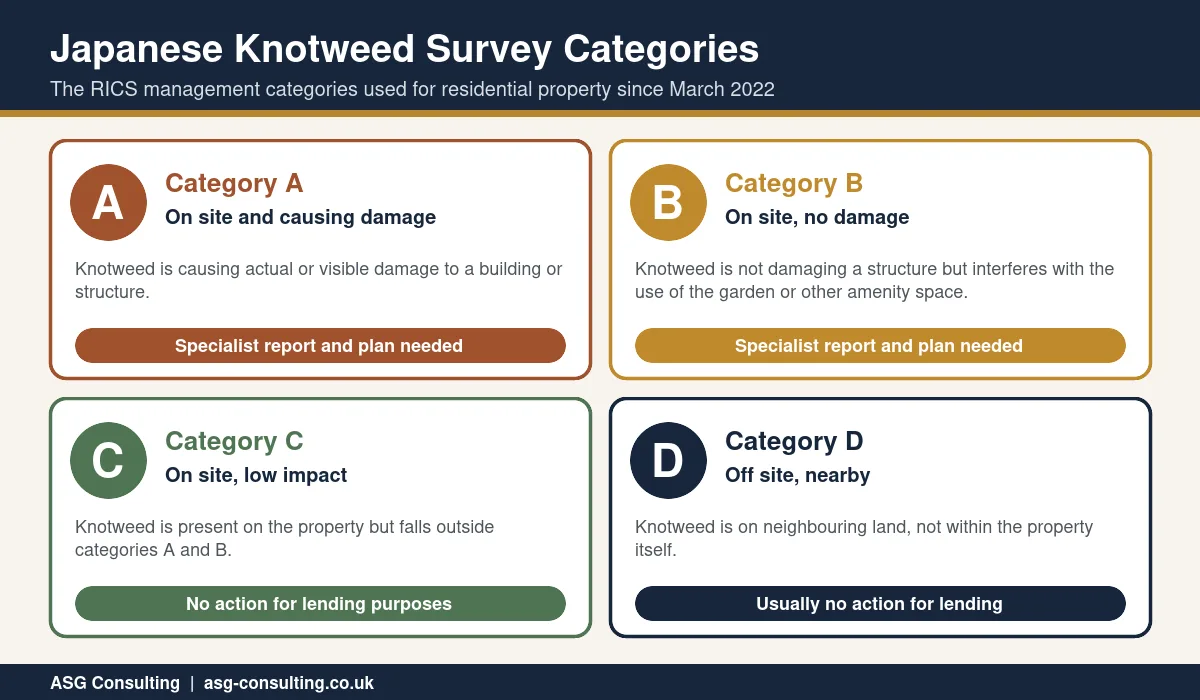
| Category | Where it is and what it is doing | What usually happens next |
|---|---|---|
| A | On the property and causing actual or visible damage to a building or structure | Specialist report, management plan and possible mortgage retention |
| B | On the property, not damaging structures, but interfering with the use of the garden or other amenity space | Specialist report, management plan and possible mortgage retention |
| C | On the property but outside categories A and B | No action needed for lending purposes, though treatment is still sensible |
| D | On neighbouring land, not on the property itself | Usually no action for lending, with advice to monitor the boundary |
The category is not just about how much knotweed there is. A small stand pushing through a patio may be category A, while a larger clump at the far end of a long garden that does not affect how the garden is used may be category C. That is why a specialist survey is so useful when the category is borderline.
When You Need a Specialist Survey
You do not need a specialist report every time knotweed is mentioned. A Japanese knotweed survey is most useful in these situations.
- Your home survey or valuation found knotweed in category A or B.
- Your lender has asked for a specialist report or a management plan before releasing funds.
- You are selling and need to answer the knotweed question on the property information form accurately.
- You suspect knotweed on your land or spreading from a neighbour.
- You are planning building work, such as an extension, where digging could spread rhizomes.
- You manage land or rental property and need a record of its condition.
For buyers, the best time to find out is before exchange. A full building survey from a Level 3 surveyor will flag visible knotweed and other defects, and the specialist report can then be ordered while there is still time to negotiate.
What the Survey Includes
A good knotweed report should be clear and practical. It will usually include the following.
- Confirmation that the plant is Japanese knotweed or a related species.
- A site plan showing each stand, its size and its distance from buildings and boundaries.
- The management category and the reasoning behind it.
- Notes on any damage to paths, walls, drains or outbuildings.
- Observations of neighbouring land where it can be seen.
- A recommended treatment method, timescale and cost.
- Details of any insurance backed guarantee that comes with the treatment.
Winter inspections can still find knotweed from its dead canes and crowns, but some stands are easier to measure in summer. A specialist will say if a return visit is needed.
Treatment Options and Costs
Knotweed can be controlled and, with time, eradicated. The right method depends on the size of the stand, the site and whether building work is planned. HouseCheckup gives these typical contractor ranges.
| Method | Typical cost | Typical timescale |
|---|---|---|
| Herbicide treatment programme | 2,000 to 5,000 pounds | About 3 to 5 years |
| Excavation and removal | 5,000 to 20,000 pounds or more | Days to weeks |
| On site burial or root barrier | 3,000 to 10,000 pounds | Varies by site |
| Combined approach | 3,000 to 8,000 pounds | About 1 to 3 years |
Herbicide treatment is the most common choice for homes because it is cheaper and less disruptive, but it takes several seasons and needs follow up visits. Excavation is faster and is often used before building work, but the soil is classed as controlled waste and must go to a licensed site. Whatever the method, ask for the plan in writing and check whether it comes with an insurance backed guarantee, commonly for 5 to 10 years.
Building Work and Knotweed
Planning an extension, a new driveway or landscaping on a site with knotweed needs extra care. Digging through rhizomes spreads tiny fragments, and each one can grow into a new plant. Soil moved from one part of a site to another, or taken away in a skip, can carry the problem with it.
If you know or suspect Japanese knotweed is present, get a specialist survey before work starts. The specialist can mark out the affected area, recommend whether to treat it first, excavate it or install a root barrier, and set out how waste soil must be handled. Builders should be told about the knotweed in writing, and machinery should be cleaned before leaving the area. Dealing with it at the planning stage is far cheaper than trying to remove regrowth from under a new floor slab.
Common Myths About Knotweed
Knotweed has attracted a lot of scary headlines. These are some common myths and the reality behind them.
- Knotweed makes a house unsellable. Homes with knotweed sell every week. A management plan and guarantee usually keep a sale on track.
- It will bring the house down. RICS guidance recognises that substantial buildings on sound foundations are unlikely to suffer structural damage. Lightweight structures and paving are more at risk.
- Any knotweed nearby means no mortgage. Knotweed on neighbouring land is category D and usually has no effect on lending.
- Cutting it down solves the problem. Cutting without treatment can encourage growth and spread fragments. Rhizomes below ground keep the plant alive.
Mortgages and Insurance
Lenders do not all take the same view, but the RICS categories have made lending decisions more predictable. In general, category C and D knotweed has little or no effect on lending. For category A and B, lenders usually want a specialist survey and a management plan from a Property Care Association member, with an insurance backed guarantee, before they lend. Some may hold back part of the loan until treatment starts.
Home insurance policies rarely cover knotweed treatment, because it is treated as a gradual problem rather than sudden damage. If you buy a property with a treatment plan in place, make sure the guarantee can be transferred to you and keep all the paperwork. A full home buyers survey will also check for other issues, such as damaged drains or walls, that knotweed may have made worse.
Selling a House with Knotweed
Sellers in England and Wales are asked about knotweed on the TA6 property information form, with the options yes, no or not known. Answering honestly matters. In the 2023 case of Downing v Henderson, a seller who answered no when knotweed had been present was found liable for misrepresentation and ordered to pay damages and costs.
If you are selling, the best approach is to get a Japanese knotweed survey, start treatment and keep the management plan and guarantee ready for buyers. A property with a professional plan and a transferable guarantee is far easier to sell than one where the problem has been ignored. If you are buying and knotweed is found, our guide to renegotiating after a survey explains how to use the findings to agree a fair price.
Buyer Checklist
If you are buying a home and knotweed comes up, work through these steps before you exchange.
- Read the seller answer on the TA6 form and ask your solicitor to raise questions.
- Check what category your surveyor or valuer has given the knotweed.
- For category A or B, order a Japanese knotweed survey from a specialist.
- Ask for the management plan, treatment records and guarantee if treatment has started.
- Confirm the guarantee can be transferred to you and is backed by insurance.
- Tell your lender and broker early so the mortgage is not delayed.
- Use the findings to agree who pays for treatment, or adjust the price.
Neighbours and the Law
Japanese knotweed is not illegal to have on your land, but several laws apply to how you deal with it.
- Private nuisance. In Network Rail v Williams in 2018, the Court of Appeal upheld damages against a landowner whose knotweed had spread into neighbouring gardens. Allowing knotweed to spread onto a neighbour can lead to a claim.
- Spreading it in the wild. Causing knotweed to grow in the wild is an offence under the Wildlife and Countryside Act 1981.
- Waste rules. Knotweed plant material and contaminated soil are controlled waste under the Environmental Protection Act 1990 and must be disposed of properly.
- Council action. Councils can issue Community Protection Notices where someone unreasonably fails to control knotweed that affects others.
The government guidance on preventing knotweed from spreading explains your responsibilities in more detail. If knotweed is coming from next door, keep dated photographs, raise it with your neighbour in writing and ask a specialist to record what is on each side of the boundary.
Japanese Knotweed in Liverpool and Merseyside
Knotweed is widespread across the North West. It thrives along railway lines, canal and river banks, former industrial land and road verges, all of which are common across Liverpool, Sefton, Knowsley, St Helens, Wirral and Warrington. Gardens that back onto these corridors, or onto overgrown alleyways and vacant plots, are more likely to see knotweed creeping in.
Many older terraced and semi detached homes in the region also have small gardens and shared alleys, where a stand on one side of a fence can quickly become a shared problem. A local surveyor who knows these patterns will check the boundaries and nearby land closely, and can advise whether a specialist Japanese knotweed survey is needed before you exchange.
Japanese Knotweed Survey FAQs
How much does a Japanese knotweed survey cost?
It depends on the size of the site and whether neighbouring land needs checking. Ask for a clear written quote, and check whether the fee can be credited against treatment if you go ahead with the same firm.
Can I still get a mortgage on a house with knotweed?
Usually yes. Category C and D knotweed often has no effect on lending. For category A and B, most lenders want a specialist report and a management plan with an insurance backed guarantee.
Will knotweed damage my house?
It can damage weak paving, garden walls, drains and lightweight outbuildings, but RICS guidance recognises that substantial buildings on sound foundations are unlikely to suffer structural damage.
Can I remove knotweed myself?
You can treat small stands yourself with suitable herbicide, but it is easy to spread it by digging or strimming, and the waste must be disposed of legally. Lenders and buyers will usually want professional treatment with a guarantee.
Is the seven metre rule still used?
No. Since March 2022, RICS surveyors use management categories A to D, with three metres from the boundary as the main distance for knotweed on neighbouring land.
Does knotweed come back after treatment?
It can regrow from rhizomes left in the ground, which is why treatment plans include several years of monitoring and follow up visits.
How long does a Japanese knotweed survey take?
A site visit for a typical home usually takes an hour or two, and the written report normally follows within a few days. Larger sites or those with access problems can take longer.
Book a Survey in Liverpool
ASG Consulting is regulated by RICS. Our surveyors identify Japanese knotweed and other defects during home surveys across Liverpool, Merseyside and the North West, explain what the category means for your purchase and advise when a specialist report is needed. To arrange a survey, visit our residential building surveying page.
About the Author
Harry is a property content writer with 3 years of experience writing about building surveying, commercial property and property compliance in the UK. He writes the guides at ASG Consulting for buyers, tenants and landlords, turning survey practice into clear, practical advice.
Reviewed by Dave MacMillan MRICS, chartered surveyor at ASG Consulting. Dave checks the technical content of our guides against current RICS practice before they are published.
Featured photo of Japanese knotweed at Myddelton House, Enfield by Acabashi via Wikimedia Commons, licence CC BY SA 4.0, cropped.