Radon when buying a house is easy to check. Radon is a natural radioactive gas from the ground. Look up the address on the official radon map or order a risk report, ask the seller for any 3 month test result, and check the local authority search. If the home is in an Affected Area and untested, agree a test after you move in.
Most buyers never think about radon, and in much of the country there is little reason to worry. In some areas, though, high levels are more likely, and long term exposure increases the risk of lung cancer. The good news is that radon is simple to test for and usually straightforward to reduce. This guide explains it in plain terms and gives you 6 safe steps to follow when dealing with radon when buying a house in Liverpool or anywhere in England.
Contents
What Is Radon?
Radon is a colourless, odourless radioactive gas. It forms naturally from small amounts of uranium in rocks and soils and seeps into buildings from the ground. Every building contains some radon, but levels are usually low.
You cannot see, smell or taste radon, so the only way to know the level in a home is to measure it. Levels vary from house to house, even on the same street, because they depend on the ground and on how each building is built and ventilated.
Why Does Radon Matter When Buying a House?
Long term exposure to high radon levels increases the risk of lung cancer, especially for people who smoke. The risk comes from breathing in radon over many years, which is why the yearly average level in a home matters more than a single short reading.
For buyers, radon is mainly a question of checking the risk, testing where needed and fixing high levels. It is rarely a reason to walk away, but it is worth sorting out before or soon after you move in.
What Do the Radon Levels Mean?
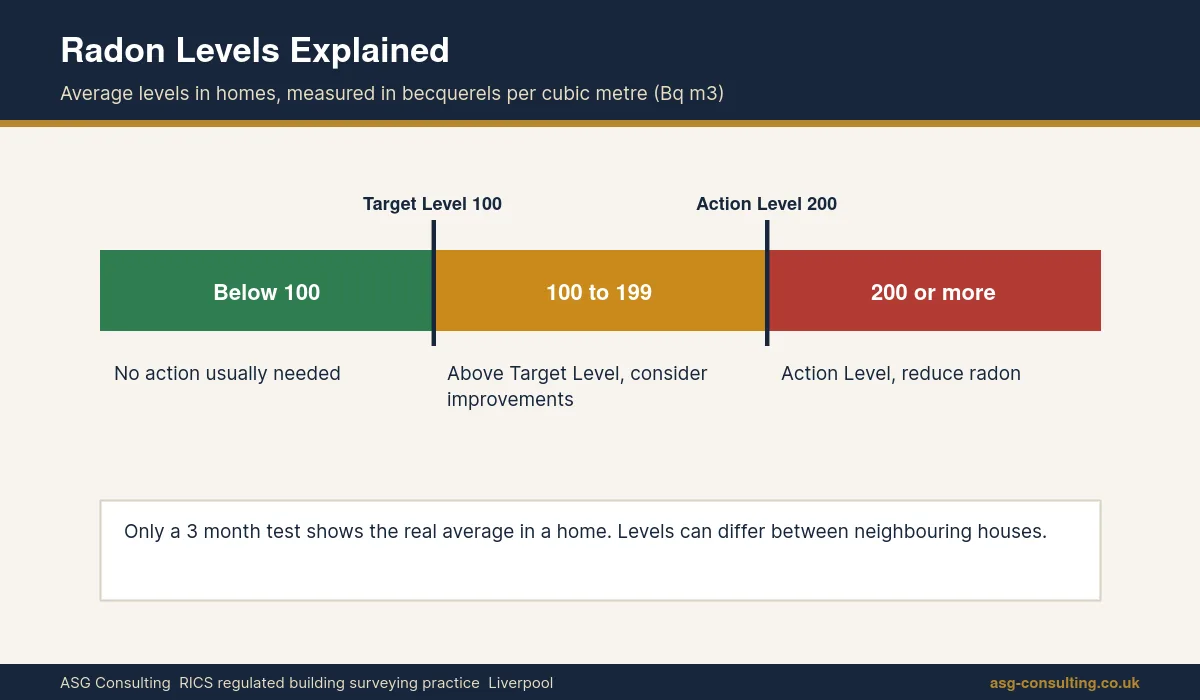
Radon is measured in becquerels per cubic metre of air, written as Bq m3. These are the two figures most buyers need to know.
| Level | What it means |
|---|---|
| Below 100 Bq m3 | Below the Target Level, no action usually needed |
| 100 to 199 Bq m3 | Above the Target Level, consider simple improvements |
| 200 Bq m3 or more | At or above the Action Level, work to reduce radon is recommended |
An Affected Area is a place where at least one in a hundred homes is estimated to be above the Action Level. Being in an Affected Area does not mean a particular home has high radon. It means a test is sensible.
What Are the 6 Safe Steps for Radon When Buying a House?
Follow these 6 safe steps to deal with radon calmly and in the right order.
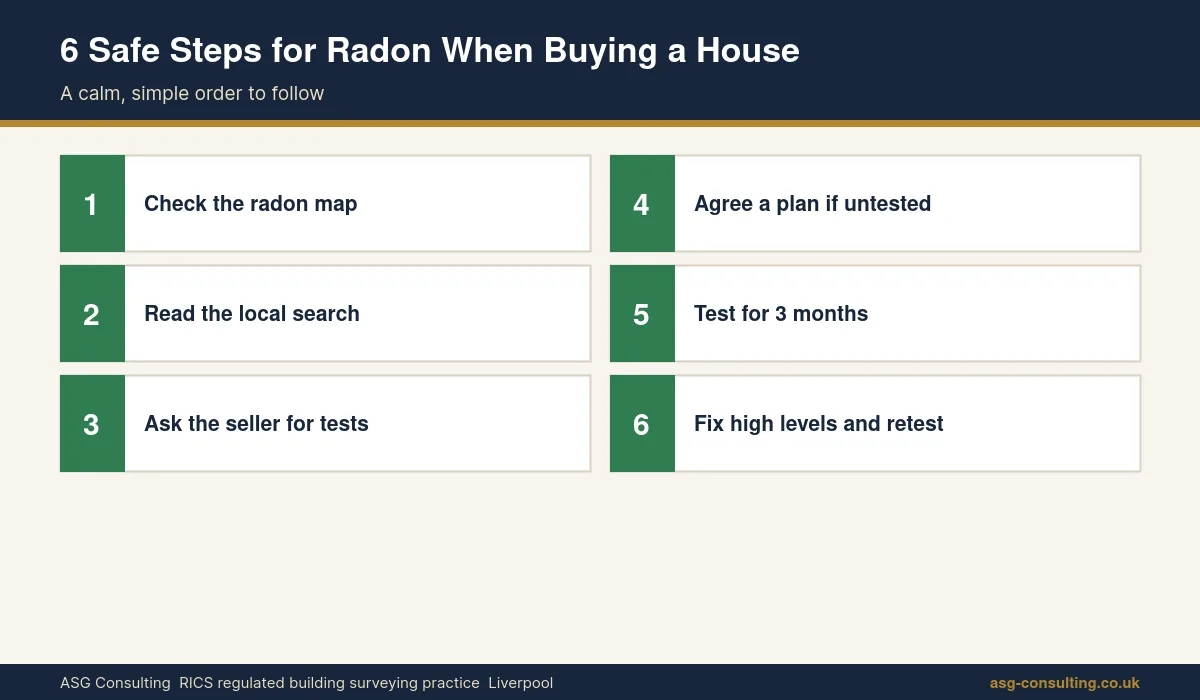
- Check the map. Use the official radon map or order a radon risk report for the address to see the chance of a high level.
- Read the local search. The local authority search shows whether the property is in a radon Affected Area.
- Ask the seller. The seller property information form asks whether a radon test has been done. Ask for a copy of any report.
- Agree a plan if untested. If the home is in an Affected Area and has not been tested, ask your solicitor about a retention, which is money held back to cover any work.
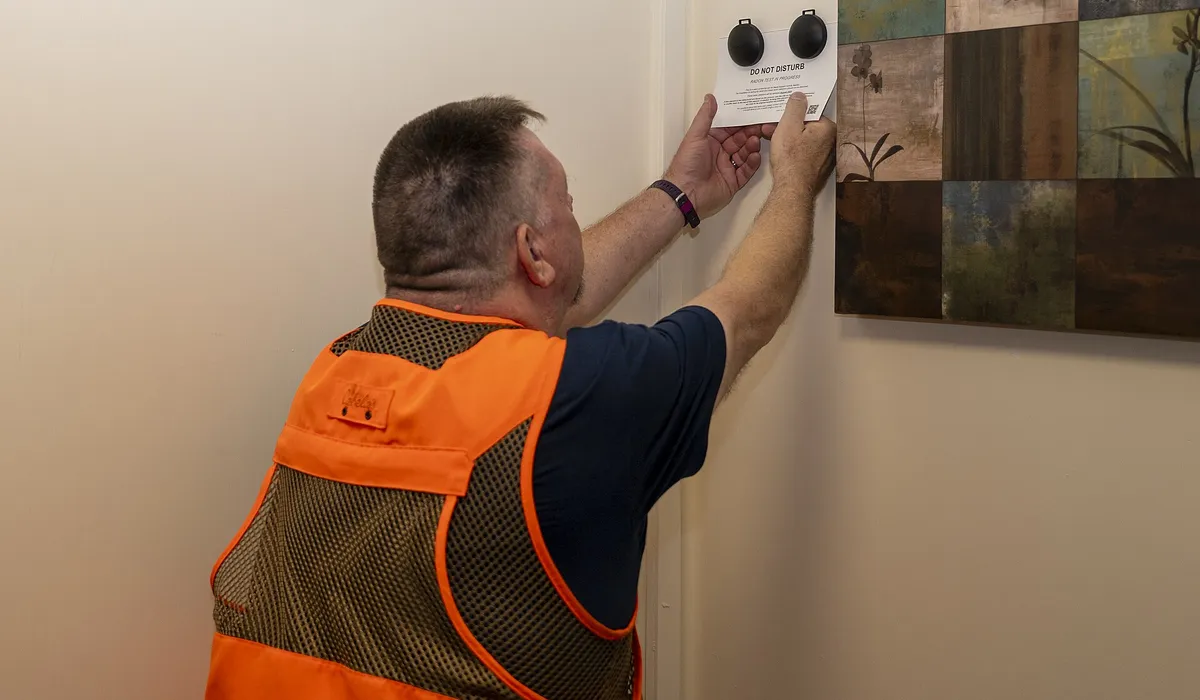
- Test after you move in. Use a 3 month home test with small detectors placed in a bedroom and a living room.
- Fix high levels. If the result is at or above the Action Level, arrange work to reduce it and test again afterwards.
The government guidance on radon for home buyers and sellers explains these steps, including how a retention works and how long the money is usually held.
How Do You Test a Home for Radon?
Testing is simple. Small plastic detectors are placed in the home for 3 months, then posted back to a laboratory. The result gives the average radon level, adjusted for the time of year.
A 3 month test gives a much more reliable result than a short test, because radon levels rise and fall with the weather and the seasons. Most buyers test after moving in, as there is rarely time to complete a full test before exchange.
How Are High Radon Levels Reduced?
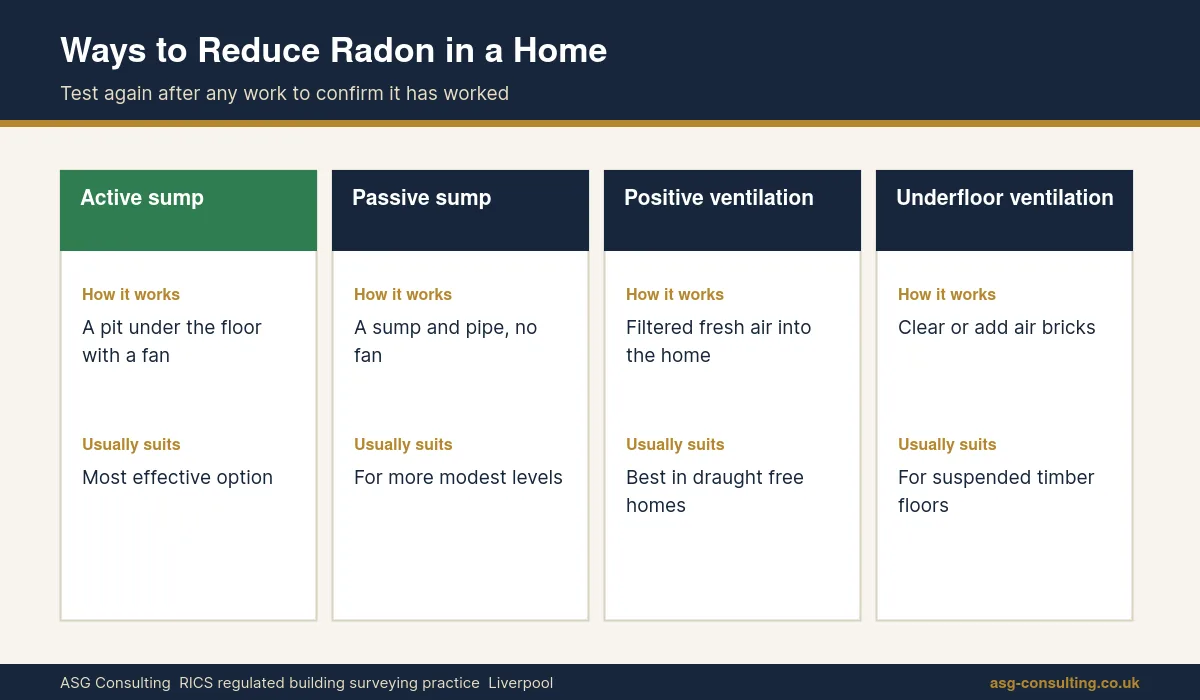
Reducing radon usually involves stopping it from getting into the house from the ground, or diluting it with fresh air. The government guidance on reducing radon levels in your home describes the main methods.
| Method | How it works | Usually suits |
|---|---|---|
| Active radon sump | A small pit under the floor with a fan that draws radon out | Most homes, the most effective option |
| Passive radon sump | A sump with a pipe and no fan | Homes with more modest levels |
| Positive ventilation | A unit that brings filtered fresh air into the home | Well insulated, draught free homes |
| Under floor ventilation | Clearing or adding air bricks, sometimes with a fan | Homes with suspended timber floors |
The guidance says a single sump is usually enough for an average sized home and normally takes 1 to 2 days to fit. Positive ventilation can also help with condensation, as explained in the guide to condensation in a house. Always test again after the work to confirm it has worked.
What Does Radon Cost to Fix?
The government guidance on radon for buyers gives a typical cost for remedial work of 2,500 to 3,000 pounds, which it uses as a guide for retentions. This is a general figure only. The actual cost depends on the house, the floor type and the method used.
Do New Build Homes Have Radon Protection?
Some do. Where Building Regulations require it, new homes in higher risk areas are built with a gas proof membrane, and some also have a sump fitted under the floor and capped for future use. The guidance still recommends testing after moving in, because protection does not guarantee a low level.
Are Cellars and Basements a Higher Risk?
Yes. Rooms below ground are in closer contact with the soil, so they are more likely to have higher radon levels wherever the home is. If a cellar is used as a living space, bedroom or office, testing is especially sensible. The guide to a damp cellar covers other issues to check in below ground rooms.
Radon in Liverpool and the North West
Radon risk varies across the North West. Local reporting on the official map shows that most of Merseyside, a low lying area with mostly sandstone bedrock, has low radon potential, with Liverpool city centre in the lowest band. There are pockets with a higher chance, including around Croxteth Park, south of Neston on the Wirral and around Prescot, St Helens and Skelmersdale. Risk can change over short distances, so always check the specific address.
Many Victorian terraces across Liverpool, in areas such as Anfield, Walton, Kensington and Toxteth, have cellars. Some have been converted into living space. If you plan to use a cellar as a room, consider a radon test even if the area risk is low. Homes with suspended timber floors also benefit from clear air bricks, which help keep both radon and damp under control.
Does a Home Survey Check for Radon?
No. A building surveyor cannot measure radon during a visit. A survey does note features that matter, such as cellars, blocked air bricks and suspended floors, and may recommend that you check the radon risk for the address.
For a conventional home in reasonable condition, a RICS HomeBuyer Survey in Liverpool is often suitable. For older homes with cellars or altered floors, the Level 3 Building Survey described on the residential building surveying page gives more detail.
Radon When Buying a House FAQs
Should I worry about radon when buying a house?
Usually not. Check the risk for the address, ask about past tests and test after you move in if the home is in an Affected Area.
How long does a radon test take?
A standard home test takes 3 months, which gives a reliable average level.
What is the radon Action Level?
The Action Level is 200 Bq m3. At or above this level, work to reduce radon is recommended.
Can radon be fixed?
Yes. A radon sump or improved ventilation usually reduces levels well. Test again after the work.
Is Liverpool a high radon area?
Most of Liverpool is in the lowest risk bands, but some pockets, such as around Croxteth Park, have a higher chance. Check the address.
Does a house survey test for radon?
No. A surveyor notes features such as cellars and air bricks, but radon needs a separate test.
Talk to a Surveyor at ASG Consulting
ASG Consulting is an RICS regulated building surveying practice based in Liverpool. It carries out RICS Level 2 HomeBuyer Surveys and Level 3 Building Surveys across Liverpool, Merseyside, the Wirral and the wider North West, with reports usually delivered within 3 to 5 working days of the inspection. Fees are fixed and given on request, usually confirmed within one working day. Call 0151 315 0626 to request a quote or to talk through which survey suits the property.
About the Author
Dave MacMillan is the lead surveyor at ASG Consulting, an RICS regulated building surveying practice at 54 St James Street, Liverpool. He has 8 years of experience in building surveying and inspects homes for buyers across Liverpool, Merseyside and the North West.
Last updated 26 November 2026