When buying a house with a shared driveway, find out who owns the drive, what rights each neighbour has, who pays for repairs and whether parking is allowed. These details sit in the title register and deeds, so ask your solicitor to check them. A survey looks at the condition of the drive, walls and drainage.
Shared driveways are common across Liverpool and the North West, from 1930s semis with a side drive leading to garages at the back to cul de sacs, converted farm buildings and newer estates. Most work smoothly, but they can also be a source of disagreements about parking, repairs and access. This guide works through the most common shared driveway situations one at a time, so you can see what to check and what to ask before buying a house with a shared driveway.
In this guide
- What is a shared driveway?
- Who owns a shared driveway?
- Where are the rights written down?
- What are the common shared driveway situations?
- Can you park on a shared driveway?
- Who pays for repairs?
- What if the rights are not written down?
- What about unadopted roads?
- Will a shared driveway affect your mortgage?
- What does a survey look at?
- What should you check, step by step?
- What should you ask the seller?
- What if you want to change the driveway?
- How are shared driveway disputes avoided?
- What mistakes do buyers make?
- Shared driveways in Liverpool
- FAQs
What Is a Shared Driveway?
A shared driveway is a drive or access road used by more than one property. It might run between two semi detached houses to garages at the back, serve a short row of houses behind the street, or form a private lane leading to several homes.
The important point for buyers is that sharing the use of a driveway is not the same as sharing ownership. Two neighbours can both drive along it every day while only one of them owns the land. What matters is what the legal documents say about ownership, rights and responsibilities.
Who Owns a Shared Driveway?
There are several common ownership arrangements.
| Arrangement | What it means | Points for buyers |
|---|---|---|
| Owned by one property | One owner holds the land and the other has a right of way over it | Check the exact rights and any limits on use |
| Split down the middle | Each owner owns half, with rights to cross the other half | Both halves need mutual rights of way |
| Owned by a third party | A developer, management company or other owner holds the land | Check for service charges and maintenance obligations |
| Unadopted road | A private road not maintained by the council | Frontagers may be responsible for upkeep |
| Unregistered or unclear | Ownership is not clearly recorded | Needs careful legal checks before you commit |
Where Are the Rights Written Down?
For registered land, HM Land Registry records ownership and many rights in the title register. Its guide on how to read a title register explains that
- the property register can record rights the land benefits from, such as a private right of way
- the charges register records burdens, including rights of way for others to cross the property
- restrictive covenants that limit how the land can be used also appear in the charges register
A legal right of way is a type of easement, which means a right over one piece of land that benefits another. HM Land Registry practice guide 62 on easements explains how these rights are registered. Your solicitor will check the register for both the house you are buying and, where relevant, the land the driveway crosses.
What Are the Common Shared Driveway Situations?
Here are six situations buyers often meet, with what to check in each.
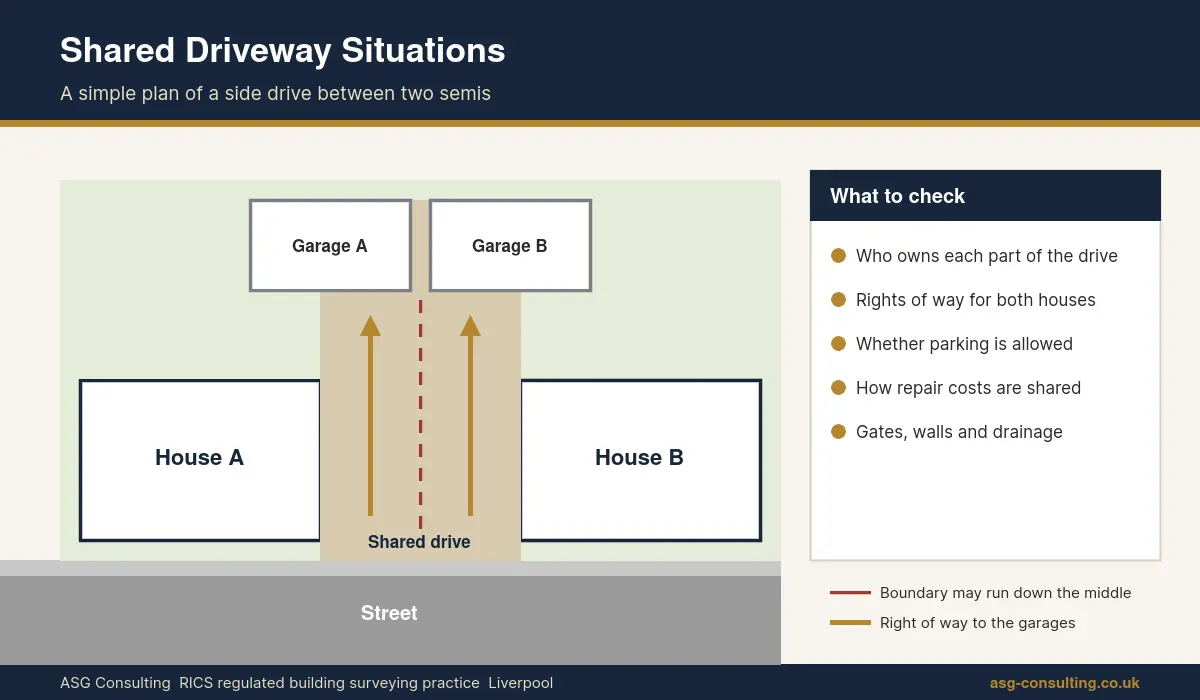
1. A side drive between two semis
Common in 1930s suburbs, a single drive runs between two houses to garages or gardens at the back. Check whether it is split down the middle with mutual rights or owned by one house, and who pays for resurfacing and drainage.
2. Your access crosses land owned by a neighbour
You rely on a right of way to reach your house or garage. Check that the right is clearly recorded, wide enough for vehicles and not limited to certain times or uses.
3. Your driveway is crossed by a neighbour
Someone else has the right to use part of your drive. Check what the right allows, whether they can park and whether they must contribute to repairs.
4. A private lane serving several houses
Several owners use a lane that may be owned by one of them, all of them or a third party. Check maintenance arrangements, any management company and whether the lane is adopted by the council.
5. A shared drive on a newer estate
Some estates have private drives serving a few houses, sometimes with a management company. Check service charges and whether the developer still owns any of the land.
6. A rear alley or entry behind a terrace
Many terraces have shared rear alleys. Check whether you have a right to use the alley, whether it is gated and who maintains it.
Can You Park on a Shared Driveway?
Not automatically. A right of way is usually a right to pass and repass, which does not necessarily include a right to park or to stop for long periods. If parking matters to you, check exactly what the deeds allow.
Parking disagreements are one of the most common shared driveway problems. Ask the seller how parking works in practice, and whether there have been any complaints. If the deeds are silent and the neighbours have an informal arrangement, remember that informal arrangements can change when people move.
Who Pays for Repairs?
The deeds may contain a covenant setting out how maintenance costs are shared, for example in fair proportions between the owners who use the drive. Some newer developments have a management company that charges a fee.
Where the deeds are silent, the position can be less clear, and agreeing who pays for resurfacing, drainage or retaining walls can cause disagreements. Ask your solicitor to explain what the documents say, and ask the seller how repairs have been handled in the past.
What If the Rights Are Not Written Down?
Sometimes a driveway has been used for many years without any written right. Rights of way can, in some cases, be acquired through long use. HM Land Registry practice guide 52 on easements claimed by prescription explains that the use must usually have continued for at least 20 years, without force, without secrecy and without permission.
Relying on unwritten rights carries more risk. Your solicitor may suggest asking the seller for a statutory declaration about past use, applying to register the right, obtaining indemnity insurance or arranging a formal deed of grant with the neighbour. Your lender may also have requirements, so raise this early.
What About Unadopted Roads?
An unadopted road is a road that the local highway authority does not maintain at public expense. Many private lanes, older back roads and some newer estate roads are unadopted. The owners of the properties that front onto the road, or a management company, may be responsible for repairs, lighting and drainage.
If the driveway leads onto an unadopted road, ask your solicitor to check who owns it, what rights you have to use it and how maintenance is organised. Some estates are built with the intention that the council will adopt the roads later, but this does not always happen. The local search will usually show whether a road is maintained by the council.
Unadopted roads are not necessarily a problem, but the cost of resurfacing or repairing drainage can be shared between relatively few households, so it is worth understanding the arrangement before you buy.
Will a Shared Driveway Affect Your Mortgage?
Lenders want to be sure the property has proper legal access, because a house that cannot be reached is harder to sell. Your solicitor will check the access rights and report any concerns to the lender as part of the conveyancing process.
In most cases, a shared driveway with clear, registered rights causes no problems. Issues are more likely where access relies on unwritten rights, where the drive crosses land with an unknown owner or where the rights do not cover vehicles. In those situations, the lender may ask for extra evidence, a deed of grant or indemnity insurance, so raise any concerns early to avoid delays near exchange.
What Does a Survey Look At?
A surveyor does not check the legal rights, but a survey looks at the physical condition of the driveway and the things around it. That can include
- the condition of the surface and any trip hazards
- drainage, standing water and gullies
- retaining walls and boundary walls beside the drive
- gates, fences and boundary features
- trees whose roots may lift the surface
- signs that the drive layout does not match the boundaries shown on plans
If the surveyor spots something that suggests a legal issue, such as a gate across a neighbour access or a wall in an odd position, they will flag it for your solicitor. A RICS Level 2 HomeBuyer Survey suits many conventional homes, and our RICS HomeBuyer Survey in Liverpool page explains what it covers. For older or altered homes, a Level 3 Building Survey gives more detail, as explained on our residential building surveying page.
What Should You Check, Step by Step?
Follow these steps when buying a house with a shared driveway.
- Walk the driveway. Note where it starts and ends, who uses it and where people park.
- Compare it with the title plan. Ask your solicitor to show you the boundaries and any rights.
- Check ownership. Find out who owns each part of the drive.
- Check rights of way. Confirm your rights and any rights others have over your land.
- Check maintenance terms. Look for covenants or service charges.
- Ask about parking. Confirm what is allowed and how it works in practice.
- Ask about disputes. The seller should disclose any disputes in the property information forms.
- Get a survey. Check the condition of the surface, walls and drainage.
- Talk to the neighbours. A friendly chat can tell you a lot about how the arrangement works.
What Should You Ask the Seller?
Ask these questions early and share the answers with your solicitor.
- Who owns the driveway, and is it shown on the title plan?
- Who else uses it, and for what?
- Where do you and the neighbours park?
- Who has paid for repairs, and how were costs shared?
- Have there been any disagreements or complaints?
- Are there any gates, and who has keys or fobs?
- Is any part of the drive maintained by a management company or the council?
Our house viewing checklist covers other questions to ask on a viewing.
What If You Want to Change the Driveway?
Plans to widen, resurface, gate or extend over a shared drive need care. You may need agreement from the other users, and work must not interfere with their rights of way. Planning rules can also apply, for example to new hard surfaces in front gardens or new access onto a road.
If you plan to build an extension or garage beside a shared drive, check that the work will not block access or affect a shared wall. Our guides to garage conversions and the party wall surveyor process explain related considerations.
How Are Shared Driveway Disputes Avoided?
Most shared driveway disagreements come from unclear rights or different expectations. Good practice includes
- knowing exactly what the deeds say before you move in
- keeping the drive clear unless parking is allowed
- agreeing repairs in writing before work starts
- sharing quotes and receipts for any joint costs
- talking to neighbours early if something changes
If a disagreement does arise, mediation is often quicker and cheaper than court. Our boundary dispute surveyor guide explains how surveyors can help where the physical boundary is in question.
What Mistakes Do Buyers Make With Shared Driveways?
Common mistakes include
- Assuming you can park. A right of way does not always include parking.
- Relying on informal arrangements. Friendly agreements may not survive a change of neighbour.
- Ignoring repair costs. Resurfacing a long drive or repairing a retaining wall can be expensive.
- Not checking the title plan. The drive on the ground may not match the plan.
- Overlooking access for works. Builders, skips and deliveries may need to use the shared drive.
Shared Driveways in Liverpool
Shared side driveways are a familiar feature of many interwar suburbs around Liverpool, such as parts of Allerton, Childwall, Woolton, Crosby and Maghull, where pairs of semi detached houses often share a drive to garages at the back. Many Victorian and Edwardian terraces across the city have shared rear alleys, some of which are now gated. Rural parts of the Wirral and Cheshire also have private lanes serving several homes.
Issues to look out for around Liverpool include
- side drives split down the middle with unclear repair arrangements
- garages at the back of semis reached only over a neighbour half of the drive
- gated rear alleys where access and keys need checking
- uneven surfaces lifted by tree roots
- private lanes and unadopted roads with no clear maintenance plan
Our guides to a 1930s house survey and flying freeholds cover other shared ownership issues common in older homes.
Buying a House With a Shared Driveway FAQs
Is it a bad idea to buy a house with a shared driveway?
Not usually. Many work well. Check ownership, rights of way, parking and repair arrangements before you buy.
How do I know who owns a shared driveway?
Your solicitor will check the title register and title plan from HM Land Registry, which show ownership and many rights.
Can my neighbour park on our shared driveway?
Only if the deeds allow it. A right of way usually allows passing along the drive, not necessarily parking on it.
Who pays to repair a shared driveway?
It depends on the deeds. Some set out how costs are shared. Where they are silent, agree repairs in writing with the other users.
Does a survey check a shared driveway?
A survey looks at the condition of the drive, walls and drainage. The legal rights are checked by your solicitor.
Can a right of way be gained through long use?
In some cases, yes. HM Land Registry guidance explains that use usually needs to continue for at least 20 years without force, secrecy or permission.
Book a Survey With ASG Consulting
ASG Consulting is an RICS regulated building surveying practice in Liverpool. We carry out RICS Level 2 HomeBuyer Surveys and Level 3 Building Surveys on homes across Liverpool, Merseyside, the Wirral and the wider North West, with reports usually delivered within 3 to 5 working days of the inspection. We give a fixed fee on request, usually confirmed within one working day. To request a quote, call 0151 315 0626 or visit our contact page.
About the Author
Dave MacMillan is the lead surveyor at ASG Consulting, an RICS regulated building surveying practice at 54 St James Street, Liverpool. He has 8 years of experience in building surveying and inspects homes for buyers across Liverpool, Merseyside and the North West.
Last updated 20 November 2026
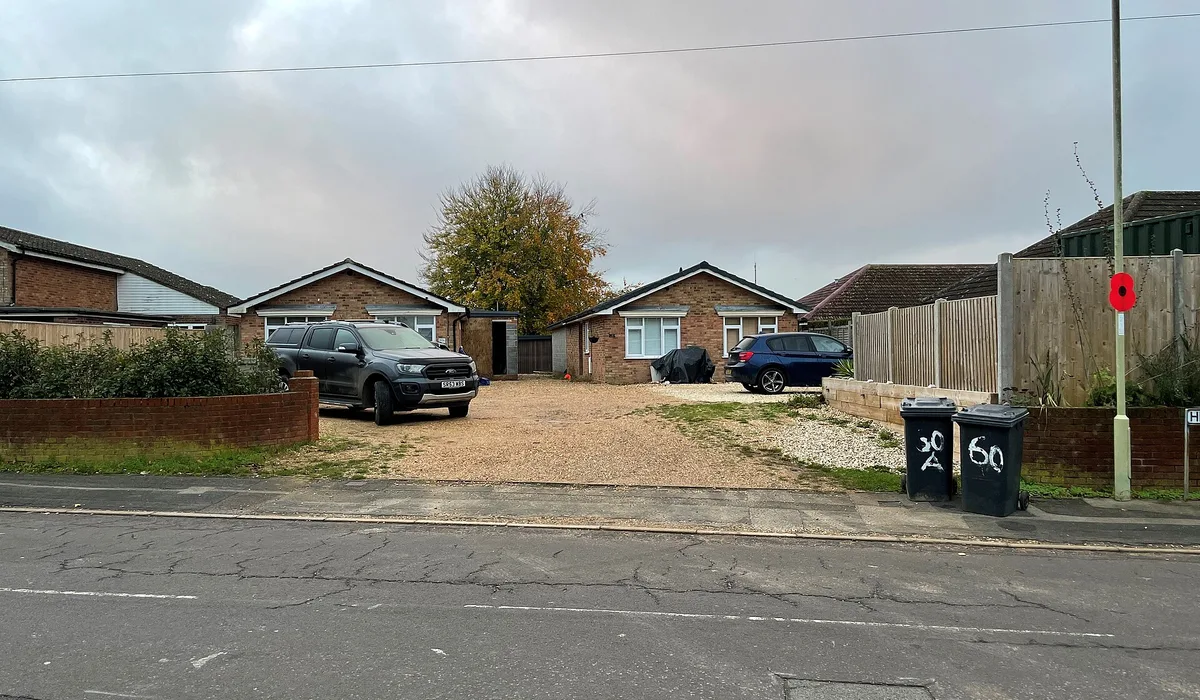
Featured photo of a shared driveway on Hill Road by Mr Ignavy via Wikimedia Commons, licence CC BY SA 2.0, cropped.