Buying a flat above a shop can be good value, but it carries extra risks that a normal flat does not. Some lenders restrict or refuse mortgages, noise, smells and fire risk depend on the business below, and the lease and service charge are often more complex. A RICS survey and careful legal checks are essential before you commit.
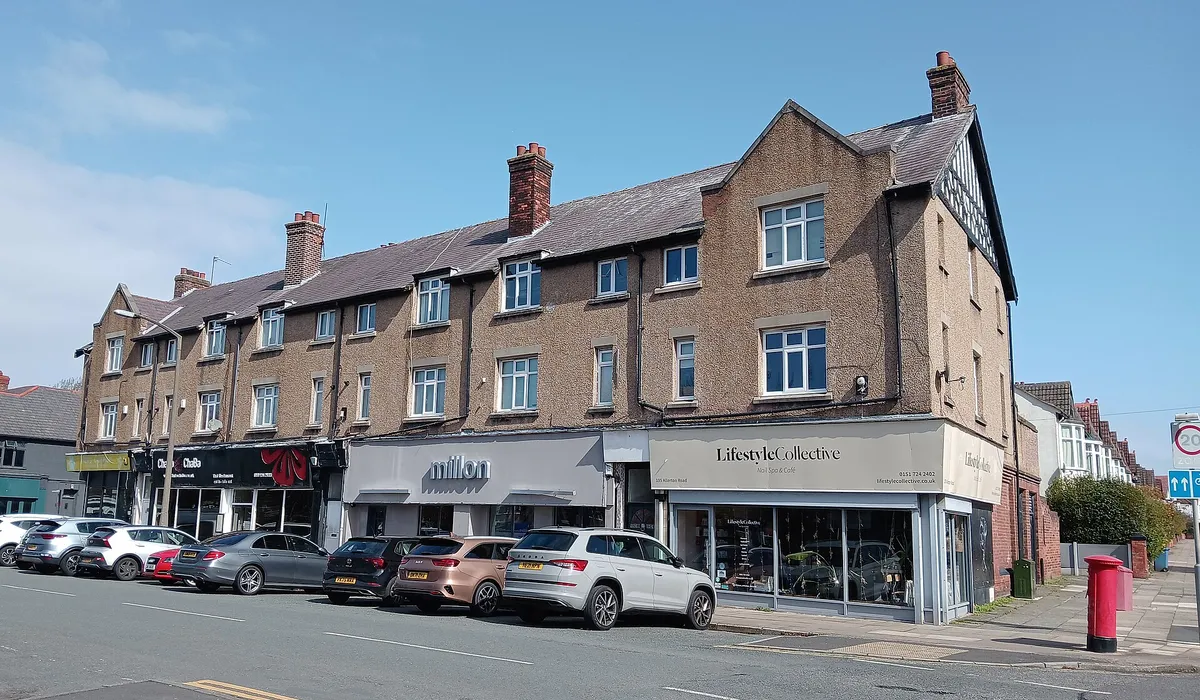
Flats above shops are common across Liverpool and the North West, from Victorian parades on Allerton Road, Lark Lane and Smithdown Road to busy high streets in Crosby, Waterloo and Birkenhead. They are often larger and cheaper than purpose built flats nearby, with high ceilings and big windows. This guide is a risk checklist for anyone buying a flat above a shop, working through the lender, the building, the business below, the lease, fire safety and insurance, so you can decide whether the property is the bargain it looks.
In this guide
- Why is a flat above a shop different?
- Can you get a mortgage on a flat above a shop?
- Does the type of shop below matter?
- What should a survey check in the building?
- What about fire safety and separation?
- What should you check in the lease?
- How are service charges and repairs shared?
- What about access, storage and parking?
- Will insurance cost more?
- What questions should you ask?
- What is the full risk checklist?
- Which survey do you need?
- Flats above shops in Liverpool
- FAQs
Why Is a Flat Above a Shop Different?
A flat above a shop is part of a mixed use building, where homes and a business share the same structure. That means your home is affected by things you do not control, such as the trading hours, the type of business, the shop fit out and the way the freeholder manages the building.
The HomeOwners Alliance explains in its guide to buying a flat above a shop that lenders often see these flats as higher risk because of noise and smells, the possibility that the shop changes hands, fire risk and a smaller pool of future buyers. None of that makes a flat above a shop a bad buy. It means you need to look harder before you commit.
Can You Get a Mortgage on a Flat Above a Shop?
Often yes, but you may have fewer lenders to choose from. Some lenders will not lend on flats above certain businesses at all, while others apply stricter criteria. Common concerns include
- businesses that cook food or sell alcohol, such as takeaways, restaurants and pubs
- businesses with strong smells or fire risk, such as dry cleaners or launderettes
- flats without their own separate entrance
- buildings where a large share of the floor area is commercial
- short leases or unclear repair responsibilities
The HomeOwners Alliance recommends speaking to a mortgage broker early. Do this before you pay for a survey or legal work, because if lenders will not accept the property, the rest of the process does not matter. Remember that the lender valuation is not a survey. Our guide to mortgage valuation vs survey explains why.
Does the Type of Shop Below Matter?
Yes, a great deal. The business below affects noise, smells, fire risk, insurance and resale. This table gives a general guide.
| Business below | Typical impact | Level of concern |
|---|---|---|
| Office, estate agent, bank, clothing or gift shop | Usually quiet, closed in the evenings | Lower |
| Hairdresser or beauty salon | Some daytime noise, chemicals and plumbing use | Lower to moderate |
| Convenience store or pet shop | Long hours, deliveries, bins and possible smells | Moderate |
| Dry cleaner or launderette | Heat, humidity, chemicals and machinery noise | Moderate to higher |
| Cafe or restaurant | Cooking smells, extraction, grease and later hours | Higher |
| Takeaway, bar or pub | Late hours, noise, smells, fire risk and crowds outside | Highest |
The HomeOwners Alliance flags dry cleaners, restaurants, bars, takeaways, launderettes, pet shops and convenience stores as the businesses with the biggest impact on daily life. Also remember that the shop can change. A quiet office below can become a takeaway if planning and the shop lease allow it.
What Should a Survey Check in the Building?
Many flats above shops are in older buildings, often Victorian or Edwardian parades, where the shop front has been altered several times. A good survey will look closely at
- The shop front structure. Large shop windows are spanned by beams. Old timber bressummers or undersized steel beams can sag, causing cracks in the walls and floors of the flat above.
- Removed walls. Ground floor walls are often removed to create an open shop. If this was done without proper design, the walls above may have no adequate support.
- Roofs. Flat roofs over rear extensions and parapet gutters on the main roof are common sources of leaks.
- Chimneys and parapets. Tall front parapets and chimney stacks on old parades can be loose or leaning.
- Extraction and plant. Ducts, fans and air conditioning units from the shop can pass close to or through the flat, bringing noise, vibration and fire risk.
- Signs and fixings. Large signs fixed to the front can damage brickwork and let water in.
- Damp. Rear yards, flat roofs and shared drainage are frequent causes of damp in the flat.
- Floors. Timber floors between the shop and flat may sag or bounce, and may not provide fire or sound separation.
If the survey finds cracking around the shop front or signs that structure has been removed, a structural engineer may be needed. Our structural engineering team can inspect and design repairs, and our guide to steel beam calculations explains what proper design paperwork looks like.
What About Fire Safety and Separation?
Fire safety is one of the biggest issues in a flat above a shop, especially above a business that cooks or stores flammable materials. Questions to ask include
- Is there fire resisting construction between the shop and the flat, especially in the floor and around any shared stairs?
- Does the flat have its own protected escape route to the street, rather than through the shop?
- Are there working smoke alarms in the flat and fire doors where needed?
- Does extraction ductwork from the shop pass through the flat, and is it properly enclosed?
- Has a fire risk assessment been carried out for the common parts, where these exist?
Building Regulations expect homes and businesses in the same building to be separated by fire resisting construction. The government guidance is set out in Approved Document B. A surveyor will flag obvious concerns, but in older or converted buildings a specialist fire assessment may be recommended.
What Should You Check in the Lease?
Most flats above shops are leasehold. Your solicitor should check
- the length of the lease and the ground rent
- who owns the freehold, and whether the shop is let on a separate lease
- who is responsible for repairing the roof, walls, structure and shop front
- how service charges are split between the flat and the shop
- any rules on alterations, letting and use
- the shop lease, if available, including permitted uses, opening hours and noise controls
The HomeOwners Alliance notes that if the freeholder has leased the shop, you may be able to ask the freeholder to act on problems caused by the shop. It also warns that a new shop lease can bring different terms if the business changes hands.
Mixed use buildings can also affect your rights as a leaseholder. The HomeOwners Alliance explains that the right to manage has historically been limited where the non residential part exceeds 25 percent of the floor area, and that under the Leasehold and Freehold Reform Act 2024 this threshold rises to 50 percent from 3 March 2025. Ask your solicitor how this applies to your building.
How Are Service Charges and Repairs Shared?
In a mixed use building, the costs of repairing the roof, walls and structure are usually shared between the flat owners and the shop. The split should be clear in the leases. Watch for
- leases that make the flat responsible for the whole roof, while the shop pays nothing
- no clear responsibility for the shop front or the beam above it
- no sinking fund for major works, such as a new roof
- higher service charges than a residential only block, which the HomeOwners Alliance says is common because commercial service charges tend to be higher
Ask for recent service charge accounts and details of any planned major works. Our guide to a section 20 notice explains how leaseholders are consulted on major works.
What About Access, Storage and Parking?
A separate entrance from the street is a big advantage, both for daily life and for lenders. Check
- whether the flat has its own front door, or shares access with the shop
- who can use rear yards, bin stores and fire escapes
- whether any storage, roof terrace or yard is included in the lease
- whether parking is included, and whether shop customers or deliveries could block it
Rights over shared areas should be set out clearly in the legal documents.
Will Insurance Cost More?
It can. The building insurance is usually arranged by the freeholder and recharged through the service charge. Where the shop below has a higher fire risk, such as a takeaway, or the area has security problems, premiums can be higher. Ask for the current insurance schedule and premium, and check that the building is insured for a realistic rebuild cost. Our guide to a rebuild cost assessment explains how that figure is worked out.
What Questions Should You Ask Before Buying?
Ask the seller or agent these questions early, and pass the answers to your solicitor and surveyor.
- What business operates below, how long has it been there and what are its opening hours?
- Is the shop owned by the freeholder or let on a lease, and when does that lease end?
- Have there been any complaints about noise, smells, pests or deliveries?
- Does the flat have its own entrance, and who can use the rear yard and bin store?
- What are the service charge, ground rent and insurance costs, and have there been any major works bills?
- Who repairs the roof, the shop front and the structure?
- Has any work been done to the shop front or the walls below the flat?
- Have any previous sales or mortgage applications fallen through, and why?
What Is the Full Risk Checklist?
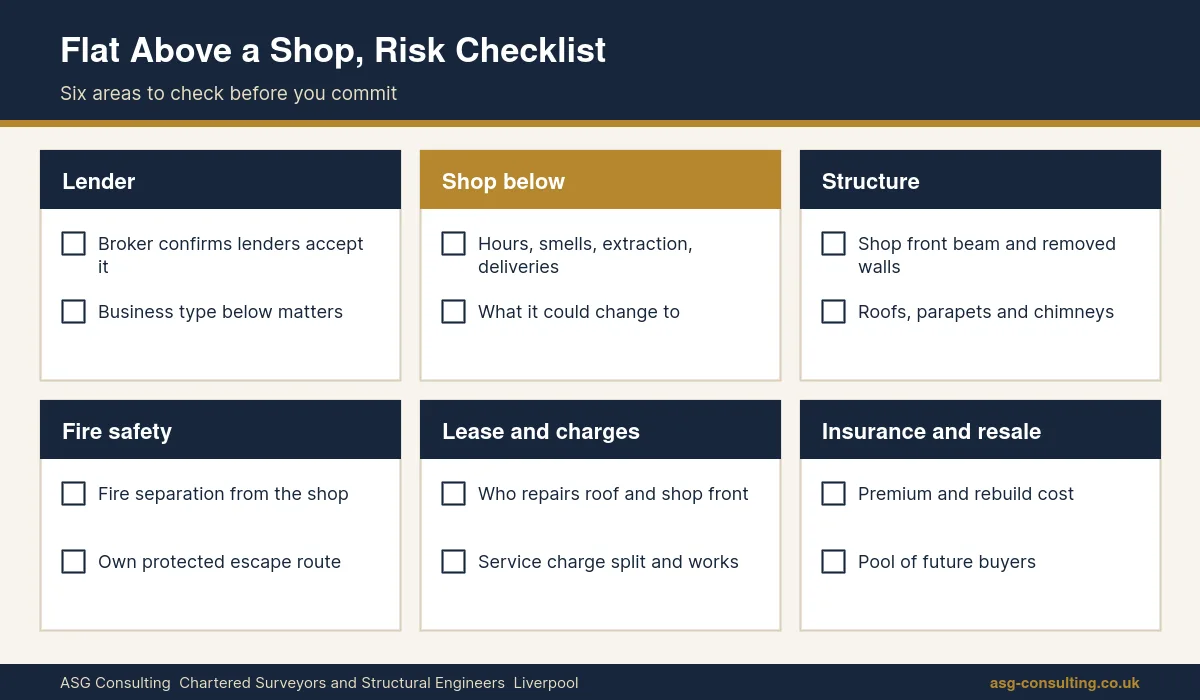
Use this checklist before you commit to a flat above a shop.
| Area | Check |
|---|---|
| Lender | Broker confirms lenders will accept the property and the business below |
| Shop below | Type of business, opening hours, extraction, deliveries and what it could change to |
| Structure | Shop front beam, removed walls, cracks, roofs, parapets and chimneys |
| Fire safety | Fire separation, protected escape route, alarms and ductwork |
| Noise and smells | Visit at different times, including evenings and weekends |
| Lease | Length, repair responsibilities, service charge split, shop lease terms |
| Charges | Service charge accounts, sinking fund and planned works |
| Access | Separate entrance, rights over yards, storage and parking |
| Insurance | Premium, cover and rebuild cost |
| Resale | How easy will it be to sell, and to whom? |
Which Survey Do You Need?
For a flat above a shop, the right survey depends on the age and condition of the building and how complex it is.
| Property | Suggested survey |
|---|---|
| Modern purpose built flat above a quiet unit, in good condition | RICS Level 2 HomeBuyer Survey |
| Flat in an older parade or converted building | RICS Level 3 Building Survey |
| Flat with visible cracking, altered shop front or fire concerns | RICS Level 3 Building Survey, possibly with a structural engineer |
| Buying the whole building, shop and flats together | A commercial or mixed use building survey |
Our RICS HomeBuyer Survey in Liverpool page explains the Level 2 option, and our residential building surveying page covers the Level 3 Building Survey. Investors buying a whole parade or mixed use building should look at our commercial building surveying service.
Flats Above Shops in Liverpool
Liverpool has a long tradition of shops with flats above, especially along Victorian and Edwardian parades. Typical locations include Allerton Road, Lark Lane, Smithdown Road, Rose Lane, County Road and Walton Road in the city, and high streets in Crosby, Waterloo, Wallasey and Birkenhead.
Common findings on surveys of these flats include
- sagging or poorly supported shop front beams, with cracking in the flat above
- leaking flat roofs over rear extensions and outriggers
- loose parapets and chimney stacks on the front of the parade
- takeaway extraction ducts running up the rear wall close to flat windows
- limited fire separation between the shop and the flat in older conversions
- shared rear yards with unclear rights and responsibilities
Visit at different times, including a Friday or Saturday evening if there is a takeaway, bar or restaurant nearby, to get a real sense of what living there is like.
Flat Above a Shop FAQs
Is it a bad idea to buy a flat above a shop?
Not necessarily. A flat above a shop can be good value, especially above a quiet business. The risks are mortgage restrictions, noise, smells, fire safety and resale, so check them carefully before committing.
Can I get a mortgage on a flat above a shop?
Often yes, but fewer lenders may be willing. Flats above takeaways, restaurants, pubs and some other businesses are the hardest to finance. Speak to a mortgage broker before paying for a survey.
Are flats above shops harder to sell?
They can be, because some buyers are put off and some lenders are restrictive. A flat above a quiet shop with its own entrance and a long lease is usually easier to sell.
What survey do I need for a flat above a shop?
A RICS Level 3 Building Survey suits most flats above shops in older parades. A Level 2 HomeBuyer Survey can suit a modern flat in good condition above a quiet business.
Who repairs the roof on a flat above a shop?
It depends on the leases. Responsibility may sit with the freeholder, the flat owner or be shared with the shop through the service charge. Your solicitor should confirm this before you buy.
What businesses should I avoid living above?
Takeaways, bars, pubs and restaurants usually have the biggest impact through noise, smells, late hours and fire risk. Dry cleaners, launderettes and convenience stores can also cause problems.
Book a Survey on a Flat Above a Shop With ASG Consulting
ASG Consulting is an RICS regulated building surveying practice in Liverpool. We carry out RICS Level 2 HomeBuyer Surveys, Level 3 Building Surveys and mixed use building surveys across Liverpool, Merseyside, the Wirral and the wider North West, with reports usually delivered within 3 to 5 working days of the inspection. We give a fixed fee on request, usually confirmed within one working day. To request a quote, call 0151 315 0626 or visit our contact page.
About the Author
Dave MacMillan is the lead surveyor at ASG Consulting, an RICS regulated building surveying practice at 54 St James Street, Liverpool. He has 8 years of experience in building surveying and inspects homes for buyers across Liverpool, Merseyside and the North West.
Last updated 12 November 2026
Featured photo of a shopping parade on Allerton Road, Liverpool by Kevin Waterhouse via Wikimedia Commons, licence CC BY SA 2.0, cropped.