A Help to Buy valuation is the RICS market valuation you need before you can repay all or part of a Help to Buy equity loan. Homes England uses the figure to work out exactly what you owe, so the report decides how much money changes hands when you sell, remortgage or buy back a share of your home. Get it right and the repayment moves quickly. Get it wrong and the report is rejected, you pay for a second one and your sale or remortgage can stall.
This guide explains how a Help to Buy valuation works in 2026, what Homes England checks before it accepts a report, what the valuer does on the day, what it costs, how long it lasts and what to do if the figure surprises you. It is written for homeowners across Liverpool, Merseyside and the North West who bought a new build home with an equity loan and are now ready to repay it.
In this guide
- What is a Help to Buy valuation
- When you need one
- How the repayment is calculated
- The Homes England checklist
- Nine steps to a report that passes
- What happens on the day
- What affects the value of a new build
- Cost and timescales
- If your valuation expires
- Rejections and disputes
- Common mistakes
- FAQs
What Is a Help to Buy Valuation?
A Help to Buy valuation is an independent market valuation of your home prepared by a surveyor who is regulated by the Royal Institution of Chartered Surveyors. It is not a mortgage valuation, an estate agent appraisal or an online estimate. Homes England, which manages the scheme in England, will only accept a formal RICS report that meets its own published criteria.
The reason is simple. A Help to Buy equity loan is not a fixed sum of money. It is a share of the value of your home. If you borrowed 20 per cent of the price, you owe 20 per cent of what the home is worth when you repay. The Help to Buy valuation sets that worth, so both sides need to trust the number.
The Help to Buy equity loan closed to new applications in England, but many thousands of homeowners still hold one. Every one of them will need at least one Help to Buy valuation before the loan is cleared.
When Do You Need a Help to Buy Valuation?
You need a fresh Help to Buy valuation each time you make a repayment. In practice that happens in four situations.
- Selling your home. The equity loan must be repaid from the sale proceeds when the sale completes.
- Remortgaging to repay. If you are borrowing more from a mortgage lender to clear all or part of the loan, Homes England needs a valuation to set the figure.
- Repaying from savings. You can repay with your own money at any time, but the amount is still based on a current valuation.
- Staircasing. A part repayment, sometimes called staircasing, also needs its own valuation. The smallest part repayment allowed is 10 per cent of the market value of your home.
You must repay the whole loan when you sell, when you pay off your repayment mortgage or when the equity loan term ends, which is normally 25 years. Interest is charged from year six of the loan, starting at 1.75 per cent of the amount originally borrowed and rising every April, so many owners choose to repay earlier rather than later.
How the Repayment Is Calculated
The maths behind a Help to Buy valuation is straightforward once you see an example. The repayment equals your equity loan percentage multiplied by the market value in the report.
| Situation | Price paid and loan | Value at repayment | Amount repaid |
|---|---|---|---|
| Value has risen | 200,000 pounds with a 20 per cent loan of 40,000 pounds | 250,000 pounds | 50,000 pounds |
| Value has fallen | 200,000 pounds with a 20 per cent loan of 40,000 pounds | 190,000 pounds | 38,000 pounds |
| Part repayment of half the loan | 200,000 pounds with a 20 per cent loan | 220,000 pounds | 22,000 pounds for 10 per cent |
When you sell, Homes England takes its percentage of the market value or the agreed sale price, whichever is higher. That stops a home being sold cheaply to reduce the repayment. When you remortgage or repay from savings, the market value in your Help to Buy valuation is the only figure used.
Interest and the monthly management fee do not reduce the loan. Only a repayment based on a valuation does that.
The Homes England Checklist for a Help to Buy Valuation
Homes England publishes a short list of rules for every Help to Buy valuation. A report that misses any of them can be rejected, so it pays to share this list with your surveyor before the inspection.
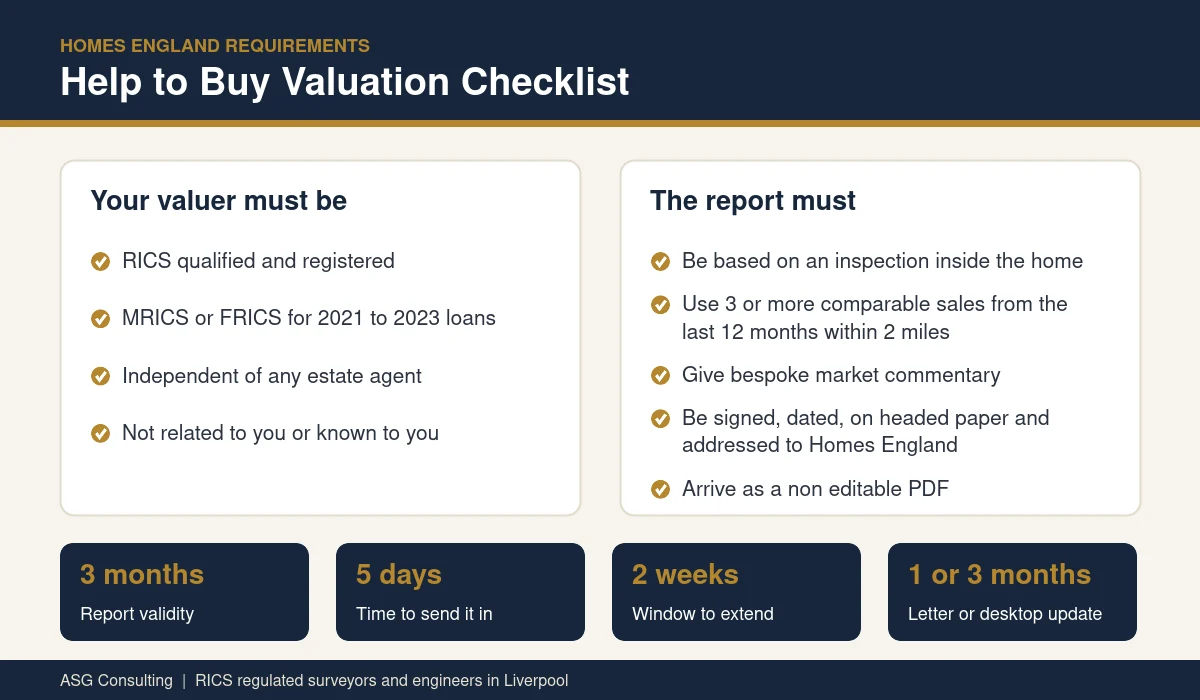
Who can carry out a RICS valuation Help to Buy accepts
- The surveyor must be both RICS qualified and RICS registered as a valuer.
- For loans taken out under the 2021 to 2023 scheme, the surveyor must also be a member or fellow of RICS, shown as MRICS or FRICS.
- The surveyor must be independent of any estate agent.
- The surveyor must not be related to you or known to you.
What the report must contain
- An inspection of the inside of the property, not just a drive by.
- At least three comparable sales from the last 12 months. They must be similar homes in type, size and age within two miles.
- Bespoke market commentary that explains how the comparable sales support the value.
- A signed and dated report on company headed paper, addressed to Homes England.
- A non editable digital file such as a PDF.
The report is valid for three months from the date it was produced, and Homes England asks you to send it within five days. You can read the full rules in the official guidance on how to get a valuation of your Help to Buy home.
Nine Steps to a Help to Buy Valuation That Passes First Time
Most delays come from small gaps rather than big problems. Follow these steps in order and your Help to Buy valuation should go through without a second attempt.
- Decide how you will repay. Sale, remortgage, savings or a part repayment each have a slightly different form and timetable.
- Check your loan scheme. Your loan paperwork shows whether you are on the 2013 to 2021 or the 2021 to 2023 scheme. The later scheme needs an MRICS or FRICS valuer.
- Line up your mortgage or sale first. Because the report lasts three months, book it when your lender or buyer is ready, not months ahead.
- Choose a RICS registered valuer. Check the firm on the RICS directory and ask for the name and membership number of the person who will inspect.
- Tell the surveyor it is for Help to Buy. They should address the report to Homes England and follow the checklist above.
- Prepare the home. Clear access to every room, the loft hatch and the boiler cupboard, and gather details of any improvements.
- Attend the inspection. Answer questions about the property and point out any work done since you bought it.
- Check the report before you submit it. Confirm the address, the date, the signature, three or more comparable sales and the PDF format.
- Submit within five days. Send the report with the repayment application form, then pass the redemption figure to your solicitor and lender.
What Happens on the Day of a Help to Buy Valuation?
The inspection is shorter than a building survey. For a typical two or three bedroom new build house, the valuer is usually on site for under an hour.
The valuer measures the home, notes the layout and number of bedrooms and bathrooms, and records the general condition of the kitchen, bathrooms, windows, heating and decoration. They look at the outside, the parking, the garden and the position of the plot on the estate. They will also note anything unusual, such as an extension, a garage conversion or signs of defects.
Back at the office, the valuer researches recent sales of similar homes nearby, compares them with your home and writes the market commentary that justifies the final figure. That research is the heart of a Help to Buy valuation, because Homes England checks the value against similar homes and can reject a figure that looks too high or too low.
A Help to Buy valuation is not a survey of condition. If you are worried about defects, cracking or damp, a separate RICS homebuyer survey and valuation or a building survey looks at condition in far more depth.
What Affects the Value of a Help to Buy Home?
Help to Buy homes are new builds, and new builds behave a little differently in the market. These are the factors a valuer weighs most often.
- New build premium. Brand new homes often sell for more than similar homes that have been lived in. Once a home becomes second hand, part of that premium can fall away, so some owners find their value has grown less than they hoped.
- Comparable sales on the same estate. Recent resales of the same house type on your development carry great weight. A large estate with plenty of resales usually gives a clear picture.
- Developer incentives. Original prices sometimes included incentives such as paid fees or free extras, which can make early sale prices a poor guide to market value today.
- Condition and improvements. A well kept home with sensible upgrades, such as a better kitchen or landscaped garden, can compare well. Tell the valuer about any improvements and keep the receipts.
- Leasehold terms. Many Help to Buy flats and some houses are leasehold. The ground rent, service charge and length of lease can all affect value.
- Cladding and planning issues. If a building has external wall cladding or there is a breach of planning permission, Homes England may require a specialist valuation.
For a wider look at how values are set and how a free agent figure differs from a RICS figure, see our guide to house valuation in the UK.
Help to Buy Valuation Cost and Timescales
You choose, arrange and pay for the Help to Buy valuation yourself. Published UK prices for a standard report on a typical new build house generally fall between about 150 and 400 pounds, with larger homes, flats with complex leases and specialist cases costing more. Homes England also charges an administration fee to process the repayment, and you will have legal costs for removing the charge.
Most valuers can inspect within a week and issue the report within a few working days of the visit. Because the report lasts three months, the timing matters more than the speed. Book the Help to Buy valuation when your sale is agreed or your remortgage application is ready, so the report is still valid on the completion date.
What to Do If Your Help to Buy Valuation Expires
Sales and remortgages sometimes take longer than planned. If your report is about to run out, Homes England allows two kinds of extension, but only if you ask the same surveyor within two weeks of the expiry date.
- One month extension letter. The original surveyor confirms the value on headed paper, addressed to Homes England, as a non editable file. It extends the report by one month.
- Three month desktop valuation. The original surveyor updates the report without a new visit. It must refer to the original report, confirm it is a desktop valuation and, if the value has changed, include at least six comparable sales from the last year.
If you miss the two week window, or the extended period runs out, you will need to pay for a brand new Help to Buy valuation. A simple diary note on the expiry date can save you that cost.
If Your Help to Buy Valuation Is Rejected or Disputed
Homes England can reject a report that does not follow the criteria or that looks too high or too low compared with similar homes. If that happens you will need a new report, so it is worth checking every item on the checklist before you submit.
If you think the value is wrong, talk to the surveyor first. A valuer can review new evidence, such as a recent sale they missed, but they will not change a figure without good reason. A Help to Buy valuation that is lower than you hoped is not always bad news, because a lower value also means a smaller repayment if you are remortgaging or buying back a share.
Common Help to Buy Valuation Mistakes
- Booking the valuation too early, so it expires before completion.
- Using a mortgage valuation or an estate agent appraisal instead of a RICS report.
- Choosing a valuer who is not RICS registered, or not MRICS or FRICS for a 2021 to 2023 loan.
- Forgetting to tell the surveyor the report is for Help to Buy, so it is not addressed to Homes England.
- Sending an editable document instead of a PDF.
- Leaving improvements out, so the valuer does not see work that adds value.
- Waiting more than two weeks after expiry to ask for an extension.
Help to Buy Valuation FAQs
How long is a Help to Buy valuation valid for?
Three months from the date the report was produced. You can extend it by one month with a letter, or by three months with a desktop valuation, if you ask the same surveyor within two weeks of the expiry date.
Can I use my mortgage valuation for Help to Buy?
No. A mortgage valuation is prepared for the lender. Homes England needs an independent RICS valuation addressed to Homes England that meets its own checklist.
Who pays for a Help to Buy valuation?
The homeowner does. You choose the surveyor, arrange the inspection and pay the fee, and you also pay the Homes England administration fee and your legal costs.
What if my home is worth less than I paid?
Your repayment falls too, because you repay your loan percentage of the current market value. If you are selling, the figure is based on the market value or the sale price, whichever is higher.
Do I need a new valuation for each part repayment?
Yes. Each repayment needs its own valid Help to Buy valuation, and the smallest part repayment allowed is 10 per cent of the market value of your home.
Does the valuer need to come inside?
Yes. The full Help to Buy valuation must include an inspection of the inside of the property. Only an approved desktop extension can be done without a new visit.
Help With Your Help to Buy Valuation in Liverpool
ASG Consulting is a firm regulated by RICS that works with homeowners across Liverpool, Merseyside and the North West. If you are planning to sell, remortgage or staircase a Help to Buy home, our team can talk you through the Homes England checklist before you book, so your Help to Buy valuation is right first time. Find out more on our house valuation Liverpool page.
About the Author
Harry is a property content writer with 3 years of experience writing about building surveying, commercial property and property compliance in the UK. He writes the guides at ASG Consulting for buyers, tenants and landlords, turning survey practice into clear, practical advice.
Reviewed by Dave MacMillan MRICS, chartered surveyor at ASG Consulting. Dave checks the technical content of our guides against current RICS practice before they are published.
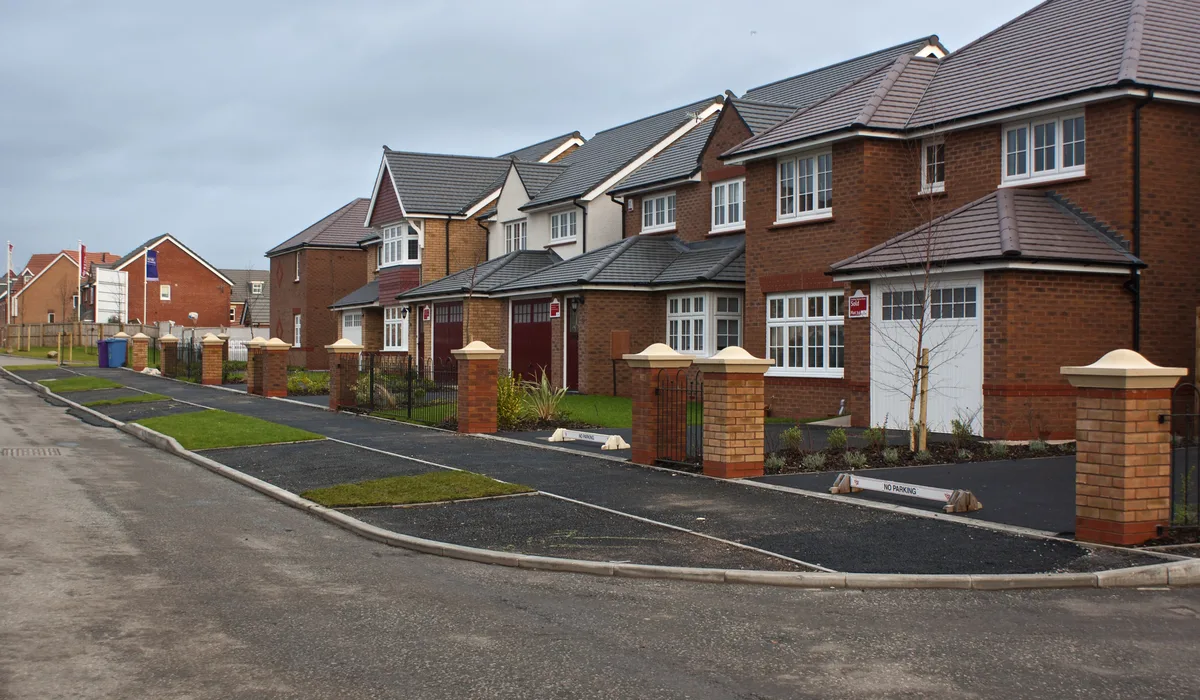
Featured photo of new houses at Cressington Grange, Liverpool by Ian Greig via Wikimedia Commons, licence CC BY SA 2.0, cropped.