
Walk down almost any street of Victorian terraces or 1960s council stock in the UK right now, and you’ll spot it a sagging gutter here, a patch of black mould creeping up a bedroom wall there. It’s not your imagination. Housing disrepair increasing across the country isn’t a headline exaggeration; it’s something surveyors like us are seeing on site visits week after week. Ask any letting agent, any housing officer, any tenant who’s spent a winter fighting condensation, and they’ll tell you the same thing.
So why does it matter, and more importantly, what can actually be done about it? That’s what this guide is for. We’ll walk through why housing disrepair increasing has become such a persistent problem, what counts as disrepair in the first place, how a proper survey works, and honestly, the part most people actually want how to stop it before it turns into a five-figure repair bill or a legal dispute.
Why Is Housing Disrepair Increasing Across the UK?
There isn’t one single cause. There rarely is. But if you strip it back, three things are driving housing disrepair increasing year on year, and we see all three constantly in Liverpool and across Merseyside ageing housing stock, rising material and labour costs, and this one gets overlooked constantly a deferred maintenance culture among landlords who are stretched thin financially.
Liverpool and Merseyside’s housing stock is genuinely old. Walk through Toxteth, Wavertree, or Birkenhead and you’re mostly looking at Victorian and Edwardian terraces, plus a fair chunk of interwar and post-war council stock in areas like Kirkby and Huyton a huge share of it built well before 1980, and a good portion before either World War. Older buildings need more attention, not less, yet inspection and maintenance budgets across the region haven’t kept pace with either inflation or the sheer volume of properties needing work. Add in the cost-of-living squeeze hitting landlords and tenants alike across Merseyside, and you get repairs quietly pushed back a season, then another, until a small leak in a Liverpool terrace becomes a structural issue.
We’d also flag something less discussed locally: tenants across Liverpool and Merseyside are more aware of their rights than they were a decade ago. That’s a good thing, but it also means more disrepair is being reported and documented rather than silently endured which partly explains why the numbers look worse in the region even where physical conditions haven’t necessarily changed dramatically. Both things can be true at once.
What Is Housing Disrepair, and Why Does It Matter?
In plain terms, it’s when a rented property falls below the standard a landlord is legally required to maintain think structural defects, damp and mould, faulty heating, broken windows, unsafe wiring, or a leaking roof that’s gone unfixed. This housing disrepair guide focuses on exactly that distinction: what counts as disrepair isn’t just cosmetic wear; it has to affect the structure, exterior, or essential installations (water, gas, electricity, sanitation) of the home.
Why it matters is fairly blunt: unresolved disrepair damages health, drains household finances, and for landlords, turns into far more expensive work than it needed to be. A £200 fix ignored for a year can become a £4,000 job. We’ve seen it happen more times than we’d like which is exactly why a proper housing disrepair Increasing guide matters before things get to that point, not after.
Health and Wellbeing Impact
Damp and mould aren’t just unsightly. Prolonged exposure is linked to respiratory issues, worsened asthma, and in vulnerable households with young children or elderly residents far more serious complications. Public Health England has repeatedly flagged cold, damp homes as a measurable health risk, not a lifestyle inconvenience.
Financial Fallout for Everyone Involved
Tenants lose money on higher energy bills trying to heat a poorly insulated home. Landlords lose money on emergency repairs, potential compensation claims, and void periods when a property becomes genuinely unliveable. Nobody wins by letting it slide which is really the whole point of this article.
How to Prevent Housing Disrepair Before It Escalates
This is where most guides get vague. We’d rather be specific.
How landlords can prevent disrepair starts with scheduling, not reacting. A fixed inspection cadence every six months for older properties, annually for newer ones catches small issues before they compound. Preventing housing disrepair Increasing is genuinely more about routine than budget; a landlord who inspects consistently spends less over five years than one who waits for tenants to complain.
Practical steps that actually move the needle:
- Get a proper condition survey done annually, not just a quick walkthrough.
- Preventing damp and mould in rental properties usually comes down to ventilation extractor fans that actually work, trickle vents that aren’t painted shut, and gutters cleared before autumn.
- Respond to tenant repair requests within days, not weeks. Small leaks left for a month rarely stay small.
- Keep a paper trail of every inspection and repair. It protects everyone if a dispute ever reaches court.
- Budget for maintenance as a fixed percentage of rental income rather than an afterthought most experienced landlords we work with set aside 1–2% of property value annually.
That last point is probably the single biggest lever for how landlords can reduce repair costs long term. It’s not glamorous advice, but it’s the one that actually works.
For tenants, how to reduce housing disrepair Increasing on your end mostly means reporting early and in writing email, not just a phone call so there’s a timestamp on when the landlord was notified. How to prevent escalating housing disrepair, from a tenant’s chair, is really about not letting “I’ll mention it next time” become six months of silence.
Real-World Example: A Small Leak That Became a Legal Claim
We surveyed a terraced property in Liverpool where a tenant had reported a slow leak under the kitchen sink eight months earlier. Nothing was done. By the time we inspected, the damp had spread into the flooring, crept up the adjoining wall, and triggered mould serious enough to worsen a resident’s asthma. The tenant had mentioned it to the letting agent twice, but neither call was logged anywhere.
What could’ve been a £150 fix turned into one of the housing disrepair claims running into several thousand pounds remedial works, alternative accommodation for two weeks while repairs were carried out, plus compensation for the health impact. Nothing dramatic, honestly. Just a small issue nobody followed up on, left to quietly get worse. That’s how most housing disrepair Increasing claims start: not with one big failure, but one small thing ignored for too long.
Housing Disrepair Survey vs. a Basic Inspection: Things to Consider
Defining a Housing Disrepair Survey
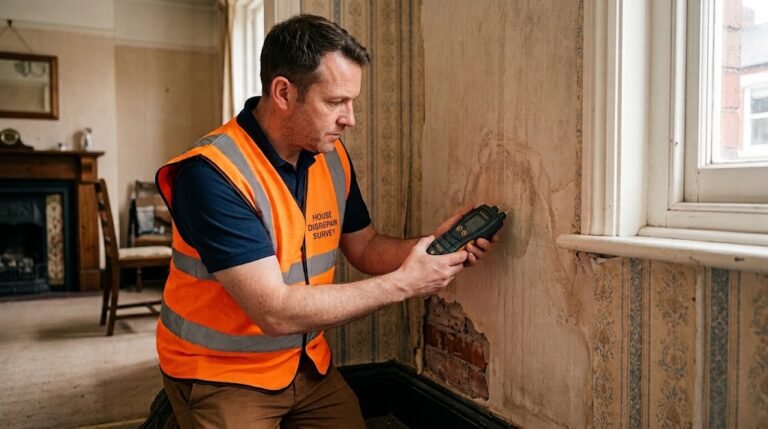
A housing disrepair Increasing survey is a formal, evidence-based inspection carried out by a qualified surveyor to assess whether a property meets its legal repair obligations. It’s distinct from a routine landlord walkthrough, which usually isn’t detailed or documented enough to hold up in a dispute. The surveyor inspects the structure, services, and finishes of the property against the relevant legal standards, namely Section 11 of the Landlord and Tenant Act 1985 and the Homes (Fitness for Human Habitation) Act 2018. Every defect is photographed, and the findings are compiled into a written report suitable for use in legal proceedings if needed.
What the Survey Covers
A typical housing disrepair Increasing survey includes an assessment of roof and guttering condition, damp readings, structural cracking, window and door function, heating and hot water systems, electrical safety indicators, and ventilation adequacy. The process itself involves the surveyor visiting the property, carrying out a room-by-room assessment using moisture meters and thermal imaging where relevant, and cross-referencing every finding against legal repair standards before compiling the final report.
Timeframe and Cost
Most residential surveys take two to four hours on site, depending on property size, with the written report typically following within five to ten working days. Costs vary by property size and complexity, but a standard residential survey usually falls somewhere between £250 and £600 a modest outlay compared to what unresolved disrepair ends up costing further down the line.
The choice between a full survey and a basic inspection really comes down to intent. If you just want peace of mind, a walkthrough is fine. If you’re heading toward a dispute, or already in one, only a proper survey carries evidential weight.
FAQs
Why are houses not selling in the UK right now?
Buyer demand is down 15% year-on-year, and overpricing by sellers is the main culprit three in five listings since early 2026 haven’t sold
. How to fix the UK’s housing crisis?
Views differ the government’s approach is 1.5 million new homes by 2029 via planning reform, though critics say social housing investment matters just as much.
How do you prove housing disrepair?
You need dated evidence photos, written correspondence with the landlord showing when the issue was reported, and ideally an independent surveyor’s report confirming the defect and its cause.
What evidence is needed for a housing disrepair claim?
A combination of a professional survey report, repair request records (emails, texts, letters), photographic timeline of the deterioration, and where relevant, medical evidence if health has been affected.
Is housing disrepair increasing everywhere, or just in certain areas?
It’s uneven. Older housing stock in northern cities and parts of London tends to show it more, largely because of building age and the density of private rentals, though no region is entirely exempt.
Final Thoughts
Housing disrepair increasing isn’t a problem that fixes itself, and it isn’t one that gets solved by hoping the next tenant or the next landlord deals with it. It gets solved by inspection, by documentation, and honestly by not letting small things sit. Whether you’re a landlord trying to protect your investment or a tenant trying to protect your home, the earliest action is almost always the cheapest one.