Chimney problems when buying a house usually show up as a leaning stack, cracked flaunching around the pots, loose bricks, failed lead flashing or damp patches on chimney breasts. Most are repairable, but some need scaffolding. Ask a surveyor to check the stack, ask the seller about sweeping and use, and get quotes before you exchange.
Chimneys are easy to forget because they sit high up and out of sight. Yet they take the full force of wind and rain, and repairs often need scaffolding, which adds to the cost. This article explains the 7 warning signs to look for, how chimneys cause damp, what to ask the seller and how a survey can help.
Contents
Why Do Chimneys Cause Problems?
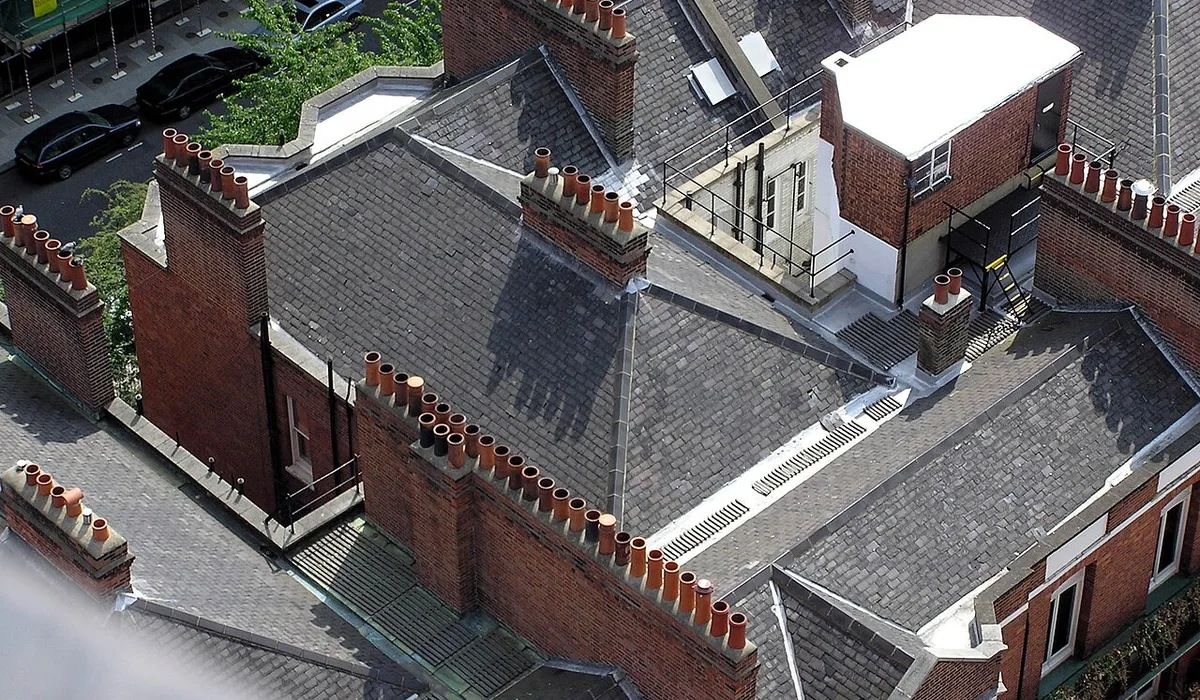
A chimney stack is one of the most exposed parts of a house. It stands above the roof, catches wind driven rain from every side and is rarely maintained because it is hard to reach. Over many years, mortar wears away, pots loosen and the lead that seals the stack to the roof starts to fail.
Inside, flues that carried smoke for decades can hold soot and salts. Disused flues that are capped without any airflow can trap moisture. Both can cause damp patches on chimney breasts long after the last fire was lit.
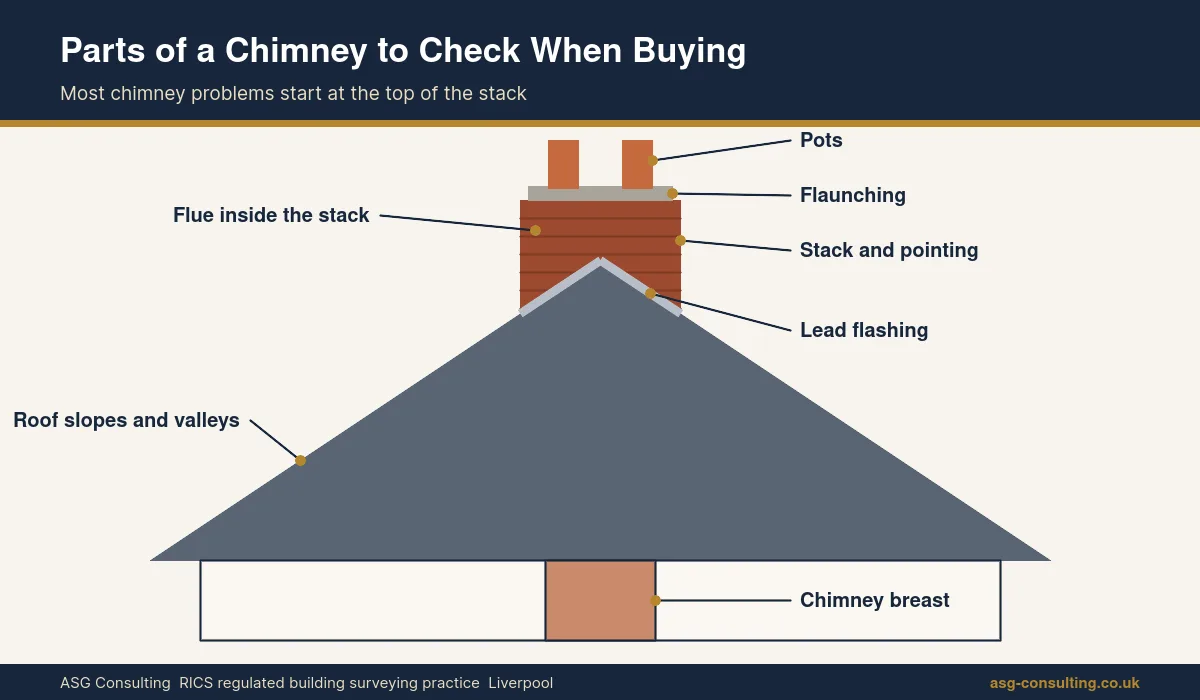
What Are the 7 Warning Signs of Chimney Problems When Buying a House?
Look out for these 7 warning signs on viewings and in the survey report.
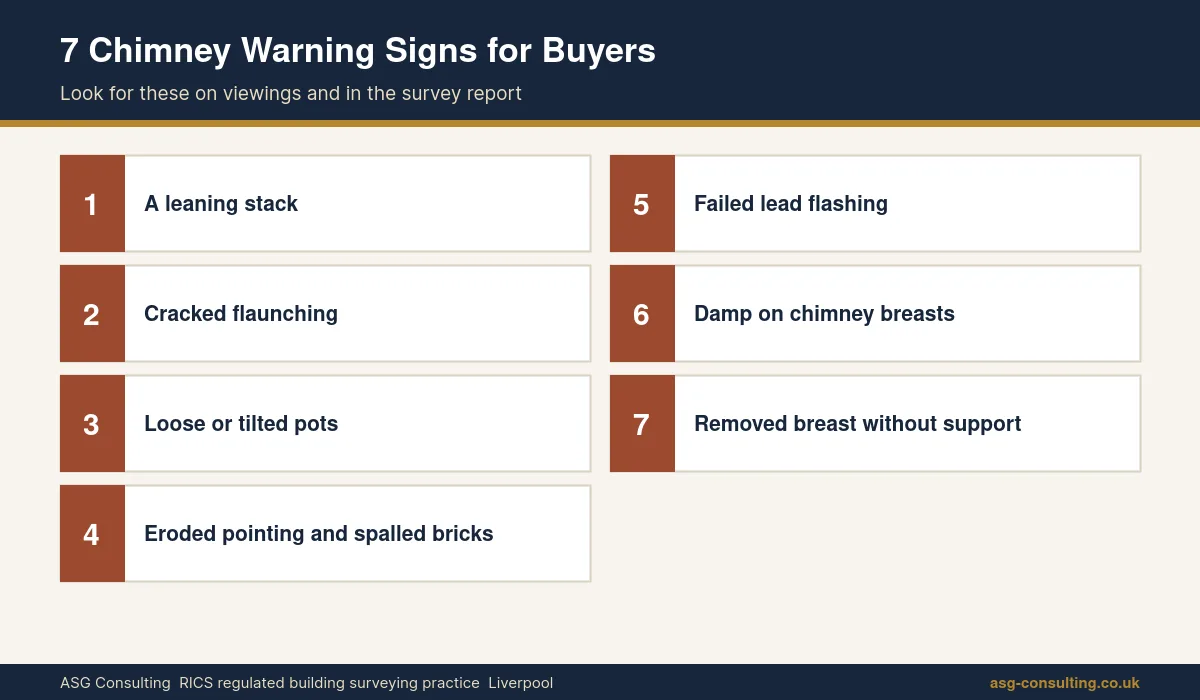
- A leaning stack. Uneven expansion of the mortar over many years can make a stack lean or bend.
- Cracked flaunching. The mortar around the base of the pots can crack and let water into the stack.
- Loose or tilted pots. Pots that move in the wind can fall and damage the roof below.
- Eroded pointing and spalled bricks. Gaps in the joints and flaking bricks let rain soak in.
- Failed lead flashing. Split, lifted or missing lead where the stack meets the roof is a common source of leaks.
- Damp on chimney breasts. Brown stains, peeling paint or salts on walls inside.
- Missing support below a removed breast. A breast taken out on a lower floor without proper support for the brickwork above.
Why Is a Chimney Breast Damp?
Damp on a chimney breast usually comes from one of three causes.
- Rain getting in at the top. Through cracked flaunching, uncapped flues, eroded pointing or failed flashing.
- Salts in the old flue. Soot and flue deposits contain salts that draw moisture from the air, leaving brown stains that come back after painting.
- No airflow in a capped flue. A flue sealed at both ends can trap moisture. A capped flue normally needs a vent at the bottom and a ventilated cap at the top.
Fixing the source at the top of the stack usually comes first. Stains caused by salts may also need the affected plaster replacing with a suitable mix.
What If a Chimney Breast Has Been Removed?
Removing a chimney breast is a common way to gain space, but the brickwork above must be properly supported, usually with steel beams or approved brackets. Building Control approval is needed for this work, and the party wall rules may apply where the chimney is shared with a neighbour.
When buying, ask for the Building Control completion certificate and any structural engineer calculations. The guide to chimney breast removal explains what proper support looks like and what to do if paperwork is missing.
Are Shared Chimney Stacks a Problem?
They can be. In terraced and semi detached houses, one stack often serves two homes, with the boundary running through the middle. Repairs to a shared stack usually need agreement with the neighbour, and both owners normally share the cost.
If the stack needs work, find out who owns which part and whether the neighbour is willing to share the cost before you exchange. Your solicitor can check the title for any rights or obligations.
Is It Safe to Use the Fireplace?
Do not assume it is. Before lighting any fire or stove, have the chimney swept and checked by a qualified sweep or installer. HETAS advice on when to get a chimney swept recommends sweeping at least twice a year when burning wood and at least once a year when burning smokeless fuels.
Fit a carbon monoxide alarm in any room with a solid fuel appliance. For rented homes, the government smoke and carbon monoxide alarm guidance explains that, since 1 October 2022, landlords must fit a carbon monoxide alarm in any room used as living accommodation with a fixed combustion appliance, excluding gas cookers. If the house has a stove, the guide to buying a house with a wood burner covers the certificates to ask for.
Chimney in Use or Disused, What Is the Difference?
Chimneys need different care depending on whether they are used.
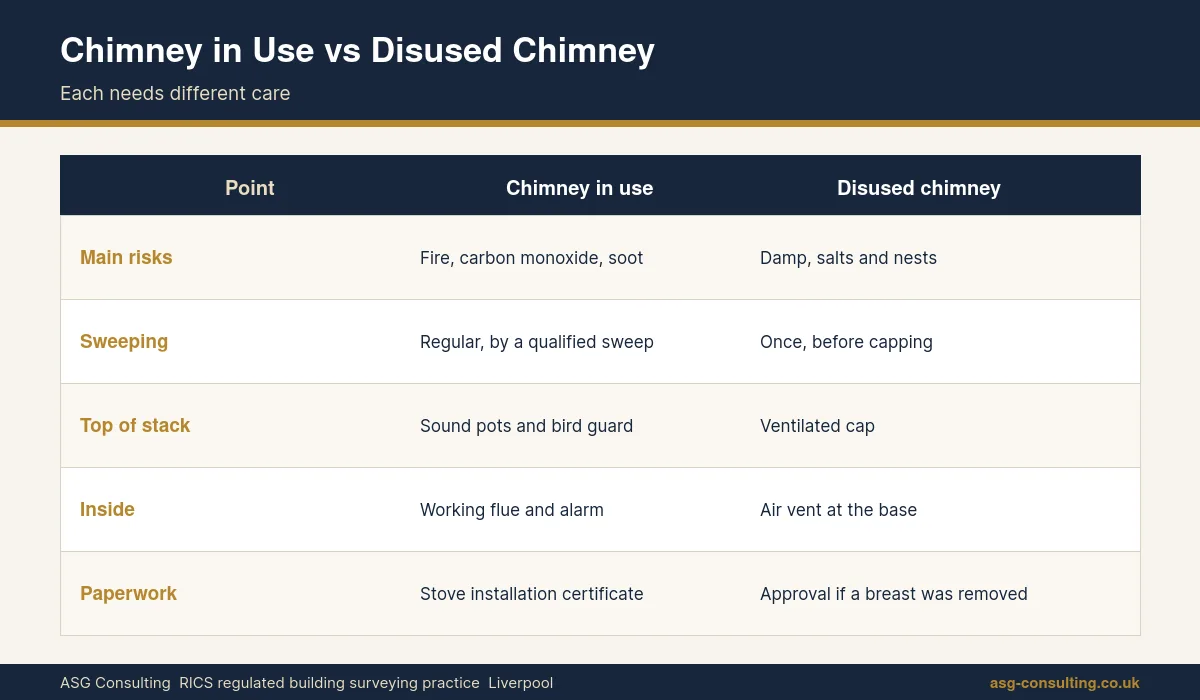
| Point | Chimney in use | Disused chimney |
|---|---|---|
| Main risks | Chimney fires, carbon monoxide, soot build up | Damp, salts, bird nests, falling debris |
| Sweeping | Regular sweeping by a qualified sweep | Sweep once before capping |
| Top of stack | Sound pots, cowl or bird guard | Ventilated cap to keep rain out |
| Inside | Working flue, sound hearth, alarm fitted | Air vent at the bottom of the flue |
| Paperwork | Installation certificate for any stove | Building Control approval if a breast was removed |
Which Questions Help You Check a Chimney?
A few short questions to the seller can save a lot of guesswork about chimney problems when buying a house.
- When was the chimney last swept, and is there a receipt?
- Which flues are in use, and which are capped?
- Has any repair been done to the stack, pots or flashing?
- Has a chimney breast been removed, and is there Building Control approval?
- Is the stack shared with a neighbour?
How Serious Are Chimney Problems When Buying a House?
Most chimney problems are routine maintenance items. Repointing, new flaunching, refixing pots and renewing lead flashing are common repairs. The cost is often driven more by access, such as scaffolding, than by the work itself, so ask for quotes that include access.
A badly leaning or unstable stack, a chimney breast removed without support or a shared stack in poor condition are more serious. These may need a structural engineer, agreement with a neighbour or rebuilding, and are worth resolving before you exchange.
Chimney Problems in Liverpool Homes
Liverpool has a huge number of homes with tall brick stacks. Victorian terraces in Anfield, Walton, Everton and Toxteth often have large shared stacks with several pots, one for each fireplace in the original house. Many of these flues have been disused for decades and some were capped without ventilation, which is a common cause of damp chimney breasts.
Interwar semis in Allerton, Childwall and Crosby usually have one stack per house, often shared with the semi next door. Coastal homes in Crosby, Waterloo, Hoylake and New Brighton take strong, salty winds, which wear away pointing and flaunching faster than inland.
Does a Home Survey Check the Chimney?
Yes, as far as is safe. A surveyor looks at the stack from the ground and other safe vantage points, checks the roof space and chimney breasts inside and notes signs of damp or movement. A surveyor does not climb onto the roof or test flues, so the report may recommend a closer inspection or a sweep.
Where a stack is too high to see well, a drone can give close up views without scaffolding, as shown on the high level drone surveying page. For older homes with several stacks, the Level 3 Building Survey described on the residential building surveying page gives the most detail.
Chimney Problems When Buying a House FAQs
Is a leaning chimney dangerous?
It can be. A slight lean may be stable for years, but a stack that is moving or badly leaning needs prompt advice and may need rebuilding.
Why does a chimney breast get damp?
Usually rain getting in at the top, salts from old flue deposits or a capped flue with no ventilation.
Should I cap an unused chimney?
Yes, with a ventilated cap at the top and an air vent at the bottom so the flue can still breathe.
How often should a chimney be swept?
HETAS advises at least twice a year for wood and at least once a year for smokeless fuels.
Who pays to repair a shared chimney?
Usually both owners share the cost of repairs to a shared stack. Check the title deeds with your solicitor.
Does a house survey check the chimney?
Yes, from safe vantage points. The surveyor may recommend a sweep, a closer inspection or a drone survey.
Talk to a Surveyor at ASG Consulting
ASG Consulting is an RICS regulated building surveying practice based in Liverpool. It carries out RICS Level 2 HomeBuyer Surveys and Level 3 Building Surveys across Liverpool, Merseyside, the Wirral and the wider North West, with reports usually delivered within 3 to 5 working days of the inspection. Fees are fixed and given on request, usually confirmed within one working day. Call 0151 315 0626 to request a quote or to talk through which survey suits the property.
About the Author
Dave MacMillan is the lead surveyor at ASG Consulting, an RICS regulated building surveying practice at 54 St James Street, Liverpool. He has 8 years of experience in building surveying and inspects homes for buyers across Liverpool, Merseyside and the North West.
Last updated 27 November 2026