Check for a dropped kerb when buying a house with a driveway, because without an approved crossing there is no lawful access across the pavement for a car. A dropped kerb must be approved by the local council, and new hard paving over 5 square metres in a front garden needs permeable surfacing or planning permission. Ask for paperwork.
A driveway is one of the most valued features for buyers in Liverpool, especially on busy terraced streets where parking is tight. But a driveway is only useful if you can legally reach it. Many listings show a car parked in a front garden without mentioning whether there is an approved dropped kerb, and that detail can make a real difference to value and to what you can do with the property. This guide works through the three situations buyers usually face, explains the application process and shows what to check before buying a house where parking depends on a dropped kerb.
What Is a Dropped Kerb?
A dropped kerb, sometimes called a vehicle crossing or crossover, is a section of pavement where the kerb has been lowered and the footway strengthened so vehicles can cross from the road onto a driveway. The gov.uk guidance on how to apply for a dropped kerb explains that it allows vehicles to cross the pavement from the road to a driveway, and that you need to contact your local council to apply.
Lowered kerbs at junctions and crossings for pedestrians are different. They help people with buggies and wheelchairs cross the road, and they are not vehicle crossings.
Why Does a Dropped Kerb Matter When You Buy?
The Highway Code says you must not drive on or over a pavement except to gain lawful access to a property. In practice, driving across a pavement where there is no approved vehicle crossing can lead to action from the council, and repeatedly driving over a normal kerb can damage the pavement, the kerb and services underneath.
For a buyer, the questions are simple. Can you legally park on the driveway? If not, can you get permission? And how much might it cost and how long might it take?
Which Situation Are You In?
Most buyers fall into one of three situations. Each needs different checks.
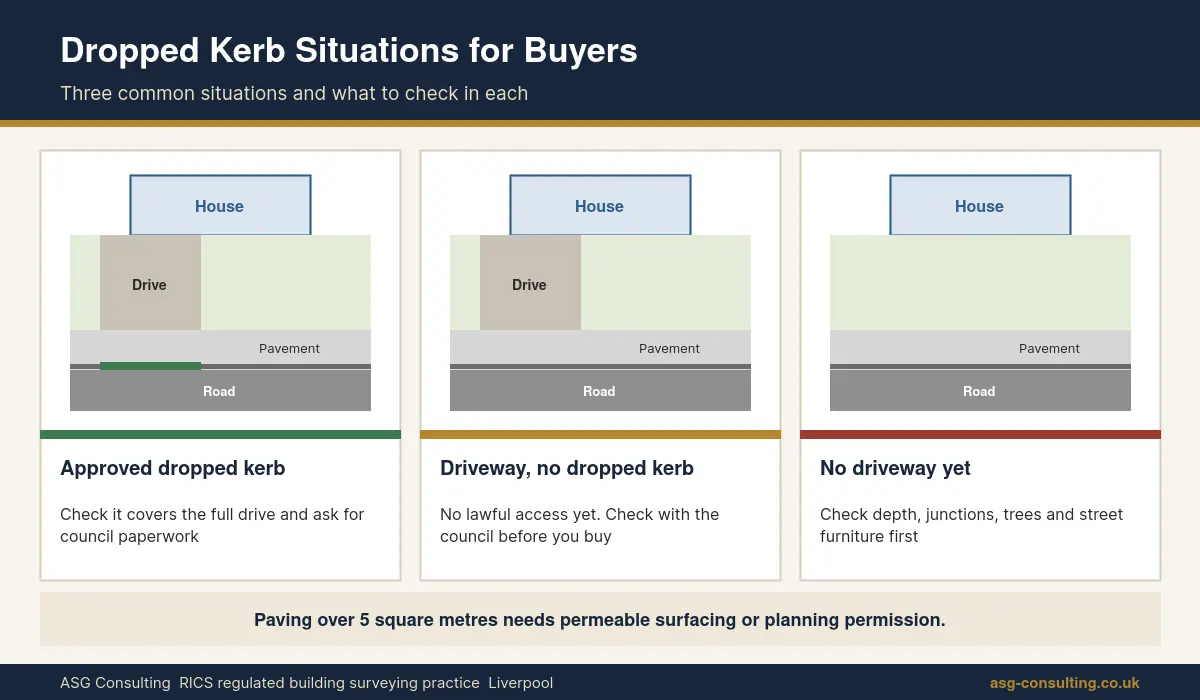
Situation one. The house already has a dropped kerb
This is the simplest case. Check that the dropped kerb lines up with the driveway, is wide enough for your car and has not been extended without approval. Ask the seller whether it was installed by or approved by the council, and whether there is any paperwork. If the driveway has been widened beyond the dropped section, cars may still be crossing a normal kerb.
Situation two. There is a driveway but no dropped kerb
This is common. The previous owner may have paved the front garden and driven over the kerb without permission, or used the driveway only for bins and bikes. Do not assume that a dropped kerb will be approved. Ask the seller, check with the council and consider how the price reflects the risk that you cannot legally use the drive.
Situation three. There is no driveway, but you want one
If you hope to create parking in the front garden, check the council criteria before you buy. Some streets, front gardens and locations will not meet the rules, for example because the garden is too shallow, the house is near a junction or there is a tree or lamp post in the way.
How Does the Application Process Work?
Each council has its own process, but it usually follows these steps.
- Check the council criteria. Look for rules on driveway depth, width, distance from junctions and obstructions such as trees, lamp posts and drains.
- Check whether planning permission is needed. This can apply on some roads, for listed buildings and for flats, so check with the council.
- Apply to the council. Submit the application with any plans and fees required.
- Site assessment. The council or its contractor checks the location and confirms whether the crossing can be approved.
- Quote and approval. If approved, you receive a quote and conditions.
- Construction. The work is carried out by the council or an approved contractor.
- Prepare the driveway. The driveway itself must also meet the rules on surfacing and drainage.
Timescales and costs vary between councils and from site to site, so ask for the current position before you rely on getting a dropped kerb.
Who Pays for a Dropped Kerb?
The homeowner usually pays for a new dropped kerb, including any council application fee and the cost of construction. The final cost depends on the width of the crossing, the type of pavement, whether utility covers or street furniture need moving and any parking restrictions that have to be changed. Councils publish their own fees, so check the current charges for the specific address. Ask for a written quote before you budget, and remember that the driveway itself, including any new surface, drainage and changes to the front wall, is a separate cost on top of the crossing.
What Do Councils Usually Look At?
Council criteria differ, but these factors often decide whether a dropped kerb can be approved.
| Factor | Why it matters |
|---|---|
| Depth of the front garden | A car must fit without overhanging the pavement |
| Distance from junctions | Crossings close to junctions can be unsafe |
| Trees and grass verges | Street trees and their roots may need protecting |
| Lamp posts, signs and drains | Moving street furniture can be costly or not allowed |
| Visibility | Drivers must be able to see pedestrians and traffic |
| Type of road | Main roads, bus routes and parking bays can raise extra issues |
| Parking restrictions | Bays or controlled zones in front may need changing |
Do You Need Planning Permission for the Driveway?
Separate rules cover the driveway surface itself. The Planning Portal guidance on paving your front garden says planning permission is needed if the area covered is more than five square metres and uses traditional impermeable materials that do not allow water to drain to a permeable area. No permission is needed if permeable surfacing is used, or if rainwater is directed to a lawn or border to drain naturally.
The same guidance notes that a dropped kerb application must be made to the local authority, that some related work may need planning permission, and that planning conditions or Article 4 directions can remove permitted development rights in some areas.
What Should You Look at on a Viewing?
Spend a few minutes outside the property and look at
- whether the kerb in front of the driveway is lowered along its full width
- whether the pavement has been strengthened, often shown by a different surface
- signs of cars mounting a normal kerb, such as damaged kerb stones or tyre marks
- whether the driveway is deep enough for a car without blocking the pavement
- the type of surface and where rainwater drains
- the condition of front boundary walls, gate posts and any retaining walls
Take photographs, and compare what you see with the information from the seller and the council.
What Paperwork Should You Request?
Ask the seller, through your solicitor, for
- confirmation that the dropped kerb was approved by the council
- any council correspondence, invoices or approval letters
- any planning permission for the driveway or front garden works
- details of when the driveway was created and by whom
If the seller has none of this, your solicitor can raise enquiries, and you can contact the council highways team to check whether a crossing is recorded at the address.
What If the Previous Owner Paved the Garden Without Permission?
It is not unusual for a front garden to have been paved and used for parking without a dropped kerb or the right surface. That can leave two separate issues for a new owner. The first is highways, because cars may be crossing a pavement that has not been approved for vehicles. The second is planning, if more than five square metres has been covered with impermeable paving that does not drain to a permeable area.
If you are buying a house like this, ask your solicitor to raise enquiries and consider checking with the council before you exchange. In some cases the best answer is to apply for a dropped kerb and adapt the surface. In others, the space may have to return to use as a front garden.
Can a Dropped Kerb Be Shared With a Neighbour?
Yes. Pairs of semi detached houses often share a single crossing that leads to two driveways or a shared drive. This can work well, but check that the crossing covers both driveways, that each house has the right to use it and that parking arrangements will not block the neighbour.
If the drive itself is shared, the title deeds should set out rights of way and responsibility for repairs. A shared crossing also means you may need to agree any changes, such as widening, with the neighbour as well as the council.
What About Charging an Electric Car?
Off street parking makes it much easier to charge an electric vehicle at home, because the charger can be fixed to the house and the cable stays on your own land. That is one reason a legal driveway is becoming more valuable.
Without a driveway, charging is harder. Running a charging cable across the pavement can create a trip hazard, and it is generally not something you should do without checking the council rules. If you are buying with plans to switch to an electric car, check the parking position carefully before you commit.
What About Front Walls, Gates and Steps?
Creating a driveway often means removing part of a front wall, widening a gateway or changing steps and levels. Front walls in older streets sometimes hold back soil where the garden is higher than the pavement, so removing them without care can cause problems. In conservation areas, changes to front boundaries may also need permission.
Look at the condition of front walls, gate piers and any steps on a viewing. Leaning or cracked walls are worth noting, and the guide to retaining wall failure explains the warning signs to look for.
How Does This Affect Value and Your Offer?
Off street parking is valued by many buyers, so a legal driveway can make a property more attractive. A driveway without an approved dropped kerb is less certain. If the council will not approve one, the space may only be usable as a front garden.
If parking matters to you, reflect the uncertainty in your offer, or ask for time to check with the council before exchange. If a dropped kerb is likely to be approved, factor the cost and time into your plans.
Dropped Kerbs Across Liverpool and Merseyside
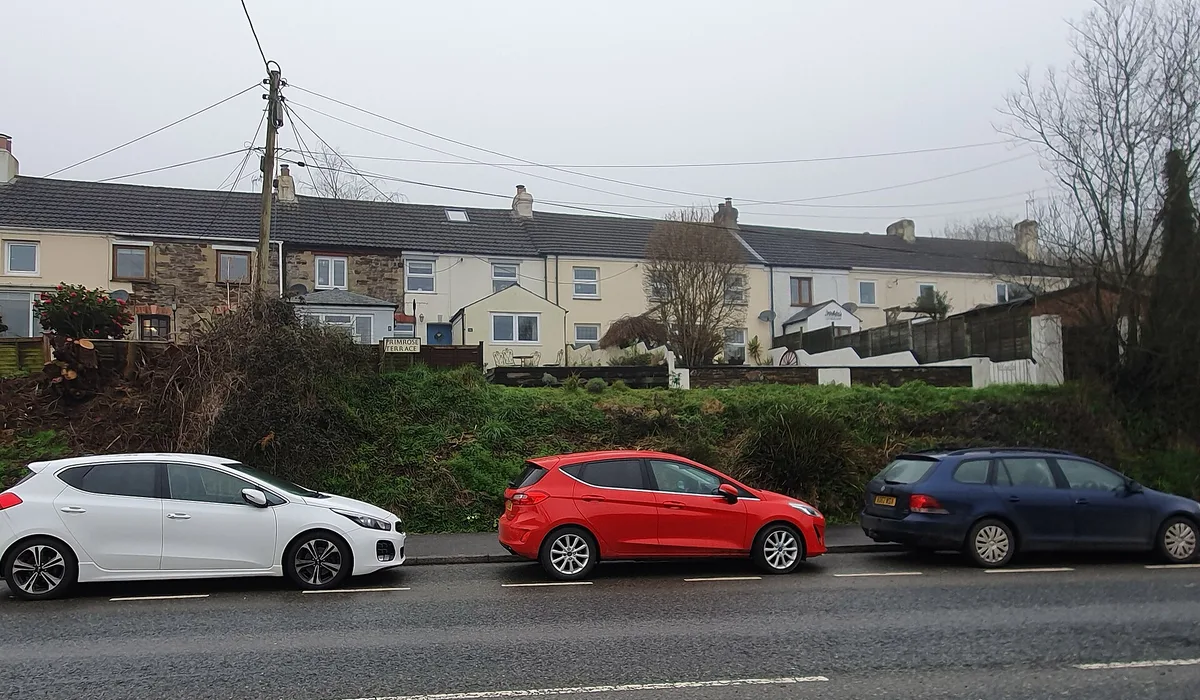
Parking pressure is high on many streets in Liverpool, especially in Victorian and Edwardian terraced areas such as Anfield, Walton, Kensington and Wavertree, where front gardens are often small or non existent. In these streets, a front garden may simply be too shallow to fit a car without overhanging the pavement.
Interwar semis in areas such as Allerton, Childwall, Walton, Crosby and Maghull are more likely to have space for a driveway, and many already have dropped kerbs. Others have had front gardens paved without the crossing being approved. On some suburban roads, grass verges and street trees between the pavement and the road add another factor the council will consider.
Each council in the city region, including Liverpool, Sefton, Knowsley, St Helens and Wirral, runs its own dropped kerb process with its own criteria and fees, so check with the council for the specific address. Shared drives between semis are common too, and the guide to buying a house with a shared driveway explains the ownership and access questions they raise.
Does a Home Survey Check the Dropped Kerb?
A surveyor does not check highway approvals, but a survey looks at the visible condition of the driveway, front boundary walls, retaining walls, paths and drainage near the house. If the surveyor notices signs that cars are crossing a normal kerb, or that the driveway may not have been approved, they can flag it for your solicitor.
A RICS Level 2 HomeBuyer Survey suits many conventional homes, as explained on the RICS HomeBuyer Survey in Liverpool page. For older or altered properties, the Level 3 Building Survey described on the residential building surveying page gives more detail.
Quick Checks Before You Exchange Contracts
Before you commit, make sure you know
- whether the dropped kerb exists and covers the full driveway width
- whether the council approved it, or whether an application is likely to succeed
- whether the driveway surface meets the planning rules
- whether a car fits without overhanging the pavement
- whether any part of the crossing or drive is shared with a neighbour
Getting clear answers now avoids disappointment later, especially if parking was one of the main reasons for choosing the house. If the answers are uncertain, ask your solicitor whether exchange can wait until the council has confirmed the position, or whether the price should reflect the risk of losing the parking space.
Dropped Kerb When Buying a House FAQs
Can I park on my driveway without a dropped kerb?
The Highway Code says you must not drive over a pavement except to gain lawful access to a property. Without an approved crossing, the council may take action.
How do I check if a dropped kerb was approved?
Ask the seller for council paperwork, and contact the council highways team to check whether a crossing is recorded at the address.
Do I need planning permission for a dropped kerb?
Sometimes, for example on some roads or for listed buildings and flats. The council will confirm when you apply.
Do I need planning permission to pave my front garden?
Only if you cover more than five square metres with impermeable materials that do not drain to a permeable area.
Can the council refuse a dropped kerb?
Yes. A crossing may be refused if the garden is too shallow, the location is unsafe or there are trees or street furniture in the way.
Does a dropped kerb add value to a house?
Legal off street parking is valued by many buyers, so an approved dropped kerb can make a home more attractive.
Talk to a Surveyor at ASG Consulting
ASG Consulting is an RICS regulated building surveying practice based in Liverpool. It carries out RICS Level 2 HomeBuyer Surveys and Level 3 Building Surveys across Liverpool, Merseyside, the Wirral and the wider North West, with reports usually delivered within 3 to 5 working days of the inspection. Fees are fixed and given on request, usually confirmed within one working day. Call 0151 315 0626 to request a quote or to talk through which survey suits the property.
About the Author
Dave MacMillan is the lead surveyor at ASG Consulting, an RICS regulated building surveying practice at 54 St James Street, Liverpool. He has 8 years of experience in building surveying and inspects homes for buyers across Liverpool, Merseyside and the North West.
Last updated 23 November 2026