The EPC rating when buying a house tells you how energy efficient the home is, on a scale from A, the most efficient, to G, the least. It also estimates running costs and lists improvements. An EPC is valid for 10 years, the seller must show it to you, and it is not a check on condition.
Energy Performance Certificates are one of the first documents buyers see, usually tucked into the bottom of a property listing. Many people glance at the letter and move on. Read properly, though, an EPC tells you a lot about heating costs, insulation, likely upgrades and, if you plan to let the property, whether you can legally rent it out in future. This guide explains each rating band, walks through the certificate section by section and shows how to use it when you are deciding whether to buy, particularly for the older homes common across Liverpool and Merseyside.
What Does an EPC Actually Measure?
An EPC is an assessment of how efficiently a home uses energy for heating, hot water and lighting. A qualified energy assessor visits, records details such as wall type, roof insulation, windows, heating system and controls, and uses standard software to produce the rating.
The gov.uk guidance on energy performance certificates confirms that an EPC contains information about energy use and typical energy costs, plus steps to improve efficiency. It gives a rating from A, the best, to G, the worst, and is valid for 10 years.
The rating is based on standard assumptions about how a household uses a home, not on the bills of the people who live there. Two identical houses will get the same rating even if one family keeps the heating on all day and the other rarely uses it.
What Does Each EPC Rating Band Mean?
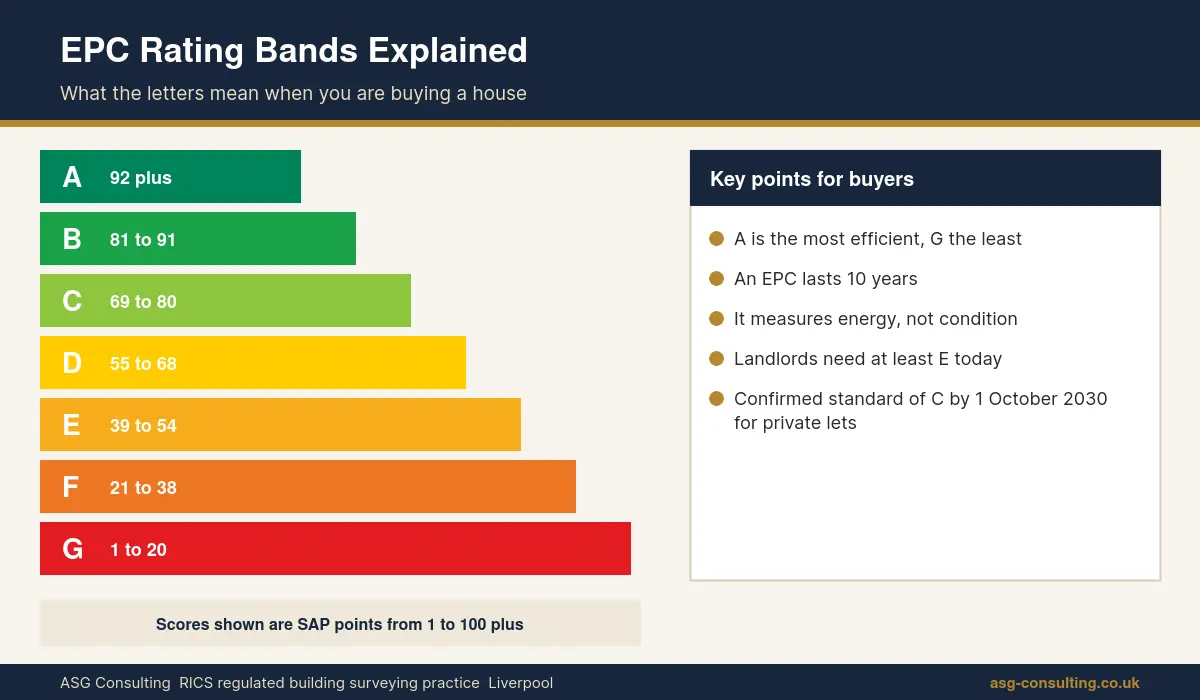
Each letter covers a range of scores. This table gives a plain English idea of what each band usually means in practice for a buyer.
| Band | What it usually means | Typical homes |
|---|---|---|
| A | Very efficient, often with renewable technology | Some new builds with solar panels or heat pumps |
| B | Efficient and well insulated | Most recent new builds |
| C | Good, with modern heating and decent insulation | Newer homes and well upgraded older homes |
| D | Around average for existing homes | Many 1930s to 1990s houses with some improvements |
| E | Below average, with clear room to improve | Older homes with limited insulation |
| F | Poor efficiency and higher running costs | Older solid walled homes or homes with old heating |
| G | Very poor efficiency | Homes with no central heating or major heat loss |
These descriptions are general. A Victorian terrace can reach C with the right improvements, and a newer home can drop to E if it has electric heating and little insulation.
How Do You Read an EPC, Section by Section?
Work through the certificate in this order. Each section answers a different question.
- The rating and potential rating. The current letter shows where the home is now. The potential letter shows where it could reach if the recommended improvements were made. A big gap between the two means there is plenty of room to improve.
- The date of the assessment. An EPC lasts 10 years, so an older certificate may not reflect recent work such as a new boiler or new windows.
- Breakdown of the property features. This lists walls, roof, floor, windows, heating, hot water and lighting, each with a rating. It is the most useful part for spotting weak points.
- Estimated energy use and costs. These are based on standard assumptions, so use them for comparison rather than as a forecast of your bills.
- Recommendations. The suggested improvements, with an indication of cost and the effect on the rating.
If the feature descriptions do not match what you see on a viewing, for example the EPC says cavity wall insulation but the house is clearly solid brick, ask questions. Mistakes and assumptions do happen.
Which Points on the EPC Deserve a Closer Look?
Some entries on the certificate are more revealing than others. Pay particular attention to
- Walls described as assumed. This means the assessor could not confirm the construction or insulation, so the real position may be better or worse.
- Main heating. Electric storage heaters, old boilers or room heaters usually pull the rating down and raise running costs.
- Hot water. An uninsulated cylinder or an immersion heater as the main source of hot water can be an easy improvement.
- Roof. A low loft insulation depth is one of the cheapest things to put right.
- Windows. Partial double glazing or single glazing tells you where heat is being lost.
- Floor. Suspended timber floors with no insulation are common in older homes and can make ground floor rooms feel cold.
Compare each entry with what you see on the viewing. If the loft has thick insulation but the EPC records very little, the certificate is probably out of date.
Do Flats and Houses Score Differently?
Yes. Flats often achieve better ratings than houses of a similar age, because they share walls, floors and ceilings with neighbouring homes and lose less heat to the outside. A flat in the middle of a block usually performs better than a top floor flat under the roof or a ground floor flat above an unheated space.
Houses vary by type too. A mid terrace house shares two walls with its neighbours, while an end terrace or semi detached house has more exposed walls and a detached house has the most. When you compare EPCs between properties, compare like with like.
Is an EPC the Same as a Survey?
No. An EPC is about energy efficiency only. The assessor records features that affect energy use, but does not look for defects such as damp, structural movement, roof problems or poor workmanship.
For example, an EPC may record that walls have cavity insulation without checking whether that insulation is causing damp. A home survey looks at condition. A RICS Level 2 HomeBuyer Survey suits many conventional homes, as explained on the RICS HomeBuyer Survey in Liverpool page, while the Level 3 Building Survey covered on the residential building surveying page is better for older or altered homes.
How Should the Rating Affect Your Offer?
A low rating is not a reason to walk away on its own, but it is useful information. Think about three questions.
- What will it cost to run? A lower rating usually means higher heating costs, especially in a larger home.
- What will it cost to improve? Some upgrades, such as loft insulation, are relatively simple. Others, such as solid wall insulation, are expensive and disruptive.
- Is the price fair for the work needed? If major upgrades are needed, factor that into what you offer.
Get quotes for the bigger improvements before you commit, so you are working with real figures rather than estimates.
Which Improvements Usually Make the Biggest Difference?
The recommendations on each EPC are specific to that home, but improvements generally fall into three groups. Starting at the top usually gives the best value.
| Priority | Typical improvements | Points to consider |
|---|---|---|
| First steps | Loft insulation, draught proofing, low energy lighting, heating controls | Usually simpler, cheaper and less disruptive |
| Next steps | Boiler replacement, hot water cylinder insulation, floor insulation, better glazing | Moderate cost and disruption |
| Bigger projects | Solid wall insulation, heat pumps, solar panels | Higher cost and may need permissions or specialist design |
Insulation must suit the building. Fitting the wrong type of insulation to an older solid walled home can trap moisture and cause damp, so get advice before major work. The guide to cavity wall insulation problems explains what can go wrong when insulation is fitted to the wrong wall.
What If You Plan to Let the Property?
If you are buying to let, the EPC matters a great deal more. Since 2020, privately rented homes in England and Wales have had to meet a minimum standard of EPC E, unless an exemption applies.
The government has confirmed a higher standard. Its response on improving the energy performance of privately rented homes says private landlords of all tenancies will need to reach EPC C or equivalent by 1 October 2030, with landlords required to invest up to 10,000 pounds per property. Some exemptions will apply.
| Rating | Position for landlords |
|---|---|
| A to C | Already meets the confirmed 2030 standard |
| D or E | Can be let now, but improvements will be needed by 2030 unless exempt |
| F or G | Cannot normally be let until improved or an exemption is registered |
If you are buying a property with an F or G rating to rent out, budget for upgrades before the first tenancy.
Can an EPC Be Wrong?
It can be out of date or based on assumptions. Assessors cannot see inside walls or under floors, so they sometimes rely on the age of the building or default values. Common reasons for an inaccurate picture include
- work done since the certificate, such as a new boiler, insulation or windows
- features recorded as assumed rather than seen, such as wall insulation
- extensions or loft rooms added after the assessment
- heating controls that have been upgraded or removed
After you buy, a new EPC can be commissioned from an accredited assessor if you want an up to date rating, for example after carrying out improvements.
How Do Older Liverpool Homes Usually Score?
Much of the housing in Liverpool was built before modern insulation standards. Victorian and Edwardian terraces in areas such as Anfield, Kensington, Wavertree and Toxteth usually have solid brick walls, which lose more heat than insulated cavity walls. Many have suspended timber ground floors, single storey rear extensions and original features that are difficult to insulate without care.
Interwar semis in areas such as Allerton, Walton, Childwall and Crosby often have cavity walls, and many have had cavity insulation, loft insulation and a modern boiler fitted over the years, which helps their ratings. Converted flats in the city centre and the Baltic Triangle vary widely depending on how well the conversion was done. New build estates across Merseyside usually achieve B, and sometimes A where solar panels or heat pumps are fitted.
When you view an older Liverpool home, compare the EPC feature list with what you can see. Look at the loft, the boiler, the windows and the walls. A home that has clearly been upgraded since the certificate was issued may perform better than its letter suggests.
Will a Better EPC Rating Help Your Mortgage or Future Sale?
Some lenders offer products aimed at energy efficient homes, and a better rating can be appealing to future buyers who are conscious of running costs. A home that has been improved from E to C, for example, may be easier to sell and cheaper to live in.
That does not mean every improvement adds value equal to its cost. Focus on upgrades that make the home more comfortable and cheaper to run, and that suit the building, rather than chasing a letter. If a heat pump is part of your plans, the guide to buying a house with a heat pump explains what to look for in an existing system.
How Can You Use the EPC to Plan Upgrades After You Buy?
The EPC can be a useful starting point for a simple improvement plan. Work through it like this.
- List the weakest features. Use the feature table to find the elements rated poor or very poor.
- Check the condition first. There is no point insulating a damp wall or a leaking roof. Use the survey findings to put repairs before upgrades.
- Start with the simple measures. Loft insulation, draught proofing and heating controls usually come first.
- Plan the bigger jobs around other work. Floor insulation fits well with new flooring, and heating upgrades fit well with a kitchen or bathroom refit.
- Take advice for older buildings. Solid walls, timber floors and listed homes need materials that let moisture escape.
- Keep records. Keep invoices and certificates, and consider a new EPC once the work is done.
Planning in this order avoids spending money twice and helps make sure each improvement suits the building. It also gives you a clear record of what has been done, which helps when you eventually sell, because buyers and their surveyors will want to see evidence of the work, the date it was carried out and who did it.
Is the EPC System Changing?
The government has said that future standards for privately rented homes will be measured using new EPC metrics, alongside the move to EPC C or equivalent by 2030. The way certificates present information may therefore change over the coming years.
For buyers, the practical advice stays the same. Look beyond the letter, read the feature list and recommendations, and judge the home on its condition, heating and insulation as well as its rating. A certificate that is close to the end of its 10 year life is worth treating with more caution than a recent one. If you are unsure what the rating means for a particular home, ask the surveyor to comment on the heating, insulation and windows during the inspection, so you can weigh up the EPC alongside the real condition of the property.
EPC Rating When Buying a House FAQs
What is a good EPC rating for a house?
C or above is generally considered good. Many older homes are rated D or E, which is around average for existing housing.
How long is an EPC valid?
An EPC is valid for 10 years. The seller must show a valid certificate to buyers when the property is marketed.
Can I buy a house with an F or G EPC rating?
Yes. You can buy and live in it, but expect higher running costs. Landlords normally cannot let F or G rated homes until they are improved.
Does an EPC check the condition of a house?
No. It only assesses energy efficiency. A RICS home survey checks the condition of the property.
What EPC rating will landlords need by 2030?
The government has confirmed that private rented homes will need EPC C or equivalent by 1 October 2030, with some exemptions.
How can I find the EPC for a property?
You can search the government register online by postcode and download a valid certificate for free.
Talk to a Surveyor at ASG Consulting
ASG Consulting is an RICS regulated building surveying practice based in Liverpool. It carries out RICS Level 2 HomeBuyer Surveys and Level 3 Building Surveys across Liverpool, Merseyside, the Wirral and the wider North West, with reports usually delivered within 3 to 5 working days of the inspection. Fees are fixed and given on request, usually confirmed within one working day. Call 0151 315 0626 to request a quote or to talk through which survey suits the property.
About the Author
Dave MacMillan is the lead surveyor at ASG Consulting, an RICS regulated building surveying practice at 54 St James Street, Liverpool. He has 8 years of experience in building surveying and inspects homes for buyers across Liverpool, Merseyside and the North West.
Last updated 23 November 2026