You should get a survey before auction, not after, because at a traditional auction contracts are exchanged when the hammer falls and you are legally committed to buy. A pre auction survey, usually a RICS Level 2 or Level 3 inspection carried out in the weeks before the sale, tells you what you are bidding on.
Property auctions are a popular way to buy in Liverpool and across the North West, especially for investors, landlords and buyers looking for a renovation project. Prices can be attractive, but the speed of the process leaves no room for the usual checks after an offer is accepted. This guide works as a countdown, from the day the catalogue comes out to the fall of the hammer, so you know when to book a survey before auction, what to check in the legal pack, how to set a sensible maximum bid and which risks catch auction buyers out.
In this guide
- Why is a survey before auction so important?
- What types of auction are there?
- What is the pre auction countdown?
- Which survey should you get before an auction?
- What if you cannot get access?
- What affects the cost of a survey?
- What should you check in the legal pack?
- What risks catch auction buyers out?
- How do you set a maximum bid?
- How do you arrange finance for an auction?
- What happens after the hammer falls?
- Buying at auction in Liverpool
- FAQs
Why Is a Survey Before Auction So Important?
In a normal private treaty sale, you make an offer, then book a survey, then negotiate if the survey finds problems, all before you exchange contracts. At a traditional auction, that order is reversed. Propertymark explains that once the gavel falls, you are bound by the terms of the sale and become responsible for insuring the property. There is no chance to renegotiate or pull out without serious cost.
That means every check you would normally make after an offer has to happen before you bid. A survey before auction is the only way to understand the condition of the property, the likely cost of repairs and whether the guide price makes sense. Auction properties are also more likely than average to have problems, because many are repossessions, probate sales, long term empty homes or properties that have struggled to sell on the open market.
Without a survey, you are bidding on photographs and a short viewing. With one, you are bidding with a clear idea of what you are buying and what it will cost to put right.
What Types of Auction Are There?
The type of auction changes how much time you have, but not the need for a survey before auction.
| Traditional auction | Modern method of auction | |
|---|---|---|
| When you are committed | Contracts exchange when the hammer falls | You pay a reservation fee after a successful online bid, then exchange later |
| Deposit or fee | Usually a 10 percent deposit on the day | A reservation fee, often 1 to 5 percent of the price |
| Time to complete | Typically 28 days | Typically 56 days in total, 28 to exchange and 28 to complete |
| Other costs | Buyer premium and administration fees may apply | The reservation fee is usually non refundable |
| Mortgage friendly? | Hard unless arranged in advance, or with bridging finance | More time for a mortgage, but still tight |
These figures come from the Propertymark guide to buying property at auction, which also notes that buyer premiums are often 1 to 5 percent plus VAT and that administration fees can range from around 195 pounds to over 1,000 pounds. Always read the auction conditions for the exact terms.
What Is the Pre Auction Countdown?
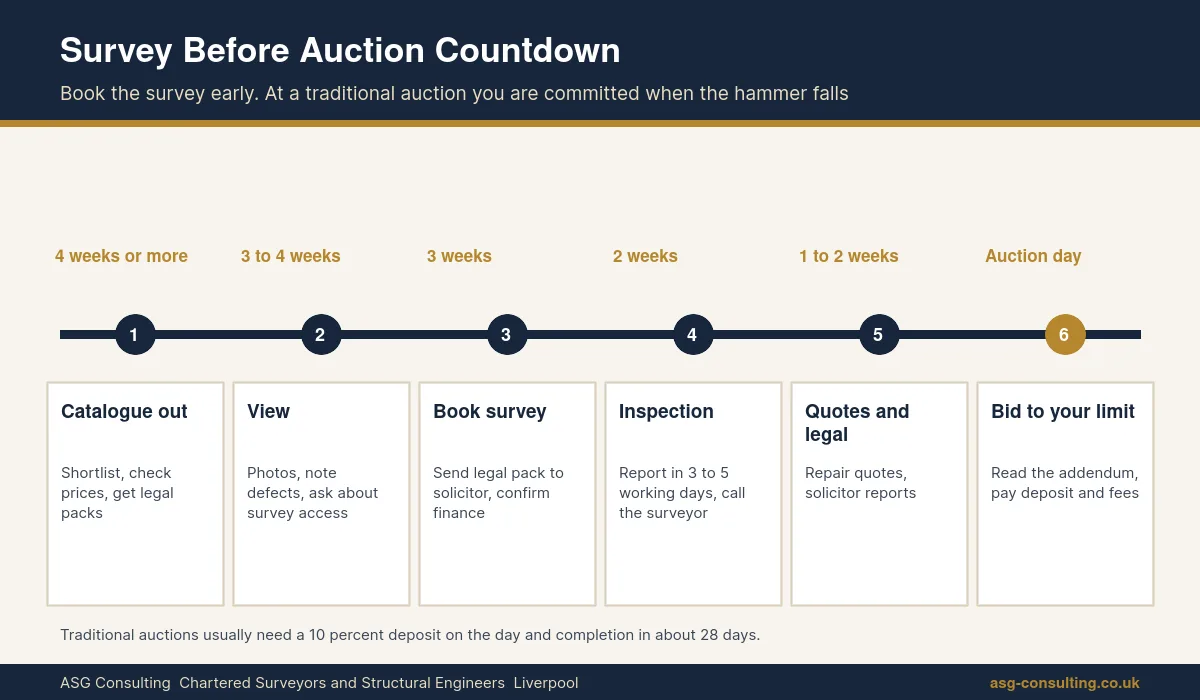
Auction catalogues are usually published a few weeks before the sale. Use that time carefully. This is a typical countdown.
- Catalogue released, four or more weeks before. Shortlist properties, check the guide prices against recent local sales and download the legal packs as soon as they are available.
- Three to four weeks before. Attend a viewing. Take photographs, note obvious defects and ask the auctioneer about access for a surveyor.
- Three weeks before. Book your survey before auction and send the legal pack to your solicitor. Confirm your finance.
- Two weeks before. The surveyor inspects. Ask for the report in time to act on it, and call the surveyor to talk through the findings.
- One to two weeks before. Get quotes for any significant repairs. Your solicitor reports on the legal pack and any special conditions.
- The week before. Set your maximum bid, check for any addendum or late changes, and register to bid.
- Auction day. Read the addendum, stick to your limit and be ready to pay the deposit and fees immediately if you win.
ASG Consulting reports are usually delivered within 3 to 5 working days of the inspection, so booking at least two to three weeks before the sale leaves time to act on the findings.
Which Survey Should You Get Before an Auction?
The right survey before auction depends on the property and what you plan to do with it.
| Property | Suggested survey |
|---|---|
| Conventional house or flat in reasonable condition | RICS Level 2 HomeBuyer Survey |
| Older property, such as a Victorian or Edwardian terrace | RICS Level 3 Building Survey |
| Property in poor condition or needing renovation | RICS Level 3 Building Survey, sometimes with a structural engineer |
| Property with visible cracking, movement or structural alterations | RICS Level 3 Building Survey plus a structural inspection |
| Commercial, mixed use or a flat above a shop | A commercial or tailored building survey |
For most auction properties, which are often older and in need of work, a Level 3 Building Survey gives the most useful detail, including likely causes of defects and repair options. Our residential building surveying page explains the Level 3 survey, and our RICS HomeBuyer Survey in Liverpool suits more conventional homes. For investors buying several properties, our pre acquisition surveys and portfolio advice service is designed for this kind of purchase.
If access for a full survey is not possible, ask the surveyor to attend a block viewing with you. A walk round with an experienced surveyor is far better than nothing, though it is not a substitute for a full inspection and report.
What If You Cannot Get Access Before the Auction?
Access is the most common obstacle to a survey before auction. Repossessed and empty properties are often only open for a few short block viewings, and some lots are sold with no internal viewing at all.
If a full inspection is not possible
- ask the auctioneer whether a separate appointment can be arranged for your surveyor
- take a surveyor with you to the block viewing for a walk round and verbal advice
- use a drone or a camera on a mast to inspect the roof and chimneys from outside
- look closely at the legal pack, searches and any previous reports supplied by the seller
- build a larger contingency into your maximum bid to reflect what you could not see
If you cannot see inside at all and the property is old or neglected, think very carefully before bidding. Our high level drone surveying service can capture roofs and chimneys that cannot be seen from the ground, even when internal access is limited.
What Affects the Cost of a Survey Before Auction?
The cost of a survey before auction depends on the size, age, type and condition of the property, the level of survey and how quickly you need the report. A large Victorian terrace in poor condition will take longer to inspect and report on than a modern flat.
ASG Consulting gives a fixed fee on request, usually confirmed within one working day, so you know the cost before you book. Compared with the price of the property and the risk of buying blind, the survey is usually a small part of the total cost of an auction purchase.
What Should You Check in the Legal Pack?
The legal pack is just as important as the survey before auction. Your solicitor should review it, but it helps to know what to look for.
- Title. Who owns the property, any restrictions, covenants and rights of way.
- Tenure. Freehold or leasehold, and for leasehold the remaining lease length, ground rent and service charges.
- Searches. Local authority, drainage and environmental searches, and their dates. If they are missing, ask your solicitor to order them.
- Special conditions of sale. These can add costs, such as seller legal fees, search costs or arrears that the buyer must pay.
- Tenancies. For tenanted properties, the tenancy agreement, rent, deposit protection and any arrears.
- Planning and building regulations. Approvals for extensions, conversions and changes of use.
- The addendum. Late changes published before or on the day, which can change the terms.
Propertymark notes that the reserve price, which the seller will not go below, is not disclosed and can be up to 10 percent above the guide price. Bear that in mind when you shortlist.
What Risks Catch Auction Buyers Out?
These are the problems a survey before auction most often uncovers.
| Risk | Why it matters |
|---|---|
| Structural movement | Subsidence, failing walls or removed structure can be expensive and affect mortgages and insurance |
| Roof at the end of its life | A full re roof is one of the biggest single costs on an older house |
| Damp and timber decay | Rot in floors and roof timbers is often hidden in empty properties |
| Non standard construction | Some concrete and steel framed houses are hard to mortgage or resell |
| Unauthorised alterations | Conversions and extensions without approval may need putting right |
| Japanese knotweed | Can affect lending and needs a management plan |
| Short leases or high charges | Can make flats hard to mortgage and expensive to own |
| Vandalism and services damage | Empty homes may have stripped pipework, boilers or wiring |
Our guides to non standard construction and Japanese knotweed explain two of the issues that most often affect lending on auction properties.
How Do You Set a Maximum Bid?
It is easy to get carried away in the room. Set your limit in advance, using the survey before auction and repair quotes to work backwards.
- Estimate the value of the property once repaired, based on recent sales of similar homes nearby.
- Deduct the cost of repairs and improvements from the survey and quotes, plus a contingency for the unexpected.
- Deduct the buyer premium, administration fee, legal costs, stamp duty and any special condition costs.
- Deduct finance costs, insurance and holding costs for the time the property is empty.
- Deduct the profit or margin you need if you are investing.
The figure left is your maximum bid. Write it down and do not go past it on the day.
How Do You Arrange Finance for an Auction?
With a traditional auction, you usually need to pay a 10 percent deposit on the day and complete within about 28 days. That is often too fast for a standard mortgage. Buyers typically use
- cash
- a mortgage agreed in principle and fully ready to go, with the lender aware of the timescale
- specialist auction or bridging finance, refinanced later onto a mortgage
Lenders will still want their own valuation, and some will not lend on properties in very poor condition or of certain construction types. That is another reason a survey before auction matters, because it flags issues that could stop a lender before you are committed. Our guide to mortgage valuation vs survey explains the difference between the lender check and your own survey.
What Happens After the Hammer Falls?
At a traditional auction, the moment the hammer falls you have exchanged contracts. You will usually need to
- sign the memorandum of sale
- pay the deposit and the buyer premium or fees
- arrange buildings insurance straight away, because the risk passes to you
- complete within the period set by the conditions, typically 28 days
If you cannot complete on time, you can lose your deposit and face further costs. Once you complete, a schedule of condition or a planned maintenance programme can help you manage the repairs. Our guide to planned preventative maintenance explains how landlords plan ongoing work.
Buying at Auction in Liverpool
Auctions are a well used route for buying property in Liverpool and Merseyside, particularly for investors and landlords. Lots often include Victorian terraces in Anfield, Walton, Kensington and Kirkdale, flats in converted houses, ex council homes and occasional commercial or mixed use buildings.
Common findings on a survey before auction in Liverpool include
- worn slate roofs and chimney stacks on Victorian terraces
- penetrating damp and timber decay in empty properties
- failed wall ties and bowing walls in older cavity walls
- rear outriggers and extensions with structural issues
- flat conversions without building regulations approval
- non traditional houses on some former council estates
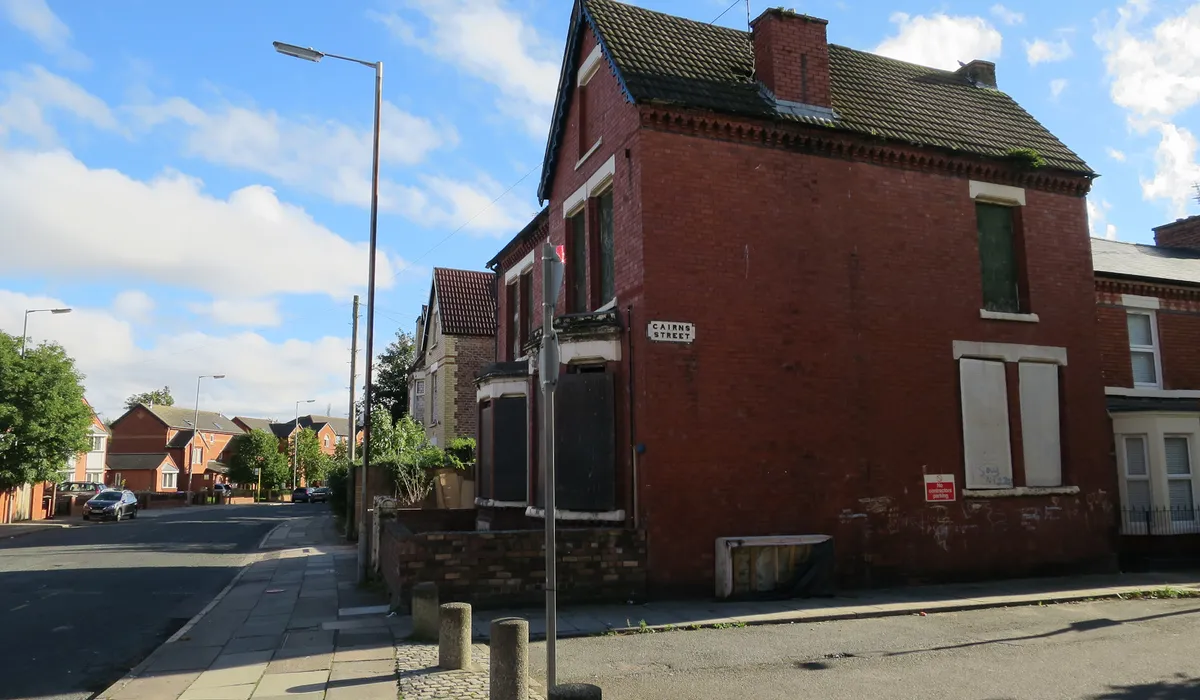
An empty terrace that has been neglected for several years can hide significant costs behind fresh paint or boarded windows. That is exactly what the survey is there to find.
Survey Before Auction FAQs
Should I get a survey before auction?
Yes. At a traditional auction you are legally committed when the hammer falls, so a survey before auction is your only chance to understand the condition and repair costs before you bid.
Can I get a survey on an auction property?
Usually yes. Ask the auctioneer or selling agent to arrange access for your surveyor before the sale. If a full survey is not possible, take a surveyor to the viewing.
Which survey is best before an auction?
A RICS Level 3 Building Survey usually suits auction properties, because many are older or need work. A Level 2 HomeBuyer Survey can suit conventional homes in reasonable condition.
How long do I have to complete after an auction?
At a traditional auction, completion is typically within 28 days. With the modern method of auction, buyers usually have 56 days in total, 28 to exchange and 28 to complete.
Can I pull out after winning an auction?
At a traditional auction, no, not without serious cost, because contracts exchange when the hammer falls. With the modern method of auction, the reservation fee is usually non refundable.
Can I get a mortgage for an auction property?
Sometimes, but the timescale is tight and the lender will need its own valuation. Many buyers use cash or bridging finance and refinance later.
Book a Survey Before Auction With ASG Consulting
ASG Consulting is an RICS regulated building surveying practice in Liverpool. We carry out Level 2 HomeBuyer Surveys and Level 3 Building Surveys before auctions across Liverpool, Merseyside, the Wirral and the wider North West, with reports usually delivered within 3 to 5 working days of the inspection. We give a fixed fee on request, usually confirmed within one working day. To request a quote, call 0151 315 0626 or visit our contact page.
About the Author
Dave MacMillan is the lead surveyor at ASG Consulting, an RICS regulated building surveying practice at 54 St James Street, Liverpool. He has 8 years of experience in building surveying and inspects homes for buyers across Liverpool, Merseyside and the North West.
Last updated 11 November 2026
Featured photo of a boarded up house by Hugh Venables via Wikimedia Commons, licence CC BY SA 2.0, cropped.