
A section 20 notice is the formal notice a landlord or management company must give leaseholders before carrying out major works or entering long term contracts that will be paid for through the service charge. It is named after section 20 of the Landlord and Tenant Act 1985. The rules give leaseholders the chance to see what is planned, comment on it and nominate a contractor before money is committed. For landlords, getting the process right protects the ability to recover the full cost. For leaseholders, it is the main opportunity to influence the scope and price of the works.
This guide sets out the section 20 consultation process as a step by step timeline, followed by practical checklists for landlords and leaseholders. It explains when a section 20 notice is needed, what each stage involves, what happens if consultation is skipped, how dispensation works, how to challenge costs and where a building surveyor fits in. It focuses on England and is written for leaseholders, landlords, right to manage companies and managing agents in Liverpool, Merseyside and the North West.
In this guide
- What a section 20 notice is
- When consultation is needed
- The section 20 consultation timeline
- Stage one, notice of intention
- Stage two, estimates
- Stage three, notice of reasons
- What a good notice contains
- A worked example
- Reserve funds
- Common mistakes
- If consultation is not carried out
- Dispensation and urgent works
- Checklist for landlords and agents
- Checklist for leaseholders
- Challenging the cost
- Where a surveyor helps
- Major works in Liverpool blocks
- FAQs
What a Section 20 Notice Is
Most leases allow the landlord to recover the cost of repairs, maintenance and some improvements to a building through the service charge. Because leaseholders can face large bills for major works, the law requires landlords to consult them first in certain cases. The consultation rules are set out in section 20 of the Landlord and Tenant Act 1985 and in regulations made under it.
A section 20 notice is one of the formal notices issued during that process. In practice, people use the phrase to describe the whole consultation, which usually involves at least two notices and sometimes a third. The notices must contain certain information and give leaseholders set periods to respond.
When Section 20 Consultation Is Needed
There are two main triggers for section 20 consultation in England.
| Type | When consultation is needed | Examples |
|---|---|---|
| Qualifying works | When any one leaseholder would contribute more than 250 pounds, including VAT | Roof replacement, external redecoration, window replacement, lift renewal, major repairs |
| Qualifying long term agreements | Contracts lasting more than 12 months where any one leaseholder would pay more than 100 pounds in a year | Cleaning, lift maintenance, gardening or managing agent contracts |
The thresholds apply per flat, based on each leaseholder share of the cost. In a large block, even expensive works may fall below the threshold, while in a small building a modest repair can exceed it. Works should not be split artificially to avoid the threshold.
The Section 20 Consultation Timeline
The infographic below shows the usual stages for qualifying works, along with the two thresholds.
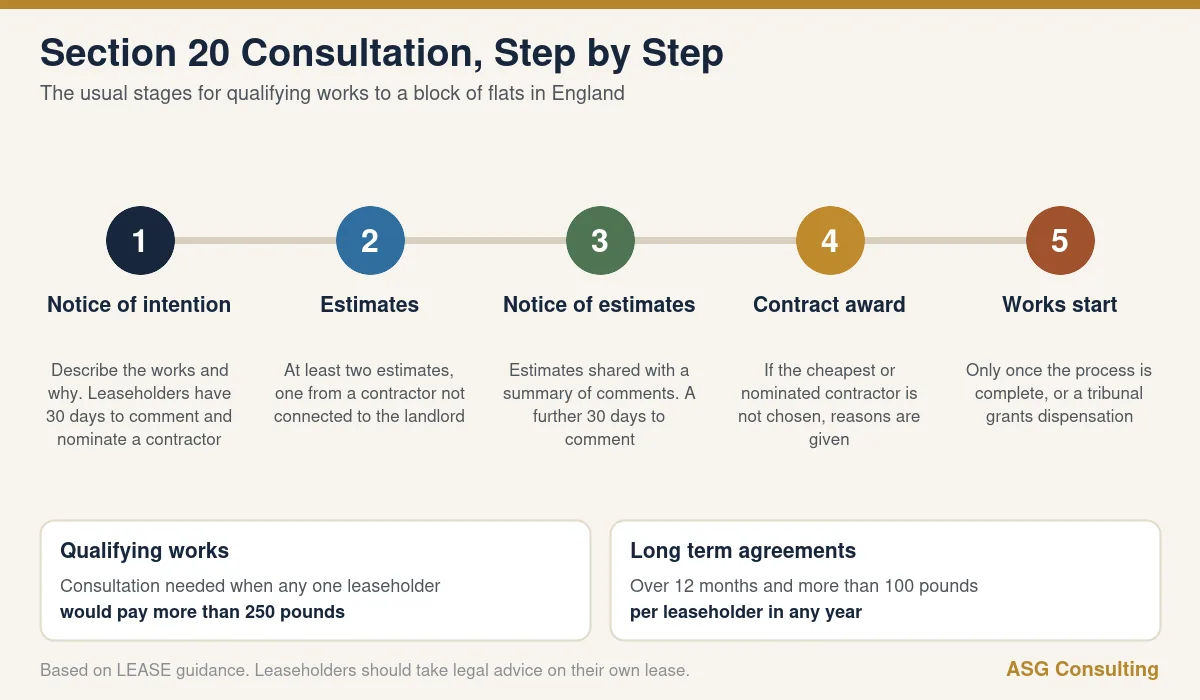
The full process usually takes at least two to three months, and often longer where specifications need to be prepared, contractors nominated and tenders returned. Building that time into planning is the best way to avoid pressure to cut corners.
Stage One, Notice of Intention
The first section 20 notice is the notice of intention. It must describe the proposed works in general terms, or say where and when a description can be inspected, explain why the works are considered necessary and invite leaseholders to make written observations.
Leaseholders have 30 days to respond. During this period they can also nominate a contractor from whom the landlord should try to obtain an estimate. Leaseholders and any recognised tenants association can make observations about the scope, timing or necessity of the works. The landlord must have regard to those observations.
Stage Two, Estimates
After the first notice period, the landlord obtains estimates. At least two estimates must be provided, and at least one must come from a contractor wholly unconnected with the landlord. Where leaseholders nominated a contractor, the landlord must try to obtain an estimate from them.
The landlord then issues a second notice, often called the notice of estimates or statement of estimates. This sets out the estimates, summarises the observations received at stage one and the landlord response to them, and invites further observations. Leaseholders again have 30 days to comment. Full estimates must be made available for inspection if they were not all supplied with the notice.
Stage Three, Notice of Reasons
If the landlord chooses a contractor who is not the cheapest, or not the leaseholders nominee, a further notice explaining the reasons for that choice and summarising observations on the estimates is usually required within a short period after entering the contract. If the cheapest or nominated contractor is chosen, this stage may not be needed.
Only once the process is complete should the works or contract begin, unless the landlord has obtained dispensation from the tribunal.
What a Good Section 20 Notice Contains
A clear section 20 notice reduces disputes. As well as the legal requirements, a good notice usually includes the following.
- The address of the building and the parts affected.
- A plain English description of the works and why they are needed.
- Where leaseholders can inspect the specification, survey or photographs.
- The deadline for observations and nominations, with the date the period ends.
- The address for sending observations.
- An indication of timing, including when works are expected to start.
Good practice also includes a covering letter, an indication of likely cost where known and an offer to meet or answer questions.
A Worked Example
This example is illustrative. A converted Victorian house in Liverpool has six leasehold flats, each paying one sixth of the service charge. The slate roof is failing and the managing agent obtains a condition survey recommending full reslating, new flashings and gutter replacement.
Because each leaseholder share will clearly exceed 250 pounds, the agent serves a section 20 notice of intention describing the works and enclosing a summary of the survey. One leaseholder nominates a local roofer. The surveyor prepares a specification and three contractors, including the nominee, return tenders. The notice of estimates sets out all three prices and summarises the comments received.
The agent chooses the middle priced contractor because the cheapest excluded scaffolding, and serves a notice of reasons explaining the choice. Leaseholders can see how the decision was made, the reserve fund covers part of the cost, and the rest is collected through the service charge. A clear section 20 consultation like this keeps costs recoverable and leaseholders informed.
Reserve Funds and Spreading Costs
Large one off bills are one of the biggest worries for leaseholders. Many leases allow a reserve or sinking fund, where small amounts are collected each year towards future major works. A well funded reserve means that when a section 20 notice is served, much of the cost may already be covered.
Landlords and right to manage companies can use a long term maintenance plan to set realistic reserve contributions. Where the lease allows, payment plans or phased works can also help spread the cost. Leaseholders should check their lease and the latest service charge accounts to see whether a reserve fund exists and how much it holds.
Common Section 20 Mistakes
- Starting works before the consultation is complete.
- Missing a leaseholder off the list or serving notices at the wrong address.
- Giving fewer than 30 days for observations.
- Failing to seek an estimate from a nominated contractor.
- Using only contractors connected to the landlord or agent.
- Describing the works too vaguely for leaseholders to comment.
- Not responding to observations or keeping records.
If Consultation Is Not Carried Out
If a landlord fails to carry out section 20 consultation properly and has not obtained dispensation, the amount it can recover from each leaseholder for those works is generally capped at the threshold of 250 pounds, or 100 pounds a year for long term agreements. The rest of the cost falls on the landlord.
For leaseholders, this is an important protection. For landlords and right to manage companies, it is a strong reason to follow the process carefully and keep good records of every section 20 notice, the dates it was served and the responses received.
Dispensation and Urgent Works
Sometimes works cannot wait for a full consultation, for example after storm damage, a dangerous structure or a failed roof letting water into flats. In these cases, the landlord can apply to the First tier Tribunal, Property Chamber, for dispensation from some or all of the consultation requirements.
The tribunal considers whether leaseholders would be prejudiced by the lack of full consultation and may grant dispensation on conditions. Even in urgent cases, landlords are usually expected to keep leaseholders informed and to consult as far as is practical. Leaseholders can respond to the application and set out any concerns.
Checklist for Landlords and Managing Agents
- Plan major works early using a condition survey and planned maintenance programme.
- Check the lease to confirm the works are recoverable through the service charge.
- Prepare a clear description or specification of the works.
- Serve each section 20 notice on every leaseholder and any recognised tenants association.
- Diary the 30 day observation periods and do not shorten them.
- Respond to observations in writing and keep records.
- Obtain at least two genuine estimates, one from an unconnected contractor.
- Seek an estimate from any nominated contractor.
- Issue a notice of reasons where required.
- Keep copies of all notices, proof of service and correspondence.
Our guide to planned preventative maintenance explains how to forecast major works years ahead, which makes section 20 consultation smoother and avoids surprise bills.
Checklist for Leaseholders
- Read each section 20 notice carefully and note the deadline for observations.
- Ask to see the specification, survey or reports that justify the works.
- Consider whether the works are necessary, whether the scope is right and whether the timing makes sense.
- Nominate a contractor if you know a suitable one.
- Compare the estimates and ask questions about any large differences.
- Put your observations in writing within the 30 day period.
- Coordinate with other leaseholders or a residents association.
- Take independent advice if the costs seem high or the works seem unnecessary.
If you are buying a flat, ask whether any section 20 consultation is under way or planned. Our checklist for a survey for buying a flat explains the questions to raise about major works, service charges and reserve funds.
Challenging the Cost
Following the section 20 consultation process does not mean leaseholders must accept any cost. Service charges must be reasonable, and works must be of a reasonable standard. Leaseholders can apply to the First tier Tribunal to decide whether service charges are payable and reasonable.
Evidence matters in any challenge. An independent survey can show whether the works were needed, whether the scope was appropriate and whether the price was in line with the market. Common issues include works that go beyond repair into improvement where the lease does not allow it, poor quality work, inflated specifications and contractors connected to the landlord.
Where a Building Surveyor Helps
A building surveyor can support both landlords and leaseholders through section 20 consultation.
| Stage | How a surveyor helps |
|---|---|
| Before consultation | Condition survey to identify what is needed and when |
| Notice of intention | Clear description of the works and why they are needed |
| Estimates | Specification and tender so estimates can be compared like for like |
| During works | Contract administration, inspections and quality checks |
| Disputes | Independent review of scope, quality and cost for leaseholders |
Common major works in blocks include roof replacement, external repairs and redecoration, window renewal, balcony repairs and fire safety improvements. Our guides to flat roof problems and the building condition survey explain how these needs are identified.
Major Works in Liverpool Blocks
Liverpool and Merseyside have a wide range of leasehold buildings, from converted Victorian houses split into a few flats to warehouse conversions, post war blocks and modern city centre apartments. Small buildings with few leaseholders often reach the section 20 threshold quickly, while large blocks may need careful planning of phased works.
The section 20 notice issues we see most often in the region include roof and external works on older conversions, window replacement on post war blocks, and building safety works on taller modern blocks. In each case, a clear specification, realistic programme and good communication with leaseholders make the process far smoother. Our property management Liverpool guide covers the wider management side.
Section 20 Notice FAQs
What is a section 20 notice?
It is a formal notice that a landlord or management company must give leaseholders before major works or long term contracts paid through the service charge, under section 20 of the Landlord and Tenant Act 1985.
How much do works have to cost before section 20 consultation applies?
For qualifying works, consultation applies when any one leaseholder would pay more than 250 pounds. For long term agreements over 12 months, it applies when any one leaseholder would pay more than 100 pounds in a year.
How long do leaseholders have to respond?
Leaseholders normally have 30 days to make observations after the notice of intention, and another 30 days after the notice of estimates.
Can leaseholders choose the contractor?
Leaseholders can nominate a contractor, and the landlord must try to obtain an estimate from them, but the landlord makes the final choice and must give reasons in some cases.
What happens if the landlord does not consult?
Without proper consultation or dispensation, the landlord can generally only recover the threshold amount from each leaseholder for those works.
Can urgent works go ahead without consultation?
The landlord can apply to the First tier Tribunal for dispensation. The tribunal looks at whether leaseholders would be prejudiced.
Does a section 20 notice mean I have to pay?
Not automatically. Service charges must still be reasonable and allowed by the lease, and leaseholders can challenge costs at the tribunal.
Can I see the full estimates?
Yes. If the notice of estimates does not include them all, the landlord must make them available for inspection, and you can ask for copies or a convenient place and time to view them.
Does section 20 consultation apply to commercial leases?
No. The section 20 rules apply to service charges paid by tenants of dwellings. Commercial service charges are governed by the lease and by professional guidance rather than these consultation requirements.
Do the same rules apply in Wales?
Wales has similar consultation rules, but there are some differences in detail. This guide focuses on England, so take local advice in Wales.
Get Help With Major Works in Liverpool
ASG Consulting is regulated by RICS. We help landlords, right to manage companies and leaseholders across Liverpool, Merseyside and the North West with condition surveys, specifications, tendering and independent reviews for section 20 consultation. To find out more, visit our asset management page.
About the Author
Harry is a property content writer with 3 years of experience writing about building surveying, commercial property and property compliance in the UK. He writes the guides at ASG Consulting for buyers, tenants and landlords, turning survey practice into clear, practical advice.
Reviewed by Dave MacMillan MRICS, chartered surveyor at ASG Consulting. Dave checks the technical content of our guides against current RICS practice before they are published.
Featured photo of scaffolding on a block of flats by Derek Harper via Wikimedia Commons, licence CC BY SA 2.0, cropped.