When buying a house with solar panels, first find out whether the panels are owned or leased. Owned panels pass to you with the house. Leased panels, often called rent a roof schemes, involve a separate lease that your lender must accept. Then check the installation certificate, any income payments, the roof condition and whether the work met planning and building regulations.
Solar panels are now a common sight on homes across Liverpool and the North West, from Victorian terraces to new build estates. They can cut energy bills and make a home more appealing to buyers. But they also raise questions about ownership, contracts, mortgages and the condition of the roof underneath. This guide compares owned and leased panels side by side, gives you a step by step checklist, and explains what a surveyor will look at when buying a house with solar panels.
In this guide
- What types of solar installation are there?
- How do owned and leased panels compare?
- What are the risks with leased panels?
- Will solar panels affect your mortgage?
- What should you check, step by step?
- What documents should you ask for?
- What does the roof need to cope with?
- Does a survey check solar panels?
- Did the panels need planning permission?
- Will you get paid for the electricity?
- What about batteries and inverters?
- What if you want to remove or add panels?
- What mistakes do buyers make?
- What happens when you sell later?
- Solar panels on Liverpool homes
- FAQs
What Types of Solar Installation Are There?
Most domestic solar installations fall into one of three groups.
- Owned solar PV panels. Photovoltaic panels that turn sunlight into electricity, bought outright by a previous owner. They are part of the house and pass to you when you buy.
- Leased solar PV panels. Panels installed by a company under a long lease of the roof space. The company usually owns the panels and may receive any income, while the homeowner gets free or cheaper electricity.
- Solar thermal panels. Panels that heat water rather than produce electricity. They are less common but still found on some homes.
The difference between owned and leased panels is the most important thing to establish, because it affects your mortgage, your legal position and what happens if the panels need repair.
How Do Owned and Leased Panels Compare?
This table compares the two main options when buying a house with solar panels.
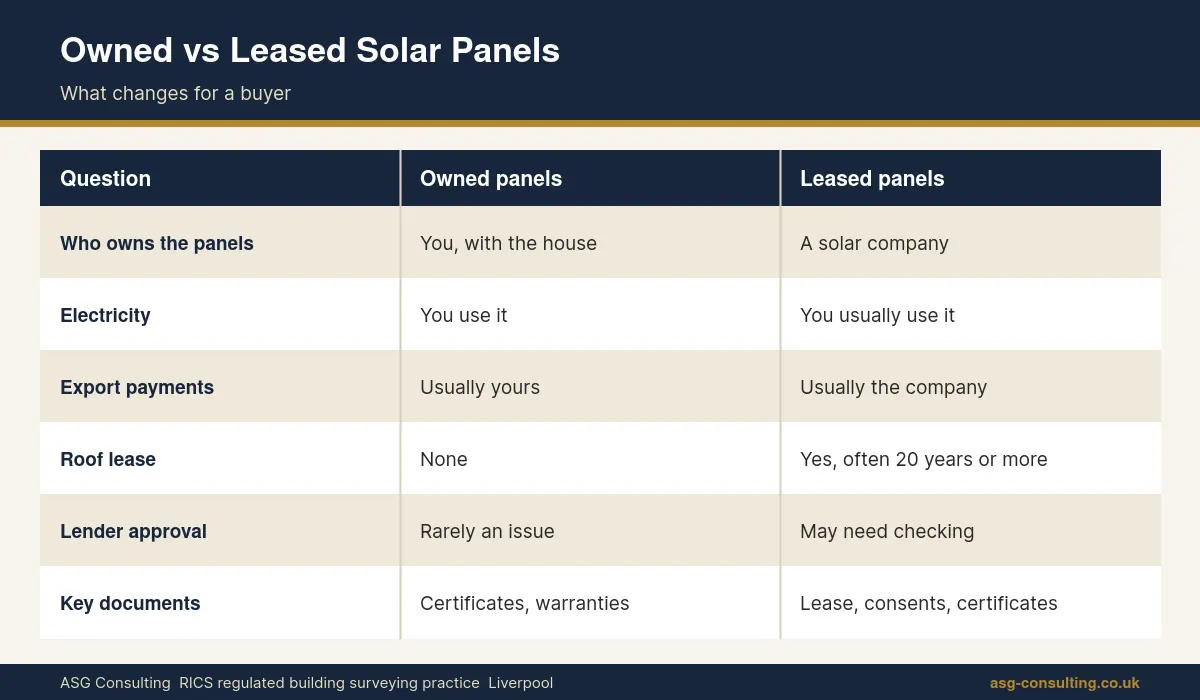
| Feature | Owned panels | Leased panels |
|---|---|---|
| Who owns the panels | The homeowner | Usually the solar company |
| Legal paperwork | Installation and warranty documents | A separate lease of the roof space, often registered |
| Income from exported electricity | Goes to the homeowner, where a scheme applies | Often goes to the solar company |
| Mortgage lender view | Usually straightforward | Lender must accept the lease terms |
| Repairs and maintenance | The homeowner | Usually the solar company, as set out in the lease |
| Roof access and repairs | The homeowner decides | May need the company to remove and refit panels |
| Effect on sale | Often seen as a benefit | Can slow a sale if the lease is not acceptable to lenders |
What Are the Risks With Leased Panels?
Leased panels, often called rent a roof or free solar schemes, were popular in the early 2010s. Many leases run for 20 to 25 years. The main risks are legal and practical rather than technical.
- Lender approval. Some lenders will not lend on homes with certain solar leases, or will only do so if the lease meets their requirements.
- Access rights. The solar company may have rights to access your roof for maintenance.
- Roof repairs. If the roof needs work, you may need the company to remove and refit the panels, which can take time.
- Restrictions. The lease may limit changes to the roof, such as loft conversions or dormers.
- Company changes. The original company may have sold its leases or ceased trading.
Industry guidance for lenders, reported by Estate Agent Today in its article on rent a roof solar and lender rules, set out that installers should obtain the consent of the lender before installation and that lenders should be able to have panels removed if they hinder a sale following repossession. Individual lenders may also have their own requirements.
Will Solar Panels Affect Your Mortgage?
Owned panels rarely cause problems with lenders. Leased panels can, depending on the lease terms and the lender. Before you commit
- tell your mortgage broker or lender early that the property has leased panels
- ask your solicitor to obtain and review the full lease
- check whether the lender has its own requirements for solar leases
- allow time for any lease variations or lender approvals
If the lease is not acceptable to your lender, the seller may need to buy out the lease or have the panels removed, which can delay the sale. Our guide to mortgage valuation vs survey explains what the lender valuation does and does not cover.
What Should You Check, Step by Step?
Follow these steps when buying a house with solar panels.
- Confirm ownership. Ask the seller whether the panels are owned or leased.
- Get the paperwork. Ask for the installation certificate, warranties, any lease and any income agreements.
- Tell your lender. Especially if the panels are leased.
- Instruct your solicitor. Ask them to review the lease and confirm what transfers to you.
- Check permissions. Confirm whether planning permission or building regulations approval was needed.
- Book a survey. Ask the surveyor to comment on the roof and the visible installation.
- Consider a specialist check. An installer can test the system, inverter and output if you want certainty.
- Arrange transfers. Update any export payment agreements and warranties into your name after completion.
What Documents Should You Ask For?
Ask the seller for
- the installation certificate, often an MCS certificate for certified installations
- the electrical installation certificate for the new wiring
- building regulations compliance evidence, where required
- panel, inverter and battery warranties
- any solar lease and related correspondence
- details of any export or income payments and how to transfer them
- service records and generation readings, if available
Missing paperwork does not always mean a problem, but it does mean more questions. Your solicitor can advise on options such as asking the seller to obtain copies or provide further evidence.
What Does the Roof Need to Cope With?
Solar panels add weight and fixings to a roof. A well designed installation considers whether the roof structure can carry the panels and the extra wind loads, and how fixings pass through the roof covering without letting water in.
Problems a surveyor may see include
- slipped, cracked or broken slates and tiles around the panel fixings
- damp staining in the loft below the panels
- sagging roof slopes where panels have been added to older or weaker roofs
- cables passing through the roof without proper sealing
- debris, moss or pigeon nests trapped under panels
- roofs that will need recovering before the panels reach the end of their life
Older roofs need particular care, because recovering a roof with panels on it means removing and refitting them. Our guide to slate roof problems explains common issues with older roofs.
Does a Survey Check Solar Panels?
A RICS survey looks at the panels as part of the roof and comments on their visible condition and any effect on the building. It does not test the electrical system, measure output or confirm the panels are working efficiently.
For most homes, a RICS Level 2 HomeBuyer Survey is suitable, and our RICS HomeBuyer Survey in Liverpool page explains what it covers. For older homes or homes with roof concerns, a Level 3 Building Survey gives more detail, as explained on our residential building surveying page. Where the roof is high or hard to see, our high level drone surveying service can give a closer view of the panels and the roof around them.
Did the Panels Need Planning Permission?
Many roof mounted panels on houses are permitted development, which means they do not need a planning application if they meet set limits. The Planning Portal guidance on solar equipment on houses explains that on a pitched roof, panels should not be installed above the highest part of the roof, excluding the chimney, and should project no more than 200mm from the roof slope.
The same guidance notes that in conservation areas, panels must not be fitted to a wall, balcony or roof enclosure that fronts a highway, and that the rules were updated from 27 August 2026 with a transitional period. Listed buildings have stricter controls. Our guide to buying a house in a conservation area explains those wider rules.
Building regulations also apply to the electrical work and to the effect on the roof structure. Certified installers usually deal with this, which is why the installation paperwork matters.
Will You Get Paid for the Electricity?
It depends on the installation and when it was set up.
| Arrangement | What it means for a buyer |
|---|---|
| Older installation with a feed in tariff | Payments may transfer to the new owner if the panels are owned, so check the agreement and transfer process |
| Export payments from an energy supplier | You may be able to set up your own export agreement after you move in |
| Leased panels | Income usually goes to the solar company, while you benefit from the electricity used in the home |
Ask the seller for details and copies of any agreements, and ask your solicitor to confirm what transfers with the property.
What About Batteries and Inverters?
Many systems include an inverter, which converts the electricity from the panels so it can be used in the home, and some also have a battery. Inverters typically have a shorter life than panels and may need replacing during your ownership.
Check
- the age and warranty of the inverter
- whether a battery is included, where it is located and its warranty
- whether batteries are installed in a suitable location with appropriate ventilation and safety measures
- whether the system has been serviced
A surveyor will note visible equipment but will not test it, so a specialist check may be worthwhile on larger or more complex systems.
What If You Want to Remove or Add Panels?
If you own the panels, you can usually remove, move or add to them, subject to planning rules and building regulations. If the panels are leased, the lease will set out what you can and cannot do, and removing them early may involve costs or negotiation with the solar company.
If you plan a loft conversion, dormer or new roof, check how the panels affect your plans before you buy. Our guide to a loft conversion structural engineer explains what roof alterations involve.
What Mistakes Do Buyers Make With Solar Panels?
Most problems with solar panels come from missing paperwork or assumptions about who owns the system. Common mistakes include
- Assuming the panels are owned. Always confirm whether the system was bought outright or installed under a roof lease.
- Not telling the mortgage lender early. Some lenders need to approve a roof lease before they will lend, which can delay the purchase.
- Missing the handover documents. Without certificates and warranties, it can be hard to prove the system was installed properly.
- Not transferring the income. If the panels earn payments, the account usually needs to be moved into your name after completion.
- Ignoring the roof under the panels. Slipped tiles, damaged slates or leaks can be hidden by the panels and their fixings.
- Overlooking the inverter. Inverters usually have a shorter life than the panels and may need replacing sooner.
What Happens When You Sell the House Later?
Whatever you learn when you buy, you will need to pass on when you sell. Keep every document you receive, including certificates, warranties, the lease if there is one and records of servicing or repairs. A complete file makes the next sale smoother and helps the next buyer and their lender feel confident about the system.
If the panels are leased, check whether the lease has been updated with any lender protections, as this can make a later sale easier. If you own the panels, keep a note of any inverter replacement or repair work so the next buyer can see the system has been looked after. It also helps to keep recent electricity bills or generation readings, which show the next buyer how the system performs in practice.
Solar Panels on Liverpool Homes
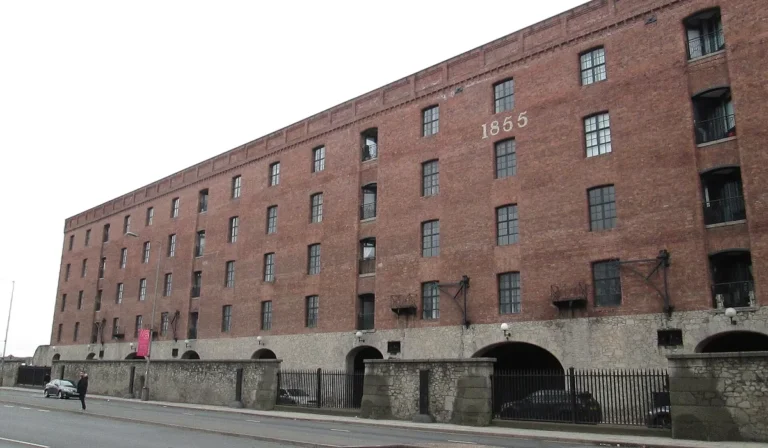
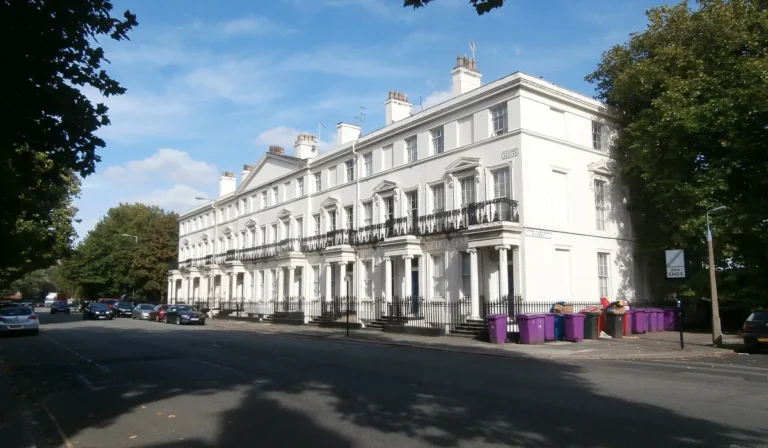
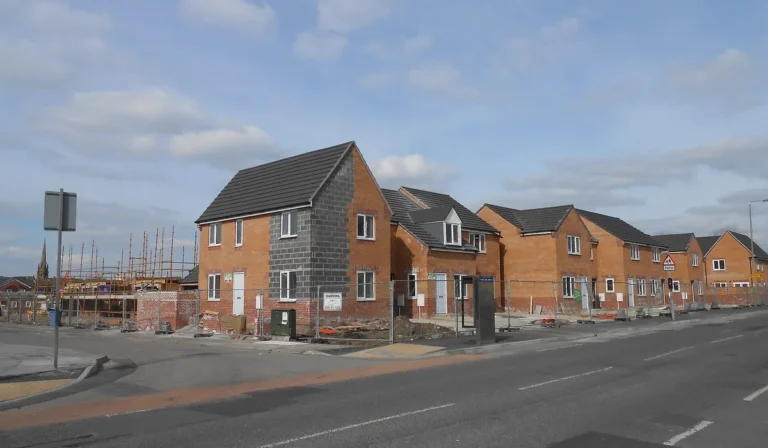
Solar panels are increasingly common on homes across Liverpool and Merseyside, including Victorian and Edwardian terraces, 1930s semis, post war council built houses and new build estates. Free solar schemes in the 2010s fitted panels to many homes across the country, so leased panels may turn up on resale properties.
Issues to look out for on local homes with solar panels include
- older slate roofs with slipped slates around panel fixings
- panels on roofs that will need recovering within the life of the panels
- pigeons nesting under panels on urban terraces
- cable routes through roofs without clear sealing
- missing installation or electrical certificates
- leased panels from older free solar schemes
Wind driven rain from the Irish Sea tests roof fixings and seals, so the roof around the panels deserves a close look on exposed coastal homes.
Buying a House With Solar Panels FAQs
Is it a good idea to buy a house with solar panels?
It can be, especially if the panels are owned, well installed and documented. Leased panels need more checks because lenders must accept the lease terms.
How do I know if solar panels are leased or owned?
Ask the seller and request the paperwork. Your solicitor will check for any lease of the roof space, which is often registered against the property.
Can I get a mortgage on a house with leased solar panels?
Often yes, but not with every lender. Tell your lender early and ask your solicitor to review the lease against their requirements.
Does a homebuyer survey check solar panels?
A survey comments on the visible condition of the panels and the roof, but it does not test the electrical system or output.
Do solar panels damage roofs?
Well installed panels should not, but poor fixings, sealing and extra weight on weak roofs can cause leaks, slipped tiles and sagging.
Do solar panel payments transfer to the new owner?
Payments for owned panels may transfer, depending on the agreement. For leased panels, income usually stays with the solar company.
Book a Survey With ASG Consulting
ASG Consulting is an RICS regulated building surveying practice in Liverpool. We carry out RICS Level 2 HomeBuyer Surveys, Level 3 Building Surveys and drone roof inspections across Liverpool, Merseyside, the Wirral and the wider North West, with reports usually delivered within 3 to 5 working days of the inspection. We give a fixed fee on request, usually confirmed within one working day. To request a quote, call 0151 315 0626 or visit our contact page.
About the Author
Dave MacMillan is the lead surveyor at ASG Consulting, an RICS regulated building surveying practice at 54 St James Street, Liverpool. He has 8 years of experience in building surveying and inspects homes for buyers across Liverpool, Merseyside and the North West.
Last updated 18 November 2026
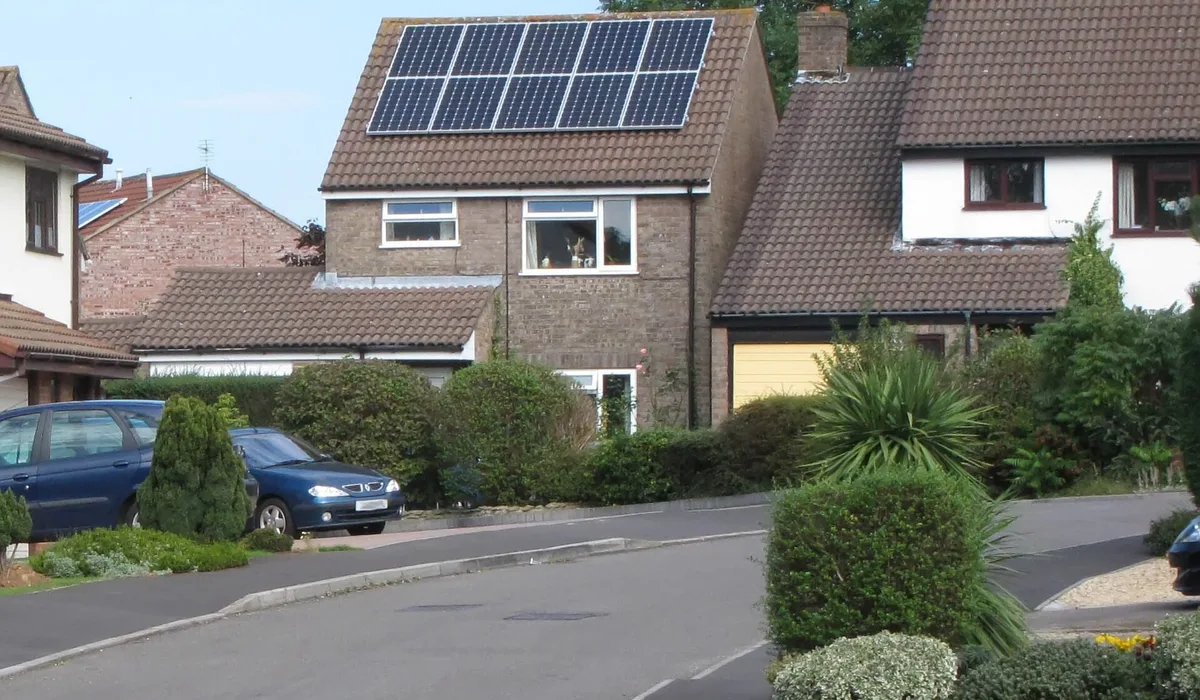
Featured photo of solar panels on a house in Yate by Adrian Pingstone via Wikimedia Commons, public domain, cropped.