Buying a house with a right of way means someone else has a legal right to cross part of the land. A public right of way, such as a footpath, lets anyone pass. A private right of way lets a named neighbour or landowner pass. Check the deeds, the council definitive map and the route on site before you commit.
Rights of way are common and often cause no trouble at all. A shared passage behind a terrace, a neighbour driving across a corner of the garden or a footpath along a field edge can all be perfectly manageable. Problems usually start when buyers do not realise the right exists until after they move in. This guide explains the difference between public and private rights, lists 5 hidden problems to watch for, and shows how to check before buying a house with a right of way.
Contents
What Is a Right of Way?
A right of way is a legal right to pass over land you do not own. It does not give the user ownership of the land. It only allows them to cross it, usually along a set route and for a set purpose.
There are two main types. A public right of way can be used by anyone. A private right of way, also called an easement, benefits a particular property or person, such as a neighbour who needs to reach their back gate.
What Is the Difference Between Public and Private Rights of Way?
This table sets out the main differences in simple terms.
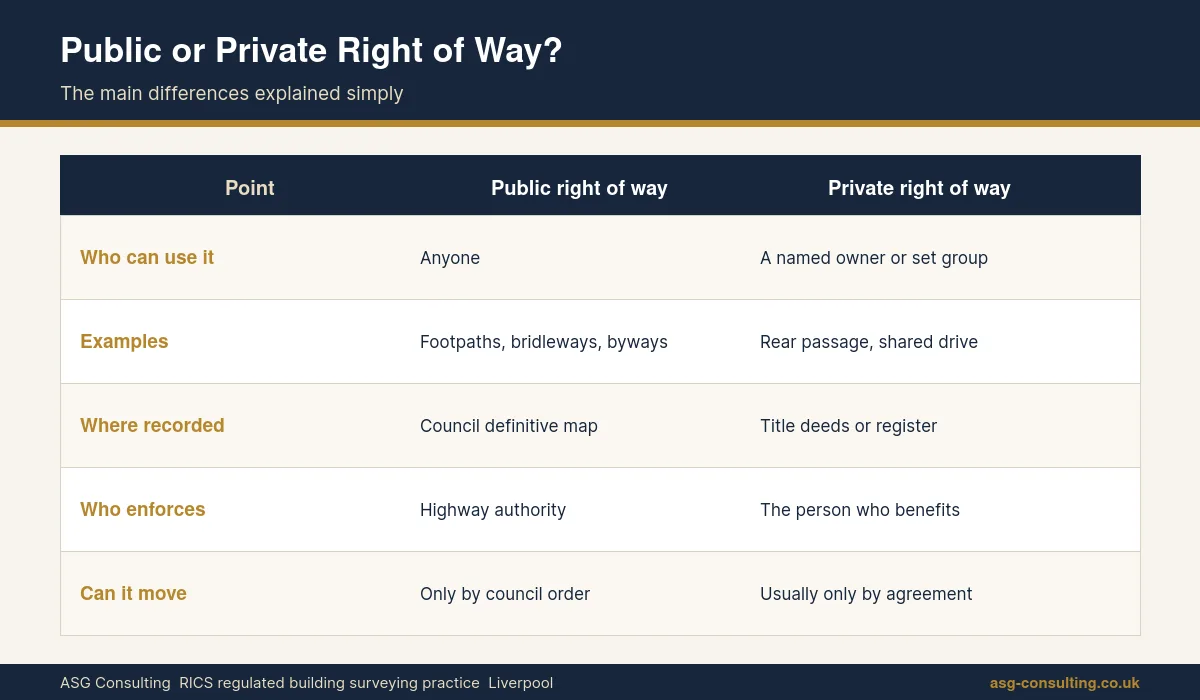
| Point | Public right of way | Private right of way |
|---|---|---|
| Who can use it | Anyone | A named property owner, their visitors or a set group |
| Examples | Footpaths, bridleways and byways | Access to a neighbour back gate, garage or shared drive |
| Where it is recorded | The council definitive map | Usually the title deeds or title register |
| Who enforces it | The local highway authority | The person who has the benefit of the right |
| Can it be moved | Only by a formal council order | Usually only by agreement with the person who benefits |
The gov.uk guide to using public rights of way explains that public routes include footpaths, bridleways, restricted byways and byways open to all traffic, each with different users allowed.
What Are the 5 Hidden Problems When Buying a House With a Right of Way?
These 5 hidden problems are the ones that most often surprise new owners. Each can be checked before you exchange.
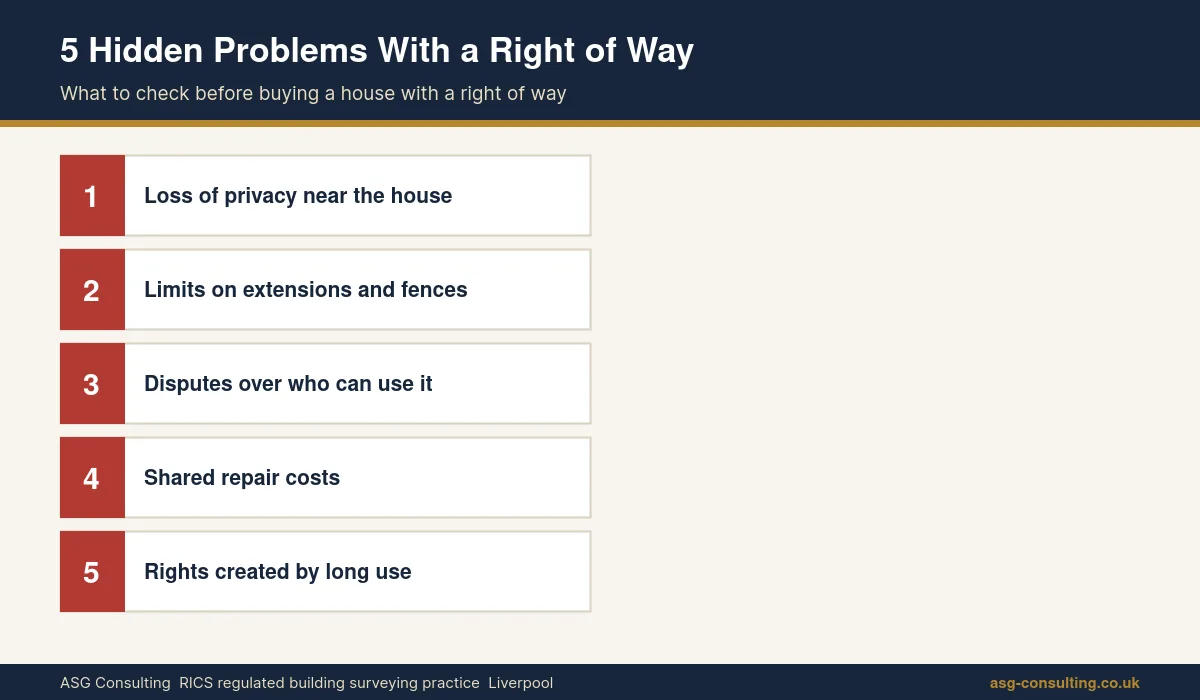
- Loss of privacy. A route close to windows or through a garden means people may pass near the house at any time.
- Limits on building work. You cannot build over or block a right of way, which can rule out some extensions, garages or fences.
- Disputes over use. Neighbours may disagree about who can use a route, for what and at what times.
- Repair costs. The deeds may require you to share the cost of maintaining a shared path or drive.
- Rights not in the deeds. Some rights are created by long use and may not appear on paper at all.
What Must You Do if a Public Footpath Crosses Your Land?
Owning land with a public right of way brings legal duties. The gov.uk guidance on landowner responsibilities says you must not block a public route with fences, walls, hedges, padlocked gates or barbed wire, and that obstructing a public right of way is a criminal offence.
The same guidance says gates and stiles that are your responsibility must be kept safe and easy to use, and that misleading signs, such as a false warning about a bull, are an offence. You can apply to the council to divert a public path in some circumstances, but this is a formal process and the outcome is not guaranteed.
How Do Private Rights of Way Work?
Private rights usually appear in the title deeds or the title register at HM Land Registry. They may say who can use the route, whether vehicles are allowed and who pays for repairs. Common examples include
- a shared passage behind a row of terraced houses
- a neighbour right to cross your garden to reach their back door
- a shared drive leading to two or more garages
- access across a yard to reach bins or a rear entrance
If a drive is shared, the guide to buying a house with a shared driveway covers the extra questions to ask about parking, repairs and access.
Can a Right of Way Exist Without Being in the Deeds?
Yes. A private right of way can sometimes be created by long use, often after 20 years of open use without permission. A public path can also exist even if it is not yet shown on the definitive map. This is why checking the site matters as much as checking the paperwork.
On a viewing, look for worn paths, gates in boundary fences, gaps in hedges and neighbours using a route. Ask the seller directly whether anyone else crosses the land, and how often.
How Should You Check for a Right of Way?
Follow these steps before you exchange contracts.
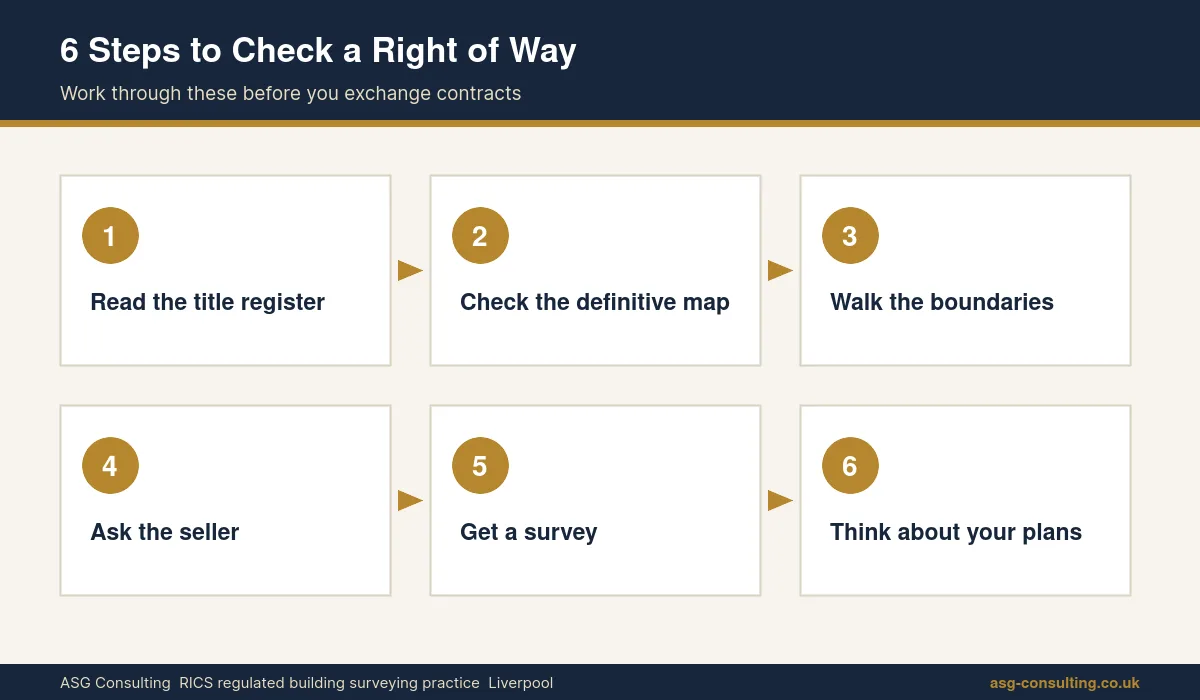
- Read the title register. Your solicitor will check for rights granted over the land and rights that benefit it.
- Check the definitive map. Your solicitor can raise an enquiry with the council about public paths, or you can view the map yourself.
- Walk the boundaries. Look for paths, gates, stiles and signs of regular use.
- Ask the seller. Find out who uses any routes, how often and whether there have been disagreements.
- Get a survey. A surveyor will note visible paths, gates and boundary features, and flag anything for your solicitor.
- Think about your plans. If you want to extend, fence or build, check the route will not get in the way.
Rights of Way and Shared Entries in Liverpool
Many Victorian and Edwardian terraces in Liverpool were built with narrow back passages, often called entries, running behind the yards. Homes in areas such as Anfield, Walton, Kensington, Wavertree and Toxteth often rely on these passages for bin access and rear gates. Who owns them and who can use them varies from street to street.
Some passages have been gated by the council to reduce crime and fly tipping, with keys given to residents. Others are unadopted and shared between neighbours. Before you buy, ask whether the rear passage is gated, who holds the keys and who is responsible for cleaning and repairs.
On the edges of the city region, in parts of the Wirral, Sefton and West Lancashire, public footpaths may cross gardens, fields or farm land attached to homes. These routes are usually shown on the council definitive map. If a boundary is unclear, the guide to a boundary dispute surveyor explains how boundaries are investigated.
Does a Right of Way Affect House Value?
It can, but not always. A rarely used private route along the side of a garden may make little difference. A busy public footpath close to the house, or a right that blocks a planned extension, may reduce the number of interested buyers. Clear paperwork and good relations with neighbours help a future sale.
Does a Survey Check Rights of Way?
A surveyor does not check legal rights, but notes visible features that may point to one, such as worn paths, gates, stiles, shared passages and signs of use by others. These are flagged in the report so your solicitor can investigate.
For a conventional home, a RICS HomeBuyer Survey in Liverpool is often suitable. For older homes or larger plots, the Level 3 Building Survey described on the residential building surveying page gives more detail about boundaries and outbuildings.
Buying a House With a Right of Way FAQs
Can I buy a house with a public footpath through the garden?
Yes. You must keep the path open and not block it, but many people live happily with a footpath on their land.
Can I stop people using a right of way?
No. A public path can only be moved or closed by a formal council order. A private right usually needs agreement.
Where can I find out if a property has a right of way?
Check the title register, the council definitive map and the site itself, and ask the seller.
Can a right of way be created by use?
Yes. A private right can sometimes arise after around 20 years of open use without permission.
Who repairs a shared right of way?
The deeds often say. If they do not, ask your solicitor and agree arrangements with neighbours.
Does a survey check rights of way?
No, but a surveyor notes visible paths, gates and passages and flags them for your solicitor.
Talk to a Surveyor at ASG Consulting
ASG Consulting is an RICS regulated building surveying practice based in Liverpool. It carries out RICS Level 2 HomeBuyer Surveys and Level 3 Building Surveys across Liverpool, Merseyside, the Wirral and the wider North West, with reports usually delivered within 3 to 5 working days of the inspection. Fees are fixed and given on request, usually confirmed within one working day. Call 0151 315 0626 to request a quote or to talk through which survey suits the property.
About the Author
Dave MacMillan is the lead surveyor at ASG Consulting, an RICS regulated building surveying practice at 54 St James Street, Liverpool. He has 8 years of experience in building surveying and inspects homes for buyers across Liverpool, Merseyside and the North West.
Last updated 26 November 2026