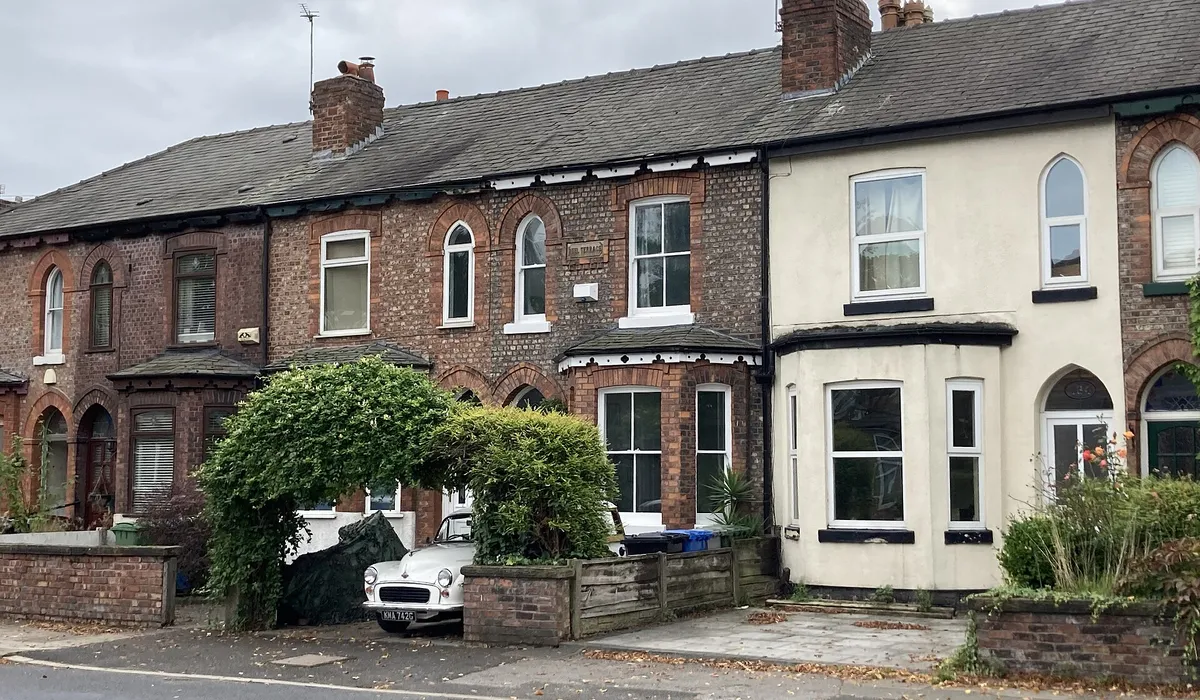
Bay window subsidence is when the bay moves separately from the main house, often because its foundations are shallower. Signs include tapering cracks where the bay meets the main wall, sticking windows and gaps at the skirting. Many bay cracks are old and stable, but new or widening cracks should be checked by a surveyor or structural engineer.
Bay windows are one of the most loved features of Victorian terraces and 1930s semis, and one of the most common places a surveyor finds cracking. A crack around a bay can look alarming on a viewing, but the cause and the risk vary a great deal. This guide shows how to read the cracks, what usually causes bay movement and what to do before buying a house with signs of bay window subsidence.
Contents
Why Do Bay Windows Move More Than the Rest of the House?
A bay is a projection from the main wall, and it often behaves like a separate small structure. Common reasons for movement include
- Shallower foundations. In many older houses the bay was built on shallower footings than the main walls, so it is more affected by changes in the ground near the surface.
- Lighter load. The bay carries less weight than the main front wall, so the two parts can settle at different rates.
- Drains nearby. Drainage often runs close to the front of the house. A leaking pipe can soften or wash away soil under the bay.
- Trees and shrubs. Roots in a front garden or from street trees can draw moisture from clay soils, causing them to shrink in dry weather.
- Altered window frames. In many 1930s bays the original timber frames help carry the load above. Replacement frames that are not designed to support that load can lead to sagging and cracking.
What Are the 5 Warning Signs of Bay Window Subsidence?
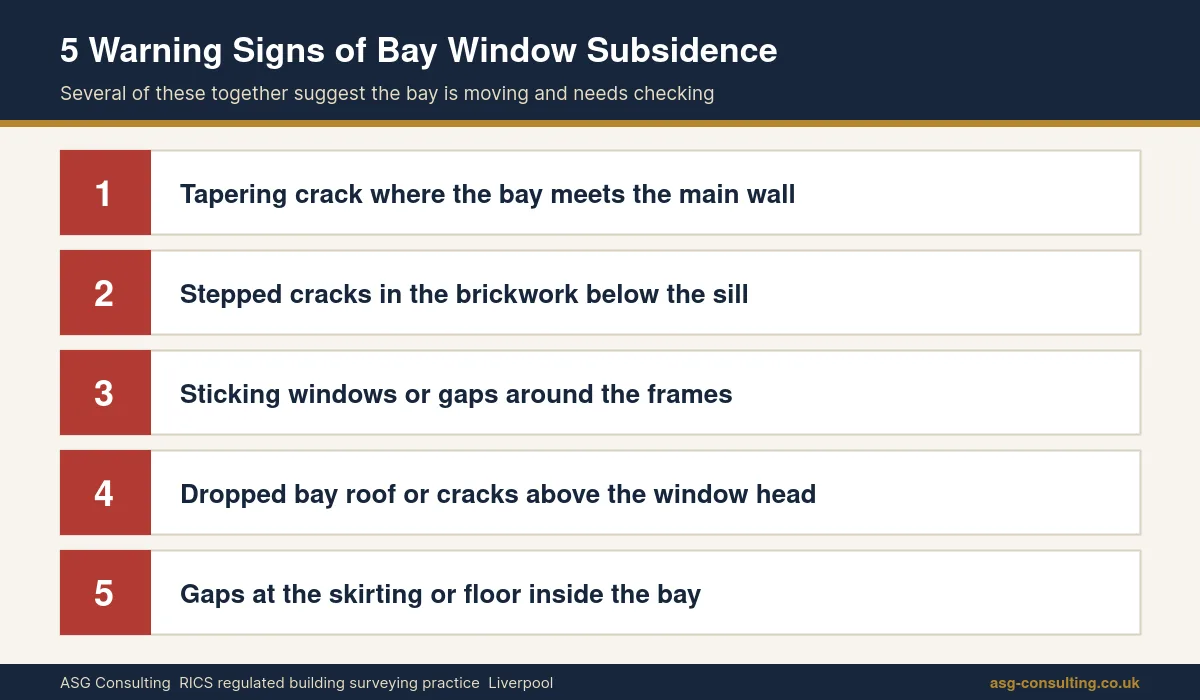
These five signs are the ones surveyors look for first. One on its own is often minor, but several together suggest the bay is moving.
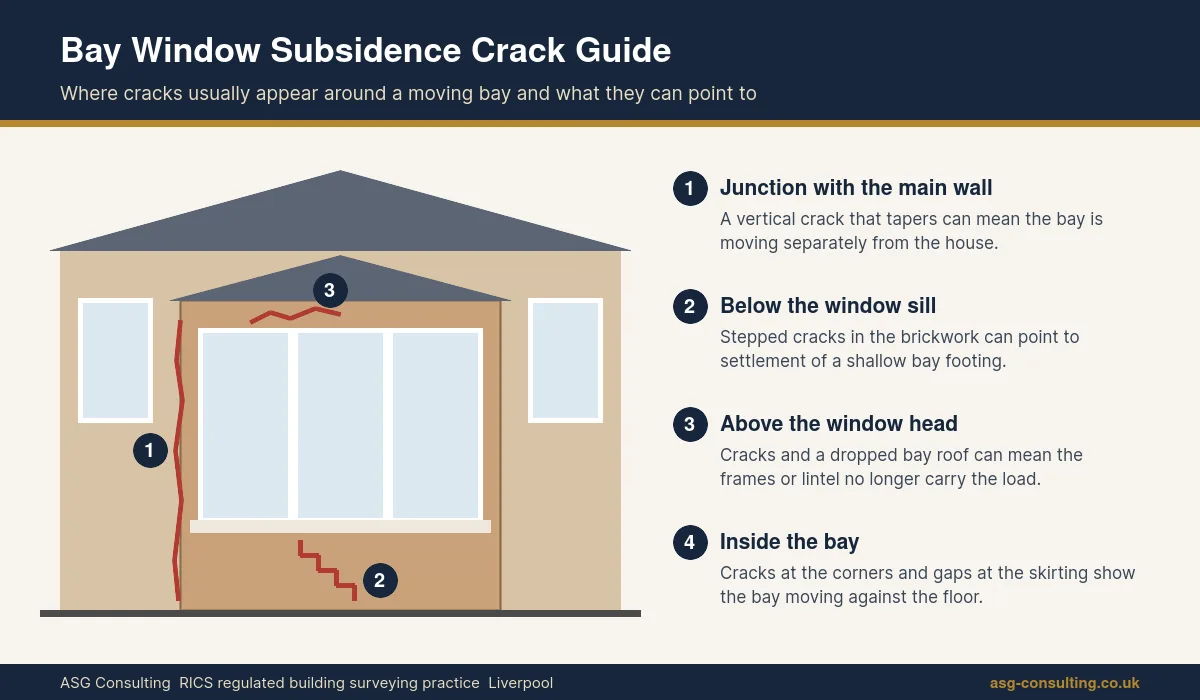
- A tapering crack where the bay meets the main wall. It is wider at one end, showing the bay is rotating away from the house.
- Stepped cracks below the sill. Cracks that follow the mortar joints like a staircase can point to a settling bay footing.
- Sticking windows or gaps around the frames. Distorted openings show the bay has changed shape.
- A dropped bay roof or cracks above the window head. These suggest the frames or lintel no longer carry the load properly.
- Gaps at the skirting or floor inside the bay. Fresh filler or new decoration in this area is worth asking about.
Where Is the Crack and What Might It Mean?
The position and shape of a crack give useful clues. This table is a general guide only, as every house needs to be judged on site.
| Where the crack is | Possible cause | Sensible next step |
|---|---|---|
| Vertical crack where the bay meets the main wall, wider at the top or bottom | The bay moving separately from the house, often foundation related | Survey, then monitoring or engineer advice if recent |
| Stepped crack in the brickwork below the window sill | Settlement or subsidence of the bay footing | Check drains and nearby trees, then monitor |
| Crack above the window head or a sagging bay roof | Loss of support above the window, such as altered frames or a failing lintel | Structural check of the window frames and head |
| Internal cracks at the corners of the bay and gaps at the skirting | Movement of the bay relative to the floor and main walls | Compare with external cracks and look for fresh decoration |
| Fine hairline cracks in plaster only | Shrinkage, thermal movement or minor settlement | Usually cosmetic, note and redecorate |
The broader guide to cracks in walls explains how surveyors judge crack width, shape and direction elsewhere in a house.
Is It Subsidence, Settlement or Something Else?
These words are often used loosely, but they mean different things. The RICS consumer guide to subsidence describes it as the downward movement of a building foundation due to changes in the supporting ground. Settlement is the normal bedding down of a building, usually early in its life.
Many bays in older houses moved decades ago and have been stable since. Others show cracking for reasons that have nothing to do with foundations, such as failed window frames, rusting steel or a decayed timber lintel. Telling these apart is the main purpose of an inspection. Where ground movement is suspected across the whole house rather than just the bay, the guide to a subsidence survey explains how a wider investigation works.
How Big a Crack Should Worry You?
The RICS guide says cracks are rarely a real concern unless they appear suddenly and are over 3 millimetres wide. Width is only part of the picture, though. A surveyor will also look at
- whether the crack tapers, which suggests rotation or differential movement
- whether it runs through bricks as well as mortar joints
- whether it has been filled before and reopened
- whether doors or windows in the bay stick or have been planed
- whether the same crack shows inside and outside
A neat repair with no reopening suggests historic movement. Fresh filler, new decoration around one area or a crack that has clearly reopened suggests the movement may be ongoing.
What Will a Surveyor Check Around a Bay?
During an inspection, a surveyor looks at the bay from several angles. The checks usually include
- the junction between the bay and the main front wall, inside and out
- the brickwork below the sills and the condition of the sills themselves
- the bay roof, its covering and whether it has dropped
- the window frames and whether they carry load or have been replaced
- gullies, drains and manholes near the front of the house
- trees and large shrubs in the front garden or street
- signs of past repairs, such as rebuilt brickwork or crack stitching
A Level 3 Building Survey, described on the residential building surveying page, gives the most detailed comment on movement and is usually the better choice for an older house with visible cracking.
How Is Bay Movement Monitored?
If it is not clear whether movement has stopped, the cracks are measured over time. This usually involves fixing small studs or gauges either side of the crack and recording readings every few weeks or months. The RICS guide notes that monitoring may need to run for as long as 12 months, so seasonal changes can be seen.
Historic England advice on structural movement points out that most old buildings move to some degree, and that movement is only a concern if it is ongoing and affects use or safety. Where ongoing movement is suspected, it recommends a structural engineer familiar with older buildings.
What Are the Usual Repair Options?
The right repair depends on the cause. Common approaches include
| Cause | Typical approach |
|---|---|
| Leaking drain under or near the bay | Repair the drain, then monitor before any structural work |
| Tree roots on clay soil | Manage the tree with expert advice, then monitor |
| Historic movement now stable | Repair cracks, repoint and redecorate |
| Ongoing movement of a shallow bay footing | Underpin the bay, or take down and rebuild it on a new foundation |
| Loss of support above the window | Install a suitable lintel or structural frame |
Underpinning is usually a last resort. For complex cases, a structural engineer can design the repair and confirm it suits the building.
Victorian Bays and 1930s Bays, What Is the Difference?
Victorian bays are usually built in solid brick or stone with a timber or stone head above the windows, and many are single storey with a small roof. Movement often shows as cracking at the junction with the main wall or below the sills.
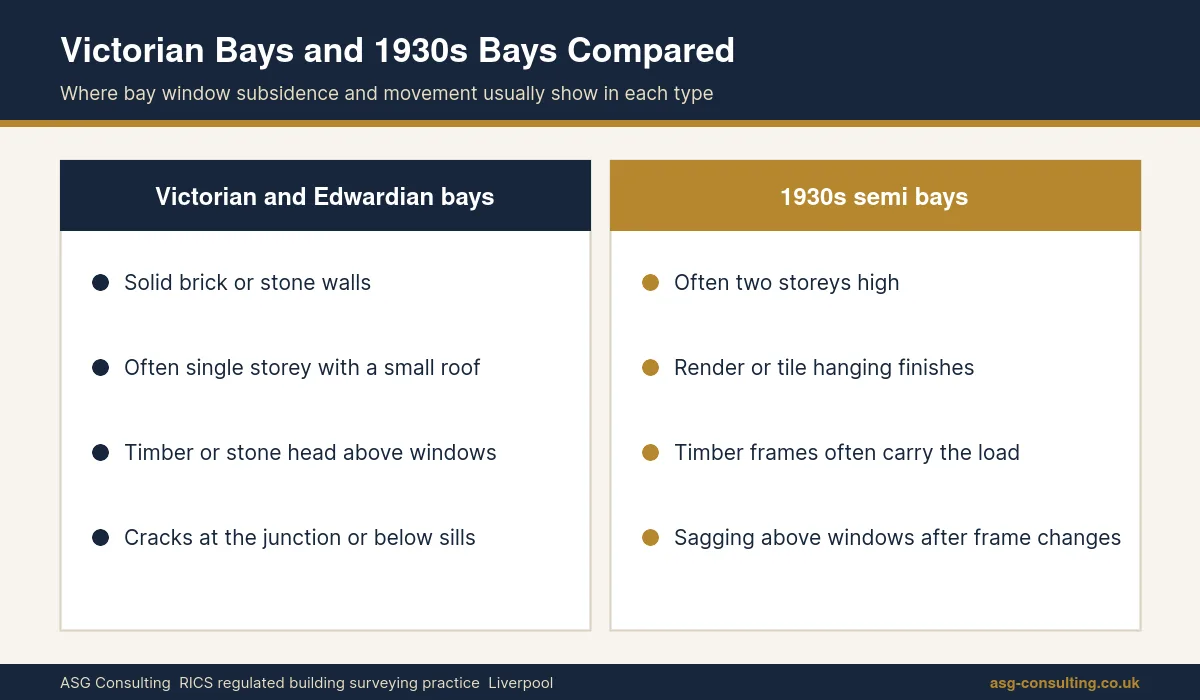
Bays on 1930s semis are often two storeys high, sometimes finished with render or tile hanging, and many rely on timber frames to carry the load above. When the original frames are replaced, the bay can drop at the top, causing cracks above the windows and distortion in the bay roof.
Bay Windows in Liverpool and Merseyside Homes
Victorian and Edwardian terraces with canted bays line streets across Anfield, Walton, Kensington, Wavertree and Toxteth. Many have had decades of drainage changes, street tree planting and window replacements, so cracking at the bay is a common finding.
Interwar semis in Allerton, Childwall, Crosby, Maghull and parts of the Wirral often have full height bays. These are where replacement frames without proper support cause the most problems. Parts of Merseyside also have clay rich glacial soils, which can shrink and swell with moisture changes, especially near trees.
Should You Still Buy a House With Bay Movement?
Often yes, provided you understand the cause. Before you exchange, ask the seller whether there has been any subsidence claim, monitoring or repair, and ask for any reports. Check with your insurer whether cover is available at a normal premium. If the survey recommends further investigation, arrange it before you commit, as the findings may affect the price or the lender.
Bay Window Subsidence FAQs
Is a crack around a bay window always subsidence?
No. Many cracks are caused by historic settlement, altered window frames or failing lintels rather than ongoing ground movement.
Why do bay windows have shallower foundations?
In many older houses the bay was built on shallower footings than the main walls, so it reacts more to changes in the ground.
Can a bay window be underpinned on its own?
Yes. Where the bay alone is moving, it can sometimes be underpinned or rebuilt without work to the rest of the house.
Will bay window subsidence affect my mortgage?
It can. A lender may ask for a structural report or monitoring results before agreeing the loan.
Can replacing bay windows cause cracks?
Yes. If the original frames carried load and the new frames do not, the bay can sag and crack above the windows.
Which survey should I get for a house with bay cracks?
A Level 3 Building Survey gives the most detail on movement, especially for older houses with visible cracking.
Talk to a Surveyor at ASG Consulting
ASG Consulting is an RICS regulated building surveying practice based in Liverpool. It carries out RICS Level 2 HomeBuyer Surveys and Level 3 Building Surveys across Liverpool, Merseyside, the Wirral and the wider North West, with reports usually delivered within 3 to 5 working days of the inspection. Fees are fixed and given on request, usually confirmed within one working day. Call 0151 315 0626 to request a quote or to talk through which survey suits the property.
About the Author
Dave MacMillan is the lead surveyor at ASG Consulting, an RICS regulated building surveying practice at 54 St James Street, Liverpool. He has 8 years of experience in building surveying and inspects homes for buyers across Liverpool, Merseyside and the North West.
Last updated 24 November 2026