An EWS1 form is a record, signed by a qualified fire professional, of whether the external walls of a block of flats need remedial work. A lender may ask for one before agreeing a mortgage on a flat in a taller or clad building. It is a valuation tool, not a fire safety certificate, and usually lasts five years.
Checking the EWS1 form when buying a flat in a modern block matters, because it can decide how quickly your mortgage is approved, or whether it is approved at all. Many buyers first hear about it when the valuer or solicitor asks for one. This article explains what the form records, when lenders need it, what changed in November 2026 and how to protect yourself when buying a flat in Liverpool or elsewhere in the North West.

Contents
What Is an EWS1 Form?
EWS stands for External Wall System. The EWS1 form was created by the property and lending industry after the Grenfell Tower fire, so that building owners could confirm to valuers and lenders that the outside walls of a block had been assessed.
RICS explains that the form applies to a whole building, so each block needs its own form. The assessment is arranged by the building owner, not by the person selling a flat, and must be carried out by a competent professional from a relevant construction body. A completed form is normally valid for five years.
The form is not a legal requirement in itself. It exists because lenders need confidence that the flat they are lending on is worth what the valuer says it is worth.
What Do the EWS1 Outcomes Mean?
The form has two main routes. Option A is used where the external walls are unlikely to support combustion. Option B is used where combustible materials are present and the assessor has judged the fire risk.
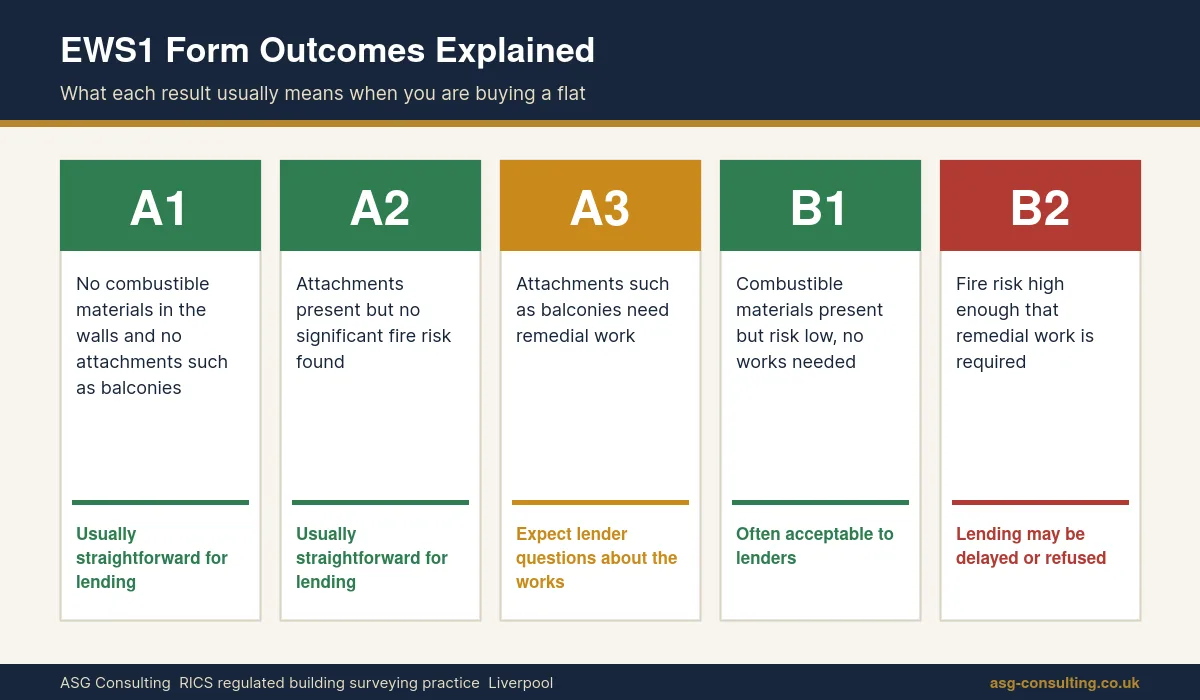
| Outcome | What it means | What it usually means for a buyer |
|---|---|---|
| A1 | No combustible materials in the walls and no attachments such as balconies | Usually straightforward for lending |
| A2 | Attachments are present but the assessor found no significant risk | Usually straightforward for lending |
| A3 | Attachments need remedial work, such as replacing combustible balcony materials | Expect questions from the lender about the works and who pays |
| B1 | Combustible materials are present but the fire risk is low enough that no remedial work is needed | Often acceptable to lenders |
| B2 | The fire risk is high enough that remedial work is required | Lending may be delayed or refused until works are planned or funded |
A B2 outcome is not automatically the end of a purchase, but it means you need clear answers about the works, the timetable and who will pay.
Does Every Flat Need an EWS1 Form?
No. RICS has published a second edition of its professional standard on valuing flats in multi storey buildings with cladding, which took effect on 1 November 2026. According to RICS, an EWS1 form should only be requested where there is a clear reason.
The criteria look at building height, visible cladding, curtain wall glazing and certain balcony arrangements, with separate approaches for buildings over six storeys, five or six storeys, and four storeys or fewer. The standard also recognises that, in some cases, a summary of a PAS 9980 fire risk appraisal of external walls can be relied on instead of an EWS1 form, provided it gives a clear outcome and is signed by a suitably qualified professional.
Lenders still set their own rules, so a particular lender may ask for more than the standard suggests.
Who Arranges and Pays for an EWS1 Form?
The building owner or freeholder is responsible for commissioning the assessment, usually through the managing agent. A seller cannot order an EWS1 for their own flat, because the assessment covers the whole building.
If a form is needed and none exists, the seller can ask the managing agent whether one has been done or is planned. Any remedial works identified are the responsibility of the building owner, although who ultimately pays depends on the building, the lease and the leaseholder protections described below.
What Are the 6 Safe Steps for an EWS1 Form When Buying a Flat?
Work through these steps as early as possible, ideally before you pay for searches and surveys.
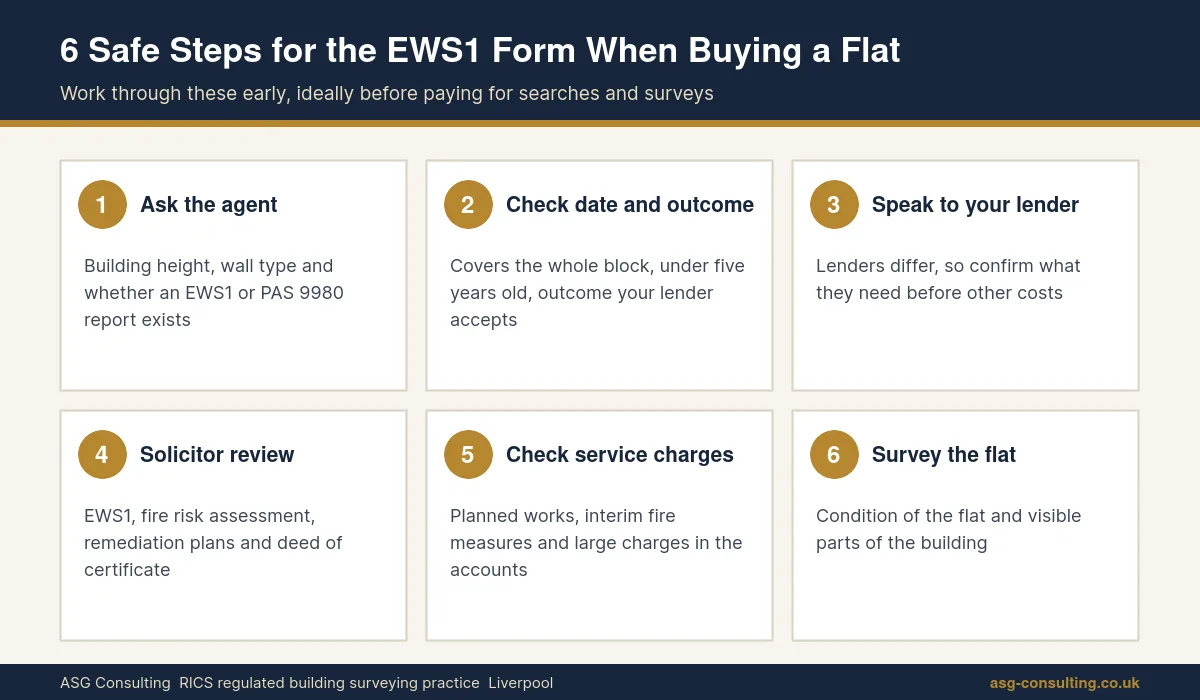
- Ask the agent at the offer stage. Find out the height of the building, the type of external walls and whether an EWS1 or PAS 9980 report exists.
- Check the date and outcome. Make sure the form covers the whole block, is within five years and shows an outcome your lender will accept.
- Speak to your mortgage broker or lender. Lenders differ, so confirm what they need before you commit to other costs.
- Ask your solicitor to review the paperwork. This includes the EWS1 or appraisal, the fire risk assessment, any remediation plans and the leaseholder deed of certificate.
- Check service charges and reserve funds. Look for planned works, interim fire measures such as waking watch, and any large charges in the accounts.
- Arrange a survey of the flat. The survey reports on the condition of the flat and the visible parts of the building, which complements the legal checks.
What Protections Do Leaseholders Have?
The Building Safety Act 2022 introduced protections for many leaseholders in England. The government guidance on leaseholder protections on building safety costs says qualifying leaseholders will no longer pay to fix or remove unsafe cladding systems, and that the protections automatically transfer to future buyers.
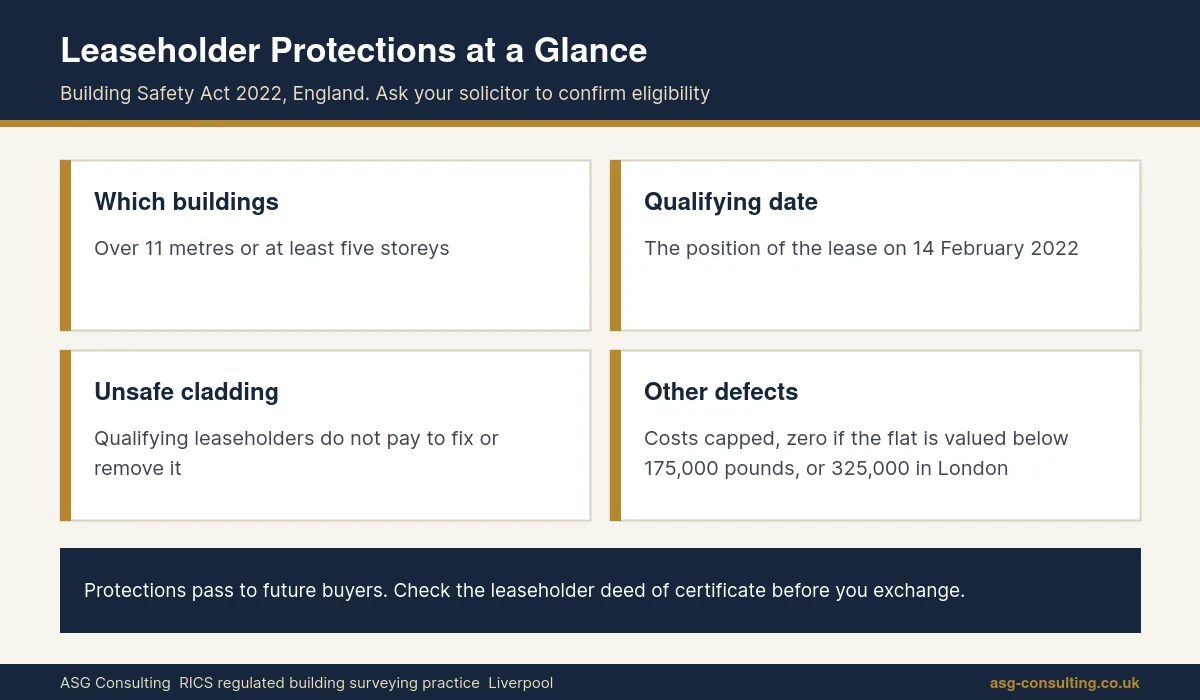
In general, the protections apply to buildings over 11 metres or at least five storeys. Whether a lease qualifies depends on the position on 14 February 2022. Costs for other historic safety defects are capped, and the cap is zero for flats valued below 175,000 pounds, or 325,000 pounds in London. Eligibility is usually confirmed through a leaseholder deed of certificate, so ask your solicitor to check it.
Which Warning Signs Should Make You Pause?
Ask more questions if you notice any of the following.
- The agent cannot say whether the building has been assessed
- The EWS1 form is more than five years old or covers a different block
- The outcome is B2 or A3 with no plan or funding for the works
- Service charge accounts show large or unexplained fire safety costs
- Waking watch patrols or temporary fire alarms are still in place
- No leaseholder deed of certificate is available
- The flat is priced well below similar flats nearby with no clear reason
Is an EWS1 Form the Same as a Fire Risk Assessment?
No. RICS is clear that the EWS1 is for valuation and lending only. It is not a life safety certificate and does not replace a fire risk assessment of the building.
The fire risk assessment looks at fire safety in the common parts, such as alarms, fire doors, escape routes and signage. Ask for a copy before you buy. A solicitor will usually request it, but it is worth reading yourself so you understand how the building is managed.
Buying a Flat in Liverpool City Centre or on the Waterfront
Liverpool has a large stock of apartment blocks built from the late 1990s onwards, particularly in the city centre, the Baltic Triangle, the Commercial District and along the waterfront. Many are four to ten storeys, with rendered panels, timber or composite cladding, glazed curtain walls or balconies, which are the features the new RICS criteria focus on.
The city also has many converted warehouses and mills in areas such as the Ropewalks and around the docks. Their brick walls may not raise cladding questions, but rooftop extensions, balconies and newer infill blocks within the same development sometimes do. The guide to a warehouse conversion survey explains what else to look for in these buildings.
Across Merseyside, purpose built student blocks have also been converted to private flats in some areas. Treat these with the same care, as the external wall build up may differ from a typical residential block.
Which Survey Suits a Flat in a Clad Building?
A building surveyor is not a fire engineer and cannot complete an EWS1 form. What a survey can do is report on the condition of the flat, the visible common parts, the roof and external walls where accessible, and anything that suggests future costs.
The article on a survey for buying a flat explains what is usually covered. For a conventional flat in reasonable condition, a RICS HomeBuyer Survey in Liverpool is often suitable. If major works are planned, ask whether leaseholders have received a Section 20 notice, which sets out consultation on large service charge costs.
EWS1 Form When Buying a Flat FAQs
Do all flats need an EWS1 form?
No. Under the updated RICS standard, valuers should only request one where there is a clear reason, based on height, cladding, curtain wall glazing and balconies.
How long is an EWS1 form valid?
An EWS1 form is generally valid for five years, unless the building owner commissions a new assessment.
Can I get a mortgage on a flat with a B2 EWS1?
Sometimes, but many lenders will want evidence that remedial works are planned and funded, and that leaseholder protections apply.
Who pays for an EWS1 assessment?
The building owner is responsible for commissioning the assessment. How the cost is recovered depends on the lease and the leaseholder protections.
Is an EWS1 form a fire safety certificate?
No. It is a valuation and lending tool. Ask for the fire risk assessment of the building separately.
Can a surveyor complete an EWS1 form?
Only a qualified fire professional who meets the criteria can sign one. A building surveyor reports on condition, not on the fire performance of the walls.
Talk to a Surveyor at ASG Consulting
ASG Consulting is an RICS regulated building surveying practice based in Liverpool. It carries out RICS Level 2 HomeBuyer Surveys and Level 3 Building Surveys across Liverpool, Merseyside, the Wirral and the wider North West, with reports usually delivered within 3 to 5 working days of the inspection. Fees are fixed and given on request, usually confirmed within one working day. Call 0151 315 0626 to request a quote or to talk through which survey suits the property.
About the Author
Dave MacMillan is the lead surveyor at ASG Consulting, an RICS regulated building surveying practice at 54 St James Street, Liverpool. He has 8 years of experience in building surveying and inspects homes for buyers across Liverpool, Merseyside and the North West.
Last updated 24 November 2026