Buying a probate property means buying a home from the estate of someone who has died, with the sale run by executors or administrators. The steps are similar to a normal purchase, but contracts cannot complete until the grant of probate is issued, and many probate homes need updating, so a thorough survey matters.
A probate property is often a long-owned family home. It can be good value and usually comes without an onward chain, but the sellers may know little about the house, and it may have stood empty for months. This guide to buying a probate property explains how probate works, the 7 steps to follow, the condition issues to look out for and which survey suits a probate home.
Contents
What Is a Probate Property?
A probate property is a house or flat that formed part of the estate of someone who has died. Before it can be sold, the people dealing with the estate need legal authority to sell it.
If there is a will, the executors named in it apply for a grant of probate. If there is no will, a close relative usually applies for letters of administration and is called the administrator. Either way, the grant is the document that lets them sign the sale. GOV.UK describes probate as the legal right to deal with a person’s property, money and possessions when they die.
Can You Buy a Probate House Before Probate Is Granted?
You can view the house, make an offer, book a survey and start the legal work. What you cannot do is complete the purchase until the grant has been issued, because only the executors or administrators named in it can transfer the property.
The GOV.UK guide to applying for probate advises people not to put property on the market until they have probate. In practice, some homes are listed as “subject to probate” while the application is still in progress. If you offer on a probate property listed this way, be ready for an uncertain timetable.
GOV.UK says the grant usually arrives within 12 weeks of the application, and can take longer if more information is needed. Any Inheritance Tax reporting has to be done before the application, which can add time.
How Do You Check Whether Probate Has Been Granted?
Ask the estate agent and the executors’ solicitor directly, and ask your own conveyancer to confirm it. Once a grant has been issued, it becomes a public record.
The GOV.UK service to search probate records lets anyone check whether probate has been issued in England and Wales and order a copy, which costs 16 pounds. This tells you who has authority to sell, which your conveyancer will need.
What Are the 7 Steps to Buying a Probate Property?
Follow these steps in order to keep buying a probate property on track.
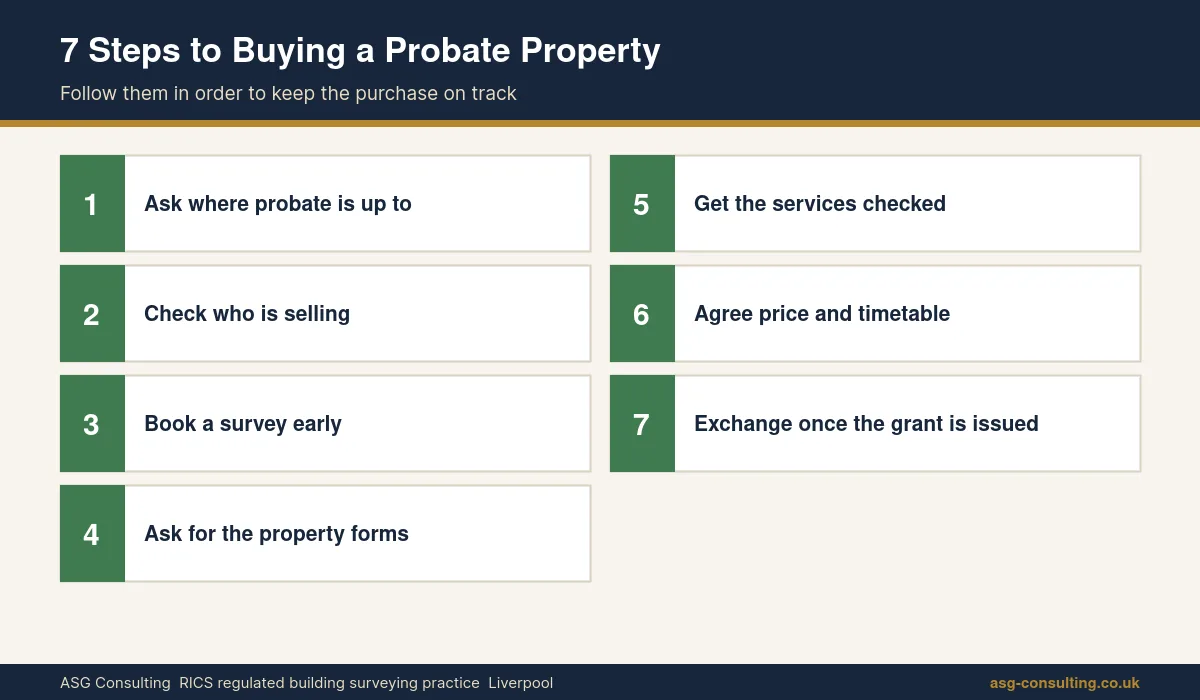
- Ask where probate is up to. Has the grant been issued, applied for or not yet started?
- Check who is selling. Your conveyancer confirms the executors or administrators named on the grant.
- Book a survey early. Use the waiting time to find out what the house needs.
- Ask for the property forms. Executors may answer “not known” to many questions, so note the gaps.
- Get services checked. Ask for the electrics, gas and water to be turned on for the survey if they are safe to use.
- Agree the price and timetable. Factor in repair costs and a realistic completion date.
- Exchange once the grant is in place. Your conveyancer will not let you exchange without it.
Why Do Probate Properties Often Need Work?
Many a probate house was lived in by the same owner for decades. Day to day maintenance may have slowed in later years, and the house may then have stood empty while the estate was sorted out. Surveyors see the same issues again and again.
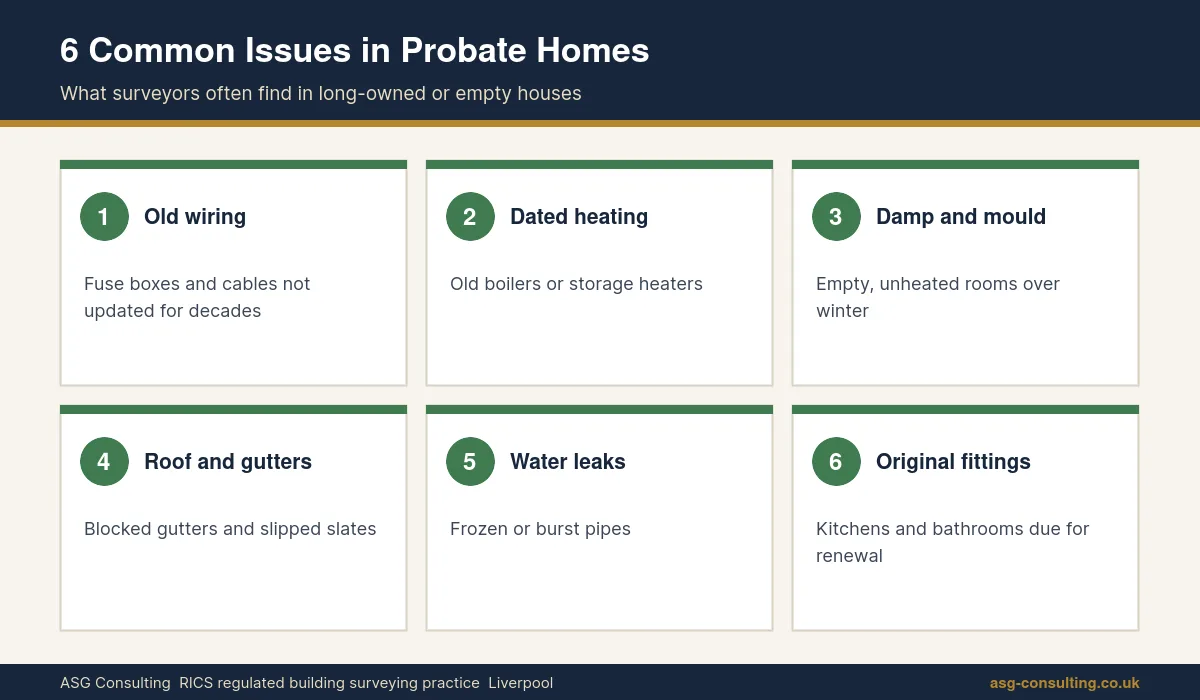
- Old wiring and fuse boxes. Rewiring may not have been done for 30 years or more. The guide to buying a house with old wiring explains the warning signs.
- Dated heating. Old boilers, back boilers or storage heaters near the end of their life.
- Damp and condensation. An empty, unheated house often develops damp and mould over a winter.
- Roof and gutter neglect. Blocked gutters, slipped slates and failed flashings that nobody has noticed.
- Water leaks. Frozen or burst pipes in houses left without heating.
- Original kitchens and bathrooms. Often in working order but due for replacement.
None of this is a reason not to buy. It is a reason to know the likely costs before you agree a price.
How Is a Probate Sale Different From a Normal Sale?
The legal process is mostly the same, but a few points change what you can expect.
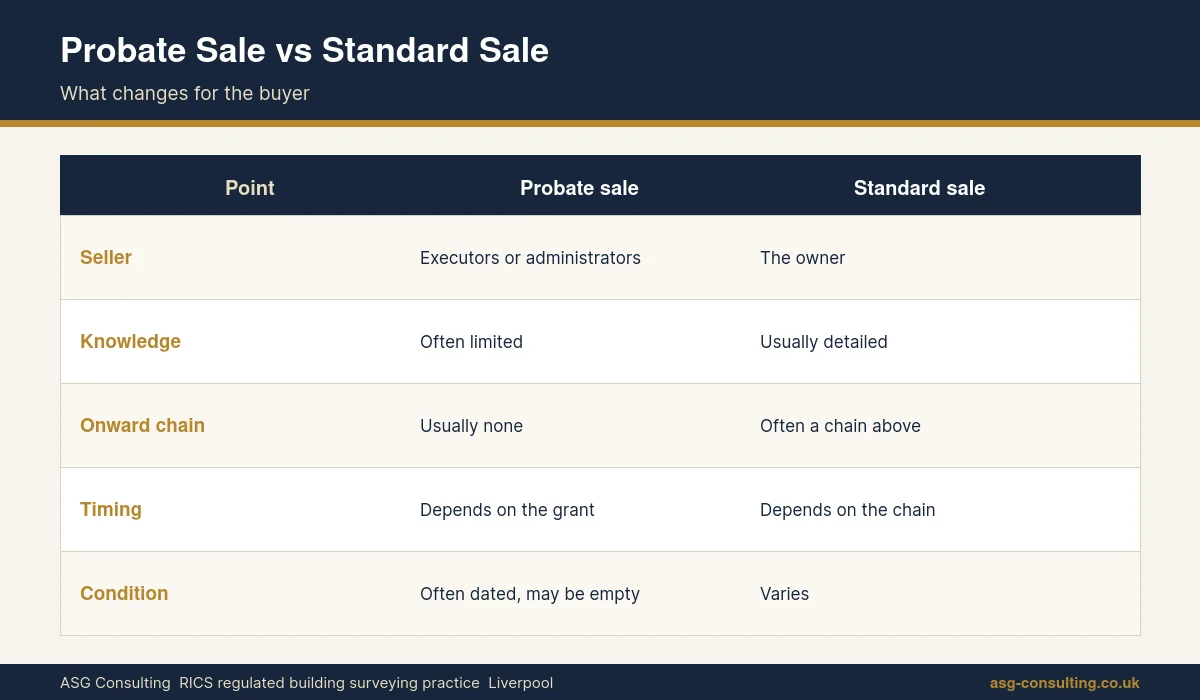
| Point | Probate sale | Standard sale |
|---|---|---|
| Seller | Executors or administrators | The owner |
| Knowledge of the house | Often limited | Usually detailed |
| Onward chain | Usually none | Often a chain above |
| Timing | Depends on the grant | Depends on the chain |
| Condition | Often dated, may be empty | Varies |
| Decisions | May need several executors to agree | One owner or couple |
Are Probate Houses Cheaper to Buy?
Sometimes. Executors often want a clean, steady sale, and a probate property that needs updating is usually priced to reflect its condition. That said, executors act for the beneficiaries of the estate, so they are expected to take a fair price rather than the first offer.
The strongest position comes from facts. A survey report with clear repair items, backed by contractor quotes, gives you a sound basis for an offer or a renegotiation. Be polite and specific. Executors are often family members dealing with a loss, and a reasonable approach tends to work better.
What About Buying a Probate Property at Auction?
Some executors sell a probate property through auction to get a quick, certain result. At a traditional auction the sale is binding when the hammer falls, so the survey and the legal pack need checking before the day. The guide to getting a survey before auction sets out the timings.
Which Survey Should You Get for a Probate Property?
It depends on the age and condition of the probate property. A modern home in fair order may only need a Level 2 survey. The RICS HomeBuyer Survey in Liverpool covers conventional houses and flats in reasonable condition.
For an older, altered or neglected house, or one you plan to renovate, a Level 3 Building Survey gives more detail on defects, likely causes and repair options. It is described on the residential building surveying page. If the house is full of furniture, the surveyor will inspect what can be reached and note any areas that were hidden.
Buying a Probate Property in Liverpool
Buying a probate property in Liverpool often means buying a long-owned family home. Interwar semis in Allerton, Childwall, Woolton, West Derby and Crosby are often in original condition inside, with 1970s or 1980s kitchens, older wiring and original windows. Victorian terraces in Wavertree, Walton and Anfield may have had very little done for decades.
Across Merseyside and the Wirral, a probate house left empty through a wet North West winter often shows damp on external walls and condensation on cold surfaces. If the house has been empty, ask how long for, whether the heating was left on and whether the water was drained down.
Buying a Probate Property FAQs
How long does it take to buy a probate property?
Once the grant is issued, a probate purchase can move at a similar speed to a normal sale. Before that, timing depends on the probate application.
Can I make an offer before probate is granted?
Yes. You can offer and start the survey and legal work, but you cannot complete until the grant of probate or letters of administration is issued.
Does a probate property need a survey?
A survey is strongly recommended. The sellers often know little about the house, and many probate homes need updating.
Who signs the contract on a probate sale?
The executors or administrators named on the grant. Your conveyancer will check this before exchange.
Can executors accept a lower offer?
They can, but they act for the beneficiaries, so they will usually want evidence such as survey findings and quotes.
What if the probate house has been empty for months?
Ask how long it was empty and whether it was heated. Empty houses often show damp, condensation or water leaks.
Talk to a Surveyor at ASG Consulting
ASG Consulting is an RICS regulated building surveying practice based in Liverpool. It carries out RICS Level 2 HomeBuyer Surveys and Level 3 Building Surveys across Liverpool, Merseyside, the Wirral and the wider North West, with reports usually delivered within 3 to 5 working days of the inspection. Fees are fixed and given on request, usually confirmed within one working day. Call 0151 315 0626 to request a quote or to talk through which survey suits the property.
About the Author
Dave MacMillan is the lead surveyor at ASG Consulting, an RICS regulated building surveying practice at 54 St James Street, Liverpool. He has 8 years of experience in building surveying and inspects homes for buyers across Liverpool, Merseyside and the North West.
Last updated 28 November 2026